Showing posts with label Vietnamese Americans. Show all posts

Monday, January 30, 2023

Census: Chinese, Tagalog and Vietnamese are among top five languages spoken in US homes


Although English is far and away the dominant language spoken in the US, the number of people in the United States who spoke a language other than English at home nearly tripled from 23.1 million (about 1 in 10) in 1980 to 67.8 million (almost 1 in 5) in 2019, according to a recently released US Census Bureau report.

The Hispanic (Latino) population is the largest minority group in the United States. So it is not surprising Spanish was the most common non-English language spoken in U.S. homes (62%) in 2019.

What is surprising are the next four frequently languages spoken at home are, in descending order, are Chinese, Tagalog, Vietnamese and Arabic, a reflection of the fastest growing demographic and immigration rate in the US.

The Census report, Language Use in the United States: 2019, uses American Community Survey (ACS) data to highlight trends and characteristics of the different languages spoken in the United States over the past four decades.
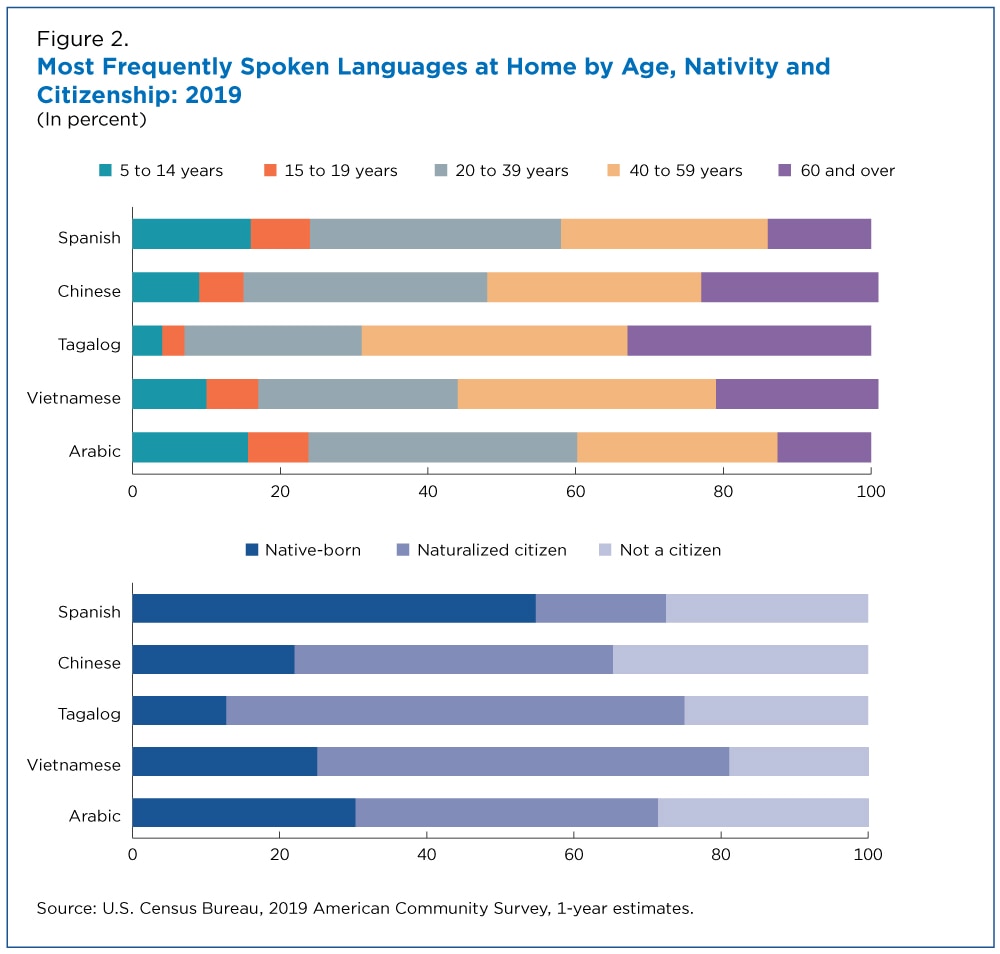
The Census Bureau release refers to foreign-language “speakers” as those who report speaking a language other than English (LOTE) at home, not necessarily all those who can speak that language. 

Figure 2. Most Frequently Spoken Languages at Home by Age, Nativity and Citizenship: 2019


Educational Attainment and Employment

In 2019, 51% of Tagalog and 54% of Chinese speakers had a bachelor’s degree or higher (these two groups were not statistically different from each other) compared to only 17% of Spanish speakers. Figure 3 shows educational attainment for the U.S. population ages 25 years and older by language spoken at home.

About a third (33%) of Spanish speakers did not graduate from high school, the largest share of speakers of the five most common languages other than English.

Employment status of speakers ages 16 and over did not vary much across the five languages (Figure 3). Less than 4% were unemployed in 2019 – not significantly different than the national average.
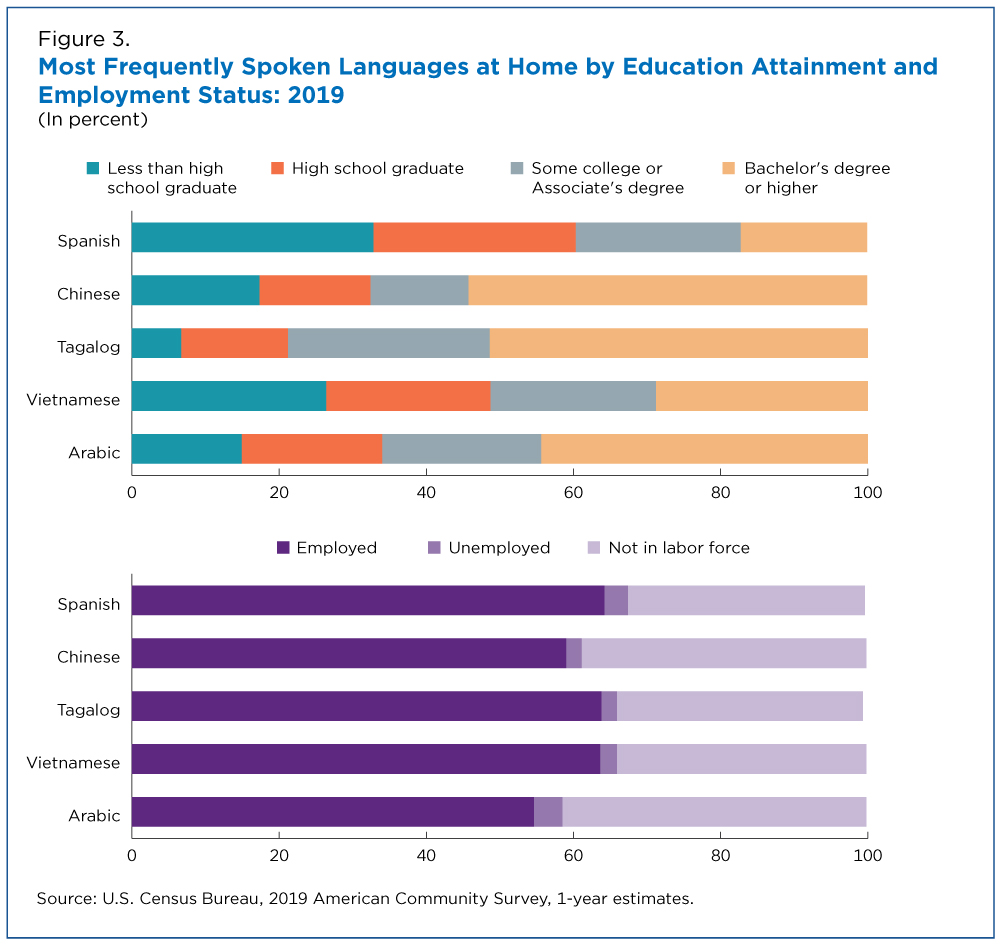
Figure 3. Most Frequently Spoken Languages at Home by Education Attainment and Employment Status: 2019


English Proficiency by Language

The federal government relies on data on language use and English proficiency to provide language services under the Voting Rights Act, as well as to allocate educational funds to state English as a Second Language (ESL) programs.

Based on the 2019 data, 52% of people who spoke Chinese and 57% of those who spoke Vietnamese at home in the United States spoke English “less than very well,” compared to the other three common languages: Spanish 39%, Tagalog 30%, and Arabic 35%. This may have resulted from a recent increase in immigration from Asia and newcomers who have not had enough time to assimilate and master
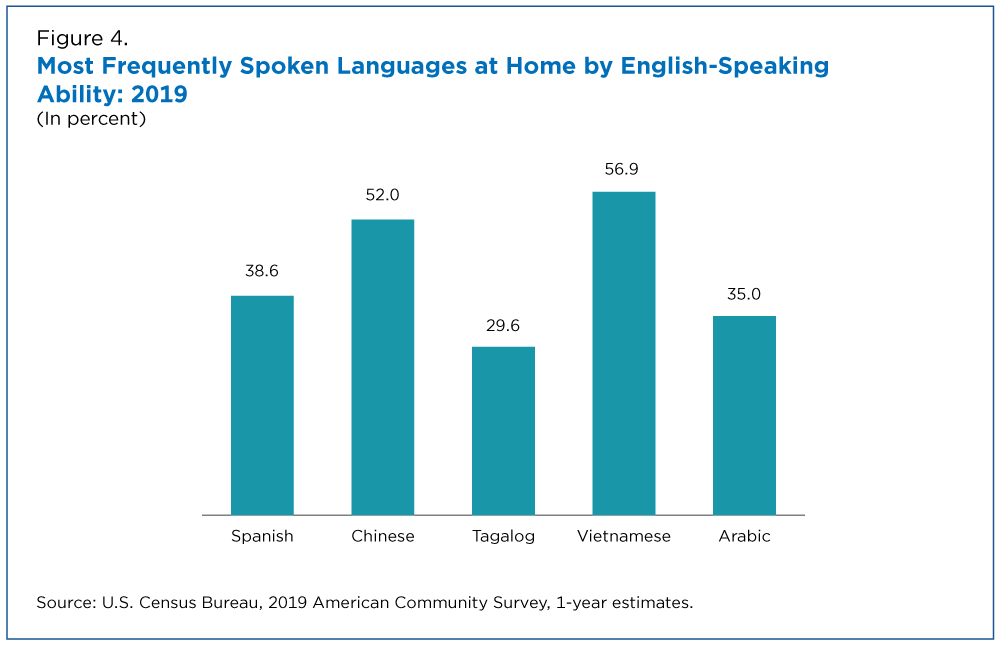
 English yet.


Household Characteristics by Language

In addition to individual differences, there were also differences in the US households that spoke the five most frequently spoken non-English languages.

A limited English-speaking household is one in which no members ages14 and over speak only English or speak English “very well.” About a third of Chinese (33%) and Vietnamese (31%) households were limited English-speaking households – four times greater than Tagalog households.

In contrast, Tagalog-speaking households were more likely to be “non-limited” English speaking. About 92% of Tagalog-speaking households were non-limited English speaking and only 8% were limited English speaking.


The majority of households across all five languages were family households, defined as having at least two members (including the householder) related by birth, marriage or adoption. On average, these households each had zero to one child under age 18 and three to four persons in the family.

Among nonfamily households, defined either as a person living alone or one who shares the housing unit with nonrelatives such as boarders or roommates, a greater proportion (30%) of Chinese-speaking households were nonfamily compared to households speaking the other four languages. Half as many Tagalog-speaking households (17%) were nonfamily households.
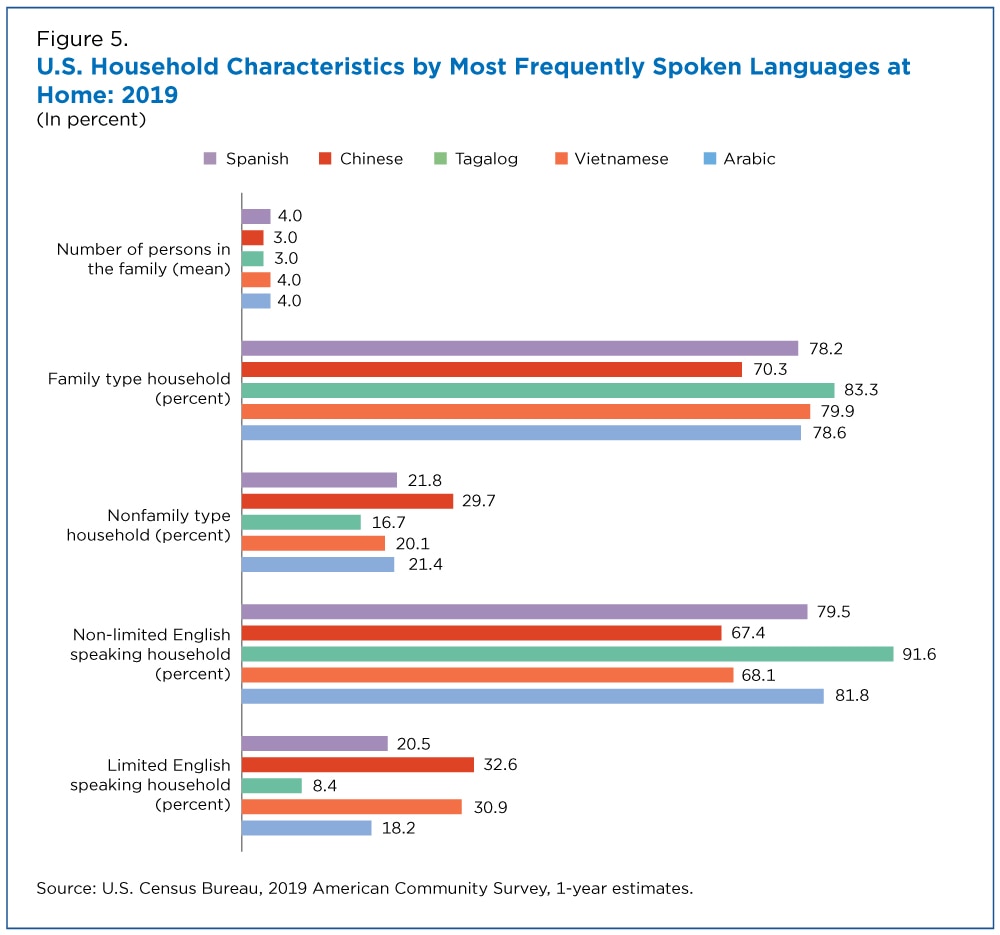


Figure 5. U.S. Household Characteristics by Most Frequently Spoken Languages at Home: 2019

FYI: For a comprehensive review at the individual languages and languages groups spoken in the United States by statisticians Sandy Dietrich Erik Hernandez, refer to the Language Use in the United States: 2019 report.
Stop Asian Hate, a community group tracking the recent surge of attacks against AANHPI in the US and Canada, lists several incidents reported where Asian Americans were attacked for speaking an Asian language.

Several other studies should put the minds of English-only advocates to rest. By the third generation after immigrating to the US, English becomes the primary language spoken at home.

Some of the ifirst-generation immigrants learned English, but preferred to speak their native languages, especially at home. Their children largely grew up bilingual, but many chose to speak English, even to their immigrant parents. When this bilingual generation established their own homes, they usually spoke English at home. “Consequently, by the third generation, the prevalent pattern is English monolingualism, and knowledge of the mother tongue for most ethnics is fragmentary at best,” according to a Pew report.

EDITOR'S NOTE: For additional commentary, news and views from an AANHPI perspective, follow @DioknoEd on Twitter. 

Wednesday, December 16, 2020

Tony Pham steps down as acting director of ICE

Tony Pham was the first refugee to head Immigration and Customs Enforcement (ICE).


After serving for five months as the acting director of ICE, Tony Pham is stepping down.

“I am grateful for the Trump Administration for providing me the single highest honor of my career in serving my adopted country as both the Principal Legal Advisor and the Senior Official Performing the Duties of the Director at U.S. Immigration and Customs Enforcement,” Pham said in a statement.

“Leading a law enforcement agency with such a committed workforce has been the honor of a lifetime. I have gotten to meet with many extraordinary employees across the United States. I will continue to be that tireless advocate for the hard working men and women at ICE. However, at the end of the year, I will be returning home to Richmond, VA to be closer to my family.”

After being appointed by Donald Trump in August to succeed the retiring Matt Albence, Pham's tenure was controversial for Asian Americans, the group with the highest rate of immigration in recent years.

Phan came to the U.S. as a refugee fleeing Vietnam as the South Vietnamese government fell to North Vietnam forces. While heading ICE, his actions were seen as enforcing the Trump administration's efforts to stem immigration or portray immigrants in a negative light,

“Five months ago, we said it was time to bring human rights home. Instead Tony Pham chose to promote Trump’s apartheid worldview, and turned his back on refugee communities, here and abroad," said community nonprofit VietRISE in a statement. "Tony Pham will not easily wash off the stain of abuse and corruption that he supervised and oversaw."

Wednesday, October 21, 2020

GOP hopes a pair of Asian American women can flip California's Orange County

Young Kim, left and Michelle Steel, GOP congressional hopefuls in Orange County

ANALYSIS

For decades, Orange County has been a Republican island in a sea of blue. In a dramatic turnaround, in the 2018 midterms the GOP lost the four Congressional seats representing the Southern California county in a Democratic tidal wave.

In response to their huge defeat in 2018, Republicans are fighting back with two Asian American candidates as their vanguard with the hope of energizing the conservatives among Asian Americans.

Former state Assembly member Young Kim is challenging Rep. Gill Cisneros in a rematch of 2018 for the 39th Congressional District, Orange County Supervisor Michelle Steel is running against U.S. Rep. Harley Rouda, D-Newport Beach for District 48. 

The other two Orange County congressional districts are District 45 held by Democrat Rep. Katie Porter and District 46, which is held by Democrat Rep. Lou Correa.

Orange County, a once a bastion of conservatism, fell to the Democrats when Democrats repulsed by Donald Trump's policies and anti-California sentiments, inspired Democrats to flock to the polls in 2018. However, Orange County's results could not have happened if a good portion of usually Republican voters had not voted for Democratic newcomers over the better established Republican candidates.

"My candidacy, I think it would really excite the base, excite the Asian American community," Kim said. Her district is probably the tightest of the four Orange County districts.

A huge migration of first-generation immigrants from Asia since the 1990s helped augment the white conservatives who dominated the county's voting rolls for so long.

Asian Americans are California's fastest-growing electorate, and in Orange County more than 400,000 are eligible to vote.

"Little Saigon" the cultural center of the Vietnamese American community is located in Orange County. Vietnamese American voters, most of whom fled when South Vietnam fell to North Vietnam, have historically gone Republican because they believe the GOP is more anti-communist than the Democrats.

Breaking Down Orange County by Race

What has happened is that the children of those refugees have grown up in the U.S. and like their peers of other ethnic groups, are more progressive in their political positions.

Filipino American Republicans are particularly active in the county, having recently held a loud car caravan through Asian American neighborhoods and business districts that drew media attention.

Korean American entrepreneurs who fled Los Angeles' Koreatown after the Rodney King riots for the perceived safety of the suburbs established mom-and-pop businesses in the communities.


In California's "jungle" primary last March 3, Kim beat Cisneros by more than 2,000 votes, with 48.4% of the vote. The two top vote-getters qualified to run against each other this November.

But it is also known that Democrats are likely to skip the midterms while Republicans can depend on their voters to turn out. This November, with a future President on the line, Democrats will likely flock to the polls. That doesn't bode well for Republicans in California, which sent only seven Republicans to Congress. The state's other 45 members of Concgress are Democrats.

Additionally, Asian Americans of all ages are trending Democratic since Trump's election, according to AAPI Data. Democrats' positions on jobs, health care, education, environment and gun control are more in line with the younger generation's values  while the Dems' policies on immigration and healthcare attract the elders.

That bodes well for first-term Congressmember Cisneros, even though he has been tagged as "vulnerable" against the formidable Kim. He is not taking the Asian American vote for granted.

He points out that his staff in his Washington, D.C. and Fullerton offices can speak Mandarin, Korean and Tagalog. His campaign manager-turned-chief of staff is of Chinese descent, while his spokesman is Filipino American.

"We're going to continue to work hard to make sure that we get them out to vote and let them know that I'm going to be the one in Washington who's going to really represent them and their values," the Latino American representative told LAist.

If Cisneros candidacy represents the new Orange County, Kim represents the Old Guard. As an aide to Rep. Ed Royce and a legislator in Sacramento, Kim has the political experience to challenge Cisneros but the albatross around her neck is the Republican Party itself.

The road to Washington is a bit rockier for Steel. Her candidacy has been dogged by revelations that her husband, Shawn Steel, is at the center of a scandal for his work to allegedly open doors for Chinese foreign nationals to funnel hundreds of thousands of dollars in political donations to Trump and the RNC’s reelection efforts.

In addition, her fellow Orange County Supervisors have accused her of using public funds for campaigning and question the award of a 35-year contract to one of her biggest donors.

Steel also has the dubious distinction of being the target of the nation's first Vietnamese language political ad put up by the Democrats. The 30-second ad accuses the candidate of corruption and “rampant misconduct,” and airs on the Asian cable outlet VietFaceTV as part of the Democrats' initial $45,000 ad buy.


Saturday, April 18, 2020

Vietnamese-owned nail salons donate thousands of masks, gloves, and gowns to local hospitals

SCREEN CAPTURE / NBC
Vietnamese-owned nail salons turn to making protective gear for health professionals.

ASAM NEWS

As health care workers report dire shortages of medical and personal protective equipment amid the COVID-19 pandemic, Vietnamese-owned nail salons across the country are donating protective masks, gloves and gowns to their local hospitals, reports NBC.
According to the NBC report, when Huy Nguyen, an owner of Top Nails 2, closed his salon in Mobile, Alabama, two weeks ago due to the pandemic, he donated his entire inventory of protective supplies –a few hundred masks and eight boxes of gloves.

In response to a Facebook request from a local Vietnamese pharmacist, dozens of other Vietnamese salon owners in Mobile collectively contributed more than 23,000 masks and 134,000 gloves to a local hospital. Nguyen later reached out to friends who own salons in other cities and urged them to join in these efforts and contribute similar donations.

“Fighting this virus is a responsibility for every one of us,” he told NBC. “We don’t work in the medical field, so we cannot fight the virus directly but we want to share our responsibility and share what we have with the community.”

The response to the pandemic by the salon owners has touched many, including Hien My Pham, a pharmacist at a local hospital in Mobile.

“It broke my heart to see my health care family share ideas on Facebook about how to make masks from cloth and how to protect themselves,” said Pham to NBC15.

Lisa Nguyen and her parents, owners of Cowboys Nail Bar in Plano, Texas, also decided to donate everything in their inventory— including 14 boxes of N95 masks — to family members working at the University of Texas Southwestern Medical Center after hearing about the supply shortages confronting hospital staff.

“Whatever we have, we only hope it will help not only our family members but their colleagues,” Nguyen said in an interview with NBC.

In Brentwood, Tennessee, the co-owners of Zen Nails have expanded their efforts by converting their nail salon into a factory producing face masks and gowns.

Employees reportedly volunteer for up to nine hours every day making protective equipment for local health care workers.

Salon co-owner Trang Nguyen worked as a registered nurse for several years and told NBC she’s still close with many nurses.

“When I saw a lot of them talking about how they are really short on equipment, I really wanted to help,” Nguyen said. “These people need to be protected before they can take care of patients. I thought we could do masks and gowns because my family knows how to sew.”

A week prior to the closure of all nonessential businesses on April 2, Nguyen closed Zen Nails and began to work on efforts to make protective equipment. Nail salon patrons reportedly donated sewing machines and funding to buy the raw materials needed for personal protective equipment.

According to NBC, in the first week of production, Zen Nails produced more than 3,000 disposable and reusable face masks and gowns, which they donated to St. Thomas Medical Partners, Williamson Medical Center and HCA Healthcare.

Rosalind Chow, associate professor of organizational behavior and theory at Carnegie Mellon University, commented on the significance of the network effect in expanding charitable acts.

“People mainly know people who are similar to them,” she said. “That’s why you might see that once one nail salon owner starts organizing something, many more similar businesses will be inclined to contribute to that offer.”

“For business owners and employees to be willing to do this work and give up these resources without knowing whether or not they’ll be paid back is a real testament to their desire to help,” Chow said.

Wednesday, June 19, 2019

Visas approved for Vietnamese brothers to give bone marrow to sibling


Two Vietnamese brothers will be allowed to travel to the US to donate blood marrow to a third brother in San Jose, Calif., says Rep. Zoe Lofgren, who worked to facilitate the visa approvals.

Lofgren and other California politicians, including Sen. Kamala Harris, intervened after it was learned that visas had been denied to the two brothers. They lobbied the State Department on behalf of the San Jose brother's family, and the U.S. ambassador to Vietnam arranged for another visa interview for the brothers.

Tu Le, a San Jose resident, has been suffering from an aggressive form of cancer that requires the transplant. His brothers were determined to be 100 percent genetic matches, but were originally denied B-2 tourism visas to enter the country.


"I couldn't be happier for Tu Le and his family," Lofgren said in a statement released Tuesday (June 18). "Imagine knowing that a bone marrow transfer may be the only way to save your life; only to see your brothers, who are the bone marrow donors, denied the chance to come save you." 

A petition in his support also gathered more than 18,000 signatures after the San Francisco Chronicle first reported about Le's condition in early June.

"I am pleased the Department of State has recognized the moral imperative to act, and that Tu Le will receive the urgent and life-saving care he needs," Harris said in a statement. "My thoughts will be with Tu Le, his daughter Diem Trinh Colisao, and the rest of their family throughout the road ahead." 


Donors of Asian descent have historically been low making finding a match difficult. Because the markers used in matching are inherited, patients are more likely to match someone from their own race or ethnicity. Adding more bone marrow donors and cord blood units from diverse racial and ethnic backgrounds to the Be The Match Registry increases the likelihood that patients will find the match they need.

Your heritage can make all the difference.If you are of Asian descent, you are especially encouraged to register as a bone marrow or donate umbilical cord blood upon delivery.

________________________________________________________________

Thursday, February 28, 2019

AAPI advocates protest deportation of Southeast Asians

searac
The Feb. 27 press conference protesting the deportations took place on the Capitol steps.

A coalition of Asian American agencies and immigrant organizations in collaboration with the Congressional Asian Pacific American Caucus denounced Donald Trump’s deportation of refugees and long-term lawful permanent residents who resettled in the U.S. after fleeing conflict in Southeast Asia.

Currently, more than 14,000 Southeast Asian Americans have been given an order of removal since 1998. The majority of these individuals resettled in the United States as refugees after the Vietnam War. 

“As this Administration continues to terrorize immigrant and refugee communities, it is crucial that our elected leaders not only speak out against the Administration’s sweeping anti-immigrant agenda but also do everything in their power to put in place real protections for our communities," said Phi Nguyen, litigation director at Asian Americans Advancing Justice | Atlanta.
RELATED: Senators seek end of deportations
The organizations taking part in a press conference Tuesday (Feb. 27) in Washington D.C., included Asian Americans Advancing Justice, Southeast Asia Resource Action Center, Southeast Asian Freedom Network, and the Vietnamese Anti-Deportation Network representing refugees from Cambodia, Laos, and Vietnam.

Some of these refugees became involved in criminal activity after being relocated into struggling neighborhoods. After two decades, many have already served their sentences, started families, and rejoined society before Immigration and Customs Enforcement (ICE) began trying to deport these individuals. 

These immigrant and refugees are facing a large increase in ICE’s detention and deportation efforts, including the agency’s continued overspending to detain more individuals than annually appropriated.
Since the start of Trump’s Administration, deportations of Southeast Asian Americans have drastically increased. Deportations of Cambodian Americans increased by 279% between 2017 and 2018, and Vietnamese Americans saw a 68% increase in the same timeframe.

Additionally, the Administration has unilaterally reinterpreted the Memorandum of Understanding (MOU) between the United States and Vietnam to allow the US to deport pre-95 Vietnamese Americans, a clear deviation from previous interpretations of the MOU. The Administration has also placed visa sanctions on Laos to pressure the country to accept individuals awaiting removal.

Southeast Asian communities have been devastated by the relentless attacks and rampant ICE arrests within our neighborhoods," said Sina Sam, community organizer with Khmer Anti-deportation Advocacy Group and the Southeast Asian Freedom Network

"The recent death of Mr. Sophorn San after his deportation to Cambodia in December, along with ICE’s intent to deport another 200 Cambodian Americans this year, have placed our communities in an extreme state of duress.
______________________________________________________________________

Wednesday, December 19, 2018

Cambodian Americans deportations continue; are Vietnamese Americans next?

THE CAMBODIA DAILY
Cambodian Americans have been fighting U.S. deportation policies for years.
EDITOR'S NOTE: Updated Dec. 19 to include final number of deportees.

THIRTY-SIX KHMER AMERICANS are in the air enroute to a country they've never set foot in before. Many don't speak the language.

The department of Immigration & Customs Enforcement (ICE) deported the Cambodian refugees Monday from its detention center in El Paso, Texas. They are scheduled to land in the Cambodian capitol, Phnom Penh on Wednesday (Tuesday, PST).


Another 9,000 Vietnamese who sought asylum during and after the Vietnam War decades ago may also be at risk of deportation, as U.S. officials and Vietnamese officials this month to discuss reinterpreting an agreement protecting them from deportation.

The moves reflect the hardline stance against refugees of the Trump administration, which has widened the pool of deportees beyond recent arrivals to include those who have put down roots in the U.S, a generation ago.

An ICE official said it is policy not to comment on the deportation flights but representatives of immigration advocates and civil rights groups confirmed the departure from Texas.

Most of the people on the chartered jet on its way to Cambodia are men and a few women, according to Anoop Pasad, senior staff attorney with Asian Americans Advancing Justice - Asian Law Caucus.D Originally, 46 were to be on the flight by through pardon and other means of relief, the number was whittled down.

Pasad said his San Francisco-based organization of legal advocates represented six clients who were slated to be deported and five were able to get last-minute reprieves from their deportation orders.

"Almost everyone is leaving family behind," he said. "Almost no one has surviving family in Cambodia."

Katrina Dizon Mariategue, director of national policy for the Southeast Asian Resource Action Center in Washington, D.C., told NPR that Trump's policy is "short-sighted and very unfair."

"Many [of those being deported] were born in refugee camps," Mariategue said. "They don't speak the language, it's really hard to imagine a means of survival, especially because they don't know the culture."


ICE deported 79 Cambodians during Fiscal Year 2016, and 29 in Fiscal Year 2017. ICE told NPR in an email that the agency removed 110 Cambodian immigrants in Fiscal Year 2018.

Orders for deportation have been sent to 2,000 Khmer Americans. Most of them were convicted of crimes -- from minor charges such as driving under the influence to serious crimes that includes murder -- that they committed in their youth. After serving their sentences, most of them have become productive residents - holding jobs, going to school and raising families.


The Trump administration wants to expand its deportation policies to include Vietnamese Americans who have been in this country since the Vietnam War.  


The State Department said it would continue negotiations with Vietnam to repatriate some of its immigrants who've committed crimes. Like the Cambodian immigrants, many Vietnamese were resettled in the U.S. during and after the Vietnam War, said Melanie Kim, an attorney with Asian Americans Advancing Justice – Asian Law Caucus.

"These are not people who haven't been held accountable, these are all people who've gone through the criminal justice system, they have paid their debt to society," Doris Meissner, a senior fellow at the Migration Policy Institute, told NPR.

"It is true you are subject to deportation [if you break certain laws]," said Meissner, who headed the Immigration and Naturalization Service from 1993 to 2000. But it's not the same as what is depicted as "criminals on the loose" by the Trump administration, she said.

“We condemn the Trump Administration’s inhumane efforts to deport Cambodian community members right before the holidays, and we denounce the US government’s ongoing effort to change its historical interpretation on the ability to deport Vietnamese refugees,” said Quyen Dinh, executive director of SEARAC.
_______________________________________________________________________________

Sunday, December 16, 2018

Cambodians, & Vietnamese Americans on edge, fighting protesting deportations.

SCREEN CAPTURE / KTLA
Hundreds protested [ossible deportations of Vietnamese Americans in Westminister, Caalif.

ASAM NEWS & VIEWS FROM ThE EDGE

VIETNAMESE AMERICANS rallied Saturday in Orange County's Little Saigon to protest a move by the Trump administration to clear the way for the deportation of Vietnamese American refugees.

“Bao ve gia dinh. Bao ve gia dinh,” protesters repeated, demanding protection against separating families. More than 300,000 Vietnamese Americans and nationals live in Orange County, the largest Vietnamese population outside Vietnam, according to KTLA. 
 It includes parts of Westminster, Garden Grove and Santa Ana. Many of them came into the country in the 1990s as refugees of the Vietnam war.

Xuyen Dong-Matsuda, a mental health worker, urged the crowd of about 100 Saturday in Little Saigon to “fight for those who need our passion and our help.”

The White House is trying to renegotiate an agreement with Vietnam that protects refugees from deportation. A new agreement would enable the U.S. to deport some 8,000 Vietnamese Americans who committed a crime-even for minor offenses that they have already served jail sentences.

“We need to open our hearts and minds to offer others a second chance,” said Lan Nguyen, a filmmaker at the rally. Lan also expressed support for the Cambodian community which is now also living under the same threat.

Meanwhile, three Khmer American men in detention in the state of Washington and awaiting deportation to Cambodia have been freed, according to the International Examiner

In Washington state, three members of the so called Washington 7 have been freed from Immigration and Customs Enforcement custody.

The Northwest Immigrants Right Project (NWIRP), Foster Pepper PLLC, Formerly Incarcerated Group Healing Together (FIGHT), and the Commission on Asian Pacific American Affairs (CAPAA) and the ad hoc response group called the Khmer Anti-deportation Advocacy Group of Washington (KhAAG) worked to get two of the men freed.

Washington Gov. Jay Inslee granted an emergency pardon for  Roeuth An. His mother recalled the shock she felt when he was taken into custody by ICE.

“When he [An] was five, the Khmer Rouge took him away from me, they don’t let you live with your parents anymore, ” said Ms. Lorng Raing, mother of Mr. Roeuth An. “When they [ICE] took him away, all those emotions came rushing back to me,” she told the International Examiner.

After the U.S. bullied Cambodia into accepting deportees, Cambodian officials agreed to accept more deportees from the U.S. Forty-six Cambodian Americans are supposed to be deported Monday (Dec. 17), the largest number of Cambodian deportees in history.

Most of the detained Cambodian Americans set to be deported have committed a crime for which they already served their sentence.

Attorneys have petitioned Gov. Jerry Brown to pardon the Cambodians which would prevent their deportation. The governor in the last 10 months has pardoned seven formerly incarcerated who otherwise would have been deported to Cambodia, drawing the ire of Donald Trump, whose administration has stepped up efforts to deport immigrants with criminal convictions.

In a rare step, the California Supreme Court has blocked one of Brown’s pardon's to a 37-year-old 
Borey Ai, who killed a woman when he was 14-years old, for which he served a 19-year sentence.

The court gave no reason for the rejection, but earlier noted it only had the authority to do so in the case of an “abuse of power.” Brown’s pardon would have effectively stopped Ai’s deportation to Cambodia, a nation where his mother was born but he has never seen.
This is a developing story. Check back later for updates.
_______________________________________________________________________________

Thursday, December 13, 2018

Homeland Security targets Cambodians, Vietnamese Americans for deportation

SEARAC PHOTO
Cambodian Americans protest the deportations.
UPDATED Dec. 14 to include comments from NAPAWF.

WHILE MOST OF THE ATTENTION has been focused on Trump's Damn Wall on the U.S.-Mexico border and blocking Central American asylum seekers, the administration has been quietly been pushing to deport more refugees from Southeast Asia, primarily Vietnamese and Cambodians.

“We are horrified by the Trump administration’s announcement of intent to deport Southeast Asian immigrants. This stunning attack on Vietnamese and Cambodian immigrants means that many who have called the United States home for years and may have no memory of living elsewhere will be sent to a country they no longer recognize,” said Dorothy He of the National Asian Pacific American Women’s Forum. 


“Like millions of other Asian immigrants, most of these individuals fled from war, hoping to rebuild their lives in a country they thought would respect their agency and right to make choices about their bodies, their lives, and their families. Now, they are being penalized for simply having dared to envision a better life — one without violence or fear,” she said.

As soon as next Monday (Dec. 17), 46 Cambodian American refugees are slated to be deported to Cambodia. It will be the largest deportation of Cambodians in U.S. history. The previous record of 40 was only eight months ago. One hundred Cambodian Americans have been deported this year, almost three times the number deported in 2017.

Between 1975 and 2000, the U.S. accepted 145,000 Cambodian refugees as part of an influx of Cambodians displaced by war.


In April, Cambodia told Washington that they would no longer accept deportations of Cambodian Americans after the Cambodian government witnessed the inhumane impacts of the deportations. Since then, the U.S. bullied Cambodia by threatening to impose travel sanctions on Cambodian officials looking to travel to the U.S.

The transition for Cambodian and Vietnamese refugees who resettled in the U.S. in the years following the Vietnam War was not easy. Due to ad hoc resettlement practices, they were often placed in resource-poor and economically deteriorating neighborhoods, where they lacked a supportive community or access to mental health services to cope with war-related trauma. 
Under these challenging conditions, some made mistakes leading to criminal convictions and ultimately deportation orders. Despite these early challenges, after serving their sentences, many have gone on to live productive lives, started families and found jobs.
Gov. Jerry Brown has pardoned a few of the young men so that they no longer were priorities for deportation, The San Francisco-based Asian Law Caucus has appealed to the California governor to pardon the Cambodians to prevent their deportation.
Also eligible for deportation are the Vietnamese immigrants who arrived in the country before the establishment of diplomatic ties between the U.S. and Vietnam and Cambodian Americans who fled the Khmer Rouge regime.


“We are seeing increased enforcement efforts, not just to detain those who are already vulnerable to removal but to pressure countries to expand how many people they are willing to accept overall,” said Katrina Dizon Mariategue, director of national policy at the nonprofit Southeast Asia Resource Action Center (SEARAC). “It is clear that they are not taking into account factors such as impact on families and communities, nor the humanitarian implications of deporting refugees.”

A State Department spokesperson confirmed the U.S.-Vietnam negotiations to HuffPost but declined to divulge the full details of the “private diplomatic conversations.” The spokesperson noted, however, that “the U.S. Government and the Vietnamese Government continue to discuss our respective positions relative to Vietnamese citizens who are now subject to final orders of removal.”


Florida's Rep. Stephanie Murphy opposes Donald Trump's efforts to deport Southeast Asian refugees.

“My family fled Communist Vietnam when I was a baby because they would have rather died in search of light than to have lived in darkness,” Rep. Stephanie Murphy, D-Fla., stated today (Dec. 12) on Twitter. “Thanks to a program under President Carter, we resettled to the U.S., and I became a proud citizen of this great nation.”

Murphy, the first Vietnamese American woman to serve in Congress, added in a second tweet, “As an American, I’m deeply concerned by [Trump’s] attempts to renegotiate the 2008 MOU between Vietnam and the U.S., which would potentially deport Vietnamese refugees who arrived in the U.S. before 1995.”

“This debate is about keeping our promises and honoring this country's longstanding humanitarian spirit,” Murphy said. “I urge [Trump] to be mindful of this proposed policy's impacts on thousands of families. We can keep America safe and continue to uphold our fundamental American values.”


Fifteen community organizations and over 50 state and local elected officials from 9 states joined Advancing Justice and SEARAC in sending letters to DHS Secretary Kirstjen Nielsen, Donald Trump, and Secretary of State Mike Pompeo, urging them to halt any changes to the agreement that would make "pre-95" immigrants subject to deportation or weaken any of the humanitarian considerations reflected in the agreement.
Modifications to the agreement could potentially make over 8,500 individuals immediately vulnerable to deportation. Many of these community members came to the United States as refugees, fleeing war and persecution, and have lived here peacefully for decades.
"For many years now, the repatriation agreement between the U.S. and Vietnam has afforded thousands of former Vietnamese refugees the opportunity to move past mistakes they've made and rebuild their lives in the country that they call home," said Phi Nguyen, litigation director at Advancing Justice - Atlanta. 

"The agreement recognizes the inhumanity of forcing refugees to return to a country that they fled many years ago in the aftermath of a U.S.-backed war. Our government should not turn its back now on the very people it felt a responsibility to take in."


in the April issue of Foreign Service Journal Ted Osius, the former U.S. ambassador to Vietnam, said he was told to pressure the Vietnamese government to take back more than 8,000 people ― most of whom were refugees who had “fled South Vietnam on boats and through the jungle” after the Vietnam War. Osius said he quit the State Department last year over the Trump administration’s plans to deport the refugees.

“The majority targeted for deportation — sometimes for minor infractions — were war refugees who had sided with the United States, whose loyalty was to the flag of a nation that no longer exists,” Osius wrote in the Journal. “And they were to be ‘returned’ decades later to a nation ruled by a communist regime with which they had never reconciled. I feared many would become human rights cases, and our government would be culpable.”
“America is my home now. All my family is here. My life is here," said Dai Diep, who came to the U.S. as a refugee in May 1995. "I hope that the U.S. government will act with honor and compassion—not just for myself but for the thousands of others who are in the same situation as me.”
______________________________________________________________________ 
_________________________________________________________________________