Views From The Edge

Raves, Rants, Reviews & Ramblings from an Asian American, Native Hawaiian & Pacific Islander Perspective

Showing posts with label Chinese Americans. Show all posts

Thursday, May 14, 2026

AANHPI Heritage Month: California state park plans a public celebration of Chinese house of worship

The interior of the Weavervill Joss House tells stories of Chinese immigrants.

California State Parks and its partner, the Weaverville Joss House Association, invite the public to watch history come alive during the Asian American Pacific Islander Heritage Day with a Lion Dance at Weaverville Joss House State Historic Park (SHP). This free event will take place Saturday, May 23, from 10 a.m. to 2 p.m.

Asian American, Native Hawaiian, Pacific Islander Heritage Month is an annually observed commemorative month in the United States. It is celebrated during the month of May, and recognizes the contributions and influence of Asian Americans, Native Hawaiians and other Pacific Islander Americans to the history, culture and achievements of the United States.

The Weaverville Joss House, known traditionally as the Temple among the Forest beneath the Clouds. Built in 1874, it stands as a resilient anchor of cultural history. It is the oldest continuously used Chinese temple in California and the entire United States.
Hundreds of Chinese miners arrived here during the 1850s Gold Rush. They faced immense discrimination and heavy foreign miner taxes. This temple was their safe space. It functioned as a house of worship, a social hall, and a travelers' hostel.
The interior walls hold actual handwritten census logs. These logs provide a rare, priceless archive of a community that left behind very few written records.
The Joss House is an active house of worship.
Culturally, it’s believed that lions will preserve peace and tranquility in the community and prevail over all evil to bring joy and happiness. After the lion dance, there will be a traditional firecracker display, followed by a dragon dance by the Eastern Ways Martial Arts School. Refreshments will include green tea ice cream with specialty tea and cookies provided by the Weaverville Joss House Association.

Since it’s the Year of the Fire Horse, there will be fire horse crafts for children and guided tours of the Temple of the Forest Beneath the Clouds (Cloud Forest Temple), the oldest continuously used Chinese temple in California.

WHAT: Asian American, Native Hawaiian, Pacific Islander Heritage Day
WHEN: Saturday, May 23, from 10 a.m. – 2 p.m.
WHERE: Weaverville Joss House State Historic Park,630 Main St., Weaverville, CA 96093
California State Parks welcomes all visitors. For more information about the event or if members of your group have accessibility needs, please contact the park at (530) 623-5284 in advance to arrange accommodations.You can also get updates by following the park’s Facebook page.

EDITOR'S NOTE: For additional commentary, news, views and chismis from an AANHPI perspective, follow me on Threads, on X, BlueSky or at the blog Views From the Edge. If you find this perspective interesting, please repost.

Posted by Edward Diokno at 12:20 AM No comments:
Email ThisBlogThis!Share to XShare to FacebookShare to Pinterest
Labels: AANHPI Heritage Month, Chinese Americans, History Matters

Tuesday, May 12, 2026

AsAm mayor resigns after admitting she was a spy for China

Once considered a 'rising star:' Eileen Wang resigns as mayor of Arcata, California.


The political landscape of the Chinese Americans of California's San Gabriel Valley was rocked Monday as Eileen Wang, the mayor of Arcadia, abruptly resigned, admitting she had been operating as an unregistered agent for the Chinese government.

In a stunning plea agreement unsealed in federal court, Wang confessed to a felony count of acting as an illegal foreign agent — a move that brings a swift and ignominious end to her short tenure as mayor. 

According to prosecutors, from 2020 to 2022, Wang was essentially moonlightng for Beijing, using a website called "U.S. News Center" to push pro-China propaganda directly into the feeds of Chinese-speaking residents in the San Gabriel Valley.

The evidence presented was as damning as it was cinematic. Text messages showed Wang reporting viewership metrics back to Chinese officials and editing articles at their behest. In one exchange that will likely haunt her legacy, she responded to a superior's praise by texting, "Thank you leader."

This isn't an isolated incident for the "City of Homes." Wang’s downfall is the latest domino to fall in a sprawling federal investigation that has already snagged her former fiancĂ©, Yaoning "Mike" Sun, and high-level operative John Chen.

Sun was the bridge between Wang and Chen, a convicted operative who worked to cultivate Wang as a "new political star" for the Peoples Republican of China. Sun is currently serving a four-year prison sentence.

Wang, who just took the mayor's gavel this past April and was considered a rising star among local politicians, now faces up to 10 years in federal prison. Her resignation is effective immediately, leaving Arcadia to pick up the pieces of a trust shattered by international intrigue.

EDITOR'S NOTE: For additional commentary, news, views and chismis from an AANHPI perspective, follow me on Threads, on X, BlueSky or at the blog Views From the Edge. If you find this perspective interesting, please repost.

Posted by Edward Diokno at 12:15 AM No comments:
Email ThisBlogThis!Share to XShare to FacebookShare to Pinterest
Labels: Chinese Americans, Eileen Wang, PRC espionage

Wednesday, May 10, 2023

Biden hosts largest gathering of AANHPI at the White House to screen "American Born Chinese"

SCREEN CAPTURE
Oscar winner Ke Huy Quan introduced President Joe Biden May 8.

President Biden hosted the largest AANHPI event ever held at the White House with Hollywood celebrities in attendance alongside community leaders and Washington politicians to attend a screening of "American Born Chinese," a new television series based on the graphic novel by Gene Luen Yang.

The May 8 screening doubled as a celebration of Asian American, Native Hawaiian and Pacific Islanders Heritage Month. "Across America we see the community give life to our cities, our small towns, our rural communities in every part of America," said Biden.

"You know, together you embody the truth that our diversity is our strength as a nation. And that’s not hyperbole. That’s a fact."


“American Born Chinese” chronicles the trials and tribulations of a regular American teenager whose life is forever changed when he befriends the son of a mythological god. This is the coming-of-age tale of a young Chinese American's battle for his own identity, told through family, comedy and action-packed kung fu.

Oscar winner Ke Huy Quan, who is part of the American Born Chinese cast, introduced the President. "It is with profound humility and gratitude that I stand before you tonight. I do not take this moment lightly, because I know this building is a monument to a country that opened its arms to me once upon a time," Quan said.

Also in attendance were stars of the Disney series, including: Ben Wang, Yeo Yann Yann, Chin Han, Daniel Wu, Jimmy Liu and Sydney Taylor, as well as the series’ creative team, including executive producer and author of the graphic novel Gene Luen Yang, executive producer and director Destin Daniel Cretton, series creator and showrunner Kelvin Yu, and executive producers Melvin Mar, Jake Kasdan and Erin O’Malley. Peyton Elizabeth Lee and Alex Aiono, stars of the Disney+ Original series “Doogie Kamealoha, M.D.”  were also in attendance.


FACEBOOK
The cast and producers of "American Born Chinese" were at the White House screening.

Biden reminded the audience acts his administration has taken to combat anti-Asian hate and gun control, two subjects atop AANHPI concerns, according to recent polls.

Speaking about representation and a Hollywood producing more series and movies about AANHPI, Biden continued: "We see groundbreaking works that capture courage, character, and the imagination and spirit of this remarkable community — diverse, remarkable community.

"When I think about this story, (of 'American Born Chinese') I think about the courage it took for so many of you and your ancestors to start the journey in America and continue the traditions of Native Hawaiians who have been engaged in that process for centuries; to adopt the old traditions anew and tell the ongoing story of America, stories of possibilities."

FYI: "American Born Chinese," will premiere with all episodes on May 24 on Disney+.

EDITOR'S NOTE: For additional commentary, news and views from an AANHPI perspective, follow @DioknoEd on Twitter or at his blog Views From the Edge.
Posted by Edward Diokno at 2:12 AM No comments:
Email ThisBlogThis!Share to XShare to FacebookShare to Pinterest
Labels: AANHPI, American Born Chinese, Chinese Americans, Gene Luen Yang, Ke Huy Quan, Representation Matters

Tuesday, April 4, 2023

Chinese Texans fear they are being punished by the state's lawmakers bills affecting home ownership, social media use

EVAN L. ROY / TEXAS TRIBUNE 
Asian Americans are getting affected by anti-Asian legislation in Texas.


BY ALEXA URA
ORIGINALLY PUBLISHED IN THE TEXAS TRIBUNE, APRIL 3,, 2023

A mid-January Twitter post by Texas Gov. Greg Abbott alerted Chinese Americans across the state that their rights might be trampled as state lawmakers rushed to burnish their geopolitical credentials.

On Jan. 15, the Republican governor told his 1 million followers he was ready to sign into law a proposed bill that would ban “citizens, governments & entities” of China, Iran, North Korea and Russia from purchasing land in the state, in effect blocking some immigrants from becoming homeowners.

The bill restricting land ownership was followed by kindred proposals to ban international college students from those same countries and to cut off Texans’ access to TikTok and another social media platform that’s become crucial for the Chinese diaspora living in the state to communicate with family in China.

The legislation came amid escalating tensions between the United States and the four targeted countries, but also tracked the increasing political scrutiny by Republicans, and some Democrats, of China’s reach in the country.

As the Legislature’s work has ramped up, the political headwinds have drafted Chinese Americans into defending their foothold in a state where many have lived for decades, and where Asian Americans have reliably made up the fastest-growing segment of population for years. They’ve grown fearful of a legislative culture that could feed challenges to the rights of Asian Texans, as well as Texans from the other targeted countries.

“You can target foreign governments, you can target [the] foreign Chinese Communist Party, but you have to separate that from the individuals that are already in this country and protected by the Constitution,” said Hugh Li, president of the Austin Chinese-American Network and a naturalized citizen of 18 years. “This is our land too. This is our home too. So for the Texas Legislature to want to pass these kinds of bills targeting us and strip away our rights, it’s just not right.”
RELATED: AANHPI voters seek a role in Texas politics
Republican lawmakers say their efforts are rooted in national security concerns. In February, state Sen. Lois Kolhorst of Brenham described the provisions of Senate Bill 147, the land ownership bill, as “commonsense safeguards” against authoritarian regimes. The senator said she was spurred to file it after it ranked among the top concerns she heard throughout her district, though she later agreed to modify the legislation after it faced loud outcry from Chinese Americans.

TARGETING TIK TOK AND WECHAT

More recently, state Rep. Jared Patterson of Frisco said that House Bill 2206’s proposed ban on social media platforms “developed or provided” by entities in the four counties is meant to protect Texans personal information from being “collected by bad foreign actors.” The social media bill echoes federal efforts to scrutinize popular platforms like TikTok and WeChat over security concerns related to China’s access to Americans' data.

“This does not seek to harm individuals from these countries, but seeks to ensure that information cannot be collected from Texas and distributed to potentially dangerous countries,” Patterson told a House committee considering his bill.

The proposals have left it to Chinese Americans to delineate for lawmakers that their lives in Texas exist far apart from geopolitical considerations.

At a House hearing in March, a contingent of Chinese Americans waited more than six hours to testify against the legislation that would ban social media platforms, detailing how they rely on WeChat to stay in touch with family. They held up screenshots of video chats between grandparents and grandchildren. One Texan grew emotional as they described how the bill would sever the “bridge for emotional connection” for many Chinese Americans.

WeChat is used by 1.3 billion people every month. In China, the platform is reportedly heavily censored and serves as an instrument for mass government surveillance. In households across the state, however, Chinese Americans primarily rely on the messaging and calling tools available through WeChat to connect with family members and friends back in China, where the use of the app is ubiquitous and where other social media or messaging platforms like Facebook and WhatsApp are banned.

In 58 pages of testimony submitted in writing to the committee, Texans described WeChat as an “indispensable lifeline connecting us to our families, friends, and culture.”

“Imagine moving to a foreign country where one social media app is the only platform that your parents and family can use to video chat with you and your children,” Weihua Zhao of Pearland wrote to the committee. “If such social media is banned by the local government, how would you feel, and how would your parents and family feel? Please put yourself in our shoes so you can understand how sad we are about this bill.”

Ironically, Li said, the opposition was organized over WeChat where groups have emerged among Texans concerned about the legislation being considered.

Some described how the use of WeChat in the U.S. has grown into an important tool for businesses connecting with supplies overseas. It was crucial for Chinese restaurants fighting to stay afloat at the start of the COVID-19 pandemic. It’s used by day cares to send notifications to parents and by community groups to distribute news, notifications and even weather warnings that otherwise would not be translated from English. The app even serves as a platform for Bible studies among Chinese-speaking churches.

Patterson’s office did not respond to a request for comment regarding the concerns raised during the hearing.

Others raised claims of unconstitutionality and questioned why Chinese Americans would be targeted in what they described as an affront to their First Amendment and equal protection rights. Federal courts blocked the Trump administration’s 2020 efforts to block TikTok and WeChat in the United States through executive orders, though the effort has more recently gained bipartisan support in Congress, where national security concerns have reverberated among lawmakers from both parties.

Members of Congress recently grilled the TikTok’s chief executive, questioning China’s influence over the video app, while the Biden administration has been hardening its position against the platform. Last year, Abbott banned the social media platform on government-issued cellphones and computers, which later led to restrictions on the use of the app on university campuses’ networks.

The hearing on the social media bill came months into a growing outcry among Asian Americans spurred by Abbott’s endorsement of the land ownership bill, which originally included broad language that would have prohibited many immigrants from buying homes. That included green-card holders stuck in the sometimes drawn-out process of applying for citizenship and even naturalized U.S. citizens who retained dual citizenship in one of the four targeted countries. There are roughly 155,000 people living in Texas originally from China — the largest count of Texans among the four targeted nationalities. Census data shows slightly more than half are naturalized citizens, but tens of thousands are not citizens.

Though they still make up a small share of the state’s population, Chinese immigrants are part of the state's fast-growing Asian population. In the last census, Texas gained three times the number of Asian residents as white residents. And Chinese is the fourth most spoken language in Texas homes behind English, Spanish and Vietnamese.

CHINESE AMERICANS PROTEST

Abbott’s tweet was circulated and recirculated over social media, raising alarm among Chinese Americans across the state, including some who had not previously paid much attention to the Legislature’s work in Austin. Some of them turned out at large rallies in the state’s largest cities. Some showed up to the state Capitol in droves in early March to protest the consideration of legislation that would’ve kept many of them from becoming homeowners.

Abbott’s office did not respond to a request for comment.

At the Senate committee hearing — at which more than 100 people packed the Senate chamber, mostly to criticize the bill — Kolkhorst pushed back on accusations of racism, but acknowledged that her initial proposal was not “clear enough.” She indicated the bill language would be changed to make clear that the land ownership ban would not apply to U.S. citizens, including dual citizens, or lawful permanent residents.

(That substitute language has not been formally adopted since the hearing, when the legislation was left pending.)

Even with those changes, the bill would have kept Christina, who asked to be identified by only her first name out of safety concerns, and her husband from becoming homeowners. The Dallas-area residents first came to the United States on student visas and purchased their first home in 2000 while on H-1B visas, which allow U.S. employers to employ foreign nationals in what the government describes as “specialty occupations.”

That modest suburban house is where they raised their two daughters and marked the point at which they made Texas home — even before they became legal permanent residents and eventually naturalized citizens.

“To be honest with you, up until SB 147, I was just really minding my own business,” said Christina, who testified at the Senate’s hearing in March. “I vote during elections, but I just haven't been really active in the political arena. But I came down to Austin to attend that hearing because I think what they’re proposing fundamentally is really against what America is.”

CHINESE FOR AFFIRMATIVE ACTION
Asian Americans stage a protest in Houston.

The proposals under consideration this year are not necessarily breaking new ground. They are shaped in the same mold as a 2021 law written in response to a Chinese billionaire’s purchase of roughly 140,000 acres near the Texas-Mexico border for a wind farm. That law, passed unanimously, banned Texas businesses and government officials from making infrastructure deals with interests from the same four countries.

Various states in the midwest have restrictions on foreign ownership of farmland, according to the Council of State Governments. A 2021 land report by the U.S. Department of Agriculture found Canadian investors own the largest share of foreign-held land, most of that being agricultural land, in both the United States and in Texas. Chinese investors, meanwhile, own less than 1% of the nation’s foreign-held acres. Just 3% of the more than 167.5 million acres of land in Texas is foreign-held agricultural land.

But in targeting homeownership, many of those who have voiced their opposition to the bills worry the Legislature will further perpetuate the anti-Asian sentiment and targeted violence that’s been on the rise in recent years. At the state Capitol and in interviews, Chinese Americans have raised the prospect of having their citizenship questioned in ways prospective homebuyers of other national origins or races would not face.

More broadly, they see the legislative session as a threat to their bonds to the state based solely on their national origin. By failing to make distinctions between foreign governments and Texans from those countries, Asian Texans have said, the bills continue a long trend of the government making immigrants feel like “others.”

“It’s just a reminder that to a lot of people, you'll never be American enough,” said Nabila Mansoor, the executive director of Rise AAPI, a progressive grassroots organization. “It doesn’t matter if you were born here or came here at a really young age and you’'re following all the legal requirements to get citizenship. You will always be considered as someone that is looked at with suspicion.”

“It’s just a reminder that the place of immigrants in this country and this state is so tenuous, and it can all be taken away so easily,” she said.

EDITOR'S NOTE: The Texas Tribune is a nonprofit, nonpartisan media organization that informs Texans — and engages with them — about public policy, politics, government and statewide issues.

Posted by Edward Diokno at 12:36 PM No comments:
Email ThisBlogThis!Share to XShare to FacebookShare to Pinterest
Labels: Chinese Americans, Texas, Tik tok, wechat

Monday, January 30, 2023

Census: Chinese, Tagalog and Vietnamese are among top five languages spoken in US homes


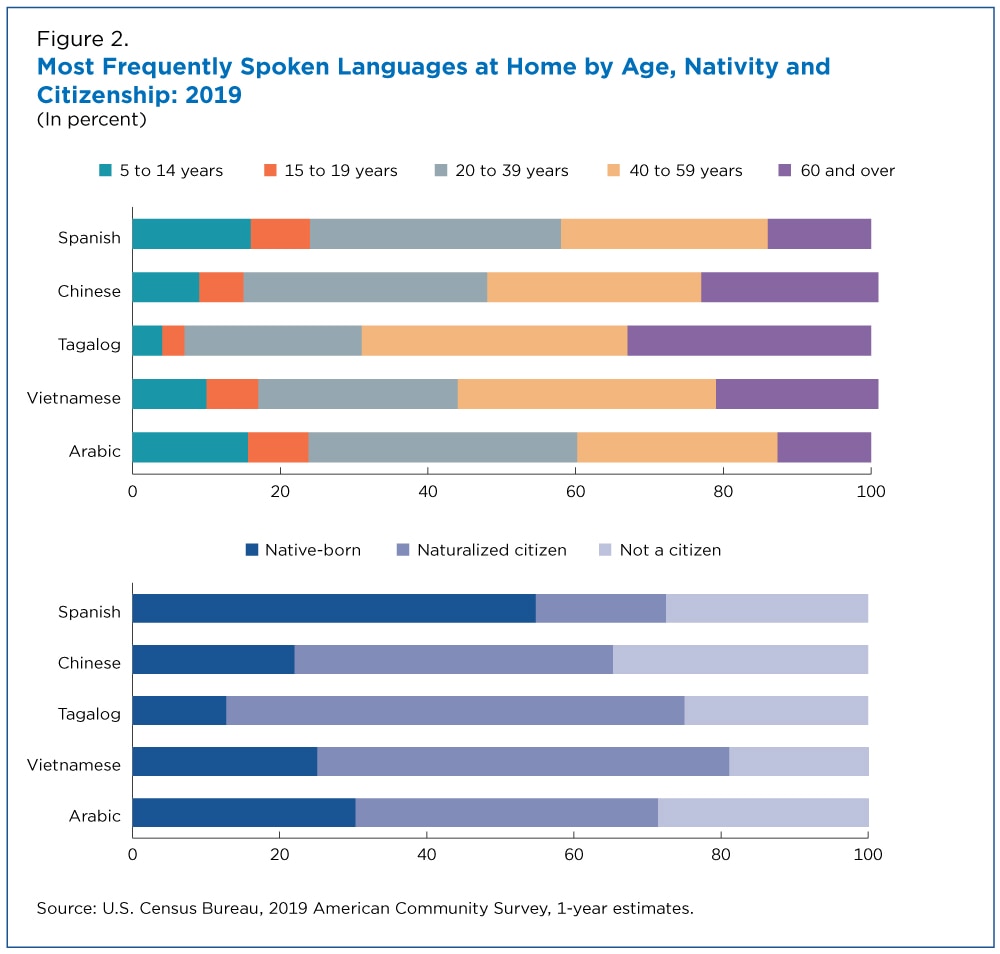
Although English is far and away the dominant language spoken in the US, the number of people in the United States who spoke a language other than English at home nearly tripled from 23.1 million (about 1 in 10) in 1980 to 67.8 million (almost 1 in 5) in 2019, according to a recently released US Census Bureau report.

The Hispanic (Latino) population is the largest minority group in the United States. So it is not surprising Spanish was the most common non-English language spoken in U.S. homes (62%) in 2019.

What is surprising are the next four frequently languages spoken at home are, in descending order, are Chinese, Tagalog, Vietnamese and Arabic, a reflection of the fastest growing demographic and immigration rate in the US.

The Census report, Language Use in the United States: 2019, uses American Community Survey (ACS) data to highlight trends and characteristics of the different languages spoken in the United States over the past four decades.

The Census Bureau release refers to foreign-language “speakers” as those who report speaking a language other than English (LOTE) at home, not necessarily all those who can speak that language. 

Figure 2. Most Frequently Spoken Languages at Home by Age, Nativity and Citizenship: 2019


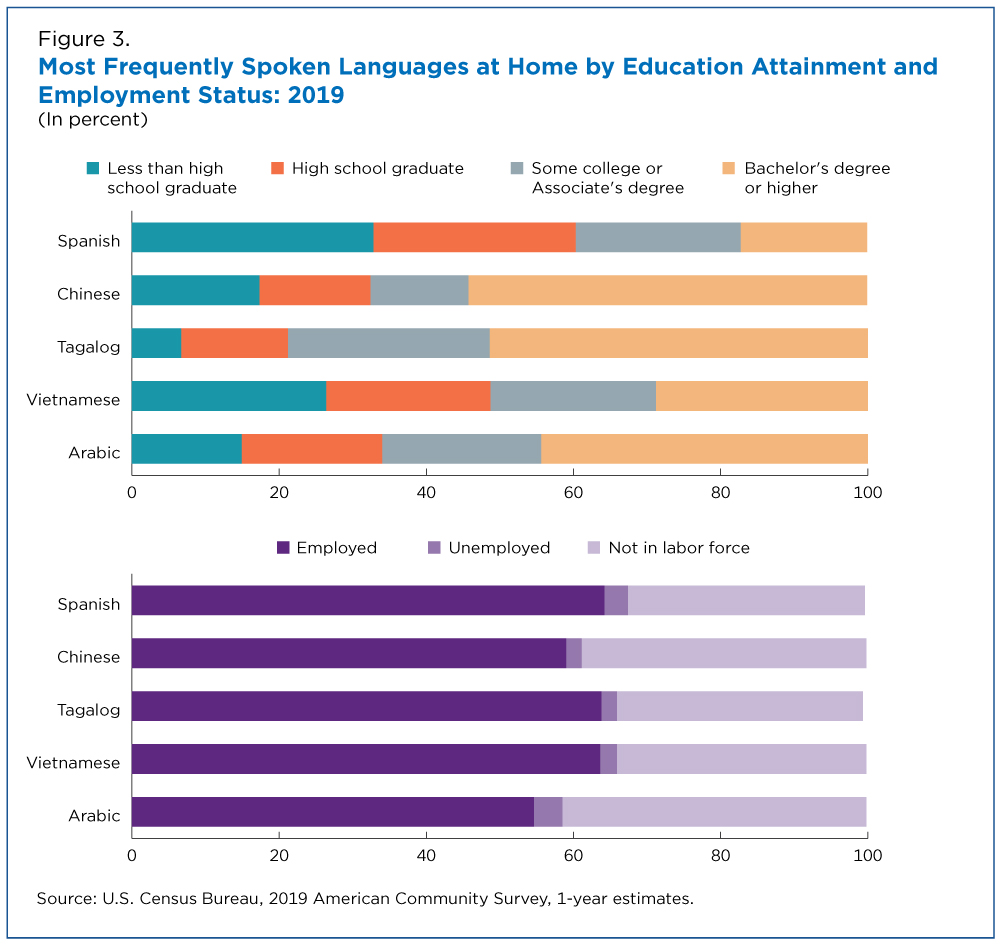
Educational Attainment and Employment

In 2019, 51% of Tagalog and 54% of Chinese speakers had a bachelor’s degree or higher (these two groups were not statistically different from each other) compared to only 17% of Spanish speakers. Figure 3 shows educational attainment for the U.S. population ages 25 years and older by language spoken at home.

About a third (33%) of Spanish speakers did not graduate from high school, the largest share of speakers of the five most common languages other than English.

Employment status of speakers ages 16 and over did not vary much across the five languages (Figure 3). Less than 4% were unemployed in 2019 – not significantly different than the national average.

Figure 3. Most Frequently Spoken Languages at Home by Education Attainment and Employment Status: 2019


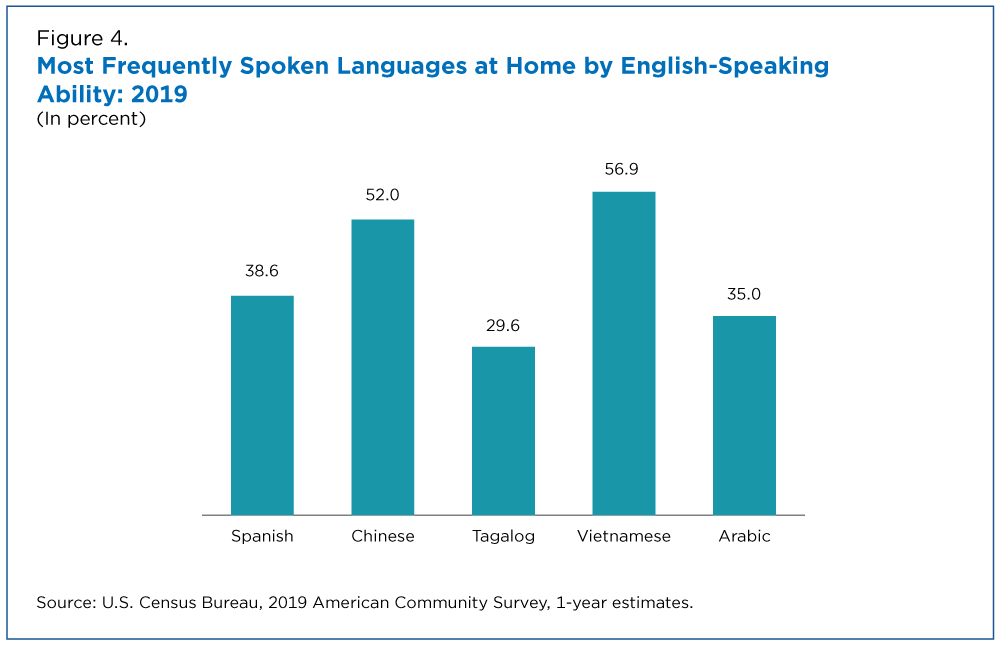
English Proficiency by Language

The federal government relies on data on language use and English proficiency to provide language services under the Voting Rights Act, as well as to allocate educational funds to state English as a Second Language (ESL) programs.

Based on the 2019 data, 52% of people who spoke Chinese and 57% of those who spoke Vietnamese at home in the United States spoke English “less than very well,” compared to the other three common languages: Spanish 39%, Tagalog 30%, and Arabic 35%. This may have resulted from a recent increase in immigration from Asia and newcomers who have not had enough time to assimilate and master
 English yet.


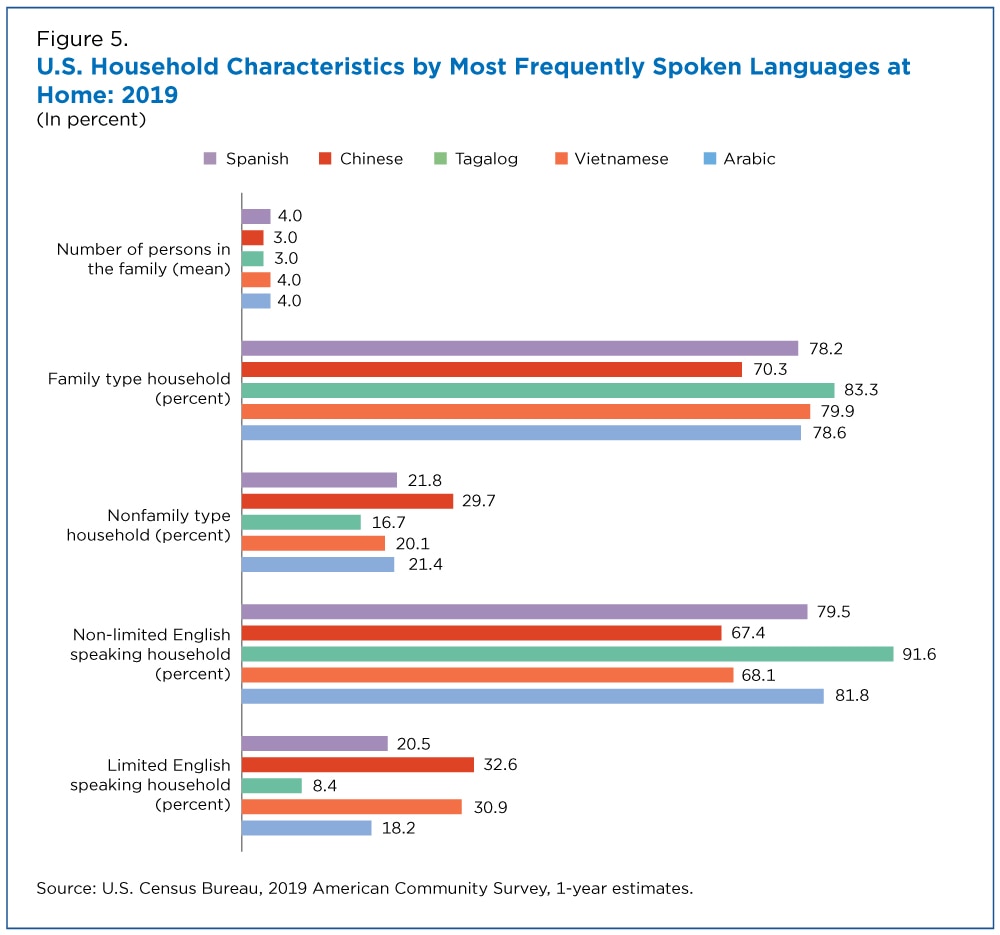
Household Characteristics by Language

In addition to individual differences, there were also differences in the US households that spoke the five most frequently spoken non-English languages.

A limited English-speaking household is one in which no members ages14 and over speak only English or speak English “very well.” About a third of Chinese (33%) and Vietnamese (31%) households were limited English-speaking households – four times greater than Tagalog households.

In contrast, Tagalog-speaking households were more likely to be “non-limited” English speaking. About 92% of Tagalog-speaking households were non-limited English speaking and only 8% were limited English speaking.


The majority of households across all five languages were family households, defined as having at least two members (including the householder) related by birth, marriage or adoption. On average, these households each had zero to one child under age 18 and three to four persons in the family.

Among nonfamily households, defined either as a person living alone or one who shares the housing unit with nonrelatives such as boarders or roommates, a greater proportion (30%) of Chinese-speaking households were nonfamily compared to households speaking the other four languages. Half as many Tagalog-speaking households (17%) were nonfamily households.


Figure 5. U.S. Household Characteristics by Most Frequently Spoken Languages at Home: 2019

FYI: For a comprehensive review at the individual languages and languages groups spoken in the United States by statisticians Sandy Dietrich Erik Hernandez, refer to the Language Use in the United States: 2019 report.
Stop Asian Hate, a community group tracking the recent surge of attacks against AANHPI in the US and Canada, lists several incidents reported where Asian Americans were attacked for speaking an Asian language.

Several other studies should put the minds of English-only advocates to rest. By the third generation after immigrating to the US, English becomes the primary language spoken at home.

Some of the ifirst-generation immigrants learned English, but preferred to speak their native languages, especially at home. Their children largely grew up bilingual, but many chose to speak English, even to their immigrant parents. When this bilingual generation established their own homes, they usually spoke English at home. “Consequently, by the third generation, the prevalent pattern is English monolingualism, and knowledge of the mother tongue for most ethnics is fragmentary at best,” according to a Pew report.

EDITOR'S NOTE: For additional commentary, news and views from an AANHPI perspective, follow @DioknoEd on Twitter. 
Posted by Edward Diokno at 11:37 AM No comments:
Email ThisBlogThis!Share to XShare to FacebookShare to Pinterest
Labels: Chinese Americans, Filipino Americans, Multilingual America, US Census, Vietnamese Americans

Sunday, November 13, 2022

Chinese American scientist vindicated with a settlement of $1.75 million settlement

SCIENTIST SHERRY CHEN


Wrongfully accused of being a spy, Chinese American scientist Sherry Chen finally received justice in the form of a $1.75 million settlement from the federal government.


“The government’s investigation and prosecution of me was discriminatory and unjustified,” said Sherry Chen. “The Commerce Department is finally being held responsible for its wrongdoing and for the conduct of its illegal security unit, which has had a devastating impact on my life and the lives of so many other federal employees. No one else should have to endure this injustice.”

On Nov. 10, Chen’s lawyers announced that the scientist won a historic $1.75 million settlement from the US Commerce Department for her wrongful prosecution and subsequent termination from the National Weather Service. “The government’s investigation and prosecution of me was discriminatory and unjustified,” Chen said in a statement. “The Commerce Department is finally being held responsible for its wrongdoing … No one else should have to endure this injustice.”

The settlement - $550,000 from the Commerce Department and an annuity from the government valued at $1.25 million over 10 years – marks the end of Chen's lawsuit.

"Ms Chen's historic settlement is a victory for her and for Chinese American communities," said Ashley Gorski, senior staff attorney with the American Civil Liberties Union, co-counsel of Chen's case. "It makes clear that profiling and discrimination are unacceptable, and that the government will be held to account," she said in a statement.

Chen's case began with racial profiling. Even though she had won awards for helping save lives from dangerous floodwaters, after she visited her elderly parents in China, she was targeted. She was accused of crimes such as espionage, interrogated without being advised of her rights, and then brought under federal prosecution and terminated from employment.

On the eve of trial, however, the government dropped all criminal charges. Sherry was always, and remains, an innocent American. 

“As a public servant, I have been in the front line protecting people’s safety and their property," said Chen. "I made my contribution to this country. I have been an innocent American and a law abiding citizen. However, my life has been turned upside down twice by our government for doing nothing wrong. I am glad to receive the court’s favorable ruling on my MSPB claim.”

Chen’s case was an early instance of what would become a much bigger pattern of the US government’s increasing suspicion of Chinese and Chinese American scientists amid growing competition between the US and China. The settlement is a personal and symbolic victory after years of persecution.

Chen’s investigation and firing predated the Justice Department’s China Initiative, a Trump-era program to counter Chinese economic espionage that, despite its stated goals, disproportionately targeted Chinese-American academic researchers for alleged grant fraud or disclosure issues—and saw a higher number of cases fall apart before trial than the federal average.

In addition to the monetary damages, Chen’s lawyers say that the Commerce Department will also host a private meeting with the scientist and provide a letter acknowledging her record and accomplishments as a government hydrologist.

It’s not quite the apology that Chen’s supporters, organized by the advocacy organization APA Justice and signed by over 1,000 individuals and organizations, demanded in an open letter sent earlier this year to Gina Raimondo, the secretary of commerce. However, the chance to sit down with Commerce Department officials and the promise of a written acknowledgement “were very important to Ms. Chen and were negotiated as part of the settlement,” Gorski told us.

The symbolism of her settlement may be especially welcome in the aftermath of the ill-fated China Initiative, which MIT Technology Review investigated last year and found to be ineffective with respect to its stated goals and to have overwhelmingly targeted individuals of Chinese heritage, who made up 90% of defendants.

The Biden administration officially ended the China Initiative in February, but numerous studies have pointed to its broader chilling effects on scientific collaboration between the US and China, as well as declining interest in the United States as a destination for higher education and research. Not to mention the lingering personal effects for individuals caught up in the web, even if they were ultimately cleared.

That gives added significance to the outcome of Chen’s lawsuits. “It’s an enormous victory for Ms. Chen personally,” said Gorski, “and for the Chinese American community as well. The settlement makes clear that when the government discriminates, it’s going to be held accountable.”

Chen's victory was cheered by Chinese American community members. “The Sherry Chen case has meant so much to Asian Americans, especially Chinese immigrants, because they identify with her," said Committee of 100 President Frank H. Wu. 

"Sherry could be your sister, cousin, or aunt. She is representative. Even though she wanted to contribute to America, she was singled out on account of who she is. So many of us have had that experience too.”

EDITOR'S NOTE: For additional commentary, news and views from an AANHPI perspective, follow @DioknoEd on Twitter.


Posted by Edward Diokno at 12:43 AM No comments:
Email ThisBlogThis!Share to XShare to FacebookShare to Pinterest
Labels: China Initiative, Chinese Americans, Racial Profiling, Sherry Chen

Tuesday, October 18, 2022

Chinese Americans urged to take part in national survey


A survey, "The State of Chinese Americans," is being conducted by Columbia University, one of the world’s leading research universities, and Committee of 100, a nonprofit organization of prominent Chinese Americans.

The joint research will provide much-needed data to shed light on the demographic, economic, health, and sociopolitical situations of the Chinese American population, and inform policymakers and the public on the status and needs of the community. The survey data will inform timely and responsive policies, programs, and services.

"Our research teams completed a successful pilot study of the survey this summer, with the help of the Chinese-American Planning Council, Chinese American Women in Action, the Community Youth Center of San Francisco, and the U.S. Heartland China Association," stated a press release from the Committee of 100. 

The nationwide survey will be conducted online in English, "simplified Chinese," and "traditional Chinese." 

All adults self-identifying of Chinese-ethnic origin and living in the United States are encouraged to participate in the anonymous survey here: bit.ly/ChineseAmericanSurvey. 

The research is carried out by researchers of the China Center for Social Policy at Columbia University School of Social Work and Committee of 100.

Columbia and Committee of 100 invite additional organizations, community members, and interested groups to participate and partner in this critical research project, to amplify the voices of Chinese American communities nationwide. For more information on how you can become involved, please contact swchinesesurvey@columbia.edu.

For more information on the survey, including an overview of the research project and the opportunity to engage in a Question and Answer session, register for an informational webinar to be held on Thursday, Nov. 3 from 1-2 pm ET.

Posted by Edward Diokno at 12:28 AM No comments:
Email ThisBlogThis!Share to XShare to FacebookShare to Pinterest
Labels: Chinese Americans, Committee of 100, Survey

Sunday, February 6, 2022

Olympics 2022: It's complicated for Chinese American athletes in the home of their ancestors


Vincent Zhou

For the Chinese American athletes in the Olympics, competing in Beijing has significance  that goes beyond their sport.

The city of Beijing and the country of China is the ancestral home of the Chinese American athletes, many still have family there.

"My grandparents still live here. Much of my extended family does. So this is almost like a second hometown to me," says figure skater Vincent Zhou.

Speaking about her father, who fled the country for his pro-democracy activities, 16-year old Alysa Liu told the Today Show before leaving for Beijing. "Obviously we still love the country of China, even after my dad left because of the government." 

Alysa Liu

"This is still his homeland, and he's very happy that I get to go to China again ... Just going back to China will make me feel good."

Nathan Chen, the United States' top men''s figure skater has fond memories of a visit to Beijing, his mother's hometown.

"I remember going to the Beijing Zoo," when he was younger, says Chen. "So like every time when we're driving from the (Olympic) Village here, I see the Beijing Zoo and am like, ‘Oh, I was here when I was 10.’

"So it's kind of cool to be able to see that. Also just hear stories from my mom growing up in Beijing and being like, ‘Wow, you know, I'm here,’" he tells the Associated Press.

"Hopefully at some point after the Games are over, I'll be able to explore Beijing a little bit more," added Chen.


Kai Owens

“It becomes full circle when I step off that plane in China,” Kai Owens told The Associated Press before arriving in Beijing.  “When my skis touch the snow in China, it’s going to be a really special moment for me because I get to ski in the Olympic Games in my birth country. It’s crazy how life works,” said the freestyle skiier, who was adopted when she was an infant by her Colorado parents.

Madison Chock's family roots more in the rural part of China. Chock is one-half of the ice dance team currently competing for a medal. 

“Every time I’m on the bus, I’m just looking out and studying the city and just imagining my roots are here, my ancestors are here,” says Chock, whose father is Chinese-Hawaiian. “And it’s a very cool sense of belonging in a way, to just be on the same soil that your ancestors grew up on and spent their lives on.”

“It’s really special, and China holds a really special place in my heart,” she told the AP.

RELATED:
Born and raised in San Francisco, Eileen Gu will represent China
Five AAPI skaters named to USA Figure Skating team.
NBC puts Nathan Chen and Chloe Kim in the spotlight to promote their coverage
Snowboarding star Chloe Kim: "I'm going to go off"
20 Asian Americans and Asian Canadians to watch at the Winter Olympics
Emotions flood over Chinese American athletes in Beiging Games

EDITOR'S NOTE: For additional commentary, news and views from an AAPI perspective, follow me on Twitter @DioknoEd.
Posted by Edward Diokno at 2:24 AM No comments:
Email ThisBlogThis!Share to XShare to FacebookShare to Pinterest
Labels: 2012 Beijing Olympics, Alysa Liu, Chinese Americans, Kai Owens, Madison Chock, Nathan Chen, Vincent Zhou

Saturday, July 24, 2021

Congresswoman Marjorie Taylor Greene wants to deport Chinese

Rep. Marjorie Taylor Greene

Rep. Marjorie Taylor Greene , R-Ga., wants Chinese Americans and Chinese visitors in the U.S. deported because of China’s links to COVID-19.

Greene, who believes in QAnon conspiracy theories, told Trump's former advisor Steve Bannon on his "War Room" program Wednesday, 
“The Chinese understand one thing and that is money. If I was in charge and I had my way, I would come down on China so hard. 

“I would put tariffs back in place and they would be more strict than [former] President [Donald] Trump’s because those tariffs worked.” 

“I would kick out every Chinese in this country who is loyal to the CCP (Chinese Communist Party)" said the radical conservative. “China tried to kill us, and did kill us, this past year” with COVID-19. “If I had my way, I would come down on China so hard.”

In an earlier interview, she called COVID-19 a "bioweapon."

One of QAnon's baseless conspiracy theories one of which   is that China, where COVID-19 first emerged, deliberately created COVID-19 to kill Americans.

It is not the first time Greene espoused her theories about the pandemic and the links to China. "Through a Chinese made bio weapon, America and the world came to a halt," Greene tweeted.

In a speech speech to the Conservative Political Action Conference, she urged the US to stop sending aid overseas, listing the countries receiving U.S. aid, including the U.S. territory of Guam.

"I'm a regular, normal person. And I wanted to take my regular – normal person, normal, everyday American values, which is: we love our country. We believe our hard-earned tax dollars should just go for America – not for what, China, Russia, the Middle East, Guam – whatever, wherever," Greene said.

She is also an outspoken critic of the vaccinations against COVID-19 even tough when questioned she would not give a direct response.

Her comments about the Chinese plays on the inbred racist trope that "others" Asian Americans as perpetual foreigners.

Green has voted against certifying Biden's election and against an investigation against the 1/6 Insurrection. She consistently courts controversy and even renewed calls for her expulsion for comparing opponents and their policies to the Nazis and the Holocaust.
Posted by Edward Diokno at 2:11 AM No comments:
Email ThisBlogThis!Share to XShare to FacebookShare to Pinterest
Labels: Chinese Americans, Covid-19, Marjorie Taylor Greene, Othering

Sunday, April 12, 2020

Sunday Read: Hey Andrew Yang! Are we American enough yet? AAPI pitching in to counter coronavirus

New York Sikhs prepare meals for those who can't fend for themselves during the coronavirus crisis.

Yeah, Donald Trump's penchant for otherizing people has opened the door for bigots to unleash their heretofore pent-up racist beliefs, but that hasn't stopped AAPI groups helping their fellow Americans despite racist attacks from ignorant bigots.

Andrew Yang's Washington Post oped calling on Asian Americans to outdo their non-AAPI neighbors in volunteering, pitching in, and other good deeds so AAPI can prove we are Americans enough is still reverberating throughout Asian America.

Apparently, before Yang's so-called call to action aimed at Asian Americans, AAPI groups and individuals have already been doing their part doing the things that good Americans do. Here are just a few examples:

AAPI medical personnel in the front lines caring for the ill

First off, we know that AAPI medical personnel, despite the risk to themselves and their families, are in the front lines of caring for coronavirus victims as nurses, doctors, and medtechs. Several of these American heroes have lost their lives trying to help the afflicted.

Even though AAPI make up only 6% of the US population, almost 20% of the physicians, 9% of physician’s assistants and nearly 10% of nurses in the United States are of Asian descent.

Asian American researchers like Dr. David Ho are also leading the research in their quest to find a vaccine for the heretofore unknown virus.

Eun Kim and Shaohua Huang, both of whom are on the University of Pittsburgh medical school faculty are reportedly on the verge of nailing down a vaccine.

Some of the physician organizations have taken the initiative to help the New York-New Jersey hospitals running short of protective gear.

The Coalition of Asian-Americans in Private Practice, a New York group with more than 1,000 members, has raised close to $250,000 since January and expects to get 80,000 N95 masks to New York hospitals this month, reports the NY Times.


A New Jersey doctor, Dr. Peter Lee, went on WeChat to make an appeal for supplies. Within three days, the Millburn Short Hills Chinese Association, based about 20 miles away, saw his post and raised more than $50,000 and obtained 10,000 masks, gowns and other pieces of equipment from a Chinese company with a warehouse in Queens. 

AAPI individuals, organizations and religious groups who are not in the medical field are "pitching-in" and "volunteering" like many other Americans. 


Asian American chamber of commerce donate to Houston hospitals

The Asian American Chamber of Commerce donated today over $42,000 in medical supplies to the City of Houston following our urgent calls for personal protective equipment.

"We as a collective body, including Chinese-American, Korean-American, Vietnamese-American, Japanese-Americans, Filipino-Americans and the various other AAPI ethnicities, are in support of helping Houston through this challenging crisis and will stand by Mayor Sylvester Turner and the City of Houston in whatever the needs are," said Bin Yu, Asian Chamber Board Chair. "The City of Houston has been in support of our Chamber since our existence 30 years ago and we have built our campaign in rallying together where we titled it: 'Together, Houston is Stronger!'


Among the donations are 10,000 N95 masks, 40 gallons of sanitaizers, 825 isolations gowns, 270 goggles and 500 face shields.


Teen raising funds and PPE donations for medical staff

Harry Ding, an eighth-grader at Buist Academy downtown. has launched a drive in the Asian American community in Charleston, S.C. to collect hundreds of personal protective equipment for hospital workers, an effort that Ding hopes will help tear away at subconscious biases that may exist locally.

“We all have biases against others,” said the 14-year old. “I think this will help.”
Ding is part of a volunteer group of more than a dozen Charleston area residents of Asian descent who have collected more than 400 N95 masks, 300 surgical masks, and several goggles, medical gloves and bottles of alcohol, as well as $4,000.
The items were taken on March 25 to a warehouse operated by the Medical University of South Carolina, and the money will be used to purchase more hospital items that will be donated as well.

San Francisco Filipino restaurants team up to Feed the Frontline with 10,000 meals

A group of Filipino American restaurants in San Francisco have combined their resources to help feed the medical staffs of local hospitals drawing on the Filipino value of kapwa. As defined by the father of modern Filipino psychology, Virgilio Enriquez, kapwa means “shared identity,” “equality,” and “being with others.” To put it simply, kapwa is the obligation we have towards our fellow man


Filipinos Feed the Frontlines is a new fundraising initiative that aims to raise $100,000 to pay struggling Filipino restaurants to provide 10,000 free meals to local hospitals and vulnerable people in the SoMa community.

The nine businesses currently signed up to provide meals through Filipinos Feed the Frontlines include some of the most prominent names in the Bay Area Filipino food community: Nick’s on Grand, Señor Sisig, Lumpia Company, Sarap Shop, Mestiza and Little Skillet, FK Frozen Custard, Manila Bowl, SF Chickenbox/IVSF Catering, and the pop-up Ox and Tiger. 

As of publication time, the campaign has raised more than $12,000 since it launched over the weekend — it’s actively seeking both corporate sponsorships and small individual donations.

Houston restaurant donates meals to hospitals

Be More Pacific in the Heights, a Filipino restaurant, is doing its part to help those on the front lines in the fight against the coronavirus. It had beenopen for only three weeks before the coronavirus pandemic hit the Houston area. It is not focused on preparing and delivering meals to local medical staff.

The Filipino-style restaurant has only been open about three weeks but is focused on preparing and delivering meals to nurses and doctors in the Houston area.

“We’re trying to provide them the food they need," said General Manager Brian Caispe.

The restaurant has asked the public for more donations. They said they are willing to continue cooking as long as people are willing to contribute.

To donate, visit their website at www.bemorepacifickitchenandbar.com or call them at 832-582-5264.

Seattle restaurant offering free meals for anyone

The restaurant Musang opened three months ago but when the coronavirus hit Seattle, the Filipino restaurant shifted to take-out order only.

Shortly thereafter, chef-owner Melissa Miranda, turned the restaurant into a communitiy kitchen, preparing meals for people in need for free.

“We decided to do this based on the needs of the community. Currently most restaurants, if not all, are on takeout or closed. There’s about 350,000 employees that have lost work,” said chef/owner Melissa Miranda.

“So we wanted to make sure we fed them. All the schools are closed now and so there’s about 56,000 students just in the Seattle public schools that are without food so we wanted to make sure that they were being fed.”
On Musang’s Instagram account, Miranda asked for programs that serve families in need to contact the restaurant with meal requests. People also have the opportunity to donate via Venmo or Paypal to keep Musang’s community kitchen running — one meal at a time.


Sikhs open their kitchens

More recently, in New York, the Sikh Centre prepared and packed over 30,000 home-cooked meals for Americans in self-isolation. 
New York's Mayor's office approached the Sikh community to make the food packages that were then distributed to several federal agencies in the area. The food packages were are to be given to the elderly, challenged people, homeless and single parents looking after their kids who can’t go out.

United Sikhs, an NGO with chapters throughout the United States, is urging people from all walks of life to donate generously.

"Once we heard people were having a problem with food when they go shopping, they can't find food in the shopping centre, then we started reaching out to people in our personal capacity in the Bay Area (San Francisco)," ANI quoted, Dr Pritpal Singh, coordinator of the American Gurudwara Prabhandak Committee (west coast) as saying.


Sikhs in California have done the same for homeless shelters, the elderly and the homeless. 


Being Sikh is “not just about the turban and the facial hair or the prayers,” Gurvinder Singh, international humanitarian aid director for United Sikhs. “It’s also about community involvement, community engagement, community activism. That’s absolutely a requirement.”

WeChat to the rescue 

Xuerong Xia is a stay-at-home mom in the Chicago area. She joined WeChat just a few months ago in order to find ways to help the people in China deal with the coronavirus, which originated in Wuhan, China.

Before long, she turned her attention to helping local hospitals, coordinating efforts to raise funds and collect items -- some aid coming from China, to supply the local hospitals which were running short of personal protective gear.

Xia soon teamed up with John Li, who like her, began helping China but turned his attention to US needs. Through WeChat, Li estimates he’s received more than $30,000 on top of the tens of thousands of face masks and other medical equipment to give to Chicago-area medical facilities.

And there are the super rich giving back

  • The Chan Zuckerberg Initiative, managed by Facebook's Mark Zuckerberg and his wife, Dr. Priscilla Chan, is donating to the COVID-19 Therapeutics Accelerator, which will help coordinate research efforts to identify new drugs and treatments for the illness. The Accelerator is already backed by $125 million in commitments from the Bill & Melinda Gates Foundation, health foundation Wellcome, and Mastercard’s Impact Fund, according a March 10th press release.
  • The foundations of business leaders including Jack Ma and Joe Tsai, co-founders of Alibaba, recently pledged to send one million surgical masks and one million N95 masks to New York state, reports the NY Times. In additin, Ma has donated $2 million to Columbia University for Dr. Ho's research into the coronavirus.

  • The Joe and Clara Tsai Foundation and the Chinese government coordinated a shipment of 1,000 ventilators to Kennedy International Airport in New York.

  • Li Lu, the chairman of Himalaya Capital Management, has also spearheaded major donations, and the Committee of 100, a Chinese-American leadership organization, has raised $1 million.

And the list goes on ...

AAPI across the United States are pitching in, volunteering, raising funds and other proactive things that "Americans" do.
  • A group of Chinese-American professors at Rutgers University raised $12,000 and collected more than 4,000 masks to support a hospital in New Brunswick. 
  • A church in Parsippany donated thousands of masks to hospitals and even to local gas stations, where attendants are still required to pump gas by law.
  • Danbury Hospital in Connecticut is receiving more than 6,000 surgical masks thanks to $20,000 in donations from the Chinese community, reports News 12. The hospital has already received 5,000 masks and another 1,500 are scheduled to arrive today

  • Elsewhere, 115 restaurant owners from the Chinese American community nationwide have raised $72,000-enough to purchase 20,000 surgical masks, according to Xinhuanet. The money is also being used to donate 300 N95 masks, 3,550 protective coveralls and 500 pairs of gloves to multiple hospitals in New York, the epicenter of the pandemic in the United States, and another hospital in New Jersey.

  • In Wisconsin, a ginseng grower has received 1,000 surgical masks and 400 N95 masks from China and has donated them to local hospitals and police departments.

  • Xinhuanet reports the Long Island Chinese American Association has donated 37,000 surgical masks and nearly 3,500 personal protective masks to ten hospitals.

Plea to Andrew Yang

So, Andrew, I see you kind of explain what you really meant in your oped. It takes a little bit of the sting out of your original thesis, though it still hurts. But its a little too late, don't you think? To use a couple of American cliche's: "The cat is out of the bag." "The horse has left the stable." 

You said in Next Shark: "I realize that the op-ed fell short. I did not mean to suggest that we as Asian Americans needed to do anything more to prove that we are Americans. We’ve been here, we belong here and will continue to be part of the fabric of America."

That interview in Next Shark conducted by a former campaign staffer doesn't come close to the reach of the international readership of the Washington Post. Most people will have missed it.

So, Andrew, I hope you can see that AAPI folk, individually and collectively, are doing the good, old American thing because, even though some were born in Asia, they choose to live in this country and in their hearts, they are American. They pledge their loyalty to the US, stand for the "Star Spangled Banner," attend religious services, learn white America's  history that largely ignores AAPI, run for office, Asian American lawmakers introduce policies, entrepreneurs start businesses, volunteer, pitch-in -- you know, all the things Americans are supposed to do.
The problem is, Andrew, despite all this pitching-in and volunteering and being American, the hate acts against Asian Americans seem to be growing more frequent and more violent.
Please, Andrew, can you write another oped to the racists and bigots who continue to harass, bully and attack Asian Americans and explain to them what they need to do in order to be good Americans? 


Posted by Edward Diokno at 2:54 AM No comments:
Email ThisBlogThis!Share to XShare to FacebookShare to Pinterest
Labels: Andrew Yang, Asian Americans, Chinese Americans, Filipino Americans, Sikh Americans
Older Posts Home
Subscribe to: Posts (Atom)

FILIPINO AMERICAN HISTORY MONTH

UPDATED: This blog compiles scores of posts about Filipino American history, accomplishments and individuals

EDITOR'S NOTE : THIS POST IS CONSTANTLY BEING UPDATED TO THE PRESENT "POSITIVELY NO FILIPINOS ALLOWED" said the sign in a Stoc...

Dedicated to the next generation.

My photo
Edward Diokno
News & Analysis and random commentary from an Asian American Perspective
View my complete profile

Search This Blog

Blog Archive

  • ▼  2026 (194)
    • ▼  September (11)
      • 9/11 anniversary: The towers came down and hate sp...
      • US Open: Jessica Pegula falls to the No. 1 seed bu...
      • US Open: Lone Asian American Jessica Pegula fights...
      • A FilAm journalist brings down the NBA elite and w...
      • US Open: Eala ousted, Pegula, Osaka, Zheng, Tien m...
      • Lea Salonga receives dual honors: Her own Walk of ...
      • US Open: Asian players advance as matches grow har...
      • Eala Mania graces NYT front page—And It’s the Asia...
      • First Afghan American sworn in for US Congress
      • Wave of Asian players and fans wash over the US Op...
      • Olivia Rodrigo's music festival raises $20M for no...
    • ►  August (24)
    • ►  July (21)
    • ►  June (19)
    • ►  May (23)
    • ►  April (26)
    • ►  March (33)
    • ►  February (22)
    • ►  January (15)
  • ►  2025 (170)
    • ►  December (16)
    • ►  November (17)
    • ►  October (17)
    • ►  September (17)
    • ►  August (13)
    • ►  July (17)
    • ►  June (13)
    • ►  May (13)
    • ►  April (11)
    • ►  March (13)
    • ►  February (9)
    • ►  January (14)
  • ►  2024 (179)
    • ►  December (16)
    • ►  November (17)
    • ►  October (21)
    • ►  September (15)
    • ►  August (16)
    • ►  July (21)
    • ►  June (12)
    • ►  May (14)
    • ►  April (10)
    • ►  March (11)
    • ►  February (11)
    • ►  January (15)
  • ►  2023 (241)
    • ►  December (17)
    • ►  November (9)
    • ►  October (16)
    • ►  September (13)
    • ►  August (20)
    • ►  July (20)
    • ►  June (23)
    • ►  May (28)
    • ►  April (22)
    • ►  March (24)
    • ►  February (25)
    • ►  January (24)
  • ►  2022 (361)
    • ►  December (22)
    • ►  November (23)
    • ►  October (26)
    • ►  September (29)
    • ►  August (31)
    • ►  July (29)
    • ►  June (37)
    • ►  May (38)
    • ►  April (27)
    • ►  March (31)
    • ►  February (34)
    • ►  January (34)
  • ►  2021 (491)
    • ►  December (33)
    • ►  November (28)
    • ►  October (27)
    • ►  September (36)
    • ►  August (40)
    • ►  July (49)
    • ►  June (39)
    • ►  May (48)
    • ►  April (43)
    • ►  March (56)
    • ►  February (47)
    • ►  January (45)
  • ►  2020 (735)
    • ►  December (38)
    • ►  November (40)
    • ►  October (50)
    • ►  September (56)
    • ►  August (63)
    • ►  July (72)
    • ►  June (65)
    • ►  May (69)
    • ►  April (67)
    • ►  March (76)
    • ►  February (69)
    • ►  January (70)
  • ►  2019 (900)
    • ►  December (67)
    • ►  November (66)
    • ►  October (67)
    • ►  September (74)
    • ►  August (78)
    • ►  July (73)
    • ►  June (78)
    • ►  May (77)
    • ►  April (82)
    • ►  March (90)
    • ►  February (68)
    • ►  January (80)
  • ►  2018 (852)
    • ►  December (74)
    • ►  November (73)
    • ►  October (87)
    • ►  September (67)
    • ►  August (65)
    • ►  July (63)
    • ►  June (71)
    • ►  May (73)
    • ►  April (71)
    • ►  March (66)
    • ►  February (68)
    • ►  January (74)
  • ►  2017 (692)
    • ►  December (60)
    • ►  November (62)
    • ►  October (66)
    • ►  September (58)
    • ►  August (51)
    • ►  July (59)
    • ►  June (51)
    • ►  May (49)
    • ►  April (58)
    • ►  March (69)
    • ►  February (49)
    • ►  January (60)
  • ►  2016 (623)
    • ►  December (58)
    • ►  November (61)
    • ►  October (51)
    • ►  September (50)
    • ►  August (51)
    • ►  July (65)
    • ►  June (46)
    • ►  May (61)
    • ►  April (54)
    • ►  March (48)
    • ►  February (38)
    • ►  January (40)
  • ►  2015 (335)
    • ►  December (35)
    • ►  November (40)
    • ►  October (36)
    • ►  September (34)
    • ►  August (29)
    • ►  July (30)
    • ►  June (29)
    • ►  May (27)
    • ►  April (22)
    • ►  March (24)
    • ►  February (14)
    • ►  January (15)
  • ►  2014 (87)
    • ►  December (12)
    • ►  November (12)
    • ►  October (20)
    • ►  September (15)
    • ►  August (10)
    • ►  July (10)
    • ►  June (3)
    • ►  May (2)
    • ►  April (3)

Translate

The opinions expressed here are my own.. Simple theme. Theme images by compassandcamera. Powered by Blogger.