Showing posts with label Orange County. Show all posts

Thursday, October 26, 2023

Spurred by Israel-Hamas war, California AG Rob Bonta addresses spike in hate crimes against Muslims and Jews

California Attorney General Rob Bonta has made fighting hate crimes one of his top priorities.


Hate crimes against AANHPI went down in California for 2022, but the total of hate crimes went up.  2023 is expected to see an overall increase due to the conflict between Israel and Hamas.

“There is no place for hate in California’s communities and cities,” said Rob Bonta, the state's first Filipino American Attorney General at a discussion in Irving, California on Monday, Oct. 23. “As our communities feel the ripple effects of the heart-wrenching violence in Israel and Palestine, we must recommit to standing united against hate, wherever it occurs in our state."

As part of a statewide effort to address hate, Bonta joined a roundtable discussion Monday  in Orange County where he was was joined by Irvine's mayor, Pakistan-born Farrah N. Khan, and other local elected and community leaders.

The roundtable in Irvine is the 13th in a series of meetings led by Bonta across the state to bring together local elected officials, law enforcement officers, and community leaders to discuss best practices in addressing hate crimes. The roundtables are broadly aimed at developing strategies to address bias and hate, increasing awareness around available resources for members of the public, and strengthening responses to hate crimes and incidents in California.

Although hate crime targeting Asians decreased by 43.3% from 247 in 2021 to 140 in 2022, there was a 20.2% increase in total reported hate crime events in California, according to a report on hate crimes released in the summer by the Attorney General. Although not captured in statewide hate crime statistics, it’s also important to remember that hate incidents — acts that do not meet the legal requirements of a crime — are also incredibly harmful and can leave lasting, negative impacts on targeted communities.

Even before the Mideast War began, the state report found that hate crimes against Jews increased 24.3% from 152 in 2021 to 189 and at the same time, anti-Muslim crimes rose from 18 in 2021 to 25 in 2022.

Blacks continue to be the community most targeted by hate in the state. Anti-Black incidents ncreased 27.1% from 513 in 2021 to 652 in 2022.


        FYI: The full 2022 Hate Crime in California report is available here.

Yulan Chung, CEO of the South Coast Chinese Cultural Association, said when one person is affected by hate, the entire community feels it. She and other community members on the Orange County panel said they’d like to see more collaboration, accountability and funding go toward addressing anti-hate work.

Over the last five years, hate activity has been on the rise locally, according to the latest OC Hate Crimes Report. In Orange County, home to a large number of Asian Americans, the number of hate incidents against Asian Americans jumped 1,800% in 2020, according to the annual Orange County Hate Crime Report.

For 2022, hate crimes have increased by only 75%, and hate incidents – incidents  motivated by hateful bias that is not a crime – rose by 142%.

There were 450 reported hate crimes and incidents in Orange County in 2022, and more than half of those were motivated by race, ethnicity or national origin bias.

To counter the rise in anti-Asian incidents and attacks, the Anaheim Union High School District has launched this school year a first-of-its-kind high school ethnic studies course focused on the experiences of Korean Americans.

Although there are no hate crimes committed since the Middel East war began Oct. 7, the Jewish community was the most targeted religion in the county, and accounted for 20% of the total number of hate crimes and incidents.

Antisemitic incidents in the United States rose by about 400% in slightly over two weeks since war broke out in the Middle East, according to the advocacy group Anti-Defamation League (ADL) said Wednesday.

In anticipation of a spike, case workers at the state's Civil Rights Department have been reaching out to mosques, synagogues, and cultural groups that serve Muslim or Arab-American Californians and are concerned about hate crimes, said Becky Monroe, a senior official at the California Civil Rights Department.

“Irvine is an incredibly diverse city,” Khan said. “However, we’ve not been immune to hate incidents or hate crimes in our city. We know this isn’t going away, and we have to do our part to make sure that our communities and our cities feel safe.”

EDITOR'S NOTE: For additional commentary, news and views from an AANHPI perspective, follow me at Threads.net/eduardodiok@DioknoEd on Twitter or at the  blog Views From the Edge.


Saturday, January 23, 2021

Man accused of killing his mother dies of coronavirus while awaiting trial

The Orange County Jail.

 A man incarcerated in the Orange County jail system and awaiting trial on charges of killing his mother and wounding her boyfriend in 2017, died Thursday of medical complications from COVID-19, officials said.

Ah Le Fang, 37, was accused of murder and attempted murder in the Aug. 15, 2017 attack in Fullerton. He pleaded not guilty in 2018 and was awaiting a jury trial scheduled for July, according to court records.

Fang tested positive for COVID-19 in December and was hospitalized on Jan. 6., the Orange County Sheriff’s Department said in a statement. He died at the Intake Release Center in Santa Ana. He is the second Orange County inmate to have died of COVID-19.

Fang had a history of mental illness and was diagnosed with schizophrenia and other disorders, authorities said. Fang was awaiting trial at the Intake Release Center in Santa Ana.

Fang’s death came after legal scrutiny over how the county’s jail system has responded to the coronavirus pandemic. The sheriff’s department has said more than 2,000 inmates in the county have tested positive for the virus.

In December, a Superior Court judge ordered Sheriff Don Barnes to release half of its jail population after the American Civil Liberties Union filed a lawsuit accusing Barnes of not taking enough precautions to sprotect inmates from COVID-19.

Friday, November 13, 2020

Young Kim helps turn Orange County purple

Young Kim will represent part of Orange County, CA in Congress.

The GOP comeback in California's Orange County succeeded in recapturing two of the four Congressional seats representing the county, once a bastion of Republican conservatism.

Young Kim narrowly defeated first-term Congressman Gil Cisneros, who in 2018 won the 39th District seat held for 26 years by Republican Congressman Ed Royce. Kim, an aide for Royce before winning a position in the state legislature, beat Cisneros with about 4,000 votes.

The demographics of the 39th has been shifting in recent years towards the Democrats who hold a slight edge in registration. That means, most likely, that some Democratic Asian Americans crossed over to vote for Kim.

In social media, Kim thanked her supporters. “I hope we can unite and move forward to address the issues that our nation faces.”

“As an immigrant … I know that the promise of America is alive,” she added. Kim doesn't agree with all of Trump's positions, especially in immigration.

Kim joins Michelle Steel, another Korean American Republican who won the 45th District from Rep. Harley Rouda earlier this week. The two Orange County women, together with Washington's Marilyn Strickland, a Democrat, as the first Korean American women in Congress.

“I’m sorry I won’t be able to continue that work in Congress this January,” Cisneros said in a statement.

“I’ve still got a lot of fight left in me,” he added, hinting that he might not be through seeking public office.


Wednesday, November 11, 2020

Two Asian American women lead GOP resurgence in Orange County; TJ Cox counting on late ballots

Young Kim, left, and Michelle Steel leading the charge for Repulicans in Orange County.


California is still a deep blue state and Democrats are not in danger of losing their grip on the nation's largest state. However, the GOP is not giving up if three Congressional races involving AAPI candidates are any indication. 

In 2018, Californians flipped seven Republican district to Democrat. This year, one returned to the GOP and two Republicans are leading Democratic incumbents.

Michelle Steel, a Korean American and chair of the Orange County Board of Supervisors, won her District 45 race against incumbent Rep. Harley Rouda, who won his seat in 2018.

Rouda issued a conceded late Tuesday morning with the following statement:.

"We did not win this election,'' Rouda said. "And while it isn't the outcome we had hoped for, it's never been more important for our leaders to hear the voice of the people, and to accept their judgment. I do."


Steel leads 50.9%-49.1% and 197,256-189,910. Steel also led 50.9%-49.1% entering Monday's count, 196,208-189,235, a margin of 6,973.

In Congressional District 39, in another part of Orange County, former state Assemblymember Young Kim is holding a slim lead over Democratic incumbent Rep. Gil Cisneros, with 51% of the vote vs. 49%.

The race is a rematch of 2018, when Cisneros narrowly defeated Young. 

If Young wins, she would join Marilyn Strickland, who won her Washington's District 10 seat and Michelle Steel as Korean American members of Congress. Prior to this election, there had never been a Korean American women Congressmembers.

Rep. TJ Cox is gaining on his Republican challenger.


Rep. TJ Cox, one of only two Congressmembers of Filipino descent, is behind challenger David Valadao by about 4,000 votes, but with only 46% of the votes tallied so far, the counting is far from over. 

The vote counting in District 21 has come to a temporary halt due to a COVID-19 exposure in Kings County, part of which lies in the district. Out of a concern of caution, the Kings County Elections Department was forced to close until Nov, 21. 

The pause in counting occurred just as the race was tightening.

Valadao is now leading with only 51.4% of the vote, compared to T.J. Cox's (D) 48.6%. According to the California Secretary of State's Election Results page. Last week, Valadao led 56% to 49%.

In addition to the ballots left to process, the counties could also still receive ballots that were postmarked by Nov. 3 and are received by Nov. 20.

“We still necessarily don’t have all the ballots in our office yet,” Kern County Clerk Mary Bedard said.

In 2018, when Cox beat Valadao, the race was the last race in the country to be decided. It looks like the same thing will happen again.

"We’ve been through this before," said Cox. "In 2018, my race wasn’t settled for 30 days. And in 2020, we’re in much the same situation. We owe it to the Valley to get this right, ensure each and every vote is counted, no matter who wins."

CORRECTION: Earlier versions of this story misidentified the ethnicity of Michelle Steel.


Wednesday, October 21, 2020

GOP hopes a pair of Asian American women can flip California's Orange County

Young Kim, left and Michelle Steel, GOP congressional hopefuls in Orange County

ANALYSIS

For decades, Orange County has been a Republican island in a sea of blue. In a dramatic turnaround, in the 2018 midterms the GOP lost the four Congressional seats representing the Southern California county in a Democratic tidal wave.

In response to their huge defeat in 2018, Republicans are fighting back with two Asian American candidates as their vanguard with the hope of energizing the conservatives among Asian Americans.

Former state Assembly member Young Kim is challenging Rep. Gill Cisneros in a rematch of 2018 for the 39th Congressional District, Orange County Supervisor Michelle Steel is running against U.S. Rep. Harley Rouda, D-Newport Beach for District 48. 

The other two Orange County congressional districts are District 45 held by Democrat Rep. Katie Porter and District 46, which is held by Democrat Rep. Lou Correa.

Orange County, a once a bastion of conservatism, fell to the Democrats when Democrats repulsed by Donald Trump's policies and anti-California sentiments, inspired Democrats to flock to the polls in 2018. However, Orange County's results could not have happened if a good portion of usually Republican voters had not voted for Democratic newcomers over the better established Republican candidates.

"My candidacy, I think it would really excite the base, excite the Asian American community," Kim said. Her district is probably the tightest of the four Orange County districts.

A huge migration of first-generation immigrants from Asia since the 1990s helped augment the white conservatives who dominated the county's voting rolls for so long.

Asian Americans are California's fastest-growing electorate, and in Orange County more than 400,000 are eligible to vote.

"Little Saigon" the cultural center of the Vietnamese American community is located in Orange County. Vietnamese American voters, most of whom fled when South Vietnam fell to North Vietnam, have historically gone Republican because they believe the GOP is more anti-communist than the Democrats.

Breaking Down Orange County by Race

What has happened is that the children of those refugees have grown up in the U.S. and like their peers of other ethnic groups, are more progressive in their political positions.

Filipino American Republicans are particularly active in the county, having recently held a loud car caravan through Asian American neighborhoods and business districts that drew media attention.

Korean American entrepreneurs who fled Los Angeles' Koreatown after the Rodney King riots for the perceived safety of the suburbs established mom-and-pop businesses in the communities.


In California's "jungle" primary last March 3, Kim beat Cisneros by more than 2,000 votes, with 48.4% of the vote. The two top vote-getters qualified to run against each other this November.

But it is also known that Democrats are likely to skip the midterms while Republicans can depend on their voters to turn out. This November, with a future President on the line, Democrats will likely flock to the polls. That doesn't bode well for Republicans in California, which sent only seven Republicans to Congress. The state's other 45 members of Concgress are Democrats.

Additionally, Asian Americans of all ages are trending Democratic since Trump's election, according to AAPI Data. Democrats' positions on jobs, health care, education, environment and gun control are more in line with the younger generation's values  while the Dems' policies on immigration and healthcare attract the elders.

That bodes well for first-term Congressmember Cisneros, even though he has been tagged as "vulnerable" against the formidable Kim. He is not taking the Asian American vote for granted.

He points out that his staff in his Washington, D.C. and Fullerton offices can speak Mandarin, Korean and Tagalog. His campaign manager-turned-chief of staff is of Chinese descent, while his spokesman is Filipino American.

"We're going to continue to work hard to make sure that we get them out to vote and let them know that I'm going to be the one in Washington who's going to really represent them and their values," the Latino American representative told LAist.

If Cisneros candidacy represents the new Orange County, Kim represents the Old Guard. As an aide to Rep. Ed Royce and a legislator in Sacramento, Kim has the political experience to challenge Cisneros but the albatross around her neck is the Republican Party itself.

The road to Washington is a bit rockier for Steel. Her candidacy has been dogged by revelations that her husband, Shawn Steel, is at the center of a scandal for his work to allegedly open doors for Chinese foreign nationals to funnel hundreds of thousands of dollars in political donations to Trump and the RNC’s reelection efforts.

In addition, her fellow Orange County Supervisors have accused her of using public funds for campaigning and question the award of a 35-year contract to one of her biggest donors.

Steel also has the dubious distinction of being the target of the nation's first Vietnamese language political ad put up by the Democrats. The 30-second ad accuses the candidate of corruption and “rampant misconduct,” and airs on the Asian cable outlet VietFaceTV as part of the Democrats' initial $45,000 ad buy.


Sunday, May 12, 2019

Progressives find new political voice in Orange County

The Asian American community in Orange County, Calif. is becoming younger and more progressive.

ASAM NEWS

Katie Nguyen Kalvoda is a fresh, new face in the progressive party and she is ready to become a leader for the Asian American community.
According to an Orange County Register article, most Asian American representatives in the county are Republicans. Yet, more Asian Americans continue to vote more for the blue party.

Last Thursday, Kalvoda announced the official launching of Asian Americans Rising, a political committee designed to help progressive Asian Americans and other non-Asian Americans who support the movement.

She says, “For too long, we have had only one representation from one party.”

The Asian American community is a rapidly growing ethnic group with a population of about 20 percent in Orange County. With around 40.9 percent of the Asian American population voting “no party preference”, Kavolda hopes to persuade more and more Asian Americans into voting progressively.

Last November, the Democrats swept six congressional contests in Orange County, once considered a Republican stronghold.

As the second generation of Asian Americans become voters, they are not following the same voting preferences of their traditionally more conservative immigrant parents. In addition, the AAPI communities are becoming more diverse. Besides the well-established Vietnamese, large numbers of Chinese, Filipinos and South Asians have turned what was once a solid GOP voting bloc into one less monolithic.

Asian Americans Rising is looking to develop this force with already 450 members in the organization.

_____________________________________________________________________


ORANGE COUNTY REGISTER


As she addressed a group of mostly Asian Americans, Katie Nguyen Kalvoda spoke of the need for elected leaders who “not only look like us, but truly represent us”.


In a county where the vast majority of Asian American elected representatives are Republicans, Kalvoda was referring specifically about progressive Asian leaders.


Her audience, Thursday night in Fountain Valley, was already on board. The group was there to cheer the official launch of Asian Americans Rising, a new political action committee designed to recruit and support progressive Asian American candidates as well as non-Asians who support the community.


The new PAC is launching at a time when Asian American voters in Orange County continue a shift from being reliably Republican to an increasingly blue voting bloc.


“For too long, we have had only representation from one party. And its grip on our community has made us fearful to speak out and to speak up,” said Kalvoda, the PAC’s co-founder and president, referring to the GOP.


“So it is fitting that as we kick off Asian American heritage month, we recognize that things must change.”


The organization, with about 450 members, is looking to build on the momentum created last November, when Democrats swept six Orange County congressional contests in what was once a county synonymous with the Republican Party. With the GOP expected to mount a strong bid to retake at least some local seats, the new PAC hopes to help the Asian American community recruit and support candidates, and connect them to leadership training opportunities – and to donors.


“Our star, as high as it has risen, it is nowhere as close to the apex that it is going to reach,” John Chiang, the former California state controller and state treasurer who ran unsuccessfully for governor last year, told some 125 people gathered Thursday night.


“Don’t let all of your efforts, your sweat, your toil, your passion go with one election cycle,” Chiang added. “Make this permanent.”


Chiang also has created a PAC – ElectAAPI.org – to help Asian-American and Pacific Islander Democrats get elected at the state and national levels.


Meanwhile, the local PAC already has moved to flex its political muscles, organizing a presidential forum for Democratic candidates to be held in Orange County in September.


“Our name, Asian Americans Rising, invokes a couple of things and a certain image,” Kalvoda said in an interview. “It’s a community that is recognizing its power and potential, in many ways, to achieve parity. We want our fair share of resources and political representation. We want people who understand our community and represent our interests.”


Earlier in the evening, recently elected state Sen. Tom Umberg looked across the room and told a Southern California News Group reporter: “You’re looking at the future of Orange County right here.”


The Asian American community is growing faster than any other racial or ethnic group in Orange County, noted Umberg, a Democrat who last November narrowly beat out state Sen. Janet Nguyen in District 34. Umberg beat Nguyen, a Republican Vietnamese American, in a district that includes Little Saigon.


But Asian voters in Orange County are hardly limited to Little Saigon. Asians account for about 20 percent of the county’s population and roughly 15 percent of all registered voters. And registration data suggests Asian voters aren’t beholden to either major party.


The top political label for Asian voters in Orange County, at 40.9 percent, is “no party preference.” Democrats account for 29.5 percent of Asian registrations while Republicans hold 28.6 percent, according to Political Data Inc., which tracks voting information.


“There’s been a massive growth of independents, and it’s been even more dramatic in the last couple of years. A lot of that is driven through DMV voter registrations, especially among young people and among Asians and Latinos,” said Paul Mitchell, vice president of Political Data.


Traditionally, various ethnic groups have voted for people whose names sound like theirs. But that may be changing, said UC Irvine Professor Linda Trinh Vo, who specializes in Asian American studies.


“You may have multiple Vietnamese candidates running for the same spot and it’s made the community rethink how they’re going to vote and question their policies more. Or you may have candidates who are not Asian but have worked with the community,” Vo said.


One example Vo cited: the 2016 46th Congressional race between two Democrats – Bao Nguyen, then mayor of Garden Grove and a Vietnamese American, and veteran lawmaker Lou Correa, a Latino who served in both county and state offices.


Correa “was very popular in the Vietnamese community” for his long-time outreach there, Vo said. In return, Vietnamese leaders organized and supported him, despite the ballot also including a Vietnamese American candidate.


Another more recent factor is what many are calling the “Trump effect.”


“As a community, Asians must understand that the rhetoric we hear from this administration about Mexicans is not about Mexicans… They are, in fact, trying to systematically erase communities of color, including Asian Americans, from the record,” said Kalvoda. As evidence, she pointed to, among other issues, the administration’s move to include a question about citizenship in the upcoming U.S. Census.


“We’re at a crossroads to win the hearts and minds of the API (Asian Pacific Islander) community,” Kalvoda said.


Annie Wright, vice president of Asian Americans Rising, got involved politically after President Trump announced in 2017 a travel ban to predominantly Muslim countries.


“It was so un-American. It was so egregious,” Wright said. “I never thought a president, whether a Republican or Democrat, could change the country so dramatically.”


So Wright, who arrived from Vietnam when she was 10, created the Aliso Niguel Democratic Club. The group started with residents from her hometown of Aliso Viejo and neighboring Laguna Niguel, and has grown to about 150 members, she said.


Still, when it comes to Asian Americans who also hold office in Orange County, the GOP has a strong foothold, particularly among people who sit on school boards, city councils and higher positions.


Fred Whitaker, who heads the GOP in Orange County, noted his party has been very successful in promoting Asian Americans elected leaders.


“We are amused that the Democratic Party, which leans so heavily on identity politics, is just waking up to the strength of the Asian American community in Orange County.”


Asian American Republicans who hold offices that represent at least parts of Orange County include Senator Ling Ling Chan and Assembly members Phillip Chen, Tyler Diep and Steven Choi. Also, the county board of supervisors has a GOP Asian-American majority (Andrew Do, Michelle Steel and Lisa Bartlett,) and the county’s clerk recorder is a Vietnamese American, Hugh Nguyen. Meanwhile, there are 13 Republicans of Asian descent on city councils, compared to four Asian American Democrats, while on Orange County school boards Asian American Republicans outnumber Asian American Democrats six to five.


“Good for the Democrats that they’re trying to catch up,” Whitaker said. “But they won’t.”


Janet Nguyen, the former state Senator who narrowly lost in the last election, said she found it offensive that a group would generalize about Asian Americans when, in reality, while they may share some similarities they also speak different languages and come from different cultures.


“We look at issues. What’s best for our families and children,” said Nguyen, who also served as an Orange County supervisor and Garden Grove council member.


“What I’ve seen, in my district, Vietnamese American voters are very savvy… very informed. And they participate. They will choose their candidates according to whether they view that person as the one who protects them, who will fight for them.”

Saturday, April 13, 2019

Presidential candidates invited to California AAPI Forum


As a sign of their growing political influence, Asian American political groups plan to host a forum in Orange County, California, for Democratic presidential candidates this September, the groups announced Thursday (Apr. 11).

AAPI Victory Fund and Asian Americans Rising said they plan to sponsor the Sept. 8 forum. Although participants have not yet been announced, the Orange County Register reported that an organizer said several “top-tier” candidates have pledged to appear.

Orange County, which used to be a bastion of Republicans, turned decidedly Democrat in the 2018 Midterms. The AAPI communities were a key factor in turning its eight Congressional Districts blue.

About 20 percent of the county’s population is Asian American or Pacific Islander, according to census estimates, with large populations of people of Vietnamese, Chinese, Korean, Filipino and Japanese descent.
To date, 18 candidates, including three AAPI candidates, are seeking the 2020 Democratic Presidential nomination, including three Asian American and Pacific Islanders. The forum will showcase the candidates who are most interested in securing the AAPI vote in the Presidential primaries.

“We saw a record number of Asian American and Pacific Islanders run for elected office in 2018 in response to the abusive policies of President Trump and the Republican Congress,” said Shekar Narasimhan, chair and founder of AAPI Victory Fund. 

“The diversity and breadth of the 2020 Presidential democratic field and our community’s desire to engage has surpassed our expectations. We felt it was important to hold this groundbreaking forum with Democratic candidates, to test if they believe the AAPI vote is worth investing in, and also to ensure that our community has the information needed to participate in the primaries and the general election,” said Narasimhan.


California has largest and most diverse population in the nation with a strong track record of early voting. Nearly 60% of California Democratic voters cast a ballot by mail in the 2016 Presidential primary. For the 2020 election, California will be voting even earlier than in previous years, as its primaries have been shifted to “Super Tuesday” in March, in order to have a greater influence on the Presidential nomination process. 

With approximately 1.6 million AAPIs in Los Angeles County alone, delegate-rich California will be receiving ballots on the same day that Iowans head to their first-in-the-nation presidential caucuses. California outpaced Iowa in delegates in 2016, 475 to 23.

“We are excited to host this forum in Orange County, where 1 in 5 residents are Asian American and Pacific Islander. Rather than being dominated by one immigrant group, Orange County’s communities have a Pan-Asian feel, with Chinese, Korean, Vietnamese, Indian, Filipino and Japanese influences,” said Katie Nguyen Kalvoda, co-founder and president of Asian Americans Rising. “We may have descended from many, but we rise as one to lift the AAPI voice for political parity.”

As the fastest growing racial group in the US, the AAPI electorate will have an even more formidable effect in the 2020 elections than it has in the past. Roughly one in four Congressional Districts have more than 5% AAPI voters, and AAPIs have become the swing vote in multiple districts and states. Results from the 2018 mid-term elections show that AAPIs contributed significantly to the Democratic margins of victory.

“The Trump Administration has repeatedly attacked and shown disregard for the AAPI community through policies that separate our families, undermine our health care and suppress our civil rights and liberties,” said Bel Leong-Hong, co-founder of AAPI Victory Fund. 

“In the 2016 Presidential Election, AAPIs made up 5.9 million registered voters, and 9.3 million eligible voters. Because of the President’s policies, we expect AAPI voter registration to increase significantly in 2020. This forum will energize the AAPI community and inform them which candidate is best suited to lead our country.”

The first-ever AAPI Democratic Presidential Forum, and the Day of Action that will precede it, will highlight AAPI issues as well as our goal of increasing the number of new AAPI voters by 1 million in 2020. 

To RSVP, and for additional information about the AAPI Democratic Presidential Forum visit www.AAPIConstellation.com.
________________________________________________

Sunday, November 18, 2018

Democrat comes from behind to beat Young Kim in California congressional race

 CISNEROS FOR CONGRESS
Gil Cisneros, left center, ran an aggressive campaign to win Asian American support, including the endorsement of Congressmember Judy Chu, who represented a neighboring district.

ASAM NEWS


A REPUBLICAN STRONGHOLD in California has fallen to the Democrats.

The Orange County Register reports that Gil Cisneros is now officially the winner over Republican Young Kim in California’s 39th Congressional District.

Kim ended election night with a 3.2 percent lead. Many prematurely proclaimed her the first Korean American women ever elected to Congress., but by Saturday (Nov. 17), Cisneros had increased his lead over Kim to 3020 votes with the help of the remaining provisional ballots that needed to be counted.

With Cisneros’ win, the Democrats have flipped five Congressional seats in Southern California, including all four Republican seats in Orange County.

“The past two years have been hard, but change is coming,” said Cisneros in a statement sent to AsAmNews. "The hard work begins now. The people of this district will receive the representation they deserve. I am honored by their support and humbled by the opportunity to represent them in Congress.”

Cisneros effectively communicated to voters that “The Republican agenda is anti-immigration.” The 39th Congressional District is now one of the most diverse in the country with two-thirds of the voters minorities, according to the OC Register.


Kim called Cisneros late Saturday to offer her congratulations and sent this message via Facebook to her supporters:


Kim had tried to distance herself from Donald Trump’s policies, saying she would protect family-based immigration programs.

According to Politico, the Democrats needed to flip 23 seats to take over Congress and actually picked up 38 seats.
_______________________________________________________________________________

Monday, September 3, 2018

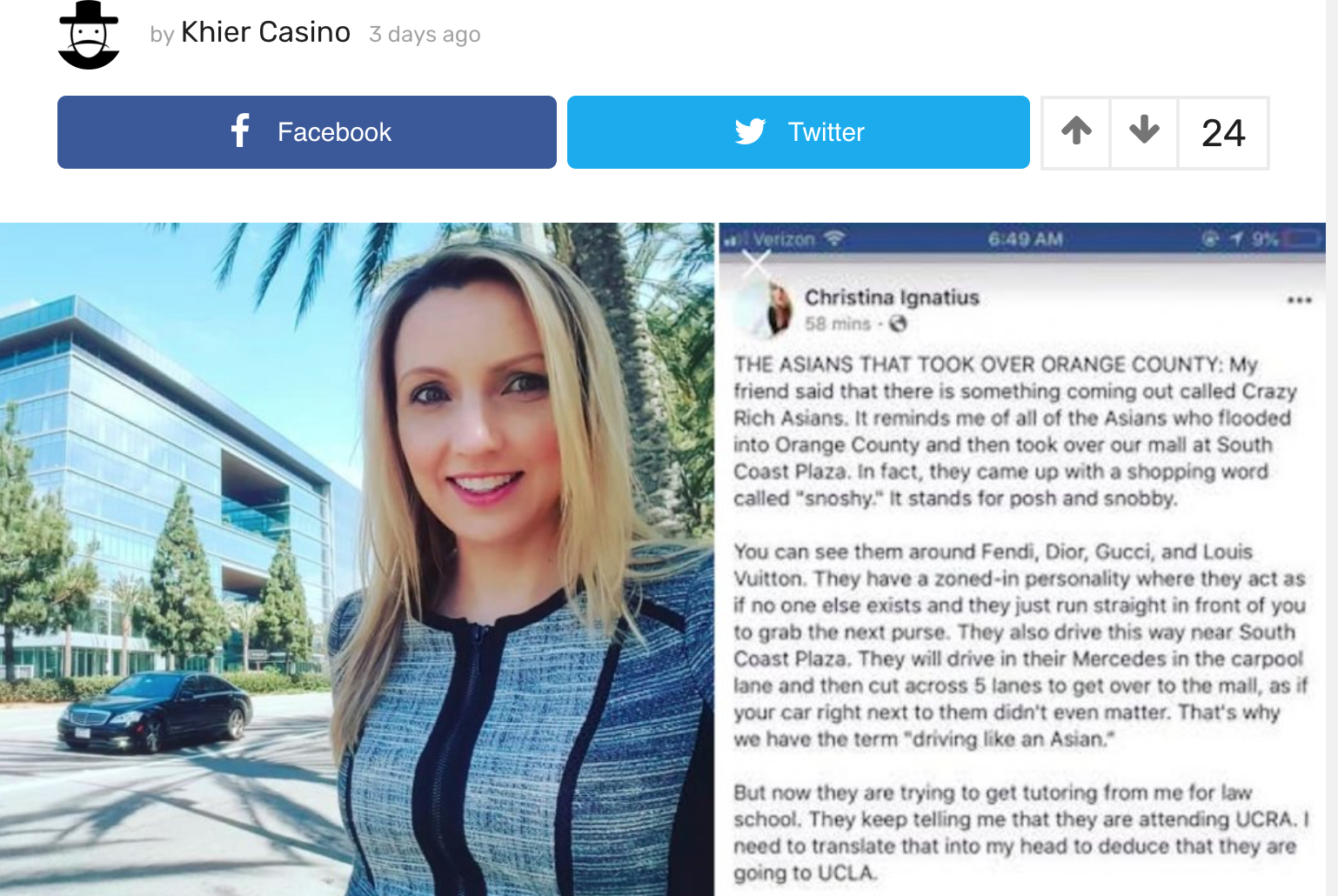
People Acting Stupid: Lawyer mocks Orange County Asians and Asian Americans


A LAWYER in Southern California says she is receiving death threats for her social media post making fun of Asians.

Christina Ignatius posted racist comments about Asians in Orange County, Calif. and she's surprised at the reaction. Talk about being so privileged that she could not understand that what she wrote might be offensive.

"My friend said that there is something coming out called Crazy Rich Asians. It reminds me of all the Asians who flooded into Orange County and then took over our mall at South Coast Plaza," Ignatius wrote.


Ignatius said she "didn't have any intent of anger and hatred," when she posted the controversial comments so she isn't deserving of the resulting flack.

"If you have no malintent, you didn't do anything wrong," she told the paper. She said the post was "meant as a joke" for her Facebook friends, according to the Register.
Hmm, not even a hint of remorse or an apology.

In the now-deleted post, she continue talking about Asians: “They will drive in their Mercedes in the carpool lane and then cut across 5 lanes to get over to the mall, as if your car right next to them didn’t even matter. That’s why we have the term “‘driving like an Asian.’”

She went on to call Asians "rice rockets," who "flooded" the University of California-Irving, which she also attended.

One of the responses came from Susan Kang Schroeder, the Korean-born chief of staff for Orange County District Attorney Tony Rackauckas. She wrote a Facebook post of her own, denouncing Ignatius' post, according to the Register.

“I am saddened by your racist, insensitive and simply unacceptable post,” she wrote. “It’s hard to imagine that an attorney in Orange County would make such an ignorant post in 2018.”

Orange County is home to the third largest Asian American & Native Hawaiian and Pacific Islander (AA&NHPI) community in the United States comprising 21 percent of its 3-million residents, according to recent reports.

________________________________________________________________________________

Sunday, June 3, 2018

AAPI VOTE 2018: Republican and Democrats woo Asian American voters in California

Dr. Mai Tran, left, and Young Kim.

ASAM NEWS

AHEAD OF CALIFORNIA'S primary elections on Tuesday 
(June 5), both Republicans and Democrats are busy wooing Asian American voters — a fast-growing and increasingly vocal demographic that candidates believe is key to winning this year’s polls.

According to CNN, both parties expect Asian American voters to show up in larger numbers than usual. Political Data Inc. found that 26 percent of all absentee ballots were sent to Asian Americans. Likewise, Asian Americans today are not as politically silent as an old stereotype suggests. To date, 11 percent of early voters in the California primaries identify as Asian — a proportion that’s close to their electorate share.

The Asian American population in Orange County has also grown from 4 percent of residents in 1980 to 18 percent in 2010.

Tricia Nguyen, representing the Vietnamese community at a southern California panel hosted by Asian Americans Advancing Justice, said to NPR that by 2020, Asians could swing an election.

In an interview with CNN, Republican Young Kim said she spent last week canvassing around Fullerton. She’s vying for a congressional seat in southern California, representing neighborhoods where historically, Asian Americans have voted red. But in 2016, most of these votes went to Hillary Clinton.

Kim blamed the recent party-split on the topic of immigration.

“Whenever Republicans talk about immigration, people immediately think it is the part of anti-immigrant messaging. It’s not,” Kim said to CNN. She explained that Republicans want to support legal immigration, and only discourage those who immigrate without necessary visas.

Another key issue, especially among Korean American voters, are relations with North Korea and negotiations over the divided peninsula. President of the Korean American Federation Josh Kim, said that its driven his group’s approval of President Trump.

“We support him,” Kim said to NPR. “Because we believe in what he’s saying now.”

But what Kim shares with his liberal counterparts in their new voting bloc is distaste for Trump’s hard-line on immigration.

RELATED: The diversity of Orange County's Asian Americans
Some Democrats are hopeful this signals a new wave of Asian American voters swinging left given the current political climate. They are focusing outreach efforts on Korean American and Chinese American communities, in particular.

Dr. Mai Khanh Tran, a Democrat running to flip the seat that Kim’s also running for, said to CNN that she believes Asian Americans have already begun to skew blue.

“We really have seen a change in the way Asian Americans are thinking and the way they are going to be voting [in the last two years],” said Tran. “They do have concerns about the way immigrants are being vilified in general. Those of us who are of different color and a different culture, people look at us with the same eye, whether or not we are documented. And I think that is a negative affect that President Trump and his administration has put on our community.”

Other candidates are less optimistic.

“I am a Democrat, but I don’t see the Democratic party doing enough to reach out to Asian voters,” said Jay Chen to CNN, a Taiwanese American who ran for the seat in 2012 but lost to then-incumbent Royce.

“The danger for Democrats is assuming that because Asians rejected Trump for President, it makes them reliably Democratic voters,” Chen said. “Asians in this district are very non-partisan and tend to vote for the candidate, not the party. If the candidate doesn’t reach out, they will not earn that vote.”
_______________________________________________________________________________

Saturday, January 27, 2018

ORANGE COUNTY REPORT: AAPI are a lot more complicated than a simple stereotype

Westminster in Orange County, Calif. is home to Little Saigon.

IN 2016, the Asian population became the largest ethnic group in California's Orange County, according to the Census. In the last two decades, the huge influx of Asian and Pacific Islanders has dramatically changed the character of the region. 

The relatively sudden population boom the county's institutions largely remain ignorant of the disparities and differences between the various Asians ethnic groups. At the same time, Orange County experiences ongoing anti-Asian sentiment, discrimination, and segregation.

“Despite these numbers and the rapid growth of the AA&NHPI population, there is little research available that describes the distinct cultures and histories across ethnic groups, their social, political, and economic contributions to the county, or the needs of a population whose majority is immigrants and refugees,” said Dr. Linda Trinh Vo, study co-author and UC Irving School of Humanities professor of Asian American Studies. 

A new report, Transforming Orange County: Assets and Needs of Asian Americans & Native Hawaiians and Pacific Islanders, provides a deeper, more intimate look into the complexity of the AA&NHPI community that belies long-held stereotypes as the “model minority" or “perpetual foreigner.”


Orange County is home to the third largest Asian American & Native Hawaiian and Pacific Islander (AA&NHPI) community in the United States comprising 21 percent of its 3-million residents. The county serves as a microcosm of the major demographic shifts taking place across the nation, placing it squarely in the midst of the growing scrutiny on the family-based immigration system. 

From 2000 to 2010, the local Asian American population jumped 41 percent, and Native Hawaiians and Pacific Islanders increased by 17 percent, compared to the county’s 6 percent total population growth, making it the fastest-growing population. With 62 percent born outside of the country, AA&NHPIs are also the county’s largest community of recent immigrants.


“Our most important policy recommendation is the collection and reporting of disaggregated data in order to better understand the nuanced diversity of the AA&NHPI community, because aggregated data conceals disparities affecting specific ethnic groups, especially Southeast Asians and Native Hawaiians and Pacific Islanders," says Vo, one of the report's authors. "We hope this will improve understanding of the specific experiences of AA&NHPI communities and race relations more broadly in Orange County.”

 Through interviews with 20 key community leaders representing different ethnic groups and interests, the report examines the major needs and assets of the AA&NHPI population in six areas: building sustainable communities, economic development and disparities, K-12 and higher education, health care services, political participation and civic engagement, and civil rights advocacy.

“In each chapter, we share key policy recommendations that will further strengthen our community’s assets and better address needs to help promote equity and improve the quality of life for everyone in the county,” says Sylvia Kim, regional director of Advancing Justice-OC. “We hope this report can be a stepping stone for business owners, elected officials, educators, healthcare professionals, and policy makers, to enhance their understanding about the complexity of AA&NHPI communities.”

Additional policy recommendations include providing culturally and linguistically accessible outreach and counseling for each area addressed in the study, and continuing to strengthen AA&NHPI-serving community agencies, cross-ethnic coalitions and organizations that amplify the assets, needs and voices of AA&NHPI community members.

“The idea for this study began in 2016 when Sylvia Kim and I discussed the need for a baseline study of the Orange County AA&NHPI communities and their economic, social and health care needs,” said social sciences dean Bill Maurer.


A South Asian couple wed in Orange County.
Some other findings of the report:
  • Homeownership among Asian Americans (58%) and NHPI (46%) is overall lower than non-Hispanic Whites (67%).6 In such an expensive county as Orange County, this disparity in homeownership is masked by the focus on wealthier overseas Asian homebuyers.
  • In 2012, AA&NHPI businesses brought nearly $26 billion in revenue and over 100,000 jobs to the county. 
  • 12% of Asian Americans in Orange County live in poverty (below general poverty rate of 13%), certain ethnic groups, including Thai, Vietnamese, Korean, and Cambodian, have higher-than-average poverty rates. Countywide, poverty rates for Thai Americans (20%), Vietnamese Americans (16%), and NHPI (15%) are particularly high.
  • AA&NHPI could potentially represent up to 20% of Orange County voters but only currently comprise 14% of voters.
  • An estimated 52,000 undocumented immigrants in Orange County identify themselves as Asian.
__________________________________________________________________________________