Showing posts with label Anti-Asian Bias. Show all posts

Saturday, October 14, 2023

Study: More anti-Asian bias likely in Republican-dominated states


It sounds so simple, familiarity tends to breed tolerance. There's new evidence to suggest that people are less likely to harbor anti-Asian bias once they get to know Asian Americans, according to a new study 

Racial biases against Asian Americans vary significantly across US states, influenced by such factors as the number of people of Asian descent and political leanings, say researchers at New York University.

Republican-majority and swing states showed indications of greater stereotyping of Asian-born and Asian Americans, with White Americans more likely to see them as foreign, said the study. Such states with high implicit bias included West Virginia, Iowa, South Carolina, Ohio, and Wisconsin.

At the same time, states with older median ages and greater percentages of Asians were associated with the less explicit bias against Asians and Asian Americans. These included Hawaii, the District of Columbia, California, Nevada, and Texas, according to the study.

“Our study shows that experiences of Asians and Asian Americans are likely to significantly differ depending on their state of residence, with residents of some states expressing more biased views that Asian Americans are not as ‘American’ as whites,” says Nari Yoo, a PhD candidate in the NYU Silver School of Social Work, who led the data-driven research, newly published by the American Sociological Assocition (ASA) journal Socius. 

The study is titled "Mapping Anti-Asian Xenophobia: State-level Variation in Implicit and Explicit Bias against Asian Americans across the United States." Coauthors include Professor Harvey Nicholson Jr. of the University of Toronto-St. George Campus, Professor Doris Chang of NYU Silver, and Professor Sumi Okazaki of NYU Steinhardt.

Violent assaults and verbal abuse against Asian Americans climbed during the peak of the COVID pandemic, bringing heightened attention as well as research to the problem. In order to improve understanding of Asian Americans’ diverse experiences of racism, Yoo and her coauthors in this study looked at state-level variations in implicit and explicit bias, as well as macro-level factors, such as racial density, political climate, and socioeconomic conditions that have been shown to influence racial attitudes.

A study finds that Republican-majority and swing states showed indications of greater stereotyping of Asian-born and Asian Americans, with White Americans more likely to see them as foreign. Click here for more details.

The specific factors that can contribute to high levels of bias at the state level are not fully known. “In some cases, under certain conditions” the study read, “growing diversity may increase bias due to perceptions of threat and competition, which may be amplified through anti-immigrant sentiment.”

That finding is consistent with a previously documented link between higher bias levels and the percentage of foreign-born Asian adults within a given state. 

In terms of the higher implicit bias in Republican and swing states, Yoo explains, “While our study is exploratory, one possible explanation is that anti-Asian bias is connected to xenophobic racial attitudes held more strongly among the political right.
 
"In some states, due to residential patterns, people may have fewer opportunities to have meaningful intergroup interactions to learn about the experiences of racial and ethnic minorities,” Yoo continued.

“Mapping Anti-Asian Xenpphobia” was conducted as part of the NYU ABRA (Asian and Black Americans, Racism, and Allyship) project whose primary investigators are Professors Chang and Okazaki. The project is funded by NYU Silver’s Constance and Martin Silver Center on Data Science and Social Equity, where Nari is a predoctoral fellow.

 “These insights should guide future research and interventions to address biases effectively at the state level,” says Yoo.

EDITOR'S NOTE: For additional commentary, news and views from an AANHPI perspective, follow me at Threads.net/eduardodiok@DioknoEd on Twitter or at the  blog Views From the Edge.

Monday, June 7, 2021

High-ranking South Asian American in Biden administration recalls his journey to the White House


DALEEP SINGH


Growing up in the United States, many children of immigrant parents have to go to great lengths -- even enduring taunts and beatings -- just to "fit in."

Many peoples journeys have taken different paths to arrive at where we are today. The pandemic and growing anti-Asian sentiment resulting in physical attacks and verbal harassment and abuse has brought AAPI together and spurred a sense of activism rarely associated with the community. 

One of the ways to fight the twin viruses of COVID-19 and racism is to forge a unity that many would consider impossible in any place other than the United States. Immigrants coming from the many countries of Asia, overcoming age-old rivalries and scores of languages.

Some of us have been fighting racism most of their lives; some of us have been forcibly reminded to look in the mirror. But no matter when or how we come to the realize all that links us together, the important thing is that we're here ... now; joining protests and marches, walking with our elders, voting and running for office, standing up, speaking out and making our presence felt and most of all, remembering where we came from.

In the waning days of Asian American, Native Hawaiian & Pacific Islander Heritage Month, Daleep Singh, President Biden's Deputy National Security Advisor and one of several AAPI who advise and support the President, wrote the following oped.

By Daleep Singh
Deputy National Security Advisor

My story is the story of so many other Indian Americans. In search of a better life for their kids – and maybe a bit of adventure for themselves – my parents left India for America in the 1970s. I was born in Maryland, spent a few years in Chicago, and settled in North Carolina when I was about seven years old.

I’ve always described my childhood as a happy one. Surrounded by a loving family, I felt like I was part of something bigger than myself, and that my life meant something to those around me. I also felt enormous pride and gratitude in being an American – having the freedom to find and become my authentic self, and the opportunity to dream big, even if in my case these were mostly athletic delusions.

At a young age, I also knew that we were different. I remember on the first day we arrived in Raleigh, our apartment was filled with unopened boxes. But instead of unpacking, my parents grabbed the phone book, found three Indian-sounding last names, and invited them over for dinner. All of them arrived within hours and, from that point on, we probably shared at least one weekend meal within the Indian community until I went away for college.

As I got older, I began to understand how much these gatherings meant. Like anyone else, my parents wanted a space where their traditions and beliefs were accepted, and that hadn’t always been their experience. When he first moved to the U.S., my dad – a turbaned Sikh – was told by his boss: if he wanted to keep his job, he’d need to fit in better. So that’s what my dad did – he sacrificed part of his identity to provide for his family. 

Meanwhile, my mom worked for the Raleigh city government, and I’ll never forget her coming home in tears after her boss openly bragged that he was a member of the KKK. He made sure to remind her of that throughout her years of dedicated but painful service in Raleigh city government.
____________________________________________________________
'I made a joke out of my family’s background to deal with my own insecurity about being different'. 
____________________________________________________________

I also wanted to feel accepted, but for that to happen as a kid it sometimes involved compromises that I now regret. I remember feeling dread in middle school whenever we’d have a substitute teacher, knowing they would butcher my name, and giving the whole class a good laugh at my expense. Sometimes I thought the solution was to just own it, so I’d speak during class with a thick Indian accent. When I think about that now, I’m ashamed. I made a joke out of my family’s background to deal with my own insecurity about being different.

Fast forwarding to the past few years, the rise in hateful attacks against Asian Americans and other communities of color made me realize that I was still carrying a lot of memories – painful ones – that felt heavier over the years. I’d almost forgotten the humiliation of getting beat up on the back of an elementary school bus for being the “dirty brown kid with smelly food,” or what it felt like to get told I couldn’t go on a date with someone in high school because I’m brown.


Much of the reason I’d been able to let these memories go was my deeply held belief that things were getting better when it came to race; that my kids would grow up in a different way. So I’ll admit, the slow progress and setbacks left me angry at times. I suspect many in the Indian American community feel the same way: we’re tired of watching the past repeat itself, and we’re exhausted from being quiet.

But to make change, we first have to recognize that we can all do better, myself included. That means being real about my own privilege as an Indian American from a middle-class household. I’m not at risk of being stopped and frisked. My wife and I don’t have to teach our kids how to survive if they get pulled over by the police. For those of us who’ve faced prejudice, we also need to check own our bias, and see our own privileges, if we’re going to do better.

It also means we need to speak out and do our part if we’re going to be seen as 100%, full-fledged, just-like-you citizens. As an Asian American, I’m deeply humbled and honored to have the privilege of serving in President Biden’s administration at a defining moment in our country’s history, while being a part of the most diverse administration ever assembled. My experience serving our country bears no resemblance to my mom’s days in Raleigh city government, but her experience back then, and recent violence toward Asian Americans, are a constant reminder to me about the responsibility I have of representing and standing up for the AAPI community every day in this job.

My role at the White House is to help create a self-reinforcing dynamic between domestic renewal, American leadership abroad, and national security. Part of domestic renewal has to do with economics: creating sustained and inclusive growth in jobs and wages, boosting the resilience of our critical supply chains, and strengthening our innovative edge. Another part of domestic renewal involves healing the wounds of racial injustice and coming together as a society to deliver on American’s unmatched promise. I don’t have direct policy responsibility in this area, but it’s central to what President Biden is trying to deliver, and a big reason why I’m here.

As a final thought, I want to use this platform to send love and support to my sisters and brothers in the Sikh community who have been a particular target of harassment, racism, and violence in recent years. I stand with them today and always.

Sunday, July 19, 2020

Maryland governor claims Trump told him that South Koreans are 'terrible people'

Maryland Gov. Larry Hogan and his wife Yumi Hogan, who was born in South Korea.

ASAM NEWS

Larry Hogan, the Republican governor of Maryland, wrote in a Washington Post op-ed that Donald Trump disparaged South Koreans in front of his South Korean-born wife.
While addressing how Trump did not help governors secure COVID-19 testing kits, Hogan shared how Trump also openly insulted South Koreans in a private dinner sponsored by the Republicans Governors Association.

Hogan recalled Trump condemning his relations with South Korean President Moon Jae-in during a private dinner held in February.

In the editorial dubbed "Fighting Alone" published on Thursday, Hogan said, “I don’t remember him (Trump) mentioning the virus, but he talked about how much he respected President Xi Jiping of China; how much he liked playing golf with his buddy ‘Shinzo,’ Prime Minister Abe of Japan; how well he got along with North Korean dictator Kim Jong Un.”

“Then, the jarring part …Trump said he really didn’t like dealing with President Moon from South Korea. The South Koreans were ‘terrible people,’ he said, and he didn’t know why the United States had been protecting them all these years. ‘They don’t pay us,’ Trump complained.”

According to the Korea Herald, Trump was referring to the 28,500 American troops dispatched in South Korea to contain North Korea’s military threat.

Hogan said Trump’s remarks were made in front of his South Korean born wife Yumi.

“Yumi was sitting there as the President hurled insults at her birthplace,” Hogan noted. “I could tell she was hurt and upset.”

This is not the first time Trump allegedly expressed dissatisfaction towards relations with South Korea.

Korea’s Joongang Daily reported Bob Woodward recounted in his 2018 book, Fear: Trump in the White House, that the US President did not have the best ties with Moon Jae-In. Woodward said Trump frequently criticized the trade deficit between the US and South Korea.

Former US national security advisor John Bolton also shared in his memoir, The Room Where it Happened, that “Trump wanted Moon nowhere around” for a meeting with North Korean leader Kim Jung-un at the demilitarized zone on June 30, 2019.

Hogan’s article came amid Trump’s strike against the governor’s efforts to secure coronavirus test kits from South Korea.

With the help of his South Korean wife Yumi, Hogan received 500,000 test kits from South Korea in April. According to Joongang Daily, Hogan credited his wife as a “special ally” that assisted in making a phone call to the South Korean ambassador to the U.S., Lee Soo-hyuck on March 28th.

The Hogans’ successful procurement of coronavirus test kits came after Trump declared each state should be responsible for their own COVID-19 testing, according to Independent.

“That request set in motion what we called Operation Enduring Friendship, 22 days of vetting, testing and negotiating an unprecedented set of protocols. Our scientists and doctors spoke to their scientists and doctors,” Hogan wrote in his anecdote. “Eight Maryland government agencies got involved, as did their counterparts in Korea. It took dozens and dozens of phone calls, night after night — sometimes it seemed like all night — working through language barriers and a 13-hour time difference.”

Hogan said he initially expected Trump to applaud the state’s efforts and was shocked when Trump publicly condemned the governor’s actions.

Hogan recollected how Trump complained, “The governor from Maryland didn’t really understand (about testing). The governor of Maryland could’ve called Mike Pence, could’ve saved a lot of money… I don’t think he needed to go to South Korea. I think he needed to get a little knowledge.”

Hogan explained how he had no choice but to reach out to South Korea. “So many nationwide actions could have been taken in those early days but weren’t. While other countries were racing ahead with well-coordinated testing regimes, the Trump administration bungled the effort,” Hogan stressed. “The test used by the federal Centers for Disease Control and Prevention early on was fraught with inaccuracies, and onerous regulations hindered the nation’s private labs. The resulting disorganization would delay mass testing for almost two months and leave the nation largely in the dark as the epidemic spread.”

Thursday, July 2, 2020

Asian Americans and Blacks are likely to feel sting of coronavirus bias


By Louis Chan

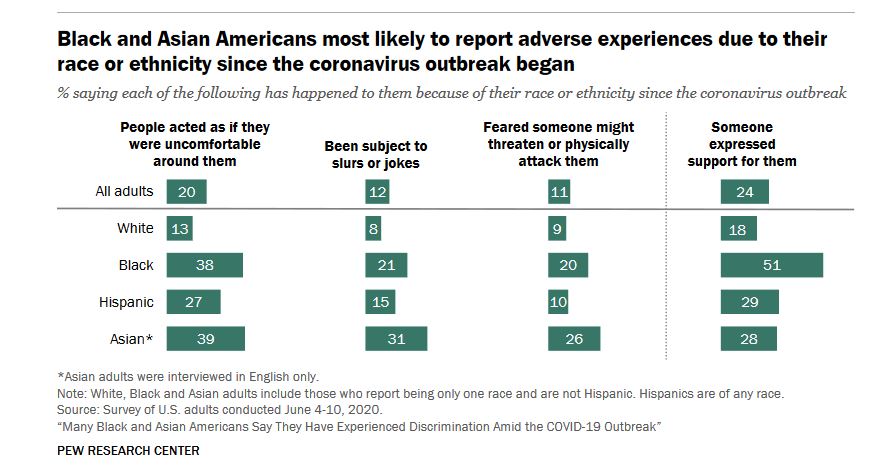
A new survey from the PEW Research Center released June 30 found Asian Americans and Blacks, more than other groups, are likely to feel discriminated against due to the coronavirus pandemic.

Roughly four in ten Blacks and Asian Americans say others have acted uncomfortable around them due to their race or ethnicity.

A third of Asians, 31%  and a fifth of Blacks, 21%, say they’ve been the target of slurs or jokes, particularly for Asians since the outbreak of COVID-19.

A quarter of Asians,
26%, say they fear someone might threaten or physically attack them. 20% of Blacks feel the same way.
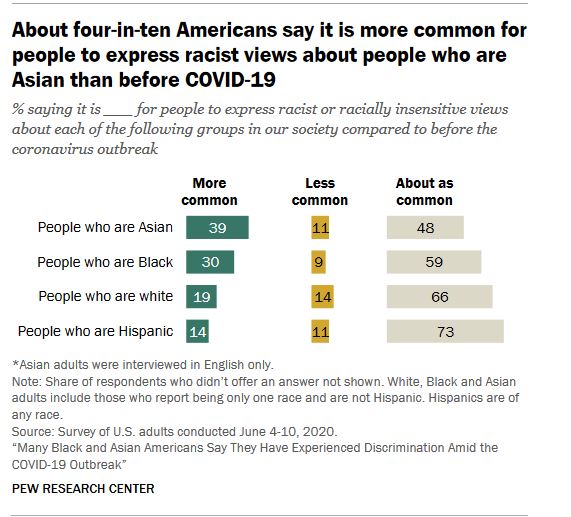
“They may be drawing on their own experiences or those of people they know when they say it’s become more common for people to express racist views toward Asian Americans,” said Dr. Neil Ruiz of the Pew Research Center and co-author of the report.PEW Research Center Graphic

Ruiz told AsAmNews that masks worn by individuals that are meant to protect others from the pandemic have made some Asian and Blacks feel like targets.

“There is currently a debate about mask wearing in America,” Ruiz said. “Our study shows that sizeable shares of Black and Asian adults say they worry other people might be suspicious of them if they wear a mask in public. About four-in-ten Black Americans (42%) and 36% of Asian Americans say they worry a great deal or a fair amount that other people might be suspicious of them because of their race or ethnicity if they wear a mask or face covering when in stores or other businesses.”

A majority of Asian Americans, 58%, say people expressing racist or insensitive views towards them is more common now than before the pandemic.


The survey of 9654 people has a plus or minus error rate of 1.6 percentage points with the error rate of Blacks at 5.3 percentage point and that of Asians at 8.2 percentage points. 278 Asians were surveyed for this report, along with 737 Blacks, 1645 Hispanics and 6602 White.

Juliana Horowitz and Christine Tamir co-authored this report.

Sunday, June 21, 2020

Sunday Read: Attacks against Asian Americans continue to rise, near 2000 incidents, says report


As of mid-May the number of attacks, harassment and abuse aimed at Asian Americans is approaching 2000 in the two months since a record of those incidents started being tracked.

While most of the incidents appear to be random spontaneous acts of hate, a few. of them, including the stabbing attacks against a Burmese American father and his two young children, were premeditated.
EXAMPLE #1: 
In multiple incidents, an elderly woman spitting out racial slurs at Asian Americans in a park in Torrance, Calif. resulted in a counterdemonstration when scores of AAPI made an appearance at the park to exercise.
Police identified the woman as Lena Hernandez, 56, last week and spoke to her Wednesday, but no arrests were made despite the videos of her tirades were viewed over a million times resulting in a public outcry.
"Based on the fact all three incidents are misdemeanor crimes and did not occur in the presence of an officer, Hernandez was not arrested at the time of the interview," police said. "The details of the interview will be submitted to the City of Torrance Prosecutors office."
Maintaining social distancing, scores of AAPI went to the Torrance Park to exercise.

Stop AAPI Hate, the leading aggregator of incidents against Asian Americans during the pandemic, has compiled a new report examining the rise in hate incidents against Asian Americans and the anti-Chinese rhetoric by political leaders. 


“We have seen time and again how dangerous it is when leaders scapegoat for political gain and use inflammatory rhetoric to stir up both interpersonal violence and racist policies. As we’ve seen throughout American history — from the Chinese Exclusion Act of 1882 to Japanese American wartime incarceration and most recently, immigration bans—Asians have been targeted with such vehement hate.” said Dr. Russell Jeung, chair of Asian American Studies at San Francisco State University. 

Last week, Stop AAPI Hate reported that as of May 13, incidents of anti-Asian American discrimination documented across the U.S. approached 1,900 since the start of the coronavirus pandemic. Of those incidents, approximately 502 incidents specifically mentioned the terms “China” or “Chinese” during the incidents of discrimination. 

According to the report, it appears that there was a spike of incidents reported to the website after Donald Trump, after a respite of several weeks, has returned to using the incorrect term, “Chinese Virus” when referring to Covid-19 inflaming his followers.

Last Saturday at a rally in Tulsa, Oklahoma, Trump revived the term along with "Kung-Flu," is his speech in front of his cheering supporters.

There are a number of variables that could explain this correlation; nonetheless, Stop AAPI Hate contends that Trump's and the GOP’s anti-Chinese rhetoric have entrenched racism and xenophobia in the public’s perception of the coronavirus pandemic.
EXAMPLE #2: 
A man painting "Black Lives Matter" on his front retaining wall in San Francisco was approached by a white couple jogging by assumed that the Filipino American was  defacing someone else's hose in the upscale neighborhood. 
As it turns out, the man has been living at the address for 18 years, videotaped the "polite racism." Police responded to the white couple's 911 call and recognized the Filipino American as the legal resident, waved and left without any further incident.

Although the white couple later apologized after the video went viral.
A white woman cals 911 against a Filiipino American resident in a posh San Francisco neighborhood.

Recent news reports have drawn the conclusion that Trump and other political leaders are stirring up anti-Chinese sentiment as a means to distract from both their handling of the coronavirus pandemic and the nationwide protests against deeply entrenched racism and violence against Black Americans in law enforcement. 

“We condemn the racist, inciteful and violent rhetoric coming from the president and political leaders at the very top, who racialize tragedies to score political points and distract from their own mishandling of the pandemic," said Cynthia Choi, Co-Executive Director, Chinese for Affirmative Action.  

"This rhetoric continues to devastate and harm communities of color in America.” 

In turn, the president is currently pouring money into campaign ads against China. On April 17, the GOP sent a memo to campaigns stating that: 
  1. China caused the virus by covering it up, 
  2. Democrats are “soft on China”, and 
  3. Republicans will push for sanctions on China for its role in spreading the virus. 
Other government leaders are picking up Trump’s racist language—Secretary of State Mike Pompeo, House Minority Leader Kevin McCarthy (R-Calif.) and Rep. Paul A. Gosar (R-Ariz.) have used similar language. 

Senator Martha McSally, up for re-election, recently said, “China is to blame for this pandemic and the death of thousands of Americans.” 

Most significantly, last month the president introduced a ban limiting Chinese students in the United States, raising concerns from a number of Asian American leaders. 

In its report on the 502 incidents of discrimination and harassment with a clear link to anti-Chinese sentiment, Stop AAPI Hate noted that the following trends emerged: 
  • Virulent animosity towards Chinese, with 37.5% of these cases laced with profanity and verbal taunts 
  • Scapegoating of China for the spread of Covid-19, with 31.7% of the perpetrators blaming China or Chinese people as the source of the disease 
  • Anti-immigrant nationalism of the assailants as they demand that Asian Americans “go back to China” or view China as the enemy (20.3%) 
  • Parroting of the term, “Chinese virus” to imply the implicit association between Covid-19 and China (17.5%) 
  • Orientalist and racist depictions of China and Chinese people as dirty, diseased, and holding strange dietary habits (12.6%) 
Trump "continues to utilize white supremacist and nationalist views as a means of scapegoating his failures for political gain," said Manjusha P. Kulkarni, Executive Director of Asian Pacific Policy and Planning Council. 

"Unless we hold him accountable, the discrimination and harassment against Asian Americans will become deeply entrenched, cause unimaginable harm and suffering, and take decades to unwind.” 

Monday, May 25, 2020

Woman arrested for posting anti-Asian flyers

A woman was posting this flyer in her San Leandro, California neighborhood.

ASAM NEWS


Police in San Leandro near San Francisco arrested a woman accused of posting racist letters on doors and other public places, reported the San Francisco Chronicle.
Authorities says the woman they identify as Nancy Arechiga, 52, posted the letters on at least five homes.

One of the letters read “Because we consider you’re (sic) a stranger, one bad person for this country, leave, go far away, go back to your country…in this place no Asian (sic) allowed.”

Images of a woman posting the letters and the letters themselves have been shared on social media.

CBS5 reports Arechiga has been booked into Santa Rita Jail in Dublin, but was released due to emergency overcrowding and safe distancing measures being taken due to the coronavirus.

One San Leandro resident whose brother found one of the letters expressed outrage.

“It was shocking and the whole family was really shaken up at it. I can’t comprehend hatefulness reading this letter send chills down my spine.” says Trihn to ABC7, who asked that her full name not be used.

Asian Americans make up 35% of the citiy's population of 85,000.

“San Leandro is a community of beautifully diverse people, who share a common desire to live in harmony and free from intimidation,” San Leandro police Lt. Isaac Benabou said in a statement. “We welcome people’s rights to express themselves but not in a manner that infringes upon a community’s sense of security and well-being.”

San Leandro Mayor Pauline Cutter also released a statement on Facebook saying “The City of San Leandro is committed to being a welcoming place for everyone. There is no place for hate in our community.”

Saturday, May 9, 2020

Senators asks DOJ to investigate coronavirus-related hate crimes against AAPI

From left, US Senators Kamala Harris, Mazie Hirono and Tammy Duckworth.

ASAM NEWS

Senators Tammy Duckworth,  Mazie K. Hirono and Kamala Harris, the Senate's three Asian American members, joined 13 other Democrat senators in calling upon the US Department of Justice to take more “concrete steps” in combating the rising number of hate crimes against Asian Americans and Pacific Islanders during the COVID-19 pandemic.

In a letter addressed to Assistant Attorney General Eric S. Dreiband, the senators expressed their “deep concern” about the surge in discrimination directed against AAPIs and urged the Civil Rights Division of the DOJ to take more active measures in responding to the rise in racism and xenophobia,
 reports WHSV

“We write to express our deep concern about the surge in discrimination and hate crimes against Asian Americans and Pacific Islanders (AAPIs) related to the COVID-19 pandemic and the currently inadequate federal response to address these racist and xenophobic attacks, a sharp break from the efforts of past administrations, Republican and Democratic alike,” reads the letter. “We strongly urge you to take concrete steps to address the disturbing increase in anti-Asian discrimination, as the Civil Rights Division of the Department of Justice (DOJ) has done in the past.”

According to the Center for Public Integrity(CPI), “Neither the Justice Department nor the Centers for Disease Control and Prevention have announced efforts to prevent the public targeting of Asians, which ranges from bias incidents to hate crimes. Both agencies were quick to act in similar situations: the CDC during the 2003 severe acute respiratory syndrome outbreak and the Justice Department after the 9/11 terrorist attacks.”

Assistant Attorney General Eric S. Dreiband reportedly assured that the Justice Department will prosecute hate crimes against AAPIs and others to the “fullest extent of the law”, but has yet to propose a plan to counteract the rise in racism, details CPI.

“I haven’t seen anything,” Stewart Kwoh, founder of Asian Americans Advancing Justice – Los Angeles told CPI. “We haven’t heard anything from … any of the federal agencies that they will be of assistance in tackling the problem. … If they really are serious about it, they are going to have to have a major outreach campaign.”

Acknowledging the warnings of public health experts that the use of stigmatized language risks fueling anti-Asian sentiment, the senators criticized Donald Trump and his administration’s referral to COVID-19 as the “Chinese Virus,” “Wuhan Virus,” as well as the “Kung Flu”.

The senators further emphasized the contributions of AAPIs in fighting against COVID-19 and the need to ensure that the rights of all Americans are protected.

“There are more than 20 million Americans of Asian descent, and 2 million AAPI individuals are working on the front lines of the COVID-19 pandemic, as health care workers, law enforcement agents, first responders, and other essential service providers,” the letter continues. “It is critical that the Civil Rights Division ensure that the civil and constitutional rights of all Americans are protected during this pandemic.”

Discussing the rise in Asian hate crimes, the senators cited the stabbing of a Burmese American family -– a father and his two children ages 2 and 6 -– by a man who thought they were “Chinese and infecting people with the coronavirus,” according to KTSM.

Data collected by the Asian Pacific Policy and Planning Council was also sourced in the letter, which reported that the STOP AAPI HATE reporting center had received nearly 1,500 reports of coronavirus-related harassment and crimes against AAPI individuals across the country.

“Asian Americans are still facing racism and xenophobia related to the #COVID19 pandemic,” tweeted Illinois' Sen. Duckworth. “That’s one reason why @SenatorDurbin (Richard Durbin) and I joined @maziehirono in calling on @TheJusticeDept to take concrete steps to address the surge in hate crimes and discrimination against this community.”

The senators called upon the Civil Rights Division to implement the measures below immediately:
  • Develop and publicly release a plan that sets forth how the Civil Rights Division will address the increase in discrimination and hate crimes against AAPI individuals;
  • Designate a DOJ official responsible for coordinating (a) a review of discrimination and hate crimes related to COVID-19 and (b) an interagency response to this issue;
  • Provide monthly reports to Congress on the (a) number of incidents of discrimination and hate crimes related to COVID-19 received—disaggregated by race, ethnicity, and gender, and (b) status of related cases that are pending;
  • Conduct extensive outreach in partnership with community-based organizations and regularly meet with AAPI community leaders; and
  • Distribute materials explaining civil rights protections in diverse languages used by AAPI communities.
The letter concluded with a request that the “Civil Rights Division respond by May 15, 2020, to inform Congress what steps the Division has taken in response to the jump in anti-Asian discrimination and hate crimes since the COVID-19 outbreak began.”

The signatories are Sens. Warner, Mazie K. Hirono (D-HI), Cory Booker (D-NJ), Richard Blumenthal (D-CT), Kamala Harris (D-CA), Sheldon Whitehouse (D-RI), Ed Markey (D-MA), Kirsten Gillibrand (D-NY), Elizabeth Warren (D-MA), Chris Murphy (D-CT), Tammy Duckworth (D-IL), Jacky Rosen (D-NV), Amy Klobuchar (D-MN), Jack Reed (D-RI), Dianne Feinstein (D-CA), and Dick Durbin (D-IL).

Saturday, April 25, 2020

Anti-Asian hate attacks explode to 1500 in only a month

SCREENCAPTURE
San Francisco school nurse Kyle Navarro says a white man spit on him and called him a “gook” as he tried to
deliver prescriptions to a family shut in by the stay-at-home order.

In the month since civil rights organizations have been collecting the data, there have been almost 1500 incidents of attacks against Asians and Asian Americans related to the coronavirus pandemic.

“The volume of incident reports continues to be concerning. But, beyond the sheer numbers, we hear the impact of hate in the pain, humiliation, trepidation and fear in the voices of AAPIs today,” stated Manjusha Kulkarni, executive director of Asian Pacific Policy and Planning Council (A3PCON). 

Most of the victims were Chinese Americans, but almost every Asian ethnicity was victimized by bigots according to a report issued last week by the Asian Pacific Policy and Planning Council (A3PCON), Chinese for Affirmative Action (CAA) and the Asian American Studies Department at San Francisco State University who launched the STOP AAPI HATE website.


Much of the anti-Chinese and anti-Asian assaults were spurred by Donald Trump and senior members of his administration who -- when they belatedly began to realize the seriousness of the pandemic -- repeatedly referred to the coronavirus as the "Chinese virus."

Although he later stopped the practice and called on the public to stop blaming Asian Americans, the damage was done as bigots continued their attacks.

This report reviews 1,497 reports of coronavirus discrimination submitted on the website from March 19 - April 15, 2020. The following patterns emerged over the course of one month:
  • Incidents from California and New York constituted over 58% of all reports.
  • Civil rights violations involving workplace discrimination and being barred from businesses and transportation or refused service made up almost ten percent of all incident reports.
  • Forty-four percent of incidents took place at private businesses.
  • AAPI women were harassed 2.3 times more than AAPI men.
  • Nine percent of respondents were AAPI seniors (over the age of 60).
  • Reports came from 45 states across the nation and Washington DC.
  • Even as shelter-in-place policies were implemented across much of the country and AAPIs interacted less with others, the rate of acts of racism remains alarming.


“The data reveals three trends," said Russell Jeung, Ph.D., chair and professor of Asian American Studies at San Francisco State University. 

"First, the high number of hate incidents, especially assaults, reflects the impact of China-bashing by politicians. 

"Second, high proportions of vulnerable populations--children, youth, elderly and limited-English speaking communities -- are sadly impacted. 

"Finally, combining cases of workplace discrimination and being barred from businesses indicates that Asian Americans' civil rights are being violated,” Jeung concluded. 

The groups stressed that the data they’ve amassed is just “a snapshot of what AAPIs are experiencing on a daily basis,” Cynthia Choi, the co-executive director of CAA, said in a statement, adding that “we can expect the situation to worsen as the anti-China, anti-Chinese rhetoric becomes normalized.”

Saturday, April 18, 2020

Racists find a new way to harass AAPI students by 'Zoombombing'

SCREEN CAPTURE / ZOOM
A meeting of Filipino American students at San Diego State was interrupted by racist 'zoombombers.'

Damn those racists! They've found a new way to harass people of color.

Even when POC, like the Andres Bonifacio Samahan — a Filipinx cultural organization at San Diego State University  -- are minding their own business and keeping to themselves, racists want to interrupt, yell racial slurs and just make life a little more uncomfortable for POC. 

So-call "zoombombers" interrupted a virtual meeting of Filipino American students using the popular Zoom app by interrupting the online gathering, said Lana Bautista, chair of the campus group, to the Daily Aztec.

“It was so random to hear these voices that were so unfamiliar and they were being so disruptive and they all came in at the same time,” Bautista told the Daily Aztec. “I felt violated.”

For a few minutes last Friday (April 10), the unwanted crashers unleashed a torrent of profanities and racial slurs, that left the Filipino American students stunned.

“All of you have coronavirus, every single one of you — coronavirus, coronavirus,” yelled the disruptors.

“We sit silent not only to prevent any reaction but out of some mix of shock, anger, confusion, and maybe most of all fear, fear that we were being violated and degraded in our homes and I hope no one else experiences that,” club member Julian Natividad said to Balitang America.

Zoombombing, which is the term used to describe a new form of online harassment in which videoconferences are hijacked and attackers post hate speech and other offensive content, has become more common in recent weeks as the nation’s universities moved to online learning and meetings during the self-isolation rules mandated by the current coronavirus crisis.

Zoombombers crashed an AP high school class on Wednesday (April 15), at Newton South High School in Massachusetts.

In his second week of remote learning, senior Sam Qian joined a Zoom meeting, ready to learn in his advanced placement Chinese class.  

Instead, he, his classmates and teacher Lanlan Chen were subjected to what Qian described as “five minutes of pure hatred and disgust.” 
Around 30 intruders joined the meeting and began shouting, all while images with phrases including “corona” and “China” took over students’ screens.
“All we could hear was just racial slurs and derogatory remarks and hundreds of comments about coronavirus,” senior Joshua Liu told WDHD.
Both incidents were reported to school authorities. In the Newton case, the incident was reported to the police.

The San Diego student club, named after a leader of the Philippine War of Independence,  issued a statement after the incident that marred their meeting:
“We will press on, AB Samahan will not be let down because we will not be put down. We will not have our experiences invalidated by people who do not even look like us. We will not stand for it. We will not let the anti-Asianness in the United States go unnoticed any more. We will no longer be the silent majority.”
“What I want people to take away from this experience is that we shouldn’t disregard small comments,” Bautista told Balitang America. “We shouldn’t let microaggressions pass. If we see something wrong we should deal with it on the spot and make sure people realize what effect their actions have.”
ASAM NEWS contributed to this article.

Friday, April 3, 2020

Three Asian American US senators to introduce resolution condemning bias vs. AAPI

From left: Senators Kamala Harris, Mazie Hirono and Tammy Duckworth.

All three Asian Americans in the US Senate intend to introduce a resolution condemning the rising attacks against AAPI and Asian immigrants by bigots who blame them for the coronavirus.

US Senators Kamala D. Harris, D-CA, Tammy Duckworth, D-IL, and Mazie Hirono, D-HI, announced their plan Thursday.

“There have been disturbing reports of increased profiling, intimidation, or hate towards Asian-Americans and Asian immigrants during the COVID-19 crisis – this is inexcusable,” said Harris. “Let’s be clear: COVID-19 does not target any group by race or ethnicity. We must condemn any instance of racism or discrimination, wherever it exists.”

Recent reports show anti-Asian sentiment has increased since the COVID-19 crisis began. According to an FBI intelligence report, hate crimes against Asian American & Pacific Islander (AAPI) communities are likely to surge as COVID-19 continues to spread. 

Representative Grace Meng, D-NY, introduced the companion resolution in the House last week.

“After Donald Trump’s inappropriate and racist efforts to ‘rebrand’ this disease, we continue to see a spike in rhetoric and actions against the Asian American community because of misguided fears surrounding the COVID-19 outbreak,” said Duckworth. 


“We must continue to speak out against these racist acts and those who are stoking these fears about a virus that we know strikes without regard to the color of a person’s skin or the language they speak. I’m proud to be introducing this important resolution with Senator Harris, Senator Hirono and Representative Meng.”

“Inflammatory and racist rhetoric from officials at the highest level of our government has contributed to a disturbing rise in hate-crimes targeting Asian Americans,” said Hirono. “Calling COVID-19 the ‘Wuhan virus’, ‘Kung flu’, or ‘Chinese virus’ isn’t clever or funny, it’s wrong and deeply harmful. This resolution sends a clear message of solidarity that stoking racial divisions will only impede our efforts to overcome the immense challenges that this virus poses to our country.”

“Asian Americans, like millions of others across the nation, are fighting on the frontlines against the COVID-19 pandemic. They also share in the extreme concern for their health and economic security," said Meng. "Yet, so many Asian Americans are also living in fear and terror following the dramatic increase of threats and attacks against those of Asian descent. 


"Since the beginning of this public health crisis, I have called on our nation’s leaders, such as our President, to cease using terms like ‘Chinese virus,’ ‘Wuhan virus,’ and ‘Kung-flu.’ Such language is reckless and downright disgusting,” she said.

“I was grateful to be joined by over 120 of my colleagues in the House of Representatives in introducing H.Res.908 to highlight this incessant and harmful rhetoric, and denounce those who would take advantage of this tumultuous time to slander and abuse the Asian American community," Meng continued.

"COVID-19 distinguishes neither race, ethnicity, class, nor any aspect of one’s background. It’s imperative that we all have the singular focus to prioritize the public safety and health of each and every person."

The resolution is endorsed by Japanese American Citizens League (JACL), National Council of Asian Pacific Americans (NCAPA), Anti-Defamation League (ADL), Association of Asian Pacific Community Health Organizations (AAPCHO), Muslim Advocates, Oxfam, National Asian Pacific American Bar Association (NAPABA), Asian Americans Advancing Justice (AAJC), Asian & Pacific Islander American Health Forum (APIAHF), and National Asian Pacific American Women’s Forum (NAPAWF).

Full text of the resolution can be found here.

Sunday, March 22, 2020

'White privilege' prevents Trump from seeing the racism in his use of 'China virus'

A closeup of Donald  Trump's speaking points.
ASAM NEWS

On Thursday, a Washington Post photographer captured an image of President Trump’s notes that shows the word ‘Corona’ crossed out and replaced with ‘Chinese’ in a description of COVID-19.

According to NBC, this edit appears to have been made in Sharpie in the president’s own handwriting.

This comes after the president told reporters on Wednesday that his consistent linking of COVID-19 to China is “not at all” racist.

Several Asian American nonprofits launched websites this week to monitor and report hate crimes and acts of discrimination against Asian people surrounding the coronavirus.

The World Health Organization has cautioned since 2015 against the use of geographic locations, species names or cultural terms in naming diseases.

“Viruses know no borders and they don’t care about your ethnicity or the color of your skin or how much money you have in the bank,” Dr. Mike Ryan, executive director of the WHO health emergencies program, told CNN. “It’s really important that we be careful in the language we use.”


Dr. Sam Louie writes in Psychology Today that Trump's defensiveness for using the racist term is a result of white privilege in that he is incapable of seeing the term from the view of those who are offended.

"Trump’s defense is his belief that 'It’s not racist.' It may not be racist in the conventional sense of burning a cross on the lawn of a Black homeowner or yelling racist epithets at people, but it’s still racist in the sense that indirectly reminds Chinese and other ethnic minorities that the White majority gets to decide what is or isn’t racist.," writes Loue,  a psychotherapist in private practice specializing in addictions, Asian American issues and Christian counseling.

"The comment itself comes from Trump, who comes from a race that can make that blanket decision based on institutional power, privilege, and protection," continues Louie.

"While level-headed White Americans may ignore Trump’s comments, what’s often lost in these discussions about individual acts of racism are the pernicious and invisible systemic and institutional powers that continue to promote, disseminate, and keep White Americans in a place of racial leverage against their fellow ethnic Americans," Louie concludes.

Saturday, March 21, 2020

California governor ends his presser by calling out racism, brings up The Chinese Exclusion Act...

SCREEN CAPTURE / MSNBC
California Gov. Gavin Newsom acknowledged the growing attacks against Asian Americans.

California's Gov. Gavin Newsom ended his dramatic Thursday press conference announcing a statewide order for residents to stay at home in an attempt to fight the spread of COVID-19, with an acknowledgement of the growing number of attacks on Asian Americans.

He said that he came from an area in the statewhere "anti-Chinese bigotry led to the Chinese Exclusion Act, a black eye in the history of the United States of America...

"One thing I also want to express: The deep, deep recognition of the xenophobia, racism being perpetuated against Asians in our state. We've seen a huge increase of people assaulting people on the basis of where they were born and how they look. 

"We're better than that. We're watching (for) that and we're going to enforce that more aggressively. I hope that people put down their bigotry, their bias. In a state where 27% of us are foreign born, a state that is truly universal, the most diverse state, the world's most diverse democracy, that in order to meet this moment, we have to recognize our common humanity."

His remarks concluded an announcement urging everyone in the state of 40 million people to stay at home. If nothing were to be done, Newsom predicted that in a worst case scenario, 56% of the state, or about 25 million people, will contract the virus.

Newsom hopes the strategy will slow down the exponentially increasing rate of the virus' spread. "We want to flatten the curve," he said.


In a follow-up announcement Friday, the governor announced the purchase of two hospitals that were having financial difficulty, including Seton Medical Center that was scheduled to go into bankruptcy within weeks. Seton is the largest employer and major medical facility in Daly City, a predominantly Asian American municipality.

The state's purchase of the two hospitals, including the recently shuttered St. Vincent Medical Center in Los Angeles County, would add about 700 beds for the expected surge of coronavirus patients. The state, said Newsom, is also looking into converting hotels and college dormitories into places where those with the virus could be placed in quarantine and monitored by medical professionals.

Also Friday, the state's lawmakers passed measures giving the state broad authority to spend up to $1 billion “for any purpose” so that California can implement the drastic measures in Newsom’s declaration of the coronavirus emergency.

Friday, March 6, 2020

CDC warns against the disease of anti-Asian attacks


I was walking down Broadway on a warm winter day in Oakland. Approaching was a woman and man with those surgical masks on. I thought it was strange that they were wearing ihe masks around the neck instead of covering the nose and mouth.

As we passed each other, they deliberately coughed.

A microagression? or was it a genuine case of itchy throat? I couldn't help but think of the timing -- just as they were passing me. Paranoia is growing because of the coronavirus.

Attacks -- minor, like mine to physical altercations are rising as the coronovirus or COVID-19, becomes more prevalent. Xenophobia against Asians is spreading even faster. It is as if the virus has given people permission to openly display their anti-Asian racism.

Business is drastically down at Chinese restaurants. Tourists are noticeably absent from Chinatown streets. From hard resentful glares from fellow commuters to a resurgence (it never went away) of the "Go-back-to-China," expletives, the fear of the virus and anti-Asian bias is on the rise.

My experience was minor compared to some of the stories around the country. It has gotten so bad that the US Centers for Disease Control, the same federal agency fighting the spread of the virus, felt compelled to issue a notice about anti-Asian acts and statements.

"At this time most people in the United States have little immediate risk of exposure to the virus that causes COVID-19. However, some people are worried about the disease," reads the notice. "Fear and anxiety can lead to social stigma towards Chinese or other Asian Americans. Stigma and discrimination can occur when people associate an infectious disease, such as COVID-19, with a population or nationality, even though not everyone in that population or from that region is specifically at risk for the disease (for example, Chinese Americans and other Asian Americans living in the United States).
"Stigma hurts everyone by creating more fear or anger towards ordinary people instead of the disease that is causing the problem. We can fight stigma and help not hurt others by providing social support. We can communicate the facts that being Chinese or Asian American does not increase the chance of getting or spreading COVID-19."

Stigmatized groups may be subjected to:

  • Social avoidance or rejection
  • Denials of healthcare, education, housing or employment
  • Physical violence.
"Stigma affects the emotional or mental health of stigmatized groups and the communities they live in. Stopping stigma is important to making communities and community members resilient," says the CDC.
The Asian American Journalists Association put out guidelines to editors and reporters to refrain from referring to the virus as the Chinese disease, or showing Asian people wearing facemasks.

"This is a global emergency that should be met with both urgency and also cultural awareness that COVID-19 is not isolated to a single ethnic population. Xenophobic attacks and discrimination towards Asian American communities are unacceptable and will not make our families safer or healthier,” said Jeffrey Caballero, executive director of Association of Asian Pacific Community Health Organizations (AAPCHO).The CDC has also issued additional guidelines to officials and communicators to:

  • Maintain privacy and confidentiality of those seeking healthcare and those who may be part of any contact investigation.
  • Quickly communicate the risk or lack of risk from associations with products, people, and places.
  • Raise awareness about COVID-19 without increasing fear.
  • Share accurate information about how the virus spreads.
  • Speak out against negative behaviors, including negative statements on social media about groups of people, or exclusion of people who pose no risk from regular activities.
  • Be cautious about the images that are shared. Make sure they do not reinforce stereotypes.
  • Engage with stigmatized groups in person and through media channels including news media and social media.
  • Thank healthcare workers and responders. People who have traveled to areas where the COVID-19 outbreak is happening to help have performed a valuable service to everyone by helping make sure this disease does not spread further.
  • Share the need for social support for people who have returned from China or are worried about friends or relatives in the affected region. 

“Many Asian Americans are just as concerned as everyone else about the coronavirus--even more so considering how in some cases, our extended families could be impacted," said Gregg Orton, National Council of Asian Pacific Americans (NCAPA). "But to let someone’s health status be a measure of how American they are is absurd. Mass hysteria will not help, and neither will bigotry.”