Showing posts with label #PacificIslander. Show all posts

Friday, November 25, 2016

'Moana' passes test of cultural authenticity

Polynesian Moana and her erstwhile companion, the demigod Maui.
EDITOR'S NOTE: Thanksgiving hangover. Thinking of taking the family to a movie? Here's an offering you should consider.


By Louis Chan
REPRINTED FROM ASAM NEWS


MY TWO 20-something children called Moana, which opened this Thanksgiving weekend, one of the best Disney movies ever.

That’s high praise from two kids who’s collection of animated Disney and Pixar movies is quite extensive. (can you still call two 20-somethings kids? Hell, yes, especially if they’re yours)

The Media Action Network of Asian Americans joined in that praise applauding Disney studios for hiring Pacific Islanders at multiple levels and reflecting accurately the values and culture of Pacific Islanders.

Moana is the gold standard for how movies should be made,” says MANAA board member Rakshak Sahni. “If you are making a film about Pacific Islanders, it is a given that you should hire Pacific Islanders both in front of and behind the camera. Yet in the past and present we have seen studios creating stories about Asians and Pacific Islanders, but hiring White writers and White actors to perform or voice the roles.”

Moana tells the story of a girl drawn to the ocean and who defies her father, the chief of the island village, when she goes beyond the reef to save her people.

According to the Disney Examiner, an independent online magazine devoted to Disney, directors John Musker and Ron Clements met up with prominent cultural advisors in the region and immersed themselves in the culture during visits to Fiji, Samoa, Tahiti, and New Zealand.

“The ocean is viewed as a living, breathing, powerful entity,” said Musker about what he learned. “There is immense respect and admiration for the ocean in this part of the world. We heard many times from the people we met during our trips to the Pacific Islands that the ocean doesn’t separate the islands, it connects them. Voyaging is real source of pride for the Pacific Islanders, a part of their identity. They were, and continue to be, some of the greatest explorers of all time. This wayfinding sense is not only quite sophisticated, it is miraculous.”

Members of MANAA had a chance to see an advanced screening of the movie. Some came away in tears.

“When many Pacific Islanders spoke up during a Q&A with ‘Moana’ producer Osnat Shurer, they were in tears,” said MANAA Vice President Miriam Nakamura-Quan. “They felt that Disney had somehow managed to combine three different cultures and values into one and present it accurately and authentically to a wider audience.”

According to MANAA co-founder Guy Aoki, there wasn’t a White person in the entire movie.

“Disney had confidence in their story that they didn’t have to compromise — as many filmmakers do — feeling they needed a White character for the audience to identify with,” he said. “We’re confident that children of all ages and backgrounds will identify with Moana.

Besides the lead voice roles of Dwayne "The Rock" Johnson and newcomer Auli’i Cravalho, the commitment of Disney to cultural sensitivity is impressive with all the Pacific Islander talent used in the movie.

Extra Hint: Watch the credits all the way to the end for an extra surprise scene.

Auli’i Cravalho as Moana

Dwayne “The Rock” Johnson as Maui

Nicole Scherzinger as Sina

Rachel House as Gramma Tala

Temuera Morrison as Chief Tui

###

Thursday, October 27, 2016

TGIF FEATURE: The Rock sings "You're Welcome" in "Moana"

Auliʻi Cravalho is the voice for the animated Moana.
DWAYNE, "THE ROCK" JOHNSON, a former professional wrestler and football player, is more than a muscle-bound, action movie star.

In the upcoming animated movie, Moana, he displays his singing talent. He sings "You're Welcome," a brand new song written for the movie by Lin-Manuel Miranda of Hamilton fame.
RELATED: First trailer for Moana
For centuries, the greatest sailors in the world masterfully navigated the vast Pacific, discovering the many islands of Oceania. But then, 3,000 years ago, their voyages stopped for a millennium – and no one knows exactly why. 


Moana is a sweeping, animated feature film about an adventurous teenager who is inspired to leave the safety and security of her island on a daring journey to save her people. Inexplicably drawn to the ocean, Moana (voice of Auliʻi Cravalho) convinces the mighty demigod Maui (voice of Johnson) to join her mission, and he reluctantly helps her become a way finder like her ancestors who sailed before her. 

Together, they voyage across the open ocean on an action-packed adventure, encountering enormous monsters and impossible odds, and along the way, Moana fulfills her quest and discovers the one thing she’s always sought: her own identity. 

In casting of the voices, Disney sought Pacific Islanders to play the main roles. The selection of Johnson, who is Samoan/American, was a no-brainer. He is the highest-paid movie star in Hollywood.

In open auditions, Disney found Cavalho, who is Hawaiian/American.

Moana” sails into U.S. theaters on Nov. 23.

Tuesday, August 16, 2016

Olympics: Pacific Islander weightlifter's dances bring attention to climat change's impact on his nation

YouTube
David Katoatau's crazy dancing has a deeper purpose.
By Louis Chan
Reprinted from AsAm News


DAVID KATOATAU of Kiribati placed 14th in the Olympic’s 105KG, but that’s not why people are talking about him.

The 5’7″ 231-pound Olympian is doing his best to raise awareness of both his country and climate change.

He has people talking with the way he exits the stage after his lifts.

Kirabati is an island nation in the Central Pacific. Most have never heard of it. Katoatau hopes his antics will bring more attention to his country and to the plight of climate change.

“I wrote an open letter to the world last year to tell people about all the homes lost to rising sea levels,” he told Reuters. I don’t know how many years it will be before it sinks. We don’t have the resources to save ourselves.”


Katoatau began his dancing crusade during the Commonwealth Games in Glasgow, Scotland two years ago. That was the first gold medal in any global sporting event for his tiny island nation of Kiribati, according to Reuters.

RELATED: 


His dancing as Kiribati's flag bearer at the Rio Games' opening ceremony made him a social media sensation.

Kiribati, located in the Central Pacific, is suffering "extreme coastal erosion not just of the beaches but also of the land" according to its government.

Some scientists have predicted a catastrophic effect on Kiribati's 21 inhabited islands, which has a population of about 100,000.

"Most people don't know where Kiribati is," Katoatau told Reuters. "I want people to know more about us so I use weightlifting, and my dancing, to show the world.

"I wrote an open letter to the world last year to tell people about all the homes lost to rising sea levels. I don't know how many years it will be before it sinks."

(Views from the Edge contributed to this report.)

Sunday, June 12, 2016

First trailer for Disney's 'Moana,' the first Polynesian priincess

Moana and the demi-god, Maui.
AS HOLLYWOOD gets dragged into the 21st century and kicking and screaming to the inevitable realization that casting diversity in motion pictures is good for business, it's a different story in the fantasy world of animation. Apparently, drawing characters of color is easier than casting actors of color.
The first trailer for Moana, Disney's latest animated movie, debuted today (June 12). It features the first Polynesian princess in Disney's universe of princesses.
In the latest addition to the Disney princess canon, Moana (Aul i'i Cravalho) sets sail for a fabled island. Joining her on the adventure is the demi-god Maui (Dwayne "The Rock" Johnson). 
The 'Moana' poster was released last week.
Funny, but while watching the trailer it looks like The Rock, who is part Samoan, put his all into his role. I have not heard him more animated (pun intended). The tats the animators drew on Maui look fantastic!
Johnson said the film is "visual and singing journey unlike anything you have ever seen before."

Notably, Lin-Manuel Miranda, the creator and star of the Broadway musical Hamilton, wrote some original music for the movie. His Hamilton co-star Phillipa Soo, who plays Hamilton's wife on stage, also stars in Moana in a still unnamed role.

RELATED: Hollywood grapples with whitewashing of Asian roles - AGAIN!
It is the first role for Aul i'i Carvalho, who is Hawaiian/American, and had to undergo a rigorous audition process to find an actress with a Pacific Islander heritage to play the princess. 

I imagine then, if Disney stays true to form in merchandising, that this Christmas, Pacific Islander parents will be buying Moana dolls that look like their daughters and temporary tattoos for their boys.
Moana joins an ever-growing list of Disney's princesses of color. After criticism arose that all the Disney princesses had been white, Disney began introducing a more diverse line of young female characters: Jasmine was the first Arab princess (1992), Pocahontas was the first Native American princess (1995), Mulan was the first Asian princess (1998), and Tiana was the first African-American princess (2009). This July, Disney will finally introduce its first Latina princess, Elena of Avalor.

It would be really good if Disney Studios, which makes moves under Lucas Films and and Marvel Studios among others, employs the same casting diversity for its real live actors that it does for its animated ones. 
"Moana" will be out in theaters on Nov. 23, 2016 in time for the holiday season. Watch the first trailer below:

###

Thursday, May 26, 2016

TGIF FEATURE: Hawaiian high school's unforgettable graduation goes viral - AGAIN!

                                                                                                                                          MoStreet Productions

KAHUKU HIGH and Intermediate School on the north shore of Oahu, Hawaii did it again. Their elaborate graduation performance has become a legendary tradition and the video of their graduation has gone viral, just like it did last year, and the year before that, and ...
RELATED: One of the coolest graduations you'll ever see
The school was founded in 1897 to serve the children of the sugar cane workers that worked the nearby fields. Today it has about 1500 students from 7th to 12th grades. You'll note from the video that Pacific Islanders make up of about 60 percent the school, almost double the average Hawaiian high school. 

On May 19, the 2016 graduating class of Kahuku High continued the tradition of grand graduation performances; this year throwing in a tribute to Prince, the Running Man, pop songs and concluding with a powerful haka, a traditional dance and chant from Polynesia that is performed on important occasions. 
RELATED: Hawaiian strips down for graduation
I don't know about your high school graduation but mine was nothing like theirs. I absolutely love their school spirit and their pride in their heritage. 

Congratulations to the Class of 2016!


The seniors of Kahuku High & Intermediate School continued the tradition of a graduation performance.
###
For more news about Asian/Americans & Pacific Islanders, read AsAm News.

Sunday, April 10, 2016

Three decades late, Olympian Greg Louganis finally gets on the iconic cereal box


When Greg Louganis was competing in the Olympics, he was virtually unbeatable.
EVEN AFTER winning all those Olympic gold medals in diving, perhaps one of the most significant honors bestowed on Greg Louganis will be having his image on a cereal box.

Louganis, arguably the best-ever competitive diver ever in the history of the sport, will be featured on the boxes of Wheaties, the Breakfast of Champions, General Mills announced April 4.

The belated honor comes decades after Louganis, a Samoan/American, was competing in his prime winning gold medals in the Olympics. He became the only man to sweep the Olympic diving events in back-to-back games when he won gold medals in both springboard and platform diving in the '84 and '88 Olympics.

Times change, gay athletes are
gaining acceptance
.
Three new sports icons will grace Wheaties cereal boxes, including Olympic diver Greg Louganis, an LGBT rights activist whom sparked a petitionwhich tens of thousands of people supported.

The General Mills breakfast cereal, known for featuring prominent athletes on its bright orange packaging, announced Monday that four-time gold medalist Greg Louganis will join swimmer Janet Evans and hurdler Edwin Moses on three separate boxes starting next month.

More than 43,000 people, inspired by an HBO documentary about the diver, had signed an online petition to get General Mills to belatedly feature the 56-year-old Louganis, who they say was overlooked for the honor at the height of his career.

Louganis, who came out as gay publicly in 1994 and revealed he was HIV-positive a year later, has said that homophobia likely blocked him from being featured on a Wheaties box after the 1984 and 1988 Summer Olympics, the New York Times reports.

“This means so much more than it would have back then,” he told the newspaper. “Getting it now means people will see me as a whole person — a flawed person who is gay, H.I.V.-positive, with all the other things I’ve been through.”

Greg Louganis today is an advocate and mentor for LBGTQ
athletes and issues.
He's now a role model for other athletes including British Olympic diver Tom Daley, who came out as gay when he was around 20 years old.
General Mills spokesman Mike Siemienas told NPR he couldn't provide an answer as to why Louganis wasn't on the box previously because no one who was involved in those decisions still worked at the company. Siemienas said a committee is responsible for determining which athletes are on the boxes.

Wheaties unveiled the "legends" cereal boxes after the documentary detailing Louganis' athletic career and experiences as a gay man sparked a petition on Change.org to get the diver on the iconic Wheaties cereal box. Created by Julie Sondgerath, who had never met Louganis, the petition garnered nearly 45,000 signatures.

"Back in '95, I wasn't expected to live very long because we thought of HIV-AIDS as a death sentence, so to be here today, now 56, the box means so much more to me than it would have then because I feel like I'm being embraced as a whole person, not just for my athletic achievements."

The cereal boxes will be in stores from May, Asian American & Pacific Islander Heritage Month, through at least the summer.

###
For more news about Asian/Americans & Pacific Islanders, read AsAm News.

Monday, March 21, 2016

The royal cloak and helmet given to Capt. Cook returns to Hawaii

The royal feathered cloak and returned to Hawaii on March 19.
TWO HISTORICAL artifacts came home to Hawaii after an absence of 237 years.

In a moving and emotional ceremony the feathered cape and helmet of Kalani'opu'u came home last weekend after being housed  in New Zealand for several years.

"The ʻahuʻula and mahiole left their homeland at the end of the season of Lono in 1779 and the memory they hold in their very fiber is that of a healthy, abundant, sovereign society," Mehanaokalā Hind, director of community engagement at the Office of Hawaiian Affairs and a lineal descendant of Kalani'ōpu'u, said in a statement. 

Kalani'ōpu'u was the chief of the island of Hawaii in 1779 when English explorer Capt. James Cook landed at Kealakekua Bay during the Makahiki festival. Cook was the first European to make contact with the Hawaiian people. In a gesture of good will, Kalani'ōpu'u gave the feathered cloak and helmet that he was wearing to Cook. 

“These priceless treasures have so much to tell us about our shared Pacific history. We are honored to be able to return them home, to reconnect them with their land and their people,” said Arapata Hakiwai, Kaihautu (Maori co-leader) of the National Museum of New Zealand Te Papa Tongarewa, where the artifacts have been on display since the early part of the 20th century. “Woven into these (treasures) is the story of our Pacific history, with all its beauty, challenges and complexity."

The exhibit at Bishop Museum will be called "He Nae Akea: Bound Together"


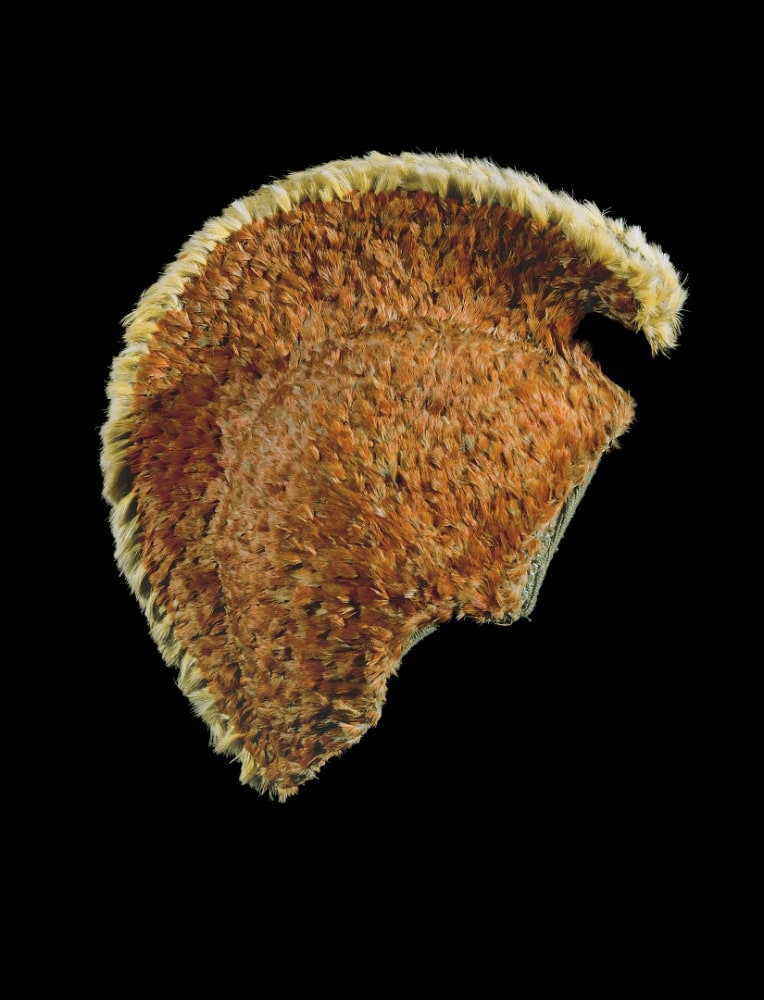
The mahiole (feathered helmet) of chief Kalani‘ōpu‘u. Michael Hall / Courtesy of Museum of New Zealand Te Papa Tongarew
10 things you need to know about the return of Kalani‘ōpu‘u’s ‘ahuʻula (feathered cloak) and mahiole (feathered helmet)

1. Kalani‘ōpu‘u was the chief of Hawai‘i Island whose regal line was traced to the great chief Līloa of Waipiʻo. In 1779, Kalani‘ōpu‘u greeted an English captain named James Cook after his ship made port in Kealakekua Bay. As a demonstration of his goodwill, Kalani‘ōpu‘u gifted the ‘ahu ʻula (feathered cloak) and mahiole (feathered helmet) he was wearing to Captain Cook.

2. According to expert scholar Adrienne Kaeppler’s publication Hawaiian Featherwork (2010), Kalani‘ōpu‘u’s cloak seemed to have started as a cape.  The design has two red triangles (huinakolu) at the neckline and a red crescent (hoaka) which formed a sacred, protective design; the resulting yellow triangles and a yellow strip at the bottom complete the original cape.  The use of so many yellow feathers demonstrates the political power of Kalani‘ōpu‘u.

3. This ‘ahu ‘ula in particular has feathers from about 20,000 birds. Skilled trappers caught the birds by employing various techniques such as snaring their prey midair with nets, or using decoy birds to lure them onto branches coated with a sticky substance. They often harvested only a few feathers from each bird before releasing them back into the wild so they could produce more feathers. Skilled workers belonging to the aliʻi class crafted the olonā cordage backing, a netting used as the foundation for the cloak, onto which the bundles of feathers were attached, creating bold designs.

4. After the ‘ahu ‘ula and mahiole left on Cook’s ship, both were taken to England and passed through the hands of various museum owners and collectors. They eventually came under the care of Lord St Oswald, who unexpectedly presented his entire collection in 1912 to the Dominion Museum in New Zealand, the predecessor of Te Papa Tongarewa. The cloak and helmet have been in the national collection ever since. 

5. In 2013, discussions began among Bishop Museum, Te Papa Tongarewa, and OHA to bring these treasures back to Hawai‘i.

6.The cloak has traveled to Hawai‘i twice without the mahiole: Mayday in 1960 and during the exhibition celebrating the 100 Anniversary of Captain Cook and his artificial Curiosities, Jan. 18 through July 31, 1978.  However, this is the first time in 237 years that both the cloak and helmet will be back home in Hawai‘i together.


Maori's turned the artifacts to the Hawaiians in New Zealand.

7. While Kalani‘ōpu‘u’s ‘ahuʻula and mahiole have been on quite an interesting journey, the return of both treasured objects is a very important event to many people of Hawai‘i because they will be staying in Hawai‘i to reconnect them with their land and their people.

8. From a historical perspective, the artifacts represent a period in the timeline of Hawai‘i when there was a balance between the cultural, political and spiritual parts of Native Hawaiians and the environment.

9. The exhibit space at Bernice Pauahi Bishop Museum will be called ‘He Nae Ākea: Bound Together.’ This reflects the connection of Kalani‘ōpu‘u to his land and people, the connection between the peoples, nations, and cultures throughout the centuries who have cared for these treasures, as well as the connection between the three institutions directly involved in this loan.

10. Last March 19 at the Bishop Museum, there was a celebration for the return of Kalani‘ōpu‘u’s ‘ahuʻula and mahiole - home at last.
###
For more news about Asian/Americans & Pacific Islanders, read AsAm News.

Wednesday, February 3, 2016

Supreme Court: Case submitted; last chance for U.S. citizenship for American Samoans

Leneuoti Tuaua is lead plaintiff in the case submitted to the U.S. Supreme Court.
ATTORNEYS representing a group of American Samoans seeking U.S. citizenship Monday (Feb. 1) asked the U.S. Supreme Court to hear their case.

The case, which if successful would recognize a constitutional right to citizenship for those born in the U.S. Pacific territory, was rejected last summer by a federal district court and appellate panel.

Tuaua v. United States is a federal lawsuit brought by Leneuoti Tuaua, the Samoan Federation of America, and others born in American Samoa who believe that so long as American Samoa is a part of the United States, people born in American Samoa have the birthright to U.S. citizenship under the Constitution.


“My passport says I am a U.S. national, but not a U.S. citizen. As someone born on U.S. soil who signed up for the draft during the Vietnam War, my family should not be treated as second-class Americans. I am hopeful that the Supreme Court will agree the Constitution does not allow Congress to create two separate classes of Americans,” said Leneuoti Tuaua, lead plaintiff in the case. 

Three of the five Tuaua plaintiffs are veterans; American Samoa has among the highest rates of U.S. military service in the nation, with casualty rates in Iraq and Afghanistan more than seven times the national average.

Plaintiffs are represented by Neil Weare, president of We the People Project, a national organization dedicated to achieving equal rights and representation for the nearly 5 million Americans living in U.S. territories and the District of Columbia; Arnold & Porter, LLP, an international law firm; and Charles V. Ala'ilima, a prominent American Samoan attorney.
Former Solicitor General Theodore B. Olson, who has a winning record of arguing before the U.S. Supreme Court, also represents them.

Under the 14th Amendment to the U.S. Constitution, anybody born within the United States is automatically considered an American citizen. However, courts have interpreted that to mean only the 50 states.

RELATED: Why the courts ruled against U.S. citizenship for American Samoans
In other territories like Guam, birthright citizenship is extended through congressional legislation.

C
urrently, the 55,500 or so American Samoans are considered non-citizen nationals, meaning they don’t have voting rights in federal elections and can’t work in government jobs. They can apply for citizenship, but that is a long drawn-out process and there’s no guarantee they’ll be approved.

Ironically, the President Obama's Department of Justice lawyers' argument against citizenship is based on a set of century-old laws called the Insular Cases steeped in racist language.
RELATED: Comedian John Oliver explains the racism vs. America Samoa
"A lot of people are justifiably embarrassed by the Insular Cases because they really do capture an earlier imperial moment that is saturated in white supremacy," says Sanford Levinson, a constitutional law professor at the University of Texas-Austin School of Law.
In subsequent cases, the courts have seen fit to grant citizenship to the other U.S. territories including Puerto Rico, Guam and the Northern Marianas but denied that same privilege to the American Samoans.

But it gets even more complicated. It appears that a lot of Samoan officials are reluctant to give up their status because it would also mean the loss of local statutes that give Samoans control of over 90% of the land.

The High Court will look over the case and if four of the nine jurists decide the case merits a hearing the entire court will hear oral arguments. If the court refuses a hearing, the ruling of the lower courts will stand.

For more news about Asian Americans & Pacific Islanders, go to AsAm News.


Saturday, January 23, 2016

In Football We Trust: a film about football and the Pacific Islanders' dreams and disappointment

The Boomfield brothers are featured in the film that took four years to complete.
FOR THE NEXT two weeks after the Carolina Panthers and Denver Broncos winning their respective divisions Sunday (Jan. 24), football fans start zeroing in the ultimate sporting event, the Superbowl.

No doubt, there will be more than a few Pacific Islanders playing 
in that event, one of the most watched games in the world. For many Polynesians, playing in the National Football League has become their ticket to the American Dream. Even though Polynesians (Native Hawaiians and other Pacific Islanders) make up only a half percent of the U.S. population, more than 200 Polynesians have played professionally in the National Football League (and in the Canadian Football League) — 28 times more likely than any other ethnic group. 

A documentary, In Football We Trust, will explore this phenomenon which some refer to  as a calling or a gift from God; others credit genetics, socio-cultural influences, or the push and pull of global sports capitalism. 

The reality is, though, only a few of them make it into the pros. For those who don't make it into the pro ranks, many face economic hardship. The lure of gangs becomes an attractive option out of poverty and disappointment.
UPDATE: The percentage of Pacific Islanders living in the U.S. has been corrected to .5 percent.
"I am first generation Tongan; born and raised in Salt Lake City, Utah," says director Tony Vainuku. "My parents are both of Tongan descent, and followed their parents to Utah in the early 1970s, where their families practiced Mormonism. I didn’t have much growing up, poor was the norm, and education was never viewed as a 'better way' out of our circumstances."

The documentary transports viewers deep inside the tightly-knit and complex Pacific Islander community in Salt Lake City, one of the chief sources of the modern influx of Pacific Islander football players to the NFL. Shot over a four-year period, the film follows four young men striving to overcome gang violence and near poverty through the promise of American football. The film follows the Bloomfield brothers, Fihi Kaufusi, and Harvey Langi, both of whom like many Polynesian NFL players, had to face poverty, gang violence, and racism.

"The kids in my neighborhood looked up to notorious gang members and popular drug dealers," says Vainuku. "However, the Polynesians who played little league football with me found their role models in Junior Seau and Vai Sikahema, pioneers for our culture in the NFL. They made the “American Dream” appear reachable. We all relied on our size and speed throughout little league, hoping to one day play in the NFL."


Featuring interviews with current and former Polynesian NFL stars Troy Polamalu, Haloti Ngata, Star Lotulelei, and Vai Sikahema, In Football We Trust reveals how making it to the NFL is like winning the lottery: the odds are discouraging but the payoff can be irresistible.

Vainuku made the documentary with 
 award-winning filmmaker Erika Cohn. "In the film, we see our subjects strive for the promise (or at least the perceived promise) of the NFL," says Cohn in an interview. 

"The American Dream phenomenon fascinates our society and unfortunately professional sport plays a large role in this. I think we need to put our idealism in check. I believe In Football We Trust will illuminate how our country’s infatuation with chasing the American Dream can often leave people entrenched in the very conditions they are striving to overcome."

"We come from a line of warriors. Football embodies what our culture is," says Vainuku.
In Football We Trust will air on PBS stations, Monday, Jan. 25. Check local listings for times.

For more news about Asian Americans & Pacific Islanders, go to AsAm News.
###

Friday, January 22, 2016

Haka at a Maori wedding goes viral

Aaliyah Armstrong was so moved, she joined in the haka performed at her wedding.
A PASSIONATE HAKA performed at a New Zealand wedding moved a bride - first, to tears and then moved her to join in to join in the chant and dance usually performed by men.

“I wasn’t planning on jumping in until one bridesmaid did," said the 21-year old bride, Aaliyah Armstrong,

Aaliyah and Benjamin Armstrong married in Auckland, New Zealand last week. The video performed by the groomsmen and guests has gone viral, viewed over 26 million times as of this writing even though it was first posted on Jan. 20.

The haka is a Maori war dance traditionally used on the battlefield to intimidate an enemy.
Haka is a fierce display of a tribe’s unity, strength and pride. The haka includes rhythmic body slapping, making fierce faces and violent foot-stamping to accompany a loud chant.

Today, the haka is often during Maori celebrations and ceremonies to honor guests and enhance the importance of that occasion.

RELATED: High school seniors perform haka at graduation;Haka-Inspired All Blacks win 2015 World Rugby Championship
She said the haka was a sign of respect from her husband's best man and family not, as some have commented online, an attempt to intimidate him. Watching it gave me chills.

The bride and groom, both Maori, watched as the groomsmen and guests surprise them the heartfelt performance of the traditional dance, before they were so moved that they couldn't help but join in.

"I felt the need to show love and respect back" said Aaliyah. I was really blown away."


Women do not normally perform the haka in Maori culture but she said they can at weddings

At her wedding, the group performed the tika tonu, which Aaliyah described as "an open-range" haka that often gets taught in high school.

"It's a standard haka that most people know, so it gives people chance to step in and show their respect, whether you are young or old, whether your knowledge of this haka is strong or weak," said Aaliyah. "It's a haka that is able to bring a lot of people together."

Wednesday, November 4, 2015

Haka-inspired All Blacks win the 2015 Rugby World Cup

Members of New Zealand's All Blacks national rugby team perform a aka before each of their games.
WAS THERE any doubt? Of course New Zealand's All Blacks won the world rugby championship played last month in England in a historic performance.

Hailed as the greatest team to have played the game, New Zealand was the first team to win the World Cup three times and the first to retain the trophy after their 34-17 victory over Australia at Twickenham on Oct. 31.


Many credit the pregame ritual and use of the haka, traditional Maori war chant, for firing up the kiwis for their awesome performance on the rugby field. Usually, the opposing team just has to stand there and watch. How can anyone respond to that?

Details of the match.

When they returned home yesterday, they were welcomed home with a series of hakas performed by the airport maintenance crew, school girls and, of course, by the New Zealand's native Maori's.


The haka, a traditional “war dance” of New Zealand’s native Māori people that New Zealand's All Blacks perform before each game. The All Blacks may be credited for exposing the haka to the world beyond the Pacific peoples.


The haka is generally thought of as way to spook and intimidate opponents. But the haka most commonly performed by the All Blacks, the Ka Mate, has an entirely different meaning if you consider the lyrics.

The song was composed by Te Rauparaha, war leader of the Ngāti Toa tribe, after he hid from his enemies, says Paraone Gloyne, a well-known haka dance performer, teacher and composer.

“That certain haka is actually about being victorious because the person who composed it, he was actually being hunted at the time by a rival tribe," says Gloyne. "That haka was actually a haka of celebration that he was still alive,”

“We respect and endear the haka. It is esteemed. It’s not something we poke fun of. We won’t do that to any other culture. We’re very conscious of the fact that haka is being commercialized and is being used as a marketing tool by people that don’t know anything about the haka, or taken the time to really research the haka."