Showing posts with label #HawaiianPride. Show all posts

Sunday, April 17, 2016

A hula for the ages

Kayli Kaʻiulani Carr tells a story through the hula.
THE HULA has become such an essential - some say trite - part of the tourist experience in Hawaii that it is easy to forget the significant role it plays in retaining the culture and heritage of native Hawaiians.

You won't find grass skirts and coconut shell bras at the 53rd Marrie Monarch Festival, a celebration of the hula held annually. Earlier this month, Kayli Ka'iulani Carr, 25, won the  competition to be named the 2016 Miss Aloha Hula.

For many native Hawaiians, hula is not simply a dance, but a way of life. In ancient Hawaii, hula was a way of communicating stories and perpetuating the traditional culture — a lesson that Carr takes seriously. She was one of the 12 contestants representing their hula schools. She is from the 10-year old Kalihi-based Hālau Hiʻiakainamakalehua, a relatively new school
.


Social media is still buzzing about Carr's performance on the first night of the contest when she performed a fast-paced traditional hula. Part of the hula included an oli, a chant in the Hawaiian language, which she delivered, appearing at times that as if she was in a trance.  The oli, "Mele Inoa No Kīhāpiʻilani," exalted the royal line of Liholiho. But you don't have to understand it to appreciate the intensity of her performance.

That set up her inquired khaki (traditional hula), with strong and precise movements.

“It felt awesome, wonderful,” said Carr, who performs at Chief's Luau at Sea Life Park. “I really just tried to be in the moment. I mean, it’s only 14 minutes and you work so hard. You work for four months to get to this point. I didn’t want it to pass me by too quickly.”


Watch Carr's performance and see if it doesn't raise the hair on your arms.

Monday, March 21, 2016

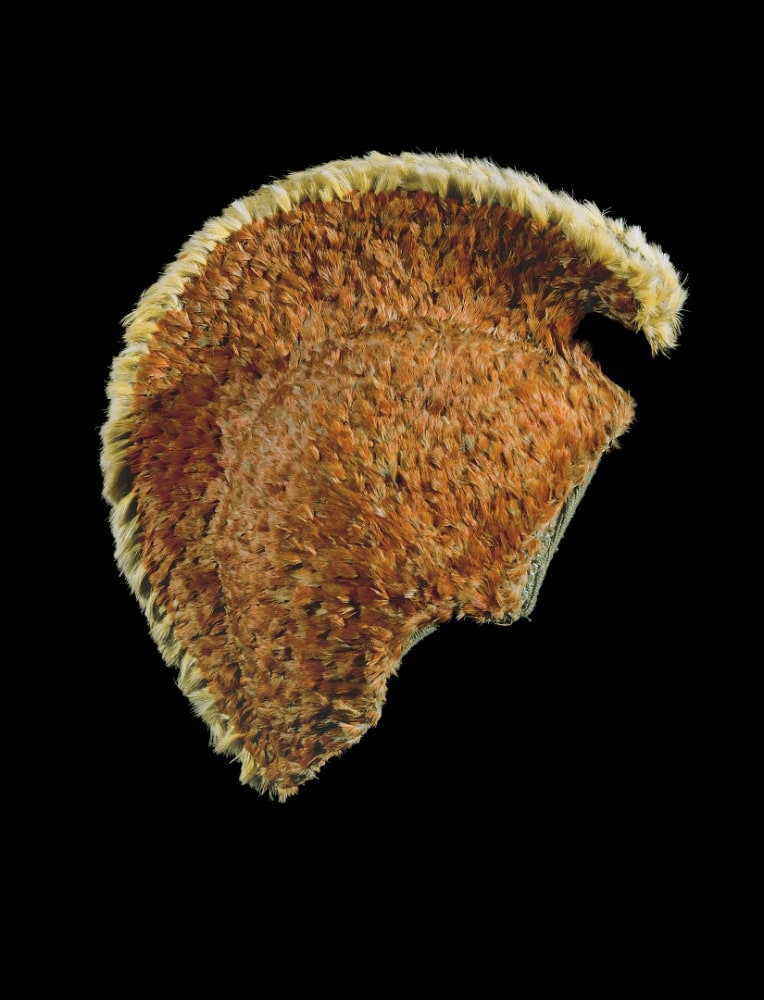
The royal cloak and helmet given to Capt. Cook returns to Hawaii

The royal feathered cloak and returned to Hawaii on March 19.
TWO HISTORICAL artifacts came home to Hawaii after an absence of 237 years.

In a moving and emotional ceremony the feathered cape and helmet of Kalani'opu'u came home last weekend after being housed  in New Zealand for several years.

"The ʻahuʻula and mahiole left their homeland at the end of the season of Lono in 1779 and the memory they hold in their very fiber is that of a healthy, abundant, sovereign society," Mehanaokalā Hind, director of community engagement at the Office of Hawaiian Affairs and a lineal descendant of Kalani'ōpu'u, said in a statement. 

Kalani'ōpu'u was the chief of the island of Hawaii in 1779 when English explorer Capt. James Cook landed at Kealakekua Bay during the Makahiki festival. Cook was the first European to make contact with the Hawaiian people. In a gesture of good will, Kalani'ōpu'u gave the feathered cloak and helmet that he was wearing to Cook. 

“These priceless treasures have so much to tell us about our shared Pacific history. We are honored to be able to return them home, to reconnect them with their land and their people,” said Arapata Hakiwai, Kaihautu (Maori co-leader) of the National Museum of New Zealand Te Papa Tongarewa, where the artifacts have been on display since the early part of the 20th century. “Woven into these (treasures) is the story of our Pacific history, with all its beauty, challenges and complexity."

The exhibit at Bishop Museum will be called "He Nae Akea: Bound Together"


The mahiole (feathered helmet) of chief Kalani‘ōpu‘u. Michael Hall / Courtesy of Museum of New Zealand Te Papa Tongarew
10 things you need to know about the return of Kalani‘ōpu‘u’s ‘ahuʻula (feathered cloak) and mahiole (feathered helmet)

1. Kalani‘ōpu‘u was the chief of Hawai‘i Island whose regal line was traced to the great chief Līloa of Waipiʻo. In 1779, Kalani‘ōpu‘u greeted an English captain named James Cook after his ship made port in Kealakekua Bay. As a demonstration of his goodwill, Kalani‘ōpu‘u gifted the ‘ahu ʻula (feathered cloak) and mahiole (feathered helmet) he was wearing to Captain Cook.

2. According to expert scholar Adrienne Kaeppler’s publication Hawaiian Featherwork (2010), Kalani‘ōpu‘u’s cloak seemed to have started as a cape.  The design has two red triangles (huinakolu) at the neckline and a red crescent (hoaka) which formed a sacred, protective design; the resulting yellow triangles and a yellow strip at the bottom complete the original cape.  The use of so many yellow feathers demonstrates the political power of Kalani‘ōpu‘u.

3. This ‘ahu ‘ula in particular has feathers from about 20,000 birds. Skilled trappers caught the birds by employing various techniques such as snaring their prey midair with nets, or using decoy birds to lure them onto branches coated with a sticky substance. They often harvested only a few feathers from each bird before releasing them back into the wild so they could produce more feathers. Skilled workers belonging to the aliʻi class crafted the olonā cordage backing, a netting used as the foundation for the cloak, onto which the bundles of feathers were attached, creating bold designs.

4. After the ‘ahu ‘ula and mahiole left on Cook’s ship, both were taken to England and passed through the hands of various museum owners and collectors. They eventually came under the care of Lord St Oswald, who unexpectedly presented his entire collection in 1912 to the Dominion Museum in New Zealand, the predecessor of Te Papa Tongarewa. The cloak and helmet have been in the national collection ever since. 

5. In 2013, discussions began among Bishop Museum, Te Papa Tongarewa, and OHA to bring these treasures back to Hawai‘i.

6.The cloak has traveled to Hawai‘i twice without the mahiole: Mayday in 1960 and during the exhibition celebrating the 100 Anniversary of Captain Cook and his artificial Curiosities, Jan. 18 through July 31, 1978.  However, this is the first time in 237 years that both the cloak and helmet will be back home in Hawai‘i together.


Maori's turned the artifacts to the Hawaiians in New Zealand.

7. While Kalani‘ōpu‘u’s ‘ahuʻula and mahiole have been on quite an interesting journey, the return of both treasured objects is a very important event to many people of Hawai‘i because they will be staying in Hawai‘i to reconnect them with their land and their people.

8. From a historical perspective, the artifacts represent a period in the timeline of Hawai‘i when there was a balance between the cultural, political and spiritual parts of Native Hawaiians and the environment.

9. The exhibit space at Bernice Pauahi Bishop Museum will be called ‘He Nae Ākea: Bound Together.’ This reflects the connection of Kalani‘ōpu‘u to his land and people, the connection between the peoples, nations, and cultures throughout the centuries who have cared for these treasures, as well as the connection between the three institutions directly involved in this loan.

10. Last March 19 at the Bishop Museum, there was a celebration for the return of Kalani‘ōpu‘u’s ‘ahuʻula and mahiole - home at last.
###
For more news about Asian/Americans & Pacific Islanders, read AsAm News.

Wednesday, December 31, 2014

Hawaiian man strips down for graduation

KALA KAAWA thought long and hard about what he wanted to do but he thought it was important to do it - take off his black robe when he graduates from the University of Hawaii.

He didn't want to ruin the serious commencement ceremony for the other graduates but it was important to him to demonstrate his pride in his Hawaiian heritage. He texted his mother to warn her beforehand so she wouldn't be shocked at her son's brazen act. She texted back, "Think about it."

When his name was called, he doffed the traditional robe and mortarboard cap to reveal his traditional Hawaiian loincloth, a malo.

He was surprised at the reaction of the audience. Read about it here.

It certainly didn't hurt that --- as a young man unmarred by any physical ailments -- he was in top physical condition. Just take a close look at the reactions of the women in the audience.

It is a growing tradition among students of color that they display something that says something about their ethnic roots. A lei is popular among Asian Americans. Oftentimes, the colors of Africa or Mexico will be in the stole worn by graduates, 


Kaawa told the Huffington Post's Carla Herreia he wanted to use the traditional Hawaiian malo garment to remind people "not to be ashamed of your culture, whether you are Hawaiian, Maori, Samoan, Tongan, etc." and to "know your roots, represent and perpetuate!

"Not just for yourself, but for your family, your ancestors and the future generations of your culture."


There's a lesson there for all of us, eh, brah'?