Showing posts with label #HawaiianHistory. Show all posts

Thursday, September 6, 2018

Hirono gives Kavanaugh a history lesson on Hawaii

SCREEN CAPTURE / . C-SPAN3
SUPREME COURT nominee Brett Kavanaugh got a lecture on Hawaiian history yesterday (Sept. 5) as he was grilled by Sen. Mazie Hirono.
On Wednesday, each member of the Senate Judiciary Committee was given 30 minutes to question Kavanaugh. Hirono used some of her time to question him about an opinion piece he wrote that questioned whether Native Hawaiians should be treated as indigenous people by the U.S. government.

Democrat Mazie Hirono used at least some of that time to give Kavanaugh a Hawaii history lesson.


Kavanaugh has been nominated to the court by Donald Trump after the recommendation of the Heritage Foundation, a right-wing think tank. In 1999 he wrote an incendiary op-ed that questioned whether Native Hawaiians should be treated as indigenous people by the U.S. government.

He wrote the piece in support of his position on Rice v. Cayetano, a case before the Supreme Court that questioned whether elections for the Office of Hawaiian Affairs were limited to only Native Hawaiians.

Hirono blasted Kavanaugh for arguing that Native Hawaiians are not indigenous because they came from Polynesia.

The senator's staffers behind Hirono held up a map showing that Hawaii was always a part of Polynesia. It was the U.S. business interests and military that came in and overthrew the Hawaiian monarchy.

Hirono also criticized Kavanaugh for saying Native Hawaiians don’t live on reservations or have their own form of government, therefore, they should not be treated the same as American Indian tribes, who are federally recognized as sovereign nations.

Again, she said, Kavanaugh is ignorant of the facts, noting that the islands had long been under their own rule before Captain James Cook “discovered” Hawaii in 1778.

“Judge Kavanaugh, it’s hard to believe you spent any time researching the history of Native Hawaiians,” Hirono chided.

She said she was particularly concerned about his views in Rice v. Cayetano because the case is often used to challenge the validity of programs designed to help Native Hawaiians.

“I think you have a problem here,” Hirono said. “Your view is that Native Hawaiians don’t deserve protections as indigenous people,” which was contradictory to the (Clinton) government's position.

Kavanaugh’s involvement in that case began with Harold “Freddy” Rice, a rancher from the Big Island, who wanted to vote in the Office of Hawaiian Affairs elections. Although Rice was born and raised in the islands, he was of European descent. (The governor named in the complaint was Gov. Ben Cayetano, the first Filipino American governor.)


SCREEN CAPTURE / C-SPAN3
Mazue Hirono used a visual aid to question Brett Kavanaugh.
The nation’s high court took up Rice v. Cayetano in 1999, and Kavanaugh, then in private practice, was commissioned to co-author an amicus brief for the Center for Equal Opportunity, a right-leaning think tank which sided with Rice, according to the Honolulu Civil Beat.

Kavanaugh thought Rice's constitutional rights were being violated by denying him the right to vote because of his race.

Before the Supreme Court heard the case, Kavqnaugh wrote a piece for the Wall Street Journal, titled, "Are Hawaiians Indians? The Justice Department Thinks So," in which he argued that the state “doles out money to certain citizens based solely because of their race.”

He wrote: “And if Hawaii is permitted to offer extraordinary privileges to residents on the basis of race or ethnic heritage, so will every other state.”

Hirono began her questioning by aggressively asking Kavanaugh on sexual misconduct, a question she has vowed to ask every judicial nominee.. Hirono asking Kavanaugh about Judge Alex Kozinksi, who retired last year after allegations of sexual assault. Kavanaugh has worked closely with Kozinski over the years.

Kavanaugh denied any knowledge of sexual misconduct by Kozinski.
_______________________________________________________________________________

Wednesday, September 28, 2016

Rule allows Native Hawaiians to form their own government

Library of Congress
Queen Liliuokalani of Hawaii, overthrown by sugar plantation owners and U.S. troops in 1893 
Compiled by Jason Daley
LAST WEEK, the Interior Department issued a final ruling allowing the Native inhabitants of Hawaii to conduct a referendum on re-establishing a government for the indigenous community for the first time in 120 years. If ratified, that body, representing 527,000 indigenous Hawaiians, would be able to establish a government-to-government relationship with the U.S. and give native islanders more power over their culture, traditions and other self-government issues, similar to sovereign Native American nations.
It’s been a long road to this point. In the 1800s, the U.S. government recognized the Hawaiian Islands as an independent nation ruled over by a native monarchy. Over time, however, American businesses continued to make inroads via trade agreements. By 1891, U.S. sugar plantation owners and companies controlled about four-fifths of the islands and had pushed through a new constitution greatly reducing the power of the native government and restricting the rights of the native population to vote.
That year the Hawaiian ruler King Kalākaua's sister, Queen Liliuokalani, took the throne. In 1893, she prepared to issue a royal fiat restoring power to the monarchy and guaranteeing the right to vote for native Hawaiians. Instead, a coup orchestrated by the sugar plantation owners and backed by U.S. warships and troops deposed the queen and established a provisional government. In 1900, the U.S. officially annexed the islands as a territory and voted it in as a state in 1959.
In 1993, Congress passed a resolution apologizing to native Hawaiians for the government's role in overthrowing their leadership and began a two-decade process of reconciliation culminating in this announcement. “Native Hawaiians have been the only major indigenous group in the 50 states without a process for establishing a government-to-government relationship with the federal government.” Robert Lindsey, chairman of the state Office of Hawaiian Affairs says in a press release. “This rule finally remedies this injustice.”
Annelle Amaral, the president of the Association of Hawaiian Civic Clubs tells Merrit Kennedy at NPR that the ruling is a big plus for the indigenous community. “What it allows us to do is to finally have control over our sacred sites, over health care for our people, over the education of our children,” she says. “Instead of waiting for someone else to do something about our problems, with our own government we can begin to initiate change.”
Not everyone is satisfied with native Hawaiians being treated simply as another indigenous body. Soon after the announcement protests by indigenous activist groups sprung up on the islands of Oahu, Hawaii, Maui, and Kauai, reports Frances Kai-Hwa Wang at NBC News.

Wang reports: “The United States took a stable government, destabilized it, and then has the nerve today to say, ‘We will make a deal with you, and the deal is you agree to become our native people and we will negotiate some kind of settlement that will make life a little bit better for you,’” Professor Jonathan Kay Kamakawiwoʻole Osorio of the University of Hawaii Kamakakūokalani Center for Hawaiian Studies said during a press conference. 


“The very very worst part of all of this is that what the U.S. has done…have really actually acted to divide a people who were moving, who have been moving, towards a legal, rational, and reasonable solution to the hewa (wrong) that the United States committed more than a hundred years ago.”

Juliet Eilperin at The Washington Post reports that the move is part of a special interest that President Obama has taken in his home state in the last year of his presidency. Last month, he created the world's largest marine reserve by expanding Hawaii’s Papahanaumokuakea Marine National Monument, a move applauded by many native leaders.

###

Monday, March 21, 2016

The royal cloak and helmet given to Capt. Cook returns to Hawaii

The royal feathered cloak and returned to Hawaii on March 19.
TWO HISTORICAL artifacts came home to Hawaii after an absence of 237 years.

In a moving and emotional ceremony the feathered cape and helmet of Kalani'opu'u came home last weekend after being housed  in New Zealand for several years.

"The ʻahuʻula and mahiole left their homeland at the end of the season of Lono in 1779 and the memory they hold in their very fiber is that of a healthy, abundant, sovereign society," Mehanaokalā Hind, director of community engagement at the Office of Hawaiian Affairs and a lineal descendant of Kalani'ōpu'u, said in a statement. 

Kalani'ōpu'u was the chief of the island of Hawaii in 1779 when English explorer Capt. James Cook landed at Kealakekua Bay during the Makahiki festival. Cook was the first European to make contact with the Hawaiian people. In a gesture of good will, Kalani'ōpu'u gave the feathered cloak and helmet that he was wearing to Cook. 

“These priceless treasures have so much to tell us about our shared Pacific history. We are honored to be able to return them home, to reconnect them with their land and their people,” said Arapata Hakiwai, Kaihautu (Maori co-leader) of the National Museum of New Zealand Te Papa Tongarewa, where the artifacts have been on display since the early part of the 20th century. “Woven into these (treasures) is the story of our Pacific history, with all its beauty, challenges and complexity."

The exhibit at Bishop Museum will be called "He Nae Akea: Bound Together"


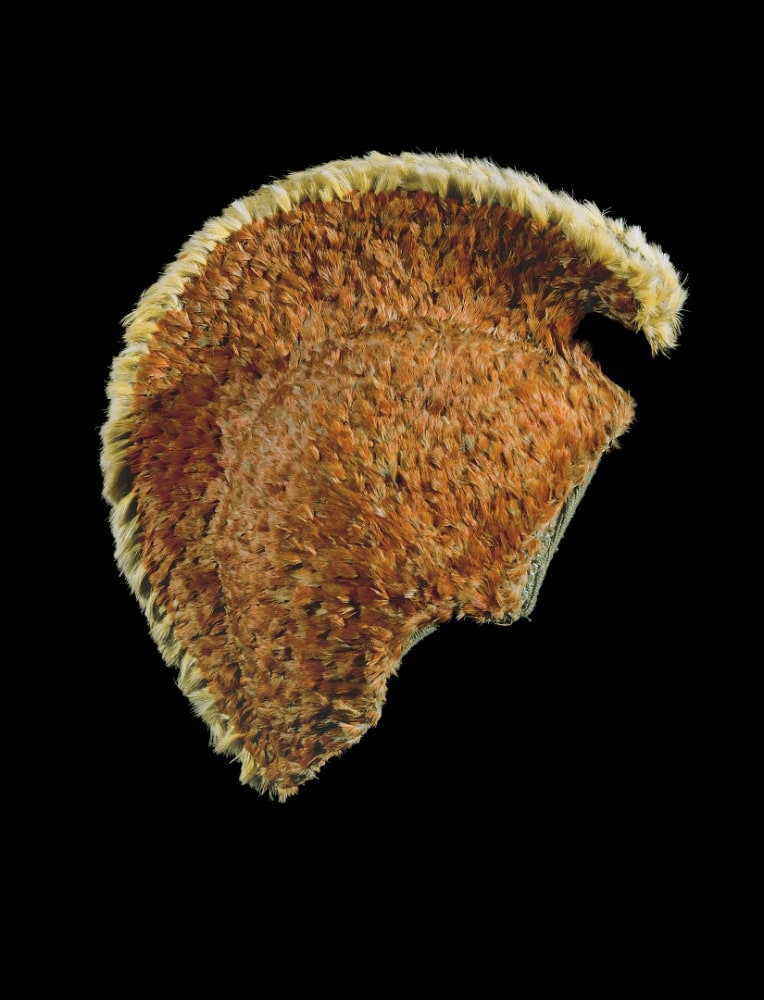
The mahiole (feathered helmet) of chief Kalani‘ōpu‘u. Michael Hall / Courtesy of Museum of New Zealand Te Papa Tongarew
10 things you need to know about the return of Kalani‘ōpu‘u’s ‘ahuʻula (feathered cloak) and mahiole (feathered helmet)

1. Kalani‘ōpu‘u was the chief of Hawai‘i Island whose regal line was traced to the great chief Līloa of Waipiʻo. In 1779, Kalani‘ōpu‘u greeted an English captain named James Cook after his ship made port in Kealakekua Bay. As a demonstration of his goodwill, Kalani‘ōpu‘u gifted the ‘ahu ʻula (feathered cloak) and mahiole (feathered helmet) he was wearing to Captain Cook.

2. According to expert scholar Adrienne Kaeppler’s publication Hawaiian Featherwork (2010), Kalani‘ōpu‘u’s cloak seemed to have started as a cape.  The design has two red triangles (huinakolu) at the neckline and a red crescent (hoaka) which formed a sacred, protective design; the resulting yellow triangles and a yellow strip at the bottom complete the original cape.  The use of so many yellow feathers demonstrates the political power of Kalani‘ōpu‘u.

3. This ‘ahu ‘ula in particular has feathers from about 20,000 birds. Skilled trappers caught the birds by employing various techniques such as snaring their prey midair with nets, or using decoy birds to lure them onto branches coated with a sticky substance. They often harvested only a few feathers from each bird before releasing them back into the wild so they could produce more feathers. Skilled workers belonging to the aliʻi class crafted the olonā cordage backing, a netting used as the foundation for the cloak, onto which the bundles of feathers were attached, creating bold designs.

4. After the ‘ahu ‘ula and mahiole left on Cook’s ship, both were taken to England and passed through the hands of various museum owners and collectors. They eventually came under the care of Lord St Oswald, who unexpectedly presented his entire collection in 1912 to the Dominion Museum in New Zealand, the predecessor of Te Papa Tongarewa. The cloak and helmet have been in the national collection ever since. 

5. In 2013, discussions began among Bishop Museum, Te Papa Tongarewa, and OHA to bring these treasures back to Hawai‘i.

6.The cloak has traveled to Hawai‘i twice without the mahiole: Mayday in 1960 and during the exhibition celebrating the 100 Anniversary of Captain Cook and his artificial Curiosities, Jan. 18 through July 31, 1978.  However, this is the first time in 237 years that both the cloak and helmet will be back home in Hawai‘i together.


Maori's turned the artifacts to the Hawaiians in New Zealand.

7. While Kalani‘ōpu‘u’s ‘ahuʻula and mahiole have been on quite an interesting journey, the return of both treasured objects is a very important event to many people of Hawai‘i because they will be staying in Hawai‘i to reconnect them with their land and their people.

8. From a historical perspective, the artifacts represent a period in the timeline of Hawai‘i when there was a balance between the cultural, political and spiritual parts of Native Hawaiians and the environment.

9. The exhibit space at Bernice Pauahi Bishop Museum will be called ‘He Nae Ākea: Bound Together.’ This reflects the connection of Kalani‘ōpu‘u to his land and people, the connection between the peoples, nations, and cultures throughout the centuries who have cared for these treasures, as well as the connection between the three institutions directly involved in this loan.

10. Last March 19 at the Bishop Museum, there was a celebration for the return of Kalani‘ōpu‘u’s ‘ahuʻula and mahiole - home at last.
###
For more news about Asian/Americans & Pacific Islanders, read AsAm News.