Showing posts with label USC. Show all posts

Wednesday, May 19, 2021

USC Report: Lack of AAPI screen presence a factor for climate of anti-Asian hate

CREDIT: ANNENBERG - USC


Like it or not, Hollywood movies have undue influence on this country's values and perspectives. A new report suggests Asian Americans and Pacific Islanders have a lot of work to do to gain recognition, support and presence in the film making industry and in the United States.

It is the "soft power" of movies, television and literature, (and more recently, social media)  that moviegoers soak in, unaware that their views of the world and people, ie. AAPI, are being shaped by a Hollywood still stuck in the 20th Century.

"The Prevalence and Portrayal of Asian American and Pacific Islanders Across 1,300 Popular Films," a report from the USC Annenberg Inclusion Initiative released Tuesday, May 18, reveals how popular films perpetuate erasure and stereotyping of this group, a state of affairs that can lead to discrimination and psychological harm and eventually leads to the wave of racist violence and hate directed towards the AAPI communities.

Of the 1,300 films over a 13-year time span, 2006-2019, included in the study, 39% had no AAPI characters at all contributing to the invisibility, or erasure, of a major demographic that has been in this country for centuries.

“People often ask me whether representations of Asian Americans and Pacific Islanders are improving,” said Dr. Nancy Wang Yuen, who co-authored the report with Dr. Stacy L. Smith. “Unfortunately, when representation looks like tokenism, Hollywood is doing the bare minimum for inclusion."

READ the full report, 'The Prevalence and Portrayal of Asian American and Pacific Islanders across 1,300 Popular Films" 

Dwayne Johnson accounts for almost a third of the lead roles for AAPI actors.


The Anneneberg initiative produces an annual report about inclusion and the diversity of the movie-making and television industries but this is the first time that a report has been focused solely on AAPIs. The study is full of loads of data that includes AAPI directors and behind-the-scene artists.

Out of 1,300 top-grossing movies, the report states, only 44 or 3.4% featured an AAPI lead or co lead. The 44 films with API leads/co leads were driven by 22 individual actors that worked one or more times as a protagonist. The wildly popular Samoan American actor Dwayne Johnson, by himself, is the lead protagonist in 14 of those films. Next in line is Keanu Reeves, who starred in five of those films.


"In 2019, 30% of API primary and secondary characters were either the only one or interacted with no other API characters on screen," said Yuen. "We need to see more than one API character on screen interacting with one another in meaningful ways.”

The USC study takes a look at Asian and Pacific Islander (API) leads and speaking characters across 1,300 top-grossing films over a 13-year span, from 2007 to 2019. 

Across 51,159 speaking characters in 1,300 top-grossing movies, 5.9% were API, the report finds. The number of films did not significantly change over the 13-year study period. This percentage falls far short of the 7.1% of the U.S. population that identifies as API. 

The USC report, released Tuesday, also found that of the 79 primary and secondary AAPI characters across the top films of 2019, “Portrayals of the API community range from invisible to fully human, with most portrayals falling into the categories of silenced, stereotyped, tokenized, isolated, and sidekicks/villains."

STEREOTYPES PERSIST

Hollywood studios and filmmakers find it all too easy to fall back to the old negative  stereotypes that have helped create the general public's images of AAPI men and women held by the general public.

"The stereotypes still present in top films include the persistent emasculation of API men – 58% were shown with no romantic partners compared to 37.5% of API women without partners – as well as that of the perpetual foreigner, evidenced by non-U.S. accents and use of non-English language. Most troublingly, portrayals of API characters still include violence, death, and disparagement.”

AAPI women, when they were seen at all, were hypersexualized or portrayed as submissive Lotus Blossoms.

Additionally, a closer look at films from 2019, the most recent year included in the study, shows that underrepresentation is only one facet of the bias facing the AAPI community in film.

DEATH & INVISIBILITY

“With the rise of anti-AAPI violence in the United States, on-screen deaths of Asians and Pacific Islander characters are particularly jarring,” Yuen said. “In the top 100 films of 2019, just over a quarter of Asian and Pacific Islander characters die by the end of the film and all but one death ended violently. This, along with 41.8% of API characters receiving on-screen disparagement – some of which are racial slurs – films can fuel anti-AAPI hate. 

"With over 6,603 hate incidents reported to Stop AAPI Hate from March 19, 2020 to March 31, 2021, Hollywood needs to take responsibility for problematic representations of Asians and Pacific Islanders,” she said.

"These findings offer more evidence that the epidemic of invisibility continues to persist and with serious consequences,” Smith agreed. “Mass media is one factor that can contribute to aggression towards this community. When portrayals erase, dehumanize, or otherwise demean the API community, the consequences can be dire. Without intention and intervention, the trends we observed will continue.”

"I've died so many times on-screen that it became a real issue for my kids," actor Daniel Dae Kim said Tuesday in response to the report. "It's now one (of) the primary factors in deciding whether I take a role or not."

Based on the study, Hollywood's popular image of AAPI is predominantly East Asian (Chinese, Korean and Japanese) even though South Asians and Southeast Asians together make up the majority of today's AAPI population in the U.S.

East Asian characters made up 65.4% of the AAPI roles. Only 13.3% of the characters were Southeast Asian and South Asians made up 17.4% of the movie roles. 

"Looking to ethnic heritage, the majority of the 22 leads/co-leads were of Indian (31.8%) followed by Chinese (18.2%) and Korean (18.2%) descent. By region, East Asian (45.5%) outnumbered South Asian (36.4%), Polynesian (18.2%), and Southeast Asian (9.1%) actors as leads/co leads," the report states. 

"Focusing on ethnic heritage, Chinese, Indian, Korean, and Japanese actors were the most likely to work across the 200 top-grossing films. A full 65.4% of all API actors were East Asian, 17.4% were South Asian, 13.3% were Southeast Asian, and 6.5% were Polynesian," the study continued.

The report also delves into the advantages of having directors, writers, casting directors, producers and studio executives of Asian, Asian American and Pacific Islander heritage. Having these behind-the-camera decision makers enhances the chances of including actors and humanized characters in the movies.

CONCLUSIONS & SUGGESTIONS

Besides the increased hiring of actors and other artists in their productions, the study also suggests that one of the solutions is that Hollywood productions include AAPI actors in front the camera in all films. Period movies and focused storylines are not excuses to not cast AAPI actors giving the success and audience appeal of the productions of Hamilton and Bridgerton.

Among the report authors' conclusions: "There are consequences to invisibility. First, it limits the career opportunities of API actors by relegating them to secondary or tertiary roles -- if they are cast at all. This prevents talented creative voices from working and achieving career sustainability. Moreover, it communicates to the millions of API youth who spend time with these stories that they do not belong at the center of storytelling and in fact may not even merit inclusion at all."


“The numbers speak for themselves — again. They are a sobering look at how far the industry still has to go to counter the invisibility of our community onscreen,"
 actor and producer Daniel Dae Kim told Variety. "If anything is to improve, the historic indifference on the part of decision-makers toward increased Asian American representation must go beyond the usual performative rhetoric to actual, demonstrable change.” 

Thursday, March 25, 2021

USC pays out $852 million to settle sex abuse case involving many Asian women


The University of Southern California and the 710 women who filed civil cases in Los Angeles Superior Court involving former Dr. George Tyndall reached a settlement agreement Thursday  that has the school paying out $852 million to the victims of sexual abuse.

Many of victims of the gynocologist were Asian women. He was accused of making  inappropriate racial comments toward Chinese international students and appeared fixated on the heritage and virginity of students of Asian and Middle East descent. 

One victim testified: "He asked intimate sexual details about me and then related my answers to my being Filipina and saying I guess that’s because you’re mixed. He had a creepy smile. He told me to undress from the bottom down and he stood there watching while I did so. And he smiled.”

Another former patient, Lucy Chi, said Thursday that she was abused by Tyndall during an exam around 2014. “George Tyndall specifically preyed upon Asian women,” Chi said. “He paid special attention to me because I was Asian.”

“It is a sickening thought that this doctor might have preyed on international Asian students because he believed they were naive and did not know what to expect during these appointments,” said Sung Yeon Choimorrow, executive director of the National Asian Pacific American Women’s Forum.

John C. Manly, Esq., on behalf of Plaintiffs' Liaison Counsel, commented, "Our team is humbled by the courage of George Tyndall's survivors, who endured this process, and hope this settlement brings them healing. Our team also acknowledges USC President Carol Folt and General Counsel Beong-Soo Kim, whose hard work and determination were critical to resolving this case."

USC General Counsel Beong-Soo Kim said, "Reaching a fair agreement with these former students has been a top priority for the Board of Trustees and President Carol Folt. We want to thank the Plaintiff's Liaison Counsel for their willingness to work with us to resolve this litigation responsibly."

Revelations that Tyndall had abused students for years were first made public in 2018 in an exhaustive report published by the Los Angeles Times, for which the newspaper won a Pulitzer Prize for investigative reporting.

Tyndall was arrested in 2019 that led to his release from the university.

"I am deeply sorry for the pain experienced by these valued members of the USC community," said USC President Carol L. Folt. "We appreciate the courage of all who came forward and hope this much needed resolution provides some relief to the women abused by George Tyndall."

Saturday, September 12, 2020

USC Report: Inclusion in Hollywood is mostly all talk, little action


What might appear to be a flood of recent and new films and TV shows featuring AAPI characters in prominent roles is really just a drop in a very big bucket.

All the movies starring Dwayne Johnson, one of the busiest actors in Hollywood, was not enough; Crazy Rich Asians, To All the Boys I Ever Loves 1 and 2, The Farewell, Always Be My Maybe, and the TV productions, Never Have I Ever, Late Night with Lilly Singh; throw in the numerous secondary roles in a dozen or so TV shows and movies and they all were still not be enough to move the needle on diversity.

In the midst of ongoing protests against racial injustice not seen since the 1960s, a new study from the University of Southern California shows Hollywood movies continues a systemic flaw in Tinseltown --  a lack of inclusive representation of those from underrepresented racial/ethnic groups, girls and women, the LGBTQ community, and individuals with disabilities.

“After 13 years, it is not clear what might convince entertainment companies to change,” said USC Prof. Stacy L. Smith, on the study's authors. 

“Despite public statements, the data reveal that there is still apathy and ambivalence to increasing representation of speaking characters overall in popular films. This is both the easiest representational gap to address and one that is essential to strengthen the pipeline to more prominent roles.”


The spate of recent productions featuring Asian American and Pacific Islanders in productions may seem like an explosion when compared to what the industries were like before Crazy Rich Asians busted through Hollywood's consciousness bringing attention to AAPI talent and the wealth of stories.

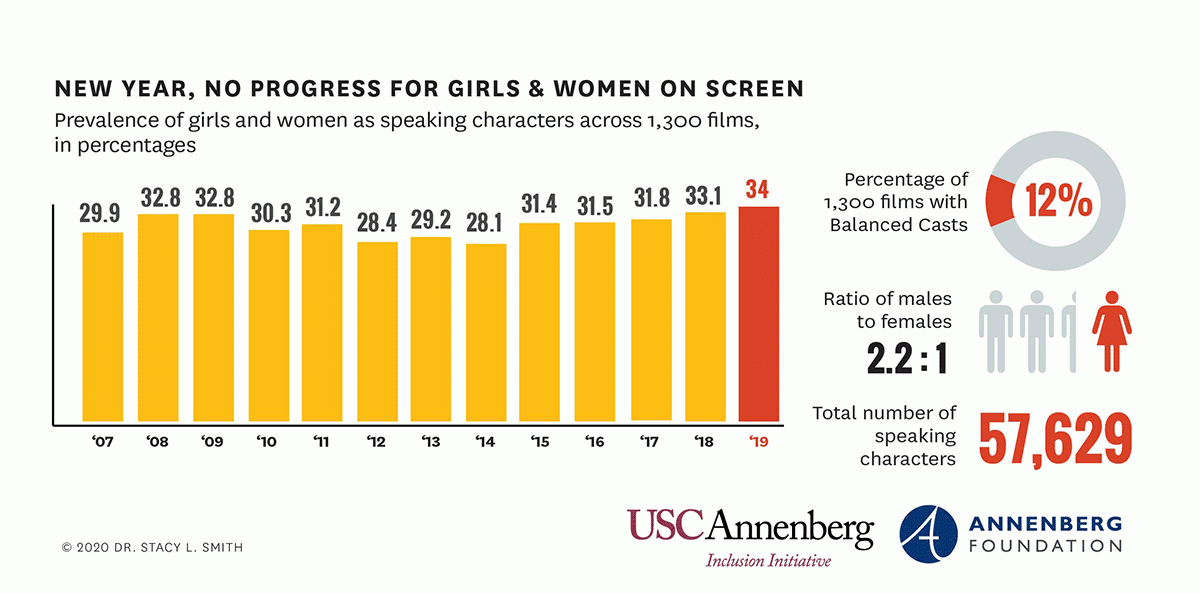
The report, from Smith and the Annenberg Inclusion Initiative at USC Annenberg, is the most comprehensive and intersectional look at film, having examined 57,629 characters in 1,300 top films from 2007 to 2019.

The study charts an increase in leading and/or co-leading characters from underrepresented racial/ethnic groups, from 27 films in 2018 to 32 films in 2019. Seventeen movies featured a girl or woman from an underrepresented group as a lead or co lead character in 2019 compared to just 11 in 2018, 4 in 2017 and 1 in 2007. 

Forty-three of 2019’s 100 top films had a girl or woman in a leading or co-leading role, a slight uptick from 39 in 2018 and a larger gain from 20 in 2007. However, only three films had a leading or co-leading role filled by a woman aged 45 or older, and only one of these roles went to a woman of color.

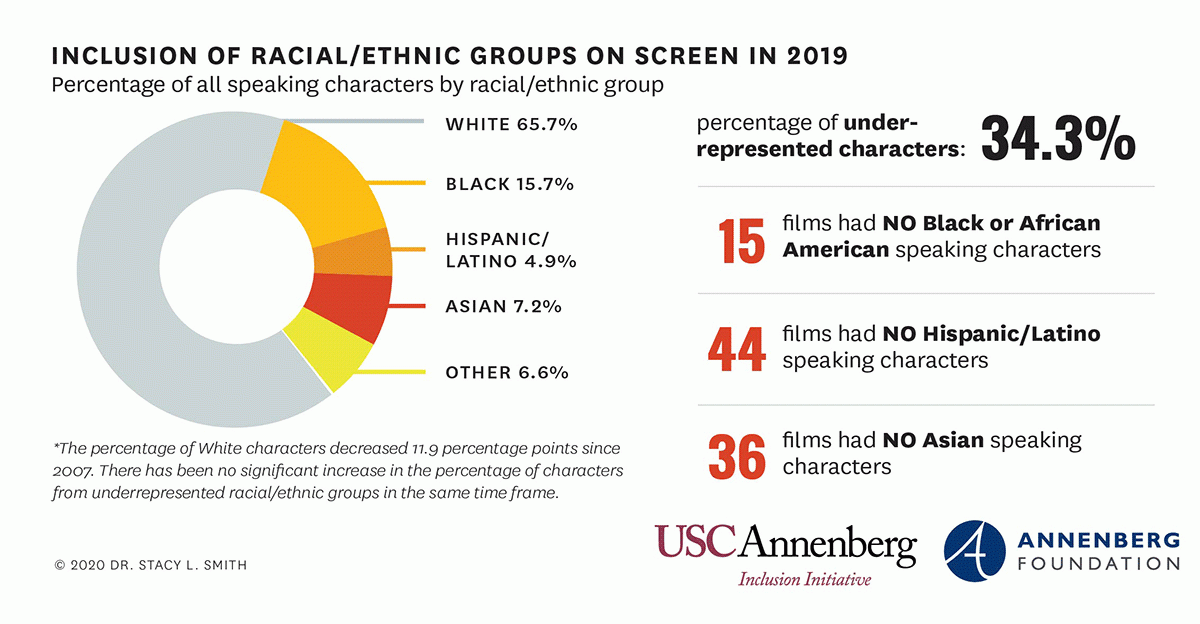
Despite the gains for AAPI actors, 36% of the surveyed films had no Asian speaking characters. In 2019, with all the aforementioned productions that represented only 7.2% of the speaking roles.

Much of the study focused on women. While showing considerable gains, and in most cases better than the job growth of actors and directors of color, women still fell way behind white men, who continue to get majority of the meatier roles and directing assignments.

When it comes to all women portraying speaking characters, there has been little to no progress in 13 years. The percentage of female-identified speaking characters has not meaningfully increased since 2007, reaching only 34% in 2019. Similarly, 34.3% of speaking characters were from underrepresented groups, which is below the U.S. population and a slight decrease from 2018. The overall ecosystem of cinematic storytelling is still one in which girls, women and people of color are marginalized and minimized.

The study also found a comparitively small number of roles for girls and women from underrepresented groups, and a similar lack of inclusiveness behind the camera -- directors, writers, casting directors and producers.

“This is a critical moment for the industry to commit to real and substantive change,” Smith said. “Too often the results of studies like this one garner attention without action. As protests for racial justice continue, it is imperative that companies move beyond performative statements and commit to take actions that will result in inclusive hiring practices on screen and behind the camera.”

READ the entire report here.

The "breakthrough" created by the success of Crazy Rich Asians may be an illusion, says report.

EDITOR'S NOTE: A word of caution, this is news sprinkled with opinion. Readers are encouraged to seek multiple news sources to formulate their own positions. 

Tuesday, May 28, 2019

Report: USC was warned about accused gynecologist prior to misconduct allegations


SCREEN CAPTURE
During a press conference last spring, Daniella Mohazab described her examination by Dr. George Tyndall.

Previously sealed records of the University of Southern California reveal that an evaluation of a campus gynecologist reported there was evidence he preyed on Asian students and had signs of "psychopathy," reports the Los Angeles Times.

The confidential report by medical experts was among USC records concerning Dr. George Tyndall that were made public last Thursday by U.S. District Judge Stephen V. Wilson at the newspaper's request.

The sealed records had been filed as a part of a class-action lawsuit by former patients against Tyndall and USC, following an L.A. Times investigation into claims of sexual abuse or harassment of patients by the gynecologist.


"Providing the public with all available nonprivileged information furthers the public narrative about inappropriate sexual behavior and ensures for longer-lasting changes beyond the case at hand," wrote the judge
Since news of the allegations and USC's handling of them over many years surfaced last year, university President C.L. Max Nikias was ousted, most top administrators have left or will soon, more than 650 lawsuits have been filed, and Los Angeles police have been conducting an extensive sex crimes investigation, according to the LAT.

Tyndall was suspended but still has not been charged. He left his position with a substantial payout, reports the LAT. He denies the allegations by at least 100 former patients.

Among the newly released records are documents handed over to lawyers for plaintiffs 
and another set of records given to the judge for his decision on whether to approve a $215 million settlement with some former patients in the class action.

In a letter to the USC community, the university explained that the settlement was $215 million. The letter said: "The settlement provides all class members (former patients who received women’s health services from Tyndall) compensation of $2,500. Patients who are willing to provide further details about their experience could be eligible for additional compensation up to $250,000."

“He told me that Filipinas are good in bed,” said Daniella Mohazab at a news conference last year. “He also said that Filipinas are devoted to their partners and they don’t sleep with many people in their lifetime. He asked intimate sexual details about me and then related my answers to my being Filipina and saying I guess that’s because you’re mixed. He had a creepy smile. He told me to undress from the bottom down and he stood there watching while I did so. And he smiled.”

Among the allegations filed against Tyndall, are:

  • Improperly photographing patient’s private parts;
  • Asking patients to remove all of their clothing for an exam;
  • Making inappropriate comments about patients’ bodies;
  • Conducting pelvic exams without using gloves;
  • Asking invasive questions about patients’ sexual backgrounds;
  • Making racially insensitive remarks; and
  • Touching other parts of patients’ bodies.

  • Tyndall is also accused of racial harassment. He allegedly made inappropriate racial comments toward Chinese international students and appeared fixated on the heritage and virginity of students of Asian and Middle East descent. 

    __________________________________________________________________