Showing posts with label #OscarsSoWhite. Show all posts

Thursday, August 4, 2022

Asian American Hollywood executive elected president of Oscars' academy

ACADEMY OF MOTION PICTURE ARTS AND SCIENCES
Janet Yang takes over helm of Oscars' sponsor.


Hollywood producer Janet Yang, who has been described as “the godmother of Asian Americans in the industry” was elected president of the Academy of Motion Picture Arts and Sciences by the organization’s Board of Governors.

“Janet is a tremendously dedicated and strategic leader who has an incredible record of service at the Academy. She has been instrumental in launching and elevating several Academy initiatives on membership recruitment, governance, and equity, diversity, and inclusion,” noted Academy CEO Bill Kramer.

“I am thrilled that she is taking on the esteemed role of Academy President and look forward to working closely with her on our shared vision to serve our membership, celebrate the collaborative arts and sciences of motion pictures, and inspire the next generation of filmmakers.”

Yang, 66, is beginning her first term as president and her second term as a Governor-at-Large, a position for which she was nominated by the sitting Academy President and elected by the Board of Governors. Gigliotti, Karaszewski, Linde, Mussenden and Thomas were re-elected as officers. It will be the first officer stint for Dorman, Howell Taylor and Taylor-Coleman.

Yang’s extensive film producing credits include “The Joy Luck Club,” “The People vs. Larry Flynt,” “Zero Effect,” “High Crimes,” “Dark Matter,” “Shanghai Calling” and the Oscar®-nominated animated feature “Over the Moon.” She won an Emmy® for the HBO film “Indictment: The McMartin Trial.”

Following Cheryl Boone Isaacs, Yang is the second person of color to hold the academy's top job.

The New York City-born daughter of Chinese immigrants has long been a significant figure in Hollywood's Asian American community. She co-chairs the academy's Asian Affinity Group and has served on the academy's board of governors since 2019 as one of three governors-at-large who were added following the 2016 #OscarsSoWhite movement to help boost diversity and inclusion.

After Oscar host Chris Rock used Asian children as props for a not-so-funny racist  joke, Yang was a part of the creatives that included some of the biggest Asian American names in the film industry, who wrote a letter to the Academy expressing their displeasure asking that the Academy initiate more efforts to be more inclusive to include more women and members of color.

The hashtag #OscarsSoWhite, brought attention to long-standing racism and bias in awards recognition in Hollywood. Since the 2019 Oscars, the Academy has increased the diversity of its membership by doubling the number of women and minority members, increasing its overall membership from 6,000 to around 10,000.

A member of the Academy’s Producers Branch since 2002, Yang most recently served on the Board as vice president and chair of the Membership Committee and prior to that, the Membership and Governance Committee. She is also co-chair of the Academy’s Asian Affinity Group.

Yang also co-founded Gold House, the collective that aims to lift the voices of Asian Americans and Pacific Islanders (AAPI) in Hollywood. She has been named one of the “50 Most Powerful Women in Hollywood” by the Hollywood Reporter.

Last June, she was feted at the Academy Museum of Motion Pictures with a pillar named in her honor. She became the first Asian American woman to have a pillar at the museum.

EDITOR'S NOTE: For additional commentary, news and views from an AANHPI perspective, follow @DioknoEd on Twitter.


Sunday, January 31, 2021

Thanks to 'Minari,' 'Nomadland' & 'Sound of Metal,' Oscars and AAPI could have a historic convergence

The Americanization of a Korean American immigrant family is told in 'Minari.'

OPINION

More and more, it looks like it could be a history-making year for Hollywood, AAPI movies and filmmakers when the Oscar nominees are announced March 15.

It looks like Minari could be up against Nomadland for best picture and best director with Sound of Metal starring Riz Ahmed as a darkhorse.

Minari, written and directed by Lee Isaac Chung, won the best picture award by the New York Film Critics Online last week. This is the third straight year the critics  picked a foreign language film as best picture. Minari, the story of a Korean American family and set in Alabama is mostly in Korean.

Last year, the film critics picked the Korean film, Parasite and the year before that, Roma, the Spanish-speaking Argentinian movie. Both films were named in the Best Picture by the Academy of Motion Picture Arts in their respective years with Parasite winning Best Picture last year and Roma winning best foreign feature the year before. 

If history is a predictor, it bodes well for Minari, to win Hollywood's coveted Oscar.

Director Chloe Zhao on location for 'Nomadland.'

Although the film Minari won the NY film critics' Best Picture accolades and Best Supporting Actress went to Yuh-Jung Youn as the grandmother in Minari, the Best Director award went to ChloĆ© Zhao for her work on Nomadland, which she can add to the three dozen other awards she received for directing the Frances McDormand starrer.

The NY critics gave the best actor award to another Asian American, Riz Ahmed for his performance in Sound of Metal. Ahmed is also in contention to be nominated for the Oscar's best actor award along with Minari's Steven Yeun.

The exclusive club of studio heads who give the green light to most Hollywood production is still overwhelmingly white and despite China overtaking the U.S. as the No. 1 moviegoing market, they are hesitant to venture beyond the Eurocentric paradigm when deciding which movies get made.

Riz Ahmad delivers an Oscar-worthy performance in "Sound of Metal."

There is also an outside chance that no Asian or Asian American will win an Oscar nomination, in which case, we should skip the Oscars altogether. If nothing else, this year demonstrates the depth of Asian and Asian American talent to Hollywood decision-makers. 

EDITOR'S NOTE: The nominations for the 93rd Academy Awards will be announced March 15 and the in-person awards show will held on April 25, 2021.

While the awards -- Golden Globes, SAG, Critics' Choice, People's Choice -- are nice to have, just as important is that there are so many choices to pick from. There are still not enough movies by and about Asian Americans and Pacific Islanders but this year, there is at least more than one film under consideration. That's a sign of progress, I guess. It is too early to say whether this year is an anomaly, a temporary trend or the birth of a permanent genre.

For members of the Academy of Motion Picture Arts who vote in the several categories, especially the newly inducted members who were "invited" to join in order to diversify its membership, we refer you to the list compiled by Gold Open in partnership with the Coalition of Asian Pacifics in Entertainment (CAPE) for their first-ever Gold List of outstanding work by AAPI artists. 

The full list of Gold List selections are below:

Best Picture
Minari and Sound of Metal
Honorable Mentions: The Half of It, The White Tiger, Yellow Rose

Best Director
Lee Isaac Chung (Minari) and Chloe Zhao (Nomadland)
Honorable Mentions: Ramin Bahrani (The White Tiger), Diane Paragas (Yellow Rose), Alice Wu (The Half of It), Alan Yang (Tigertail)

Best Actor
Riz Ahmed (Sound of Metal) and Steven Yeun (Minari)
Honorable Mentions: Adarsh Gourav (The White Tiger), Dev Patel (The Personal History of David Copperfield), Harry Shum Jr. (All My Life) 

Best Actress
Yeri Han (Minari) and Leah Lewis (The Half of It)
Honorable Mentions: Hong Chau (Driveways), Tsai Chin (Lucky Grandma), Eva Noblezada (Yellow Rose)

Best Supporting Actor
Alan Kim (Minari) and Orion Lee (First Cow)
Honorable Mentions: Lucas Jaye (Driveways), Tzi Ma (Mulan), Rajkummar Rao (The White Tiger)

Best Supporting Actress
Phillipa Soo (Hamilton) and Yuh-Jung Youn (Minari)
Honorable Mentions: Priyanka Chopra Jonas (The White Tiger), Gong Li (Mulan), Lea Salonga (Yellow Rose)

Best Original Screenplay
Lee Isaac Chung (Minari) and Alice Wu (The Half of it)
Honorable Mentions: Mong-Hong Chung and Yao-Sheng Chang (A Sun), Diane Paragas (Yellow Rose), Isabel Sandoval (Lingua Franca), Alan Yang (Tigertail) 

Best Adapted Screenplay
Ramin Bahrani (The White Tiger) and Chloe Zhao (Nomadland)

Best Documentary Feature
Be Water and A Thousand Cuts
Honorable Mentions: 76 Days, The Donut King, The Social Dilemma

Best Animated Feature
Bombay Rose and Over the Moon
Honorable Mentions: Demon Slayer: Mugen Train, On-Gaku: Our Sound, A Whisker Away

A WORD OF CAUTION: This is an opinion piece. Readers should research multiple sources to form their own opinion.

CORRECTION Feb. 3, 12:30 p.m. to clarify Roma winning an Oscar for Best Foreign Motion Picture in 2019.


Saturday, September 12, 2020

USC Report: Inclusion in Hollywood is mostly all talk, little action


What might appear to be a flood of recent and new films and TV shows featuring AAPI characters in prominent roles is really just a drop in a very big bucket.

All the movies starring Dwayne Johnson, one of the busiest actors in Hollywood, was not enough; Crazy Rich Asians, To All the Boys I Ever Loves 1 and 2, The Farewell, Always Be My Maybe, and the TV productions, Never Have I Ever, Late Night with Lilly Singh; throw in the numerous secondary roles in a dozen or so TV shows and movies and they all were still not be enough to move the needle on diversity.

In the midst of ongoing protests against racial injustice not seen since the 1960s, a new study from the University of Southern California shows Hollywood movies continues a systemic flaw in Tinseltown --  a lack of inclusive representation of those from underrepresented racial/ethnic groups, girls and women, the LGBTQ community, and individuals with disabilities.

“After 13 years, it is not clear what might convince entertainment companies to change,” said USC Prof. Stacy L. Smith, on the study's authors. 

“Despite public statements, the data reveal that there is still apathy and ambivalence to increasing representation of speaking characters overall in popular films. This is both the easiest representational gap to address and one that is essential to strengthen the pipeline to more prominent roles.”


The spate of recent productions featuring Asian American and Pacific Islanders in productions may seem like an explosion when compared to what the industries were like before Crazy Rich Asians busted through Hollywood's consciousness bringing attention to AAPI talent and the wealth of stories.

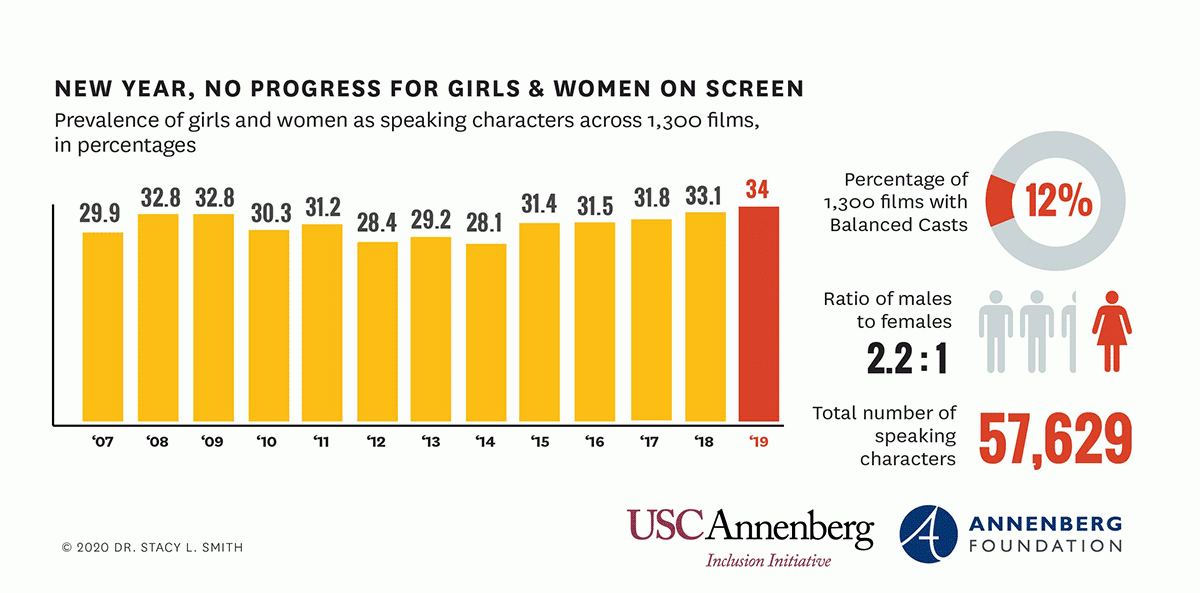
The report, from Smith and the Annenberg Inclusion Initiative at USC Annenberg, is the most comprehensive and intersectional look at film, having examined 57,629 characters in 1,300 top films from 2007 to 2019.

The study charts an increase in leading and/or co-leading characters from underrepresented racial/ethnic groups, from 27 films in 2018 to 32 films in 2019. Seventeen movies featured a girl or woman from an underrepresented group as a lead or co lead character in 2019 compared to just 11 in 2018, 4 in 2017 and 1 in 2007. 

Forty-three of 2019’s 100 top films had a girl or woman in a leading or co-leading role, a slight uptick from 39 in 2018 and a larger gain from 20 in 2007. However, only three films had a leading or co-leading role filled by a woman aged 45 or older, and only one of these roles went to a woman of color.

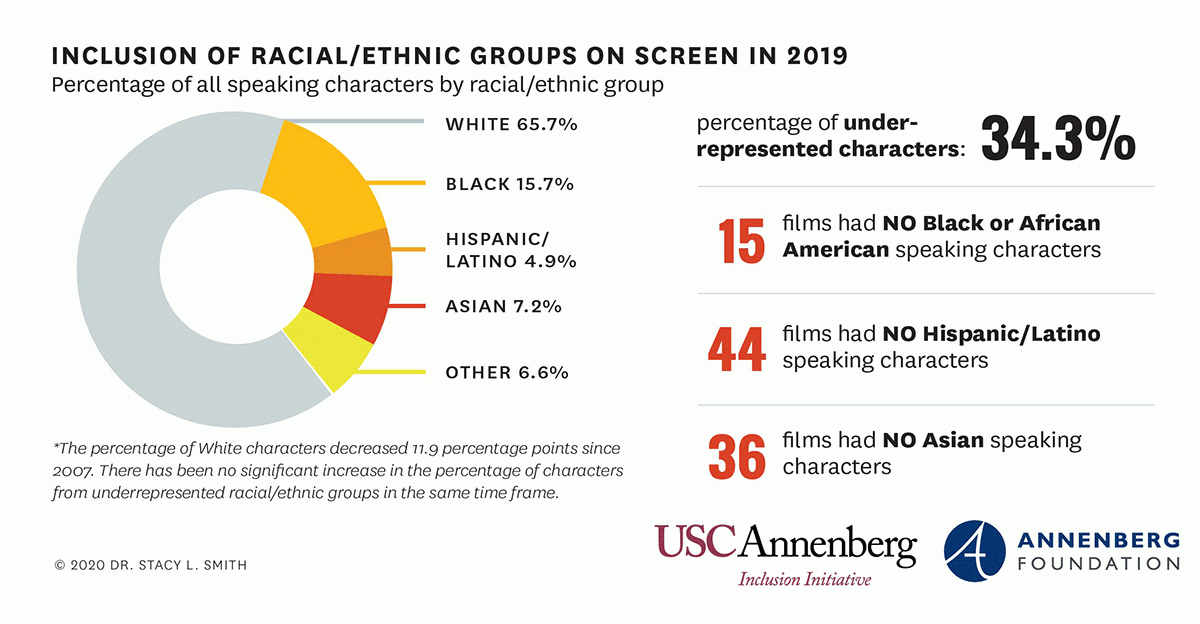
Despite the gains for AAPI actors, 36% of the surveyed films had no Asian speaking characters. In 2019, with all the aforementioned productions that represented only 7.2% of the speaking roles.

Much of the study focused on women. While showing considerable gains, and in most cases better than the job growth of actors and directors of color, women still fell way behind white men, who continue to get majority of the meatier roles and directing assignments.

When it comes to all women portraying speaking characters, there has been little to no progress in 13 years. The percentage of female-identified speaking characters has not meaningfully increased since 2007, reaching only 34% in 2019. Similarly, 34.3% of speaking characters were from underrepresented groups, which is below the U.S. population and a slight decrease from 2018. The overall ecosystem of cinematic storytelling is still one in which girls, women and people of color are marginalized and minimized.

The study also found a comparitively small number of roles for girls and women from underrepresented groups, and a similar lack of inclusiveness behind the camera -- directors, writers, casting directors and producers.

“This is a critical moment for the industry to commit to real and substantive change,” Smith said. “Too often the results of studies like this one garner attention without action. As protests for racial justice continue, it is imperative that companies move beyond performative statements and commit to take actions that will result in inclusive hiring practices on screen and behind the camera.”

READ the entire report here.

The "breakthrough" created by the success of Crazy Rich Asians may be an illusion, says report.

EDITOR'S NOTE: A word of caution, this is news sprinkled with opinion. Readers are encouraged to seek multiple news sources to formulate their own positions. 

Tuesday, January 14, 2020

Korean movie 'Parasite' wins six Oscar nominations, Awkwafina snubbed

Parasite' by Bong Joon -ho

The six Oscar nominations for the South Korean movie Parasite will not be enough to hide the lack of diversity among the Academy Award nominees.
Of the four acting categories with 20 nominations, there was only one actor of color, Cynthia Erivo in Harriet, a film about Harriet Tubman.

It was widely expected that Awkwafina, who had just won a Golden Globe, for her performance in The Farewell, would be among the nominees. Also giving a Oscar-worthy performance last year was Jennifer Lopez, for her role in Hustlers.

The snub of the two actresses gave resurgence of #OscarsSoWhite, which went viral on social media two years ago when all the acting nominees were white.

Jojo Rabbit, directed, written and produced by New Zealander Taika Waititi, was also nominated for best picture.

Largely though, Parasite almost had to carry the diversity flag by itslef.

The dark comedy -- a metaphor for class inequality -- also nabbed nominations for best director, best picture, best original screenplay, film editing, production design, and international feature film.

Again, with all those nominations speaking to the quality and originality of the film, none of it's excellent cast earned a nomination for acting.

Parasite's Bong Joon-Ho became the first Korean director to get an Oscar nomination for best director and his movie is the first movie from South Korea to get a best picture nomination.

Besides actors of color, the Oscars snubbed an entire gender in the directing category which consisted of all men.

The directing nominations left out Greta Gerwig, who helmed the successful Little Women remake, The Farewell's Lulu Wang and A Beautiful Day in the Neighborhood director Marielle Heller, among other notable entries.

Ironically, making the nominee announcements Monday morning were John Cho and Issa Ray to perhaps to show how serious the academy is about inclusion.

In other categories:

Best song: "Into The Unknown" from Frozen II, with Music and Lyric by Kristen Anderson-Lopez and Robert Lopez, a Filipino American.

St. Louis Superman snagged a nomination In the short documentary category. The film was directed by Smriti Mundhra and Sami Kha, tells the story of black rapper and activist Bruce Franks, who was inspired to run for office by the unrest in Ferguson, Mo., in 2014. 

In the same category, another entry from South Korea In the Absence by Yi Seung-Jun and Gary Byung-Seok Kam was nominated. Its about the aftermath of the ferry sinking where 300 passengers lost their lives.

Maori director Taika Waititi earned a nomination for his screenplay adaptation for Jojo Rabbit, about a Nazi summer camp for children.

In the best animated short category, Dcera (Daughter) by Takikistan director Daria Kashceeva as did Sister by Siqi Song.

The 92nd Oscars will be Sunday, Feb. 9, in Hollywood, and will be televised live on the ABC Television Network at 6:30 p.m. ET/3:30 p.m. PT.

Wednesday, October 31, 2018

Michelle Yeoh getting Oscar buzz

WARNER BROTHERS

COULD IT HAPPEN? Could Michelle Yeoh be honored with an Oscar nomination for her role as Eleanor Young in Crazy Rich Asians?

At least two articles out say the answer could be yes.

Forbes says “rule out (Yeoh) at your peril” and puts the veteran actress in the long shot category for best supporting actress.

Gold Derby, however, makes a strong case that Yeoh’s nomination should be more than a long shot. Rather it should be a sure thing.

Reviewer Kevin Jacobsen describes Yeoh’s performance as a “tough yet vulnerable take on a character who could easily verge into two-dimensional villainy.”

If nominated, Yeoh would be the first Asian actress to be nominated since Rinko Kikuchi for Babel in 2006. Kikuchi is one of five nominated in the past. The others include Jennifer Tilly for Bullets over Broadway in 1994,Meg Tilly for Agnes of God in 1985, Miyoshi Umeki who won for Sayonara in 1957, and Maori Merle Oberon for The Dark Angel in 1935.

Friday, August 3, 2018

New law introduced to reduce 'whitewashing'

Actors Emma Stone, Johnny Depp and Scarlett Johansson have all been beneficiaries of whitewashing.

By Ahmed Sharma
ASAM NEWS


MEMBERS of the legislative Asian Pacific Islander Caucus in California are celebrating the signing of new legislation that hopes to decrease whitewashing in Hollywood.

“Whitewashing in Hollywood has existed for far too long,” said Rob Bonta to AsAmNews. He is Chair of the Caucus and the first Filipino American elected to the Assembly,

“Roles that are typically for Asian Americans given to Caucasian Americans. We see this and some of my legislators are going ‘is this really happening? It’s 2018! How is this still going on?’”

The bill requires production companies to report the diversity of their workforce.

“Studios are also going to be required to report the programs they’ve put in place to promote diversity. We want to create more above the line jobs for writers, producers, actors, Bonta said.

The API Caucus was united in pushing for the language to be added to the Film Tax Credit.

The credit which is designed to encourage filmmaking in California had been scheduled to expire in 2020 before the legislature extended it another five years.

“This is just the start. We have an on-going intent to promote more diversity and fix whitewashing. Most roles should be available for any ethnicity, but when there is a specific ethnic requirement, those roles should be given to one who fits that ethnic group.” He explained further, “that authentic, nuanced, true, powerful story of Asian Americans can be told only by Asian Americans: By those who have that spiritual and cultural connection.”

A recent article in The Hollywood Reporter says Sony’s Quentin Tarantino and Disney have already reaped the benefits of this tax credit for their upcoming films Once Upon a Time in Hollywood and the latter’s Captain Marvel.

“We wanted to make sure we were competitive so that the internationally renowned Hollywood film production companies [we have] continue to stimulate the economy, create good jobs, and encourage [actors] to stay close to their families,” he said.

Indeed, Bonta and his fellow lawmakers have taken a big, historical step in their push for diversity, authenticity, and breaking the status quo in Hollywood. Akin to Bonta’s election as the first Filipino American legislator in California history, “when something has never been done before, there’s no blueprint or model for how to do it and people think if it’s never been done, it’s impossible.” However, in pursuing the impossible, they have achieved something purposeful.
________________________________________________________________________________

Sunday, March 4, 2018

Pre-Oscar: Asian American filmmakers win Independent Spirit Awards

Kumail Nanjiani and Emily V. Gordon at the Spirit Awards.

FORGET THE OSCARS! If you're a proponent of diversity in content, perspectives and talent in filmmaking, the really big awards night was the day before the Oscars. 


In one night, the Independent Spirit Awards gave more recognition and awards to Asian/American creatives than other award shows for film, television or Broadway.

Asian/American filmmakers and actors nabbed  awards in four categories and received nominations
 in several categories.

Kumail Nanjiani and his wife Emily V. Gordon won in the Best First Screenplay for the semi-autobiographical romantic comedy The Big Sick.

Chloe Zhao
Sayombhu Mukdeeprom won in Best Cinematography for his work capturing the Tuscan landscape and atmosphere in Call Me by Your Name.

Producer/director ChloƩ Zhao (The Rider) won the inaugural Bonnie Award, named after Bonnie Tiburzi Caputo (the first female pilot to fly for a major airline) recognizes a mid-career female director and includes $50,000 unrestricted grant for the winner. Also in this category was Korean/American filmmaker So Yong Kim.

Justin Chon, director of Gook, won the Someone to Watch Award, which recognizes a talented filmmaker of singular vision who has not yet received appropriate recognition. The award includes a $25,000 unrestricted grant funded by Kiehl’s Since 1851.

Besides the winners, AAPI talent nominated in their categories included:

Producer Chloe Zhao's The Rider was nominated in the Best Feature category. The eventual winner was Get Out.

Columbus, directed by Kogonada and starring John Cho, was nominated for Best First Feature.

In the same category, Oh, Lucy, was nominated. Directed and produced by Atsuko Hirayanagi, her movie is based on her short film, a story of a middle-aged woman coming of age in a foreign environment.

Shinobu Teraijima
Shinobu Terajima was nominated for Best Actress in Oh Lucy! She lost out to winner Frances McDormand for Three Billboards Outside Ebbings, Missouri.

Chloe Zhao was also nominated in the Best Director category for The Rider.

Kogonada also received a nomination in Best First Screenplay for Columbus.

Motherland, about the young women giving birth in a Manila hospital, was nominated for Best Documentary by Filipino/American filmmakers Director/Producer Ramona S. Diaz and Producer Rey Cuerdo.
Upon winning the Spirit Award for Best Feature Award, Get Out director Jordan Peele said: "It's clear to everybody in this room, and across the country and across the world, that we are in the beginning of a renaissance right now — where stories from the outsider, stories from the people in this room — the same stories that independent filmmakers have been telling for years — are being honored and recognized and celebrated and I'm so proud to be here with this group of people receiving this."

Missed the show? Relive some of the highlights below. You can watch the entire broadcast again in its entirety via the Film Independent Spirit Awards page on Facebook Watch.


Watch for these films at a theater near you: 
  • Gook was released August 18, 2017.
  • Oh, Lucy was released March 2, 2018.
  • The Rider will be released May 20, 2018.
(UPDATED for clarity, March 5, 12:20 a.m.) 
______________________________________________________________________________

Wednesday, February 28, 2018

Report: Hollywood diversity in film, TV slowly inches forwards


“OUR FINDINGS reveal that, regardless of race, audiences want to see diversity on the screen,” said Ana-Christina Ramón, director of research and civic engagement for the Division of Social Sciences, and one of the authors of UCLA's Hollywood Diversitiy Report.
“Our reports have continually shown that diversity sells, but the TV and film product continues to fall short. So audiences are left wanting more representation on screen that reflects the world they see in their daily lives.”


Despite the findings of the report, Hollywood decision makers still think the undeniable success of a movie like The Black Panther, is an anomaly. This type of thinking means Hollywood's trend to truly reflect its audience is moving forward at glacial speed.

The recent report suggests that the industry at large should invest in hiring that is reflective of the U.S. population, which is nearly 40 percent minority and at least 50 percent female. The fifth annual report was published today (Feb. 27).

"There is still a long way to go before women or people of color reach proportionate representation among the actors in film and television, but at least the trend lines for both groups point in the right direction," the report added.

Gains were primarily confined to digital scripted shows for female leads, broadcast television for leads, and show creators of color. The report emphasized that positive trends for women and minorities in film were much less pronounced.

The disparity extended to behind the camera also. Minorities made up 12.6 percent of film directors for the movies in the report; and minorities made up just 8.1 percent and women only 13.8 percent of writers of those movies.

The report also includes a preliminary analysis of gender and racial diversity among 2017–18 television programs. Actors of color claimed 28 percent of the lead roles for new scripted shows in broadcast, cable and digital, but women lost ground in acting roles. And there were fewer women or people of color among TV show creators compared to the 2015–16 season, the report found.
“Unfortunately, the industry has been much slower to accept the related truth that its success in providing today’s (and tomorrow’s) audiences with what they crave also hinges on the presence of diverse talent behind the camera — in the director’s chair, in the writers’ room, and in executive suites,” the report said. “The resulting missed opportunities, this report series has documented, are not good for Hollywood’s bottom line.”

Even as the report demonstrates audiences’ preference for films and TV shows with diverse casts, it paints a picture of an industry slow to correct its own gender and racial disparities and biases. The level of representation for women and minorities mostly improved from 2015 to 2016 — especially in acting roles in film and cable shows — but their numbers remained stagnant in some areas and declined in others.

Among viewers in Asian, Black and Latino households, the majority of the top 10 broadcast scripted shows featured casts that were at least 21 percent minority. In white households, half of the top rated shows boasted at least 21 percent minority casts. The same held true for scripted shows on cable.

Black actors held 12.5 percent of film roles, 17 percent of roles in broadcast scripted shows and 13.3 percent of roles in cable scripted shows analyzed by the report — figures that are generally in line with the African/American population in the U.S. overall. But all other minority groups were underrepresented.

Despite the presence of shows like Fresh Off the Boat, Master of None, Andi Mack and Into the Badlands, in the overall industry giving AAPI actors a host of opportunities, they still represent just a drop in the bucket. These shows and the sprinkling of AAPI actors in other shows indicate that some progress in casting, writing and producing is being made but it still doesn't match the the diversity of the audience.

Whether or not The Black Panther's success will be a cultural milestone that changes Hollywood's thinking or in typical Hollywood fashion, produce a bunch of copycat projects, thus produce real change, remains to be seen.
Taken as a whole, the study confirms that from a business standpoint, Hollywood executives are leaving money on the table when they don’t produce movies and television with diverse casts and creators.
________________________________________________________________________________


Wednesday, February 14, 2018

Hollywood comes to Filipinotown with a message of diversity

Ava DuVernay, Dan Lin and L.A. Mayor Eric Garcetti launch a new hub for TV and film production.

A NEW INITIATIVE led by several of Hollywood's movers and shakers was launched of a new movie production hub in Los Angeles' Filipinotown.

Los Angeles Mayor Eric Garcetti, A Wrinkle in Time director Ava DuVernay, and It producer Dan Lin have kicked off the Evolve Entertainment Fund to promote inclusion in Hollywood.

“As we radically reimagine Hollywood, it is critically important that young people are included in our vision,” Ava DuVernay said Monday (Feb. 12) at the unveiling of the diversity initiative in partnership with HBO and the City of Los Angeles.

“Real change happens when we take tangible action, and that means giving young women and people of color opportunities in the industry early on so they have the chance to shape its future,” the director and ARRAY founder added of the new partnership between the City of L.A, studios, networks and nonprofits that seeks to provide placement in the industry for those traditionally left on the outside.

“What is one thing that people can do to instigate inclusion on film set? Hire a woman,” Oscar nominee DuVernay also made a point of noting. “Films directed by women have 76% percent more inclusion across people of color and women.”

Teaming-up with the Academy of Motion Picture Arts and Sciences, Issa Rae Productions, Dan Lin’s Rideback, ARRAY, WME, Netflix, HBO, Film Independent, CAA, UTA, Anonymous Content, Lionsgate, Charles D King’s MACRO, Oprah Winfrey Network, the Sundance Institute, Shondaland, Ryan Murphy, Innovative Artists and Warner Bros, among others, the EEF intends to raise over $5 million to fund programs up to and beyond 2020.

With emphasis on creating TV, film and digital career opportunities for people of color, women and low-income residents of the City of Los Angeles and securing mini-grants and placement for eligible filmmakers, the newly announced EEF has already established 150 paid summer internships for students participating in the HIRE LA’s Youth program working with 9-1-1 EP Murphy’s production company, DreamWorks Animation and Kobe Bryant’s Granity Studios. The hope is that the number of those internships will expand to 250 by the end of the year, and up to 500 placements by 2020.

The first EEF grant recipient will be the Women in Entertainment Mentorship Program is the initial EEF grant recipient with the focus of working with young women from low-income communities to work up-close with entertainment industry pros.

“We created the Evolve Entertainment Fund to give people in underserved communities a new opportunity to chase their dreams in Hollywood, whether they want to be the next award-winning director or screenwriter, or are looking to secure a future in below-the-line jobs that are the bedrock of this city’s middle class,” LA Mayor Eric Garcetti told the crowd gathered at the newly minted Historic Filipinotown-based Rideback Ranch HQ of The LEGO Movie producer Dan Lin, who serves on the EEF Advisory Board.
As a part of EEF chipping away at some of the entry point barriers that some face, Lin’s Rideback has set up a new internship to expose participants to the development of big screen and little screen content for the international market. 
“I came to the U.S. as an immigrant from Taiwan,” Lin told the assembled invitees  Monday morning. “I’ve seen firsthand how difficult the industry is, how hard it is for writers, filmmakers and other artists to get their films and television series made,” the producer declared. “It’s even harder for someone with no connections to get a career started. It takes the generosity of others to lend a hand and get you through the door.”
Lin also announced at the launch that his decade-old Lin Pictures would be rebranded with the Old West term Rideback, meaning to help a rider who has fallen off their horse back up. The new campus where the EFF event was held will also house Warner Animation Group’s LEGO team plus Phil Lord and Chris Miller’s Lord Miller and David Ayer and Chris Long’s recently announced Cedar Park Entertainment.

DuVernay also revealed on Monday that a new HQ for the indie film focused ARRAY will be opening on Glendale Boulevard, also in Filipinotown.
“After 20 years in the business, it’s time for me to give back,” the Taiwan-born Lin said. “A more diverse mix of people and stories is essential for the future of our industry. We look forward to working alongside our colleagues to make EEF flourish and to launching new opportunities for young people of all backgrounds to join our industry.”
_________________________________________________________________________________

Wednesday, January 24, 2018

Academy Awards still sees the world in black and white


IT MAY not be #OscarsSoWhite this year, but after hearing the nominations for the Academy Awards announced today, it's clear that the motion picture industry still has a way to go to reflect the American movie-going audience.


Asians and Asan/Americans got overlooked again. Latinos fared no better. Absolutely no Asians or Latinos were among the nominees in the Oscars' acting categories.
Four African/American actors were nominated in the acting categories. Mudbound's Mary J. Blige, The Shape of Water's Octavia Spencer, Get Out's Daniel Kaluuya and a surprise nomination for Roman J. Israel, Esq.'s Denzel Washington.
Jordan Peele was included in the Best Director Category for his work for Get Out.
Only Guillermo del Toro, director of The Shape of Water, was able to break through the monochromatic nominations in the major categories. The movie garnered 13 nominations, including del Toro's Best Director nomination.
Hong Chau, who was nominated for best supporting actress by the Golden Globes and by the Screen Actors Guild, missed out getting nominated for her portrayal of a Vietnamese refugee in Downsizing.
The absence of Asans or Asian/Americans was not missed by actress Constance Wu (Fresh Off the Boat and the upcoming Crazy Rich Asians).


Kumail Nanjiani and his wife Emily V. Gordon were nominated for Best Original Screenplay for writing The Big Sick. Many thought the movie, based on the intercultural, interracial courtship of Nanjiani and Gordon, should have supporting acting nods for Holly Hunter.
Among the other awards, Abacus, the documentary of how the government went after a small Chinese/American bank for its role in the mortgage crisis but let the big banks off the hook, was among the nominees for Best Documentary. (If you haven't seen it yet, it's on Amazon.)
Nominated for best song, Coco's "Remember Me," was composed by Filipino/American Robert Lopez.
Coco, a Mexican-themed animated movie, which was nominated for Best Animated Feature.
“There’s still a lot of work that needs to be done,” said April Reign, originator of the hashtag #OscarsSoWhite. “People unduly focus on films that reflect the black experience, when that has never been the goal of #OscarsSoWhite.
“It’s about everyone in this country being able to see themselves on-screen,” she told the Daily News. “Because we are very slowly becoming a more inclusive society and definitely a browner country, people who pay their $15 to sit in the theaters deserve to see their stories being told.”
__________________________________________________________________________

Sunday, November 26, 2017

AAPI actors making the move from sidekick to star

Darren Criss will star in Versace: American Crime Story in January.

ASIAN/AMERICANS may be on the cusp of a Golden Age with an increased multifaceted presence on U.S. television.

One 10-episode miniseries will air in January and three sitcoms, four dramas and a dramedy starring Asian/Americans are in various stages of development.

In the next couple of years, these projects could be joining the six shows that already feature Asian/American actors in their leading roles: Master of None, Into the Badlands, Andi Mack, Quantico and Fresh Off the BoatThese five shows success has been proof enough for studio honchos to see that diverse casts can "cross over," so to speak, to attract audiences of all races. It is also recognition that audiences themselves, are growing more diverse and demanding to see shows that reflect their experiences.

The shows in various stages of development, might, or might not, get the OK from the studios for a full season. Some may fall to the wayside for any number of reasons, but some will most certainly make it all the way to our living rooms. One thing all the new shows show is that the immigrant story is an American story.

Versace: American Crime Story
Kicking off the new year is the acclaimed American Crime Story's 2018 production of Versace, a 10-episode mini-series starring Darren Criss as Albert Cunanan, the Filipino/American who killed fashion designer Versace. Based on the true story, Filipinos will face a dilemma. All at the same time, Filipinos will celebrate that a Filipino/American has an important pivotal role in a major television production; and at the same time, wince at the depiction of Cunanan, a deraged murderer, might cast an unsavory light on Filipino/Americans. I can hear my late parents tsk, tsk, "But, Eddie, not all Filipinos are like that."

Criss, best known up to now for his singing in TV's Glee and lately in the stage musical, Hedwig and the Angry Inch, can see a whole lot of new doors open for him if the role of the jealous, hedonistic megamaniac turns out to be the breakout role as it is projected to be.

Watch this Versace trailer:


Warrior
Shooting is underway for Warrior, a 10-episode series ordered by Cinemax. The Bruce Lee inspired action drama will be executive produced by Justin Lin, Danielle Woodrow and Jonathan Tropper and Perfect Storm Entertainment, according to DeadlineWarrioris expected to fill a marquee spot in Cinemax new expanded line up of original primetime programming.
“We are brimming with excitement for this unique martial arts series combining Bruce Lee’s inspired conception with the immense storytelling talents of Jonathan Tropper and Justin Lin,” said Kary Antholis of Cinemax to Deadline.
Warrior is described as a gritty, action-packed crime drama set during the brutal Tong Wars of San Francisco’s Chinatown in the second half of the 19th century. The series follows Ah Sahm, a martial arts prodigy who immigrates from China to San Francisco under mysterious circumstances, and becomes a hatchet man for one of Chinatown’s most powerful tongs.
Tong Wars
Casting is underway for Netflix's Tong Wars, a 10-part saga set in San Francisco, 1905 to 1971 covering the history, influence and impact of the tongs, Chinese organizations that provided financial, political, legal assistance and protection for Chinese immigrants in the U.S. The almost all-Asian and bilingual cast will be directed by famed Chinese director Wong Kar-Wai. Because of its late start, it is unlikely it will debut in 2018.

Big Men
The premise for Big Men should draw an instant audience from Asian/Americans, especially Filipino/Americans, who are basketball fanatics. Written and executive produced by Brosh McKenna and Filipino/American writer Rene Gube, Big Men centers on an Asian/American rookie pro basketball player who dreams of a baller lifestyle but standing in his way are his 13-year-old twin sisters whom he co-parents with his overbearing immigrant father. 

Model Minorities Deadline reported earlier this month that Fox ordered a series pilot for Model Minorities. Sanjay Shah, Fresh Off the Boat executive producer and writer, said the series will explore the culture clash between first- and second-generation immigrants in a new series with 20th Century Fox.

Deadline says the show “follows a highly educated but struggling Indian-American who moves in with his uneducated, but rich, immigrant cousin.” No details are available on the show’s cast.

Make Divya Great Agan
The CW gave the greenlight to Blackish writer Devanshi Patel’s dramedy Make Divya Great Again. In it, an Indian/American woman named Divya makes up the perfect desi, albeit fictional, boyfriend to avoid an arranged marriage. Things go wrong when her ex-fiance dies in a darkly comical fashion and she becomes a suspect.

The dramedy's storyline sounds dark, witty, and full of colorful drama all at once. For instance, by inventing an Indian boyfriend, she is able to get out of her arranged marriage. And as if that’s that enough drama to deal with, she is challenged with having to clear her name as a suspect in the accidental death of her ex-fiance. 

RELATED: New TV season, new opportunities for AAPI actors
Unnamed?
One of the most intriguing projects under development is one that is not even written yet and doesn't have a title. NBC has tabbed Sleepy Hollow co-showrunner Albert Kim for a script for an unnamed drama that sounds like it would be the Asian equivalent to Empire. Instead of the recording industry, the Korean/American family at the center of the plot would be in the business of electronics.

According to The Hollywood Reporter, the NBC project revolves around a family-owned Korean electronics corporation that is rocked when its CEO dies on the eve of launching their American subsidiary, with his will revealing the existence of a previously unknown heir. 

Kim based the original concept on Korean chaebolsmultinational business conglomerates like Samsung that are run by single ruling families that often go through succession dramas. It is described as a multicultural soap, the story of a modern-day Anastasia — an ordinary woman who grew up halfway across the world in the U.S., unaware of her elite status as corporate royalty. "Poised to inherit fame, wealth and influence beyond her dreams, her emergence ignites a Shakespearean battle for power amongst her newfound siblings in the Los Angeles-based drama."

It is being produced by Lin Pictures, headed by Dan Lin, a Taiwanese-born American film producer. Lin Pictures has its hands on other projects that have Asian/American angles, including The Lego Movie, The Lego Batman Movie, The Lego Ninjago Movie, Sherlock Holmes, Death Note and more. 


Daniel Dae KIm as lots to smile about.

Daniel Dae Kim has bemoaned the lack of parts for Asian/American actors. He has kept himself busy since leaving Hawaii Five-0. He's one of the few actors to move behind the camera to try and do something about it. After the success of The Good Doctor, adapted from the Korean series of the same name, Kim, as a producer, hopes to hit the jackpot again with Re Jane, and Exhibit A, both adapted from Korean dramas. 

Kim received criticism from some circles for not casting an Asian/American as the lead in  The Good Doctor. If his two new projects find their way on air, he'll more than make up for  that criticism as he plans to have Asian/Americans as the main protagonists.

Re Jane
Re Jane is a comedy adaptation of the Patricia Park novel of the same name, has landed at TV Land. 
Set in the geographically close but highly disparate worlds of Flushing, Queens and Brooklyn, the single-camera comedy centers on Jane Re, a honhyol (mixed race) Korean-American woman who feels like an outsider in every sense: She didn’t attend an Ivy League school, she’s been fired from her first Wall Street job and at 5-foot-7 she towers over the other Korean-American women around her. 
Feeling trapped by Korean principles including nunchi (a combination of good manners, hierarchy and obligation) that have defined her life so far, Jane finds an opportunity to jump into a different life when she becomes an au pair to the adopted Chinese daughter of Beth and Ed, a couple of Brooklyn intellectuals. 
Exhibit A
Exhibit A is a legal drama based on the South Korean series My Lawyer, Mr. Jo, in the works at CBS.  According to Deadline, if Exhibit A is picked up to series, it would be the first U.S. non-action drama to feature an Asian/American lead. 


Written by Hawley, Exhibit A is based on the South Korean series My Lawyer, Mr. Jo. It centers on a disgraced Korean/American prosecutor who finds redemption as a defense lawyer when he pairs with a young idealistic attorney and the two fight for the underdogs of Los Angeles. 

UPDATED: Nov. 27, 11 a.m. to include Warrior.
________________________________________________________________________________