Showing posts with label Hollywood. Show all posts

Saturday, September 12, 2020

USC Report: Inclusion in Hollywood is mostly all talk, little action


What might appear to be a flood of recent and new films and TV shows featuring AAPI characters in prominent roles is really just a drop in a very big bucket.

All the movies starring Dwayne Johnson, one of the busiest actors in Hollywood, was not enough; Crazy Rich Asians, To All the Boys I Ever Loves 1 and 2, The Farewell, Always Be My Maybe, and the TV productions, Never Have I Ever, Late Night with Lilly Singh; throw in the numerous secondary roles in a dozen or so TV shows and movies and they all were still not be enough to move the needle on diversity.

In the midst of ongoing protests against racial injustice not seen since the 1960s, a new study from the University of Southern California shows Hollywood movies continues a systemic flaw in Tinseltown --  a lack of inclusive representation of those from underrepresented racial/ethnic groups, girls and women, the LGBTQ community, and individuals with disabilities.

“After 13 years, it is not clear what might convince entertainment companies to change,” said USC Prof. Stacy L. Smith, on the study's authors. 

“Despite public statements, the data reveal that there is still apathy and ambivalence to increasing representation of speaking characters overall in popular films. This is both the easiest representational gap to address and one that is essential to strengthen the pipeline to more prominent roles.”


The spate of recent productions featuring Asian American and Pacific Islanders in productions may seem like an explosion when compared to what the industries were like before Crazy Rich Asians busted through Hollywood's consciousness bringing attention to AAPI talent and the wealth of stories.

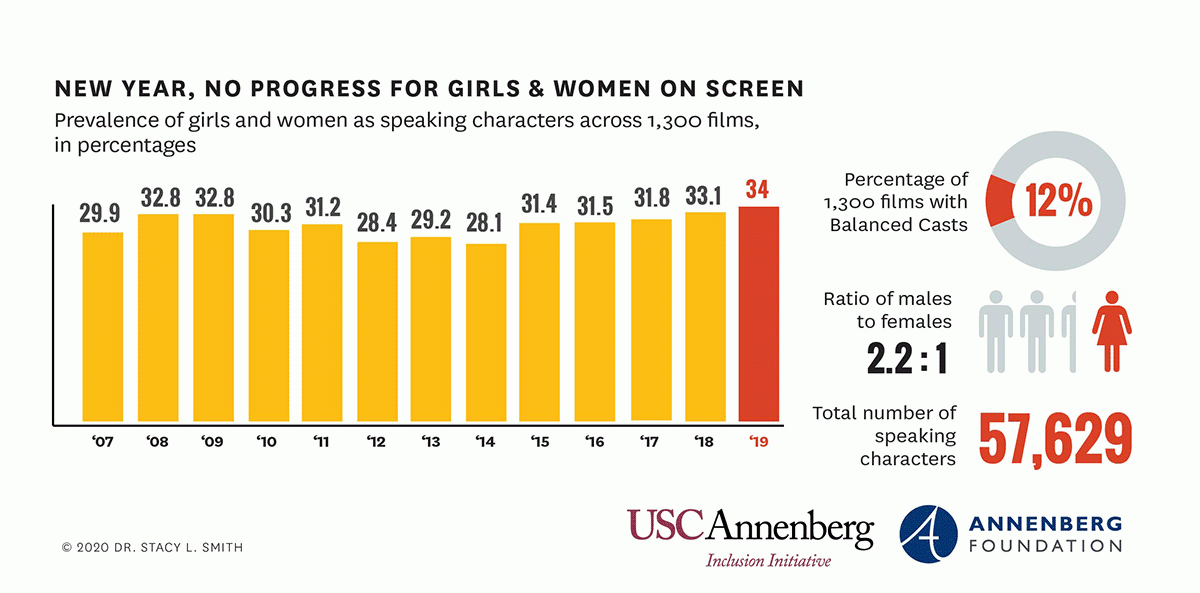
The report, from Smith and the Annenberg Inclusion Initiative at USC Annenberg, is the most comprehensive and intersectional look at film, having examined 57,629 characters in 1,300 top films from 2007 to 2019.

The study charts an increase in leading and/or co-leading characters from underrepresented racial/ethnic groups, from 27 films in 2018 to 32 films in 2019. Seventeen movies featured a girl or woman from an underrepresented group as a lead or co lead character in 2019 compared to just 11 in 2018, 4 in 2017 and 1 in 2007. 

Forty-three of 2019’s 100 top films had a girl or woman in a leading or co-leading role, a slight uptick from 39 in 2018 and a larger gain from 20 in 2007. However, only three films had a leading or co-leading role filled by a woman aged 45 or older, and only one of these roles went to a woman of color.

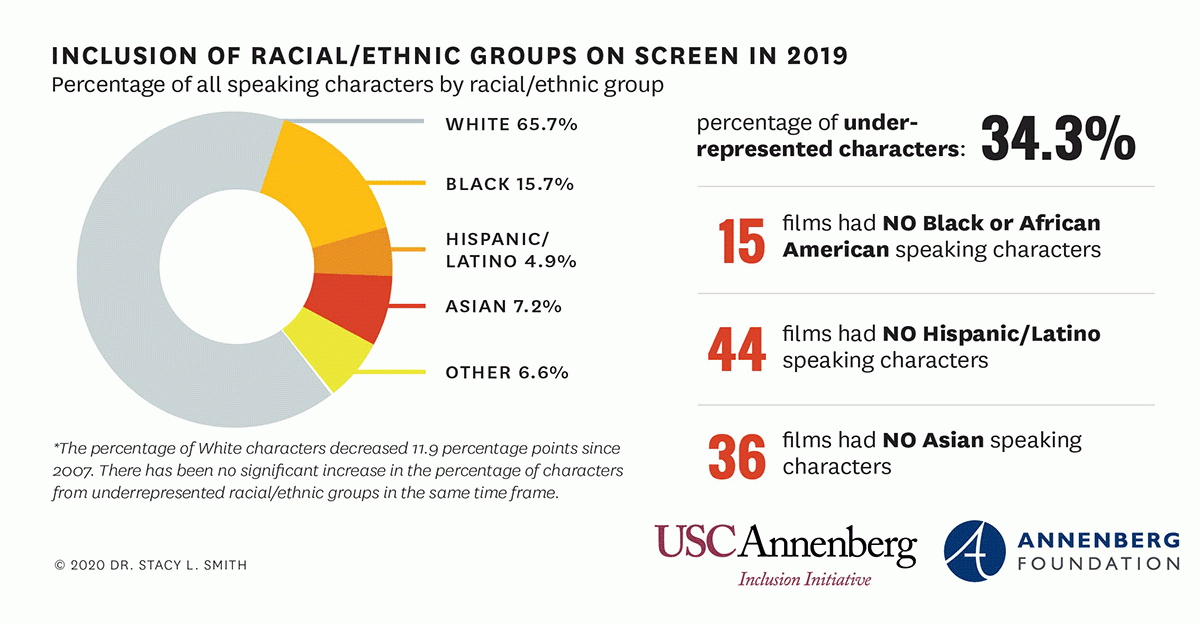
Despite the gains for AAPI actors, 36% of the surveyed films had no Asian speaking characters. In 2019, with all the aforementioned productions that represented only 7.2% of the speaking roles.

Much of the study focused on women. While showing considerable gains, and in most cases better than the job growth of actors and directors of color, women still fell way behind white men, who continue to get majority of the meatier roles and directing assignments.

When it comes to all women portraying speaking characters, there has been little to no progress in 13 years. The percentage of female-identified speaking characters has not meaningfully increased since 2007, reaching only 34% in 2019. Similarly, 34.3% of speaking characters were from underrepresented groups, which is below the U.S. population and a slight decrease from 2018. The overall ecosystem of cinematic storytelling is still one in which girls, women and people of color are marginalized and minimized.

The study also found a comparitively small number of roles for girls and women from underrepresented groups, and a similar lack of inclusiveness behind the camera -- directors, writers, casting directors and producers.

“This is a critical moment for the industry to commit to real and substantive change,” Smith said. “Too often the results of studies like this one garner attention without action. As protests for racial justice continue, it is imperative that companies move beyond performative statements and commit to take actions that will result in inclusive hiring practices on screen and behind the camera.”

READ the entire report here.

The "breakthrough" created by the success of Crazy Rich Asians may be an illusion, says report.

EDITOR'S NOTE: A word of caution, this is news sprinkled with opinion. Readers are encouraged to seek multiple news sources to formulate their own positions. 

Sunday, May 3, 2020

Darren Criss writes about his love for his late father

Darren Criss, center, with his parents.

The father of actor Darren Criss passed away last Sunday. The  award-winning actor announced the death of his father, Charles William "Bill" Criss, on his Instagram account the following day, showing pictures of his family. In a moving tribute to his late father, he wrote:

"Bill Criss has left the building. After many years of coping with a rare heart condition - which, true to his form, very few would have even been aware of - he finally checked out peacefully yesterday morning, surrounded by his loved ones.

"Dad lived an extraordinary life. Anyone who ever met Bill Criss adored him instantly. He could talk to anyone about anything. Well-read and well-traveled, he made the world a better place wherever he went. (sic)"

The actor, 33, praised his dad for being an "outstanding father" and a "true gentleman through and through".

Darren added: "He was as deliriously charming as he was relentlessly selfless; always putting other people first, making anybody who ever got into a conversation with him genuinely feel like they were the most incredible person in the room.

"And although he would have been the first to gracefully protest it, the simple truth is that he was in fact, every inch the exemplary man: a devoted husband, an outstanding father, a loving grandparent.


"He lived his days the same way he loved his friends and family - with an unwavering sense of composure, compassion, generosity, and humility.

"He was a true gentleman through and through, and was a constant source of joy and inspiration for me.


"I've spent most of my life trying to be like him, wanting to see and do all the incredible things he did — and I'm so grateful he was around to see me actually pull a few off," Criss wrote. "He was there for the greatest moments of my life, which of course, he always dressed up for. His kind blue eyes, big laugh, and infamous warm smile could not have been a better representation of who he was to his core."

"I cherished him every day, and will forever."

Darren Criss' latest project, Hollywood, is now streaming on Netflix. In the 7-part reimagining of Hollywood's Golden Age after WWII, Criss plays to type, a Filipino American of mixed heritage.

In 2018, Darren Criss won a Golden Globe and an Emmy for his chilling portrayal of killer Andrew Cunanan, another Filipino American real-life character, in the American Crime Story dramatic series, The Assassination of Gianni Versace."

Charles William Criss Jr. leaves behind his wife Cerina Bru, his sons Darren and Chuck Criss, and his grandchildren.

Friday, May 1, 2020

TGIF Feature: 'Hollywood' with Darren Criss available for streaming on Netflix

Darren Criss will play a Filipino American in Netflix's 'Hollywood.'

Finally, it's May 1 and AAPIs will get a chance to view the much anticipated Hollywood, starring Darren Criss, who plays an aspiring Filipino American director during Tinseltown's so-called Golden Age, right after WWII.

The sprawling 7-part drama is an alternate history of that era, mixing fictional characters with real-life figures of that period. Certainly, the depiction of the movie industry fully accepting People of Color and LGBTQ in this day and age would be labeled a fantasy, much less, in 1940s Hollywood.

"It is sort of a Hollywood-ization of Hollywood itself, or the Ryan Murphy version of that fantasy," Criss, who also served as an executive producer, told Deadline. "I hope people watching it go in taking it with a grain of salt that this isn't sort of a grand expose of the time, or some sort of factual recounting.

"I think that it will become very clear from the tone that things happen [in the show] that, clearly, didn't happen, otherwise you would've heard about it. It becomes pretty clear that this is, again, Hollywood getting the Hollywood treatment."


For AAPI fans, the depiction of Raymond Ainsley (Criss) as a half-Filipino, as the lead character is historic in itself. But the series also serves as an introduction of the real-life travails of the legendary Anna May Wong, played by Michelle Krusiec, to today's audience are major reasons to watch to watch the mini-series.

Criss, who is of mixed Filipino and white heritage, describes his characer "as an outsider, which is usually ground zero for anybody feeling isolated but in Raymond's case, he has a bit of a chip on his shoulder for being of half-Asian descent, which I think is just something that Ryan has always been interested in, especially being white passing."

The line uttered by Ainsley, "I am half-Filipino" will probably bring an audible cheer and high-fives from Filipino Americans because it is so rare that a Filipino American character have such a prominent role in a US-produced project.

The only other time a Filipino American played a lead role in a Hollywood production is 2018's The Assassination of Gianni Versace in which Criss portrayed Filipno American serial killer Andrew Cunanan. Criss won a Golden Globe and an Emmy for his work in that dramatic series.

Michelle Krusiec will help tell Anna May Wong's story in Netflix's 'Hollywood.'

In the little-known story of Wong, Krusiec was able to find common ground. In an interview with Deadline, Krusiec identified with Wong's plight.

“I’m constantly being underestimated and being reduced or relegated to side parts, supporting parts or parts where the characters are in service of someone else’s narrative,” said Krusiec. “I felt during [Wong’s] entire career, she was constantly cast in these kinds of roles because it brings so much to the table in terms of what she was actually doing with those parts. She was really hard to ignore and it was really hard to dismiss her. She became brokenhearted by her career, but she still persisted.”

“As an Asian American actor, I’ve been treading that road for a long time and trying to understand my own wrestling with identity and how do I persist and how do I have resilience,” she told Deadline.

EDITOR'S NOTE: As Hollywood unfolds on Netflix, check back on Views From the Edge for more articles about the series.

Tuesday, April 21, 2020

Darren Criss plays another Filipino American character in his latest outing


Some three years ago, Darren Criss got into trouble questioning his identity because of his mixed racial heritage -- white and Filipino.

Since then, in the roles he's taken and public statements he's made, there is no doubt of his pride in being a Filipino American. In his latest project, Netflix's llmited series Hollywood, which debuts May 1 on Netflix, Criss plays Raymond Ainsley, an aspiring movie director who is half Filipino.

It would be the second Filipino American character played by Criss, whose mother is from the Philippines. In 2018, he won plaudits, including an Emmy and Golden Globe, for his portrayal of Filipino American serial killer Andrew Cunanan in American Crime Story: The Assassination of Gianni Versace.

When he won his Golden Globe, he thanked his mother: “This has been a marvelous year for representation in Hollywood, and I am so enormously proud to be a teeny, tiny part of that, as the son of a firecracker Filipino woman.”

Hollywood is set in post-World War II, Tinseltown's so-called Golden Age. In reality, it wasn't a golden age for actors of color or the LGBTQ. Just Google Anna May Wong, Rock Hudson or Hattie McDaniel.

Based on the subject matter and the trailer, Criss could very well be up for awards again.

The Ryan Murphy fictional drama follows a group of aspiring actors and filmmakers as they try to make a career in the movies, amid the prejudices stacked against their race, gender, and sexualities.

“We began a lovingly constructed look at how I wished Hollywood would have operated back then; a world where women, gay people, and people of color could flourish,” Ryan explains in a statement. “I think the world would be very different than it is today if that happened.”

Hollywood has the glitz and glamor associated with that era and features

Criss' character Raymond Ainsley is one of the main characters. Ainsley is a Filipino American passing as white., who "aspires to broaden the stories Hollywood tells." 

Criss, who admits he benefited from his looks giving him the ability to portray white characters. [I was] eager to explore what that means for somebody who passes as white in an era where that is a socio-economic advantage," Darren says. 

"What does it mean when you're given opportunities, and what is your responsibility to the people in your life who don't have access to those opportunities?" 

For those actors of color, those questions are just as relevant in 2020 as they were in 1940s Hollywood. In Raymon Ainsley, Criss appears to be answering those questions raised by his doubters. Nevertheless, perhaps because of ethnic ambiguity, outside of his legion of  Filipino American fans, Criss has not been warmly embraced by the Asian Americans since his breakout role in the TV hit Glee. Hollywood may change that.

The series was co-written by Janet Mock, who is part Hawaiian, and features Michelle Krusiec as Anna May Wong, the first Asian American movie star. There will also be bevy. of special-guest-star appearances by Maude Apatow, Mira Sorvino, Rob Reiner, Michelle Krusiec, and Queen Latifah, playing some of the best known actors of that era.

In addition to having one of the lead roles, Criss was also executive producer.

Hollywood debuts on Netflix beginning May 1.

Thursday, September 19, 2019

UCLA report: Hollywood needs to change its world view to reflect today's multi-ethnic audiences


The bottom line of a new UCLA report for Hollywood's corporate leaders is: Diversity is good for business.
For Hollywood to be a more inclusive and diverse industry, companies need to implement a five-point strategy for hiring, sponsoring and promoting minorities and women — especially women of color — the new UCLA study suggests
The study, published Wednesday (Sept. 18), was drafted by the authors of UCLA’s Hollywood Diversity Report. It is based on an analysis of current diversity programs at Hollywood studios, agencies and other companies and interviews of 21 entertainment industry leaders with experience in diversity and inclusion efforts.
“There are many diversity hiring programs in place, but they are not always systematic or fully integrated into how companies actually do business,” said Darnell Hunt, dean of the division of social sciences at UCLA, and co-author of the report. “While these programs have served as a sort of lottery benefiting a few exceptional individuals, they are not contributing to overall, sustained progress on the equitable representation of women and minorities.
“Thus, they also do not serve the larger issue of making the content that today’s increasingly diverse audiences demand.”
According to the report, companies can improve diversity and inclusion by following five essential practices:
  • Modernize their worldviews of the evolving American audience, which is now 40 percent minority and 50 percent female. Businesses can do this by establishing a public statement about their diversity mission, setting specific goals with timelines that support the stated mission, and teaching employees that change is not only inevitable but beneficial.
  • Expand hiring searches to include candidates of diverse racial, ethnic, gender, disability and LGBTQ backgrounds. In part, companies can do this by tapping into databases like Creative Artist Agency’s list of TV writers of color and Women in Hollywood’s female filmmakers roster, and by expanding outreach to colleges.
  • Implement a robust strategy to amplify the roles of women, and women of color in particular, in leadership roles. Previous research has shown that when women occupy leadership roles, projects and work environments are considerably more inclusive.
  • Normalize compensation packages, especially for entry-level jobs, because minority hires from non-affluent backgrounds often cannot afford to take low-paying jobs despite their high-value networking opportunities.
  • Structure incentives for decision makers to prioritize diversity and inclusion at all levels.
Modernize their worldviews of the evolving American audience, which is now 40 percent minority and 50 percent female. Businesses can do this by establishing a public statement about their diversity mission, setting specific goals with timelines that support the stated mission, and teaching employees that change is not only inevitable but beneficial.

“Clearly there is no one-size-fits all approach to this issue, and making meaningful change is a deliberate process that requires sustained effort and a commitment to carry out the work at all levels from top to bottom,” said Ana-Christina Ramon, director of research and civic engagement for the social sciences division and the co-author of the new report. “We’re offering a list of sustainable actions that can be refined and adapted to fit any existing efforts. This problem won’t solve itself. The path ahead must be paved with intention.”
The box office success of 'Crazy Rich Asians' widened Hollywood's world view.
The researchers write that all five practices must be integrated to achieve the kind of meaningful change that would enable Hollywood to reflect America’s increasingly diverse mainstream. The Hollywood Diversity Report, which published the results of its sixth annual analysis in February, has repeatedly demonstrated that films and programs with diverse casts and creators are profitable.  
“Diversity must be seen as a business imperative, because it is,” Hunt said.
"In 2017, Latino market buying power was $1.5 trillion, followed by $1.3 trillion for African Americans, $986 billion for Asian Americans and $114 billion Native Americans, respectively. The result? Today’s “mainstream” market is defined by its remarkable and increasing diversity," cites the report.
"It follows that people of color are also avid moviegoers and have had a profound impact on the success of Hollywood’s top films. In 2017, for example, people of color accounted for the majority of domestic ticket buyers for five of the top ten films, ranked by global box office," continued the report. "Moreover, people of color bought half of the tickets for one of the remaining five top ten films that year. It is worth noting that seven of the top ten films had casts that were 21 percent or more diverse."
UCLA’s annual Hollywood Diversity Report series published in February has consistently found that despite the stark underrepresentation of women and people of color in the industry, diversity sells at the box office. The report cites the box office success of Crazy Rich Asians and Black Panther as examples.
After the so-called “Hollywood white out” TV season of 1999–2000 began without a single new show featuring a lead character of color, the NAACP and a coalition of media and social justice organizations demanded that the entertainment industry stop systematically excluding minorities.
“We are once again challenging studios, networks and production companies to take a hard look at their workforce, to see where and if they have improved, and to seek out ways to ensure that the entertainment industry is diverse and inclusive, and to continue their focus on the creative community’s acceptance of talent, regardless of age, race, religion or gender,” said Vicangelo Bulluck, who as executive director of the NAACP’s Hollywood bureau, led efforts against the “white out” and chaired the advisory board for the report.
Scarlett Johansson 'whitewashed' Ghose in A Shell.

In addition, today’s multi-ethnic audiences are also very savvy and sensitive to inauthentic casting or “whitewashing.” Ghost in the Shell, a film based on a Japanese comic and numerous anime adaptations, received negative attention once news circulated that the lead character — who is Japanese in the original story — would be portrayed by the white actress Scarlett Johansson. The movie grossed only $40.6 million in the United States, despite a budget of $110 million. 
The report concludes: "Current status quo approaches to addressing the entertainment industry’s diversity problem have failed to move the needle in any significant way. This fact is documented in numerous studies cited throughout this report. 
"We must get beyond thinking of diversity programs as lottery systems that reward just a few hardworking and highly talented individuals. If the goal is truly to establish an inclusive Hollywood, one in which the storytelling that defines us as a nation better reflects the new mainstream, then the means outlined in this report must replace industry default positions and simply engaging in business as usual."
________________________________________________________