Showing posts with label AAPI Actors. Show all posts

Friday, December 9, 2022

Time names Michelle Yeoh 'Icon of the Year'


It was her multi-faceted dramatic performance in the surreal movie, Everything Everywhere All at Once that put the spotlight on actress Michelle Yeoh, but it was her 40-year "battle" for meaningful roles that earned her the title Icon of the Year from Time.

Yeoh tells the magazine that she had to fight a Hollywood movie industry that offered her parts that were stereotypes of Asians or harmful tropes of Asian women.

“It shouldn’t be about my race, but it has been a battle,” Yeoh tells Time. “At least let me try.”

In an interview with Time published Dec. 6, the Malaysian-born actress, 60, opened up about career obstacles she says she faced as an Asian actress in the entertainment industry.

Yeoh was already an icon in the Asian film industry for her roles in then got the role in the 1997 James Bond film Tomorrow Never Dies, in which she plays Bond’s equal. She continued to win over American audiences with her supporting roles in Crouching Tiger, Hidden DragonThe Mummy: Tomb of the Dragon EmperorKung Fu Panda 2, several Marvel films and 2018's groundbreaking Crazy Rich Asians that featured an all Asian cast

Crazy Rich Asians' box office success and audience appeal opened the eyes of Hollywood studios and opened the doors to other Asian and Asian American actors and more diverse storylines and projects for the big screen and television.

It wasn’t until this last year though that Hollywood began to recognize Yeoh as a top-billed actor, seen for her acting abilities beyond white audiences' expectations of Asian thespians. 

In Everything Everywhere All at Once she starred as Evelyn Quan Wang, the universe-jumping owner of a struggling laundromat. Her performance in EEAO placed her in the mix for an Oscar nomination in the Best Actress category.

In a Gentlemen's Quarterly interview that went viral on social media, a tearful Yeoh said her role as Evelyn “was something I had been waiting for a long time”, to show audiences “what I am capable of”.

Given the Oscar buzz and the studio campaign promoting her performance, Yeoh said she feels the pressure of possibly winning as Oscar. She would be the first Asian woman to win the lead actress a

“I’ve thought about it,” Yeoh tells Time about a possible history-making Oscar win. “And not just me – I feel like my full Asian community has thought about it. They come up to me and they say, ‘You’re doing it for us.’”


“It’s not about needing it,” she tells Time. “It’s that feeling that you don’t have to explain: it’s love from other people. My arms are out open.”

"I've worked in this industry for almost 40 years, and to finally be recognized for the work that you do," she tells Buzzfeed after being honored by Time. "I've been everywhere, and I've done everything, and now I get it all at once," she joked. "So it's worth the wait."


EDITOR'S NOTE: For additional commentary, news and views from an AANHPI perspective, follow @DioknoEd on Twitter.


Tuesday, January 11, 2022

Anna May Wong coin is the change Asian Americans seek


If you are among those still using real money, be sure to check your change starting today. You might get a quarter with the image of Anna May Wong on it.

 The Anna May Wong Quarter is the fifth coin in the American Women Quarters™ Program. Anna May Wong was the first Chinese American film star in Hollywood. She left a legacy for women in the film industry.

Wong, born in Los Angeles in 1905, appeared in more than 60 movies throughout her career. In addition to her roles in silent films, television, and stage, she landed a role in one of the first movies made in Technicolor. She achieved international success despite racism and discrimination.


The quarter is the result of the American Women Quarters Program, a four-year program that celebrates the accomplishments and contributions made by women to the development and history of our country. 

RELATED: Movie about Anna May Wong planned, starring Gemma Chan

"Each time we redesign our currency, we have the chance to say something about our country — what we value, and how we've progressed as a society. I'm very proud that these coins celebrate the contributions of some of America's most remarkable women," said Treasury Secretary Janet Yellen, who had final approval over the choices.

The quarter was designed by United States Mint Artistic Infusion Program Designer Emily Damstra and sculpted by United States Mint Medallic Artist John McGraw.

“Many prominent actors from the 1920s and 1930s saw their name framed by lightbulbs on movie theater marquees, so I thought it made sense to feature Anna May Wong in this way,” said Damstra. “Along with the hard work, determination, and skill Anna May Wong brought to the profession of acting, I think it was her face and expressive gestures that really captivated movie audiences, so I included these elements next to her name.”

The Mint will begin shipping the quarters on October 24. If you’d prefer not to wait for circulating change, you can order the currency from the U.S. Mint.

Beginning in 2022, and continuing through 2025, the U.S. Mint will issue up to five new reverse designs each year. The obverse of each coin will maintain a likeness of George Washington, but is different from the design used during the previous quarter program.


Anna May Wong, the first Asian American female movie star.

The other women in the first batch that the program is honoring are:

  • Maya Angelou – celebrated writer, performer, and social activist
  • Dr. Sally Ride – physicist, astronaut, educator, and first American woman in space
  • Wilma Mankiller – first female principal chief of the Cherokee Nation
  • Nina Otero-Warren – a leader in New Mexico’s suffrage movement and the first female superintendent of Santa Fe public schools

The American Women Quarters may feature contributions from a variety of fields, including, but not limited to, suffrage, civil rights, abolition, government, humanities, science, space, and the arts. The women honored will be from ethnically, racially, and geographically diverse backgrounds.

Upcoming, a quarter featuring the legendary teacher of hula and University of Hawaiʻi instructor Edith Kanakaʻole, will be minted.

The American Women Quarters Program is authorized by the Circulating Collectible Coin Redesign Act of 2020 (Public Law 116-330).

Look for these quarters in your change. Or shop online and enroll in this groundbreaking program to sign up to receive all four annual installments as they become available. Limited quantities will be produced, so enroll today to ensure you receive a complete collection!

“Anna May Wong was basically ‘hashtag representation matters’ decades before Twitter was even invented,” Paula Yoo told the New York Times. Yoo is a screenwriter in Los Angeles who wrote a children’s book about Wong’s life. “That’s why this quarter is important — because she’s minted, she’s part of Americana, she’s part of American history.”

EDITOR'S NOTE: For additional commentary, news and views from an AAPI perspective, follow me on Twitter @DioknoEd.


Sunday, November 14, 2021

Jason Momoa and Dave Bautista motion picture reportedly in the works.

Buddies onscreen and in real life: Dave Bautista, left, and Jason Momoa.

What started as a tweet teaser has turned a bidding war for a movie starring two big AAPI stars, Jason Momoa and Dave Bautista.

The duo enjoyed working with each other in "See," the dystopian action series that is airing its third season on Apple-TV.

The idea began as a tweet last August from Baustista, a Filipino American former wrestler.

“Just going to throw this out into the atmosphere and see what happens. Here we go…Me and Momoa in a Lethal Weapon type buddy cop movie directed by David Leitch. Ok! There it is. Now we wait,” tweeted Bautista, who made a strong impression in his role as the alien Drax in Guardians of the Galaxy.


Momoa, the Aquaman star, responded," absolutely.!" Bautista's suggestion to film in Hawaii, Momoa's home state, just added to the appeal.

They didn't have to wait long. The idea, apparently, is selling itself.

Studios began bidding against each other to get the two action stars to co-star in a major film. MGM reportedly is closing in on the deal, according to Deadline.

Although they are not in any scenes together, both stars are in the latest iteration of Dune where both play warriors.


Thursday, October 28, 2021

UCLA report reveals viewers prefer TV content that reflects reality of a diverse America

Netflix's "Awkwafins is Nora from Queens" has a laregly Asian cast.


The changing demographic trends in the U.S. is slowly beginning to show up in movies houses and home screens even as Hollywood decision makers continue to cater to an audience that continues to shrink.

The latest UCLA Hollywood Diversity Report, Part 2 published Tuesday, reveals that U.S. television viewers during the COVID-19 pandemic look for and prefer content that reflects the diversity of the real America and addresses concerns or situations faced by people of color. Surprisingly, and perhaps a ray of hope, White audiences shared the same preferences.

“We have seen this appetite for diverse content repeated over the history of our analyses,” said Darnell Hunt, co-author of the report and UCLA’s dean of social sciences. “The fact that shows with diverse writers rooms did well last year also illustrates that audiences are looking for authentic portrayals.”

The report comes a month after the Emmys featured all White nominees in the acting categories demonstrating Hollywood studio's apparent ingrained racial bias in casting prominent roles and producing entertainment catering to an audience from the 1950s made up primarily of Blacks and Whites.

Click here to download the complete UCLA report.

Asian, Latino and Indigenous talent in front of and behind the camera continue to get under represented.

The UCLA report, which covers statistics for the 2019–20 TV season, tracks racial and gender diversity among key job categories, as well as ratings and social media engagement for 461 scripted shows across 50 broadcast, cable and streaming providers.

Part 1 of the report released  by UCLA earlier this year, focused on the diversity efforts of the movie industry.

The new study found a continued correlation between the racial makeup of shows’ writers and TV ratings. For example, among households of all races in 2019–20, the scripted broadcast shows that earned the highest ratings were those in which people of color made up between 31% and 40% of the credited writers. 

Overall, racial diversity improved in almost every job category tracked by the report, and representation among women improved in about half of the job titles. Despite the better numbers of POC employment in the industry, Asians, Latinos and Indigenous talent continue to be underrepresented.


And for the first time in the report’s history, people of color had a higher percentage of scripted broadcast TV acting roles, 43.4%, than their overall percentage of the U.S. population.

Across all three platform types -- broadcast, streaming, digital -- there were more people of color credited as writers than in the previous report. Overall, people of color made up 26.4% of the credited writers for broadcast series last season (up from 23.4%), 28.6% of credited writers for cable (up from 25.8%) and 24.2% of credited writers for streaming (up from 22.8%). Most of those modest gains were recorded by women, according to the study.

But people of color are still largely underrepresented among TV writers, given that 42.7% of Americans are nonwhite.

More actors of color

Over the decade since the Hollywood Diversity Report began, diversity has improved the most among acting jobs, especially in TV, compared with all other TV and movie job types. In 2019–20, television shows with majority-nonwhite casts were more prevalent than ever.

Bolstered by Asian American shows such as Never Have I Ever and Awkwafina is Nora From Queens, for the first time since the researchers began tracking data, a plurality of shows on cable (28.1%) and streaming platforms (26.8%) featured casts in which the majority of actors were nonwhite. And 32.1% of broadcast shows had majority-nonwhite casts, up from just 2.0% in the first report 10 years ago.

The new report provides further support for the fact that audiences favor shows with diverse casts. During 2019–20, among white households, ratings for scripted broadcast shows were highest for shows whose actors were 31% to 40% nonwhite. Among Black households, scripted broadcast shows with the highest ratings where those in which cats were more than 50% nonwhite.

For streaming programming, which is dominated by Netflix, ratings among white, Black and Asian households were highest for shows with casts that were from 31% to 40% nonwhite.


TOP: Mindy Kaling's "Never Have I Ever" features a diverse cast and, bottom, the 2021 version
 of  "Kung Fu" centers on an Chinese American family.


The report’s authors also analyze audiences’ interaction with TV programs on social media, and how those trends correspond with cast diversity. For scripted cable shows during 2019–20, for example, they found that programs with majority nonwhite casts had the highest engagement on Facebook, Instagram and Twitter. And for streaming shows, audience engagement on Twitter specifically was highest for programs with majority nonwhite casts.

Diverse show creators equals mixed casts 

Another area in which diversity improved was among show creators such as Mindy Kaling, Awkwafina and Dean Devlin. That’s an important datapoint because show creators have influence over which stories are developed, whose stories they represent and how they’re told, said Ana-Christina Ramón, co-author of the report and the director of research and civic engagement in the UCLA Division of Social Sciences.

“We also see that when women and people of color hold high-level creative positions, there is greater diversity down the line in casting and likely for crew hiring,” Ramón said. “Women and people of color are still very underrepresented in these and other behind-the-camera jobs, which is why this report continues to exist.”

EDITOR'S NOTE: For additional commentary, view and news with an AAPI perspective, follow me on Twitter @DioknoEd


Saturday, August 7, 2021

"Blindspotting" introduces a groundbreaking Filipina American character

Filipino American actress April Absynth breaks stereotypes with her character,
Jacque, in "Blindspotting."

 
"Blindspotting" features best friends Jacque, left, and Trish.

OPINION

I love the Filipino American character April Absynth plays in the television series Blindspotting.

Abseynth plays Jacque, the BFF of Trish, one of the Latino characters in the Starz series. Jacque is unlike any other Filipino characters ever portrayed on American TV. She's not a computer nerd, a valuable assistant, accountant or a Lotus Blossom or Dragon Lady.

You see, the series takes place in Oakland, a wonderful polyglot community where no ethnic group is in the majority. And the series itself is unlike any other series. Perhaps if you took the movie In The Heights and the groundbreaking musical dramedy of Crazy Ex-Girlfriend, mixed it in with the city's gritty hip-hop culture, you might get an idea of how unique this show is.

Jacque is Trish's street-smart business partner in her quest to establish a business unique to her, uh, talents: like catering to customer's sexual preferences. Jacque is like the little angel on the shoulder whispering advice to Trish, played by Jaylen Barron, encouraging entrepreneurial Trish and gently bringing her down to earth. 

But what I like about Jacque is her complete dismantling of the Asian woman as the  shy, demure stereotype loved by white producers and writers. Jacque has a no-holds-barred willingness to loudly express her own desires in terms that leaves no one guessing.

"I found my giant and I just need a beanstalk," Jacque says after meeting a "fine-as-hell" Black attorney. The attorney is clearly interested because, as it turns out, is a fan of Jacque, who is an artist and displays her artwork on her website

Absynth is from the Bay Area and was the leading female character in the movie Lumpia With A Vengeance, an independent feature by Filipino American creator Patricio Alicaway Ginelsa, that is currently making the rounds on the AAPI  film festival circuit.

If you haven't seen Blingspotting yet, you should get to Starz right away. Because of the unapologetic format of the series, a second season is in doubt despite Variety calling Blindspotting the best show on television. 

It centers around Ashley, a breakout role for Jasmine Cephas Jones, the girlfriend of the imprisoned Miles.

Starz's "Blindspotting" uses songs, dances and poetry to advance its narrative.
The Filipino American character, Jacque, pllayed by April Absynth, is at far left.

Joining Jones is a formidable cast — including the aforementioned Jaylen Barron, Benjamin Earl Turner and Helen Hunt — and a surreal sensibility that incorporates music, dance and spoken word breakdowns without weighing the narrative down.

The setting of the series depicts Oakland lovingly, showing the city's blue-collar diversity and the beauty of relationships between family and friends. Despite the recent spate of attacks on elderly Asian Americans by Blacks, whether it intended to or not, Blindspotting refreshingly shows the reality of the day-to-day long-standing relationship between the city's Asian, Black and Latino communities. No big deal. It just "is."

Let's hope Starz gives Blindspotting a second season and a backstory for Jacque (like, give her a last name) because she's funny, smart and there is clearly more to her than just being Trish's pal.

EDITOR'S NOTE: For additional commentary, news and views from an AANHPI perspective, follow @DioknoEd on Twitter.


Wednesday, August 4, 2021

Dave Bautista joins Jason Momoa in "See's" season 2; watch trailer

APPLE / SEE
Jason Momoa and Dave Bautista play brothers in Apple's dystopian drama, See.


It's not often that both the leading man and the villain of a Hollywood production feature AAPI actors. That's what season 2 of Apple's See will feature.

Two of the biggest AAPI stars, Jason Momoa and Dave Bautista, will face off in the second season of the post-apocalyptic adventure drama, which takes place hundreds of years into the future when the world's population has lost the ability to see.

Filipino American Bautista will portray Edo Voss, the estranged brother of Baba Voss, the hero played by Momoa, whose father is Native Hawaiian. Also in the cast are Hoon Lee and Olivia Cheng.

In season 2, Baba is struggling to reunite his family amid the looming threat of war between two rival kingdoms. Despite his best efforts, his wife (Hera Hilmar) and sighted children (Archie Madekwe and Nesta Cooper) are pulled to the forefront of the conflict, where Edo's long-simmering hatred for his brother imperils them all even further. Turns out life in a desolate, primitive future where almost no one can see isn't so easy.

The first season was popular enough that a second season was granted. In the first season we are introduced to Momoa) is the Chief of the Alkenny tribe and his wife gives birth to a set of twins who, miraculously, are able to see. The queen of another tribe wants to capture Voss’ children so he must rely on his instincts and warrior skills to protect them.

Before the second season premiers on Aug. 27 on Apple TV+, the show has been given a third season.


Thursday, July 15, 2021

Emmy nominations remind us AAPI representation on television falls short of reality

Bowen Yang on "Saturday Night LIie" was nominated for an Emmy

OPINION

Just as it might appear that Asian representation on American television is at an all time high with a record number of shows featuring Asian leads, along comes the Emmy nominations to remind us that AAPI actors, producers and writers have a long, long way to go to achieve anything resembling real life.

There were zero number of Asian and Asian American actors in any of the categories for lead actors, the categories that get the most media attention and are featured in prime time during the broadcast.

Nevertheless, we celebrate Bowen Yang for getting nominated for his part(s)  on "Saturday Night Live" with an Emmy nomination for Best Supporting Actor in A Comedy.

Congratulations are due, too for Philippa Soo getting nominated in the Best Supporting Actor in a Limited Series for her heartbreaking role in "Hamilton;" and Max Minghella of "The Handmaid's Tale" was nominated in Best Supporting Actor in a Drama Series.

There has been an improvement in Asian representation on television but if you're not a TV addict or someone who actively looks for Asian and Asian American stories and actors in featured roles, Asian and Asian American representation continues to look abysmal.

We are grateful for Mindy Kaling's "Never Have I Ever," "Awkwafina Is Nora From Queens," Netflix's "Warrior," and Disney's 'High School Musical: The Musical: The Series" starring Olivia Rodrigo, "Blue's Clues" host Joshua Dela Cruz, Lou Diamond Phillips in "Prodigal Son," Sandra Oh in "Killing Eve," Michelle Yeoh in "Star Trek: Discovery" and the increase of secondary roles awarded to AAPI actors in a number of series, but the fact that I can name practically all the shows and actors in one paragraph leads us the sad conclusion that Hollywood is far from seeing America for what it is.

These Emmy statistics, of course, are linked to the overall underrepresentation of Asian and Pacific Islanders on television. Actors of Asian descent made up 1.7%, 3.1% and 1.8% of lead roles across broadcast, cable and digital shows, respectively, during the same time period (while making up 5.6% of the U.S. population, according to UCLA's Hollywood Diversity Report 2020: A Tale of Two Hollywoods

Following are the nominations in the major categories (minus the technical nominations) featuring Asian American artists.

PEN15 starring Maya Erskine -- Best Comedy

Maya Erskine, “PEN15” (“Play”) -- Best Writing for A Comedy

Yahlin Chang, “The Handmaid’s Tale” (“Home”) -- Writing for A Drama Series

Janet Mock , “Pose” (“Series Finale”) -- Writing for A Drama Series

Padma Lakshmi, "Top Chef -- Outstanding Host for a Reality Program

Tan France of “Queer Eye" -- Outstanding Host for a Reality Program

Brett Chan, Stunt Coordinator, "Warrior" -- Outstanding Stunt Coordination


Monday, May 24, 2021

UCLA Report: Audiences want movies that reflect the diversity of America

Will the pandemic force Hollywood to rethink diversity goals?


ANALYSIS

For the movie industry, 2020 was a year like no other. Theaters shuttered, No red carpets. Audiences staying home. Movies premiering on streaming channels.

Like everyone, Hollywood studios had to get creative in 2020. UCLA’s latest Hollywood Diversity Report, published  last week by the UCLA College Division of Social Sciences, shows that 54.6% of the top films of 2020 were released solely via streaming subscription services, a major departure from business as usual.

But like reports from recent years, movie audiences -- whether at home or at the few theaters that remained open -- were more diverse and movies that had diverse casts continued to do better at the box office.


However, Hollywood decision-makers appear not moved by the report's data. The most underrepresented groups in all job categories, relative to their presence in the U.S., are Asian, Latino and Native actors, directors and writers.

Th
e film installment of this year’s Hollywood Diversity Report tracks the top 185 films of 2020, breaking down performance by box-office revenue for theatrical releases and, new for this year, Nielsen ratings for streaming films.

Though 2020 was far from a typical year in the Hollywood film sector, new evidence nonetheless supports longstanding findings from the UCLA report series that America’s increasingly diverse audiences prefer diverse content. Movie fans of color had a larger impact than usual because of the industry's move to releasing new films on streaming platforms, where diverse audiences flocked to during the pandemic

For six of the top 10 theatrically released films, minorities accounted for the majority of domestic ticket sales during opening weekend. For the seventh top film, minorities accounted for half the ticket sales.

For the smaller-than normal number of top films released theatrically in 2020, median global box office receipts peaked for those that had very diverse casts — from 41 percent to 50 percent minority, states the report 

For the much larger collection of top films released via streaming platforms, ratings and social media interactions were highest for titles with casts that were from 21 percent to 30 percent minority. 


Meanwhile, people of color accounted for the majority of opening weekend domestic ticket sales for six of the top 10 films released in theaters in 2020 (ranked by global box office), as well as half of the tickets for a seventh top 10 film. Similarly, households of color accounted for a disproportionate share of the households viewing eight of the top 10 films released via streaming platforms in 2020, ranked by total household ratings. 

Finally, findings based on box office share and household ratings reveal that the films most favored by diverse moviegoers and households in 2020 tended to have casts that were greater than 30 percent minority. 

Constituting more than 40 percent of the U.S. population, people of color accounted for an even a larger share of the market due to their heavy consumption of top films in 2020, and the data clearly show they preferred diverse content.

Coinciding with Hollywood’s most atypical year in terms of how films were released was the industry’s most successful year on the diversity front. As this report documents, women and people of color not only made progress in each of the major employment arenas considered in 2020, but in two of them — among leads and total actors — both groups either reached or came very close to reaching proportionate representation. This was a first.

These market realities clearly make the case for Hollywood treating diversity as a first-order business imperative, states the UCLA report. "Indeed, a recent McKinsey & Company report estimates that the industry is leaving about $10 billion on the table by not including more Black talent and stories in its creative ecosystem," the report says. "This figure only grows when we consider the audience shares and purchasing power of other diverse groups marginalized by the industry."

Could there be a correlation between the the pandemic's health measures and the tremendous progress observed on the diversity front? Or were these corresponding breaks with business as usual a mere coincidence, Hollywood finally coming to terms with its diversity problem by happenstance in a year also skewed by the pandemic? 
How do we know that the progress observed in 2020 was not an anomaly that will be revealed as such by findings from the next report?
Movies with AAPI leads or themes slated to be released in 2021 can give us an indication. Already Raya and the Last Dragon, Mortal Kombat and Army of the Dead have already had their premieres this year
Some of this year's blockbuster releases include: Jungle Cruise will debut in July, Shang Chi and the Legend of 10 Rings is scheduled for a September premiere, Oscar winner Chloe Zhao's The Eternals starring Gemma Chan and Kumail Nanjiani ,has a November opening; Matrix 4, December.
In addition, several other films with smaller budgets, but more intimate, such as  Paper TigersThe Fabulous Filipino Brothers and Islands, are making the rounds in the film festival circuit, seeking distributors that might be released throughout the year.

Movie productions usually are years in the making so the the decisions made this year will be the true test. The headline for this time in 2022 could be: 2020 was the turning point for Hollywood's diversity woes; or, Hollywood goes back to its old ways in 2021.
EDITOR'S NOTE: A word of caution, this post is news laced with opinion. Readers are encouraged to access multiple news sources to form their own opinion.


Saturday, September 12, 2020

USC Report: Inclusion in Hollywood is mostly all talk, little action


What might appear to be a flood of recent and new films and TV shows featuring AAPI characters in prominent roles is really just a drop in a very big bucket.

All the movies starring Dwayne Johnson, one of the busiest actors in Hollywood, was not enough; Crazy Rich Asians, To All the Boys I Ever Loves 1 and 2, The Farewell, Always Be My Maybe, and the TV productions, Never Have I Ever, Late Night with Lilly Singh; throw in the numerous secondary roles in a dozen or so TV shows and movies and they all were still not be enough to move the needle on diversity.

In the midst of ongoing protests against racial injustice not seen since the 1960s, a new study from the University of Southern California shows Hollywood movies continues a systemic flaw in Tinseltown --  a lack of inclusive representation of those from underrepresented racial/ethnic groups, girls and women, the LGBTQ community, and individuals with disabilities.

“After 13 years, it is not clear what might convince entertainment companies to change,” said USC Prof. Stacy L. Smith, on the study's authors. 

“Despite public statements, the data reveal that there is still apathy and ambivalence to increasing representation of speaking characters overall in popular films. This is both the easiest representational gap to address and one that is essential to strengthen the pipeline to more prominent roles.”


The spate of recent productions featuring Asian American and Pacific Islanders in productions may seem like an explosion when compared to what the industries were like before Crazy Rich Asians busted through Hollywood's consciousness bringing attention to AAPI talent and the wealth of stories.

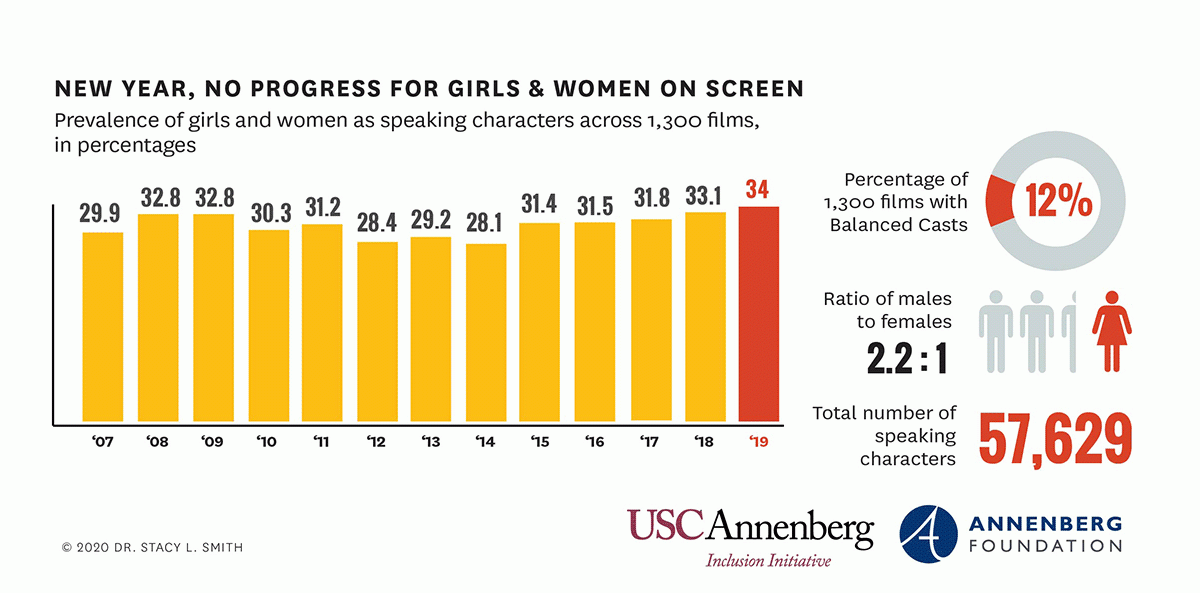
The report, from Smith and the Annenberg Inclusion Initiative at USC Annenberg, is the most comprehensive and intersectional look at film, having examined 57,629 characters in 1,300 top films from 2007 to 2019.

The study charts an increase in leading and/or co-leading characters from underrepresented racial/ethnic groups, from 27 films in 2018 to 32 films in 2019. Seventeen movies featured a girl or woman from an underrepresented group as a lead or co lead character in 2019 compared to just 11 in 2018, 4 in 2017 and 1 in 2007. 

Forty-three of 2019’s 100 top films had a girl or woman in a leading or co-leading role, a slight uptick from 39 in 2018 and a larger gain from 20 in 2007. However, only three films had a leading or co-leading role filled by a woman aged 45 or older, and only one of these roles went to a woman of color.

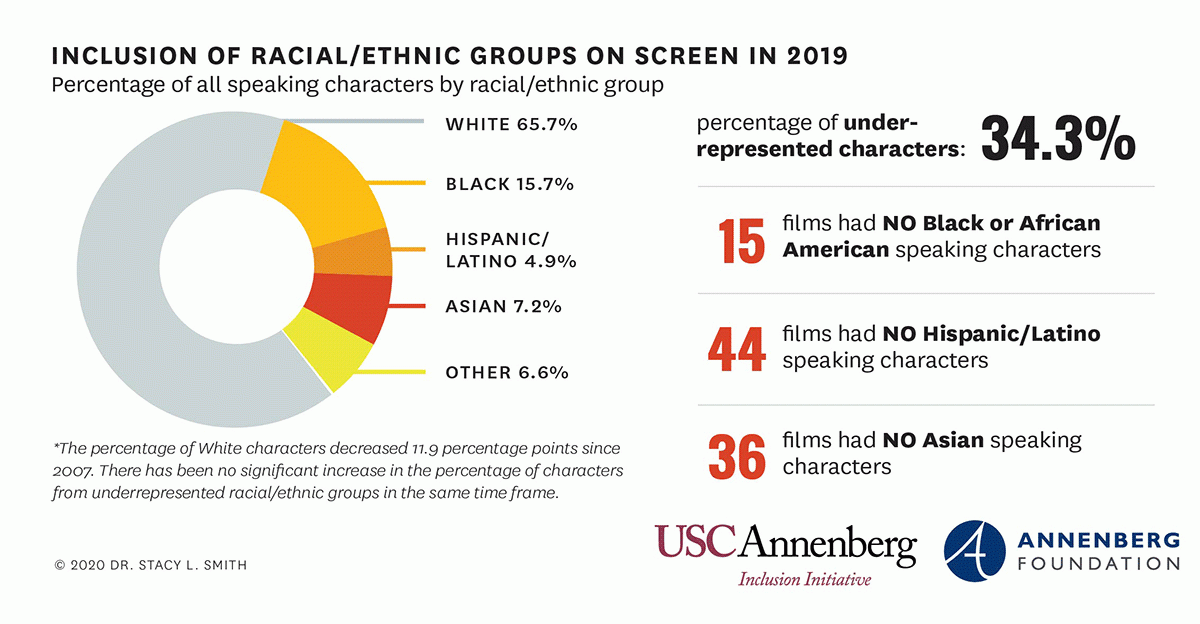
Despite the gains for AAPI actors, 36% of the surveyed films had no Asian speaking characters. In 2019, with all the aforementioned productions that represented only 7.2% of the speaking roles.

Much of the study focused on women. While showing considerable gains, and in most cases better than the job growth of actors and directors of color, women still fell way behind white men, who continue to get majority of the meatier roles and directing assignments.

When it comes to all women portraying speaking characters, there has been little to no progress in 13 years. The percentage of female-identified speaking characters has not meaningfully increased since 2007, reaching only 34% in 2019. Similarly, 34.3% of speaking characters were from underrepresented groups, which is below the U.S. population and a slight decrease from 2018. The overall ecosystem of cinematic storytelling is still one in which girls, women and people of color are marginalized and minimized.

The study also found a comparitively small number of roles for girls and women from underrepresented groups, and a similar lack of inclusiveness behind the camera -- directors, writers, casting directors and producers.

“This is a critical moment for the industry to commit to real and substantive change,” Smith said. “Too often the results of studies like this one garner attention without action. As protests for racial justice continue, it is imperative that companies move beyond performative statements and commit to take actions that will result in inclusive hiring practices on screen and behind the camera.”

READ the entire report here.

The "breakthrough" created by the success of Crazy Rich Asians may be an illusion, says report.

EDITOR'S NOTE: A word of caution, this is news sprinkled with opinion. Readers are encouraged to seek multiple news sources to formulate their own positions. 

Wednesday, June 17, 2020

Win a date with Keanu Reees

Asian American & Pacific Islander actor Keanu Reeves is donating his time for a charity.

What would you tell Keanu Reeve if you had 15 minutes with him? You can have the movie star's undivided attention - for a price - all for a good cause.


The 55-year old actor is auctioning off his time to the highest bidder in an auction that would benefit Camp Rainbow Gold, an agency providing "emotionally empowering experiences to Idaho’s children diagnosed with cancer and their families."


If you're interested, you better act quick and click here. The bidding for the Zoom call ends on Monday, June 22. As of Wednesday morning, June 17, it was already up to $16,700.

The benefit is a fundraising efforts for Camp Rainbow Gold following a postponed event due to the coronavirus pandemic, according to the Hollywood Reporter. 

"We quickly realized we wouldn’t be the only ones moving our fundraiser to an online auction,” said the charity's executive director Elizabeth Lizberg. "We also realized after months at home, people are craving connections and experiences that are safe but fulfilling."

The Hollywood trade magazine also reports that besides Reeves, other items donors can bid on include former Fifth Harmony member Ally Brooke who will perform a 15-minute private Zoom concert; legendary voice actor Rob Paulsen who will mimic some of his memorable characters from Jimmy Neutron to Pinky and the Brain while also donating swag and a recorded voicemail message. Other offers include: a signed Andy Grammer guitar; a spa day; custom tattoo design; and getaways to Mexico, a dude ranch, and Sun Valley. 

This is not the first time the Hawaiian Chinese American actor has helped out a charity. He has donated his fame and time to various cancer chairities in the name of one of his sisters who died of leukemia.

The star of the Matrix franchise and Bill & Ted adventures, recently played a fictional version of himself in a Netflix romcom, Always Be My Maybe starring Ali Wong and Randall  Park.

Tuesday, April 21, 2020

Darren Criss plays another Filipino American character in his latest outing


Some three years ago, Darren Criss got into trouble questioning his identity because of his mixed racial heritage -- white and Filipino.

Since then, in the roles he's taken and public statements he's made, there is no doubt of his pride in being a Filipino American. In his latest project, Netflix's llmited series Hollywood, which debuts May 1 on Netflix, Criss plays Raymond Ainsley, an aspiring movie director who is half Filipino.

It would be the second Filipino American character played by Criss, whose mother is from the Philippines. In 2018, he won plaudits, including an Emmy and Golden Globe, for his portrayal of Filipino American serial killer Andrew Cunanan in American Crime Story: The Assassination of Gianni Versace.

When he won his Golden Globe, he thanked his mother: “This has been a marvelous year for representation in Hollywood, and I am so enormously proud to be a teeny, tiny part of that, as the son of a firecracker Filipino woman.”

Hollywood is set in post-World War II, Tinseltown's so-called Golden Age. In reality, it wasn't a golden age for actors of color or the LGBTQ. Just Google Anna May Wong, Rock Hudson or Hattie McDaniel.

Based on the subject matter and the trailer, Criss could very well be up for awards again.

The Ryan Murphy fictional drama follows a group of aspiring actors and filmmakers as they try to make a career in the movies, amid the prejudices stacked against their race, gender, and sexualities.

“We began a lovingly constructed look at how I wished Hollywood would have operated back then; a world where women, gay people, and people of color could flourish,” Ryan explains in a statement. “I think the world would be very different than it is today if that happened.”

Hollywood has the glitz and glamor associated with that era and features

Criss' character Raymond Ainsley is one of the main characters. Ainsley is a Filipino American passing as white., who "aspires to broaden the stories Hollywood tells." 

Criss, who admits he benefited from his looks giving him the ability to portray white characters. [I was] eager to explore what that means for somebody who passes as white in an era where that is a socio-economic advantage," Darren says. 

"What does it mean when you're given opportunities, and what is your responsibility to the people in your life who don't have access to those opportunities?" 

For those actors of color, those questions are just as relevant in 2020 as they were in 1940s Hollywood. In Raymon Ainsley, Criss appears to be answering those questions raised by his doubters. Nevertheless, perhaps because of ethnic ambiguity, outside of his legion of  Filipino American fans, Criss has not been warmly embraced by the Asian Americans since his breakout role in the TV hit Glee. Hollywood may change that.

The series was co-written by Janet Mock, who is part Hawaiian, and features Michelle Krusiec as Anna May Wong, the first Asian American movie star. There will also be bevy. of special-guest-star appearances by Maude Apatow, Mira Sorvino, Rob Reiner, Michelle Krusiec, and Queen Latifah, playing some of the best known actors of that era.

In addition to having one of the lead roles, Criss was also executive producer.

Hollywood debuts on Netflix beginning May 1.