Showing posts with label hapa. Show all posts

Tuesday, November 18, 2025

NFL players mourn shooting death of Korean American coach and mentor

Coach John Beam, was 66 years old when he was fatally shot.


John Beam was the celebrated Korean American coach at Oakland's Laney College  whose life was tragically cut short in a campus shooting.

Coach Beam died on November 14 from a gunshot wound sustained during a shooting on the Laney College campus the previous day. A suspect, a former high school player from an rival school, was arrested in connection with the fatal shooting.
Beam was a highly respected figure in the Bay Area, a mentor to thousands of young people. He was a proud Korean American, a fact passed over by most mainstream media. It's a shame because his racial heritage was a major part of what made him who he became.

Beam was born in San Diego, but his father, a US Navy veteran who met his wife in Korea, moved the family to Japan to be closer to her home country. Beam spent his early childhood there and was reportedly fluent in Japanese, which his mother also spoke with their maid. This immersion in a different culture from a young age helped shape his worldview.

The family moved to San Diego when Beam's father was reassigned to that city where he continued to thrive in the multicultural environment.

His mother's influence seems to be most evident in the grounding in different cultures and the strong family values that friends and family say he carried throughout his life, becoming a father figure to thousands of young men in the process.

Being Hapa

Beam's pride in his mixed-race background was evident throughout his life. He openly discussed his heritage in a 2011 interview with HalfKorean.com, where he detailed his mother's background and their unique family dynamic, highlighting the normalcy of their diverse household.

Here's an excerpt from that interview:

Growing up my breakfast was different in that I didn’t eat cereal. I had hard-boiled eggs sliced up with soy sauce. I had rice and hot water and cut a fish or squid. You’re doing these things at school where we’re trying to figure out if you’re eating healthy. We would work on assignments that asked “what was your breakfast?” but none of the food I ate was on any list.
Beam coached for over 45 years at Laney College and Skyline High School, mentoring thousands of students, including many who went on to play in the NFL. His influence extended beyond sports, with many community members mourning the loss of a man who was dedicated to building up the youth of Oakland, according to CBS News.

He was the head coach of the Laney College football team from 2012 to 2024 and then became the athletic director. His 2019 season with the Laney Eagles was featured in the Netflix documentary series Last Chance U, which brought his story and identity to a national audience.
He helped more than 20 of his players go on to play in the NFL and was instrumental in shaping the lives of numerous athletes, many of whom credit him with saving their lives.

NFL player's emotional tribute

Chicago Bears cornerback Nahshon Wright, who played for Beam at Laney, paid an emotional tribute to his "father figure" during the game against the Vikings. After catching interception he went the endzone and knelt to honor Beam while his teammates consled him.

SCREEN CAPTURE
Chicago Bears Nashon Wright paid tribute to the slain John Beam.

Other players, including Nahshon's brother Rejzohn Wright, a cornerback for the New Orleans Saints, and former NFL player William Blackwell Jr., have also expressed their grief, with many highlighting Beam's profound impact on their lives and careers.

Nahshon Wright, spoke about the significant impact Beam had on their lives, often describing him as a father figure.

"We talked once a week, easily," Nahshon Wright told KTVU. "He did a lot for me and my brother."

NBA star and Oakland native Damian Lillard called Beam a "true Oakland legend and GREAT man" on Instagram. "Hundreds of kids all over Oakland became the type of men they are today because of this dude."Golden State Warriors head coach Steve Kerr wore a shirt with Beam's name on it before a game against the Spurs. He also used the tragedy to speak about the larger issue of gun violence.

“We have to be the change, as a community, as citizens, we have to be the ones that insist that we address the gun violence issue in this country,” he said.

Days after the fatal shooting, Oakland police arrested Cedric Irving, 27, as a suspect .

Oakland police Assistant Chief James Beere told reporters that police believe Irving knew Beam but that they "did not have a relationship."

"This was a very targeted incident," Beere alleged. "I will say Coach Beam, although they did not have a close relationship, was open to helping everybody in our community and this is not uncommon for him to have a relationship with someone that he would think needs help."

EDITOR'S NOTE: For additional commentary, news, views and chismis from an AANHPI perspective, follow me on Threads, on X, BlueSky or at the blog Views From the Edge. 


Monday, June 12, 2023

Loving Day 2023: Multiracial people the fastest growing population in the US

Richard and Mildred Loving defied the status quo.


Love conquers all! The movement towards a more multiracial population in the United States might scare the holy bejeebus out of white supremacists, but the good news is that the trend is unmistakable, according to data released by the US Census.


Count among the growing number of multiracial Asian American celebrities singer H.E.R, actor Darren Criss, US Senator Tammy Duckworth, tennis player Naomi Osaka and, of course, Vice President Kamala Harris.

Some have even coined the word "hapa" that originally meant a person of Hawaiian and White heritage but in recent usage, has grown to refer to those individuals who are Asian mixed with some other race. It is no wonder that Hawaii has the largest percentage of blended individuals -- 40% of the island state's population.

As we mark Loving Day, June 12, the day the US Supreme Court ruled that a white man and black woman, Richard and Mildred Loving, can legally marry, repealing the anti-miscegenation laws that dominated most of the nation for centuries. Since then, the mixing of the races has taken a natural path as people of different races, increase interaction with each other at work, play, school and in their communities.
RELATED: 

After getting arrested in Virginia in 1958 for having an interracial marriage, nine years later the Lovings won their case on June 12th, 1967. It was more than a victory for their family. It struck down all state laws against interracial marriage in the US. However, it wasn't until 2000 when Alabama complied.

For those Asian American immigrants who came to the US after that date, it might seem inconceivable that such laws existed as recent as 23 years ago. It goes to show how far the US has come as a country that today, interracial relationships are much more commonplace.

It is no coincidence that Loving Day takes place as we celebrate Multiracial Heritage Week, June 7-14.


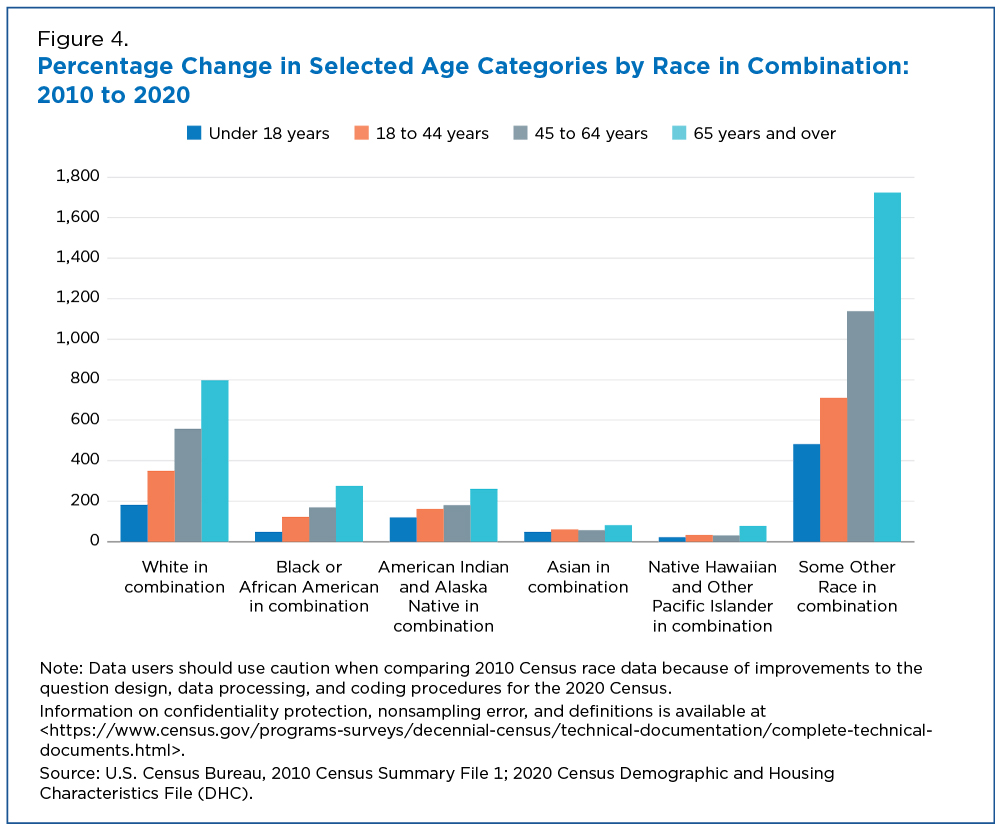
Census figures show that the population that reported multiple races grew faster than all race alone groups in 2020. Figure 4 shows age-specific changes for each race in combination population between the 2010 and 2020 censuses.

All race in combination groups saw growth across each age category over the decade. The Some Other Race in combination population grew the fastest – by over 482% for every age category.

Figure 4. Percentage Change in Selected Age Categories by Race in Combination: 2010 to 2020


Nearly all groups saw population gains this decade and the increase in the Two or More Races population (referred to throughout this story as the Multiracial population) was especially large (up 276%). The White alone population declined by 8.6% since 2010.

The 2020 Census shows:
  • The White population remained the largest race or ethnicity group in the United States, with 204.3 million people identifying as White alone. Overall, 235.4 million people reported White alone or in combination with another group. However, the White alone population decreased by 8.6% since 2010.
  • The Multiracial population has changed considerably since 2010. It was measured at 9 million people in 2010 and is now 33.8 million people in 2020, a 276% increase.
  • The “in combination” multiracial populations for all race groups accounted for most of the overall changes in each racial category.
  • All of the race alone or in combination groups experienced increases. The Some Other Race alone or in combination group (49.9 million) increased 129% surpassing the Black or African American population (46.9 million) as the second-largest race alone or in combination group.
  • The next largest racial populations were the Asian alone or in combination group (24 million), the American Indian and Alaska Native alone or in combination group (9.7 million), and the Native Hawaiian and Other Pacific Islander alone or in combination group (1.6 million).
  • The Hispanic or Latino population, which includes people of any race, was 62.1 million in 2020. The Hispanic or Latino population grew 23%, while the population that was not of Hispanic or Latino origin grew 4.3% since 2010.
Have a lovely Loving Day, folks!

EDITOR'S NOTE: For additional commentary, news and views from an AANHPI perspective, follow @DioknoEd on Twitter or at his blog Views From the Edge.

Sunday, April 30, 2023

Mixed-race children define themselves in a new HBO documentary "1000% Me"


With humor and sensitivity, filmmaker and comedian W. Kamau Bell tackles the joys and challenges of growing up mixed-race through conversations with kids and families in the San Francisco Bay Area, including his own, that he he has put together in an upcoming HBO special, "1000% Me: Growing Up Mixed."


Recognizing that his own children, born to a Black father and White mother, and growing up in a country still deeply divided by race, would have very different experiences in America than he and his wife did, embarks on a journey of discovery in his family’s Bay Area community. 

RELATED: 

The documentary focuses on interracial families from the San Francisco Bay Area, featuring interviews with multiracial children from about 7-years-old up to 16-years old, interracial couples, and field experts. While it will include different perspectives, Bell aims to largely showcase the experience of multiracial children and how their racial identity is a formative part of growing up.

In a series of playful and impactful conversations, Bell explores how these young people navigate issues of identity in a world that can ask them to pick a side and thoughtful exchanges with families reveal the many joys and complexities of what it means to raise multiracial children. 

In his trademark fashion, Bell maintains a serious focus while keeping the discussions lively and accessible, proving along the way that children are more than capable of understanding and furthering complex conversations about race, culture, and identity.

Featured participants, include m
any who come from families of Asian combined with other races.: 

  • Sami (10) is Black and White and looks up to Alicia Keys and Juno, Sami’s sister (7), will tell you why it’s the best to be a middle child.
  • Myles (11) is Black and Filipino-American, likes to play basketball, and helps his lola (grandmother) compete in a Filipino cook off.
  • Presley (10) is White and Filipino-American. She has her own punk band and occasionally rides around San Francisco with her dad belting tunes from his Karaoke motorcycle.
  • Kanani (10) is White, Indigenous, and Latina. She and her parents spend every summer with her dad’s tribe in Costa Rica.
  • Anisa (11) is Black and Pakistani-British and she considers being Muslim as much a part of her “mix” as race.
  • Her friend Mila (10) is Chinese American and Black. She is deeply thoughtful and speaks in the measured tones of a future world leader while her parents discuss the deeper implications of wearing mismatching socks.
  • Sumaya (7) is Guinean and Punjabi and has strong opinions about mangoes, dogs, and llamas.
  • Carter (13) is Black and Latina and her best friend Nola (13) is Black and White. They both have two moms but very different birth stories.
  • Kaylin (16) has two mixed-race parents. She’s part White, part Black, and part Korean.
  • Older family members also participate in the discussions including siblings, parents, grandparents, as well as other adults, and professionals invested in these issues.
The number of Americans identifying as more than one race nearly doubled to 13.5 million between 2010 and 2020, according to US Census data, making mixed race the fastest growing segment of the population.

To some observers, the increase in the number of Americans identifying as more than one race shows that barriers are breaking down. But the increase also may reflect changes to census questions designed to tease out the heritage of multiracial people.

It may also be attributed to the high-profile presence and acceptance of mixed race individuals in the public eye, including: 

Former President Obama and current Vice President Kamala Harris are of mixed race as is Justin Jones, who was in the news recently as one of the Tennessee 3 who were expelled from the Tennessee legislature..

Include AANHPI actors Dwayne Johnson, Jason Momoa and Vanessa Hudgens as mixed race; as well as entertainers Olivia Rodrigo, H.E.R. and Saweetie and athletes tennis player Naomi Osaka and NFL quarterback Kyler Murray.

Journalist Alex Wagner, who is of Burmese and White descent, talks about the moment she realized she was of mixed race in an interview with HelloGiggles:

There were a few discrete moments, though, where I understood that I wasn’t “generically American.” One of them, which I talked about in the book, was this time when I was about 12 years old, when my dad and I were at the local diner, and my dad, who was white, got up and went to use the men’s room. The line cook looked at me and said, “Are you adopted?” It was the first time I thought, “Oh wait, he thinks I look really different. He thinks that I don’t belong in this particular family picture. Why is that?” I was embarrassed in that moment, and I was ashamed for myself, which is totally messed up on a number of levels, but is, I think, a natural reaction to being made to feel like you don’t belong, that you’re an outsider. That was the seed of like, “Okay, wait a second. What does it mean to not be of this place? Where do I fit in the American story? Where does a mixed-race person find that sense of cultural rootedness?”
According to the 2020 US Census, California had the largest numeric increase in people identifying as more than one race, growing 61% from 2010 to slightly over 2 million. People who identified as both White and Asian made up the largest group in both years. Americans identifying as White and American Indian grew by 84% to 384,600.

As children of older generations struggled to fit in and find themselves, the children in Bell's HBO special as the next generation of mixed-race Americans, are offering their own definition of themselves, which could also help define the new America emerging from the old Black-White paradigm.

 FYI: "1000% Me: Growin Up Mixed" airs at 8 p.m., Monday, May 1, 2023 on HBO.

EDITOR'S NOTE: For additional commentary, news and views from an AANHPI perspective, follow @DioknoEd on Twitter.


Saturday, December 18, 2021

Miss America talks about being Korean American and representing

Korean American Emma Broyles was crowned Miss America Thursday.


As Miss Alaska, Emma  Broyles is the first Korean American to win the Miss America competition Thursday in the pageant's 100-year history.


"Being the first Korean Miss America, that we know of, is really cool because I think about when I was younger and I was growing up and not really seeing Korean women who looked like me in popular media," says Broyles, 20 in an interview with People. "I remember I was ashamed of my heritage and I was avoiding embracing it at all costs.

"Now that I'm older, I've really been able to embrace my ethnicity and embrace my background, embrace the journey that my grandparents made 50 or so years ago," she continues. "And I think that having a woman who's kind of an underdog — being only 20 from Alaska and being half-Korean — is representative of all that Miss America stands for."

Broyles, 20, is a Service High School graduate in Anchorage and currently in her junior year at the Honors College at Arizona State University where she’s majoring in biomedical studies and minoring in voice performance, according to the Miss America Organization.

Broyles said being crowned Miss America is “an incredible dream come true,” according to a statement announcing her win from the organization.

"I hope at least one person out there feels like they can see themselves in me and feel inspired," she said.

In an interview with the Anchorage Daily News, her hometown newspaper, she was asked about her Korean heritage and family.

"Being what we know of to be the first Miss America of Korean descent is another really cool thing because I think it represents all of the the positive change that we’ve seen in Miss America in the past 100 years," Broyles told the ADN.

"I mean, even just in the past decade, we’ve seen such a diverse group of Miss Americas, and to be representing Asians all over the United States is a really, really cool and a really special moment for me.

"My grandparents, they came to America about 50 years ago — right before my mom was born — with this idea that they wanted their kids to be able to live that American Dream and have every opportunity possible. They actually moved straight to Anchorage, Alaska, so they’ve been here for quite a while, which is why my family has our roots in Anchorage, Alaska, and all of their other family members came from Korea to Anchorage, Alaska.

"So I have a huge Korean family in Anchorage, and it’s really, really neat because my grandpa was actually the president of the Korean Alaskan organization.

"And it was a really cool win for my grandparents as well, I think, to see their Korean granddaughter making strides and being in a competition like Miss America. And you know, there were so many other Koreans on that stage with me, which — it was a really cool experience, and I feel so grateful for my heritage and for the ability to represent other Korean Americans all across the country. And I think my grandparents are especially grateful and especially excited.


“As a Korean American, I am so grateful for the opportunity to compete alongside so many brilliant, talented women,” she said. “I hope to live up to the legacy, serve as a positive role model for women of all ages and make the Miss America Organization proud. It’s been an honor to represent the great state of Alaska and I look forward to making a significant impact through my social impact initiative on the national stage.”

For winning the Miss America crown, Broyles, a first-year student at Arizona State University, will get a $100,000 scholarship and earn a six-figure salary during her one-year reign.

The Miss America pageant, which has moved away from the emphasis on physical appearance to placing more importance on leadership, talent and communication skills, was not held last year because of the pandemic and it wasn't held for several years in the late 1920s and early 1930s. It was moved from its traditional site in Atlantic City, N.J. and held at the Mohegan Sun Resort and Casino in Uncasville, Connecticut. 

Broyles is unusual among pageant winners in that she openly talks about her flaws.  "I think that people tend to put Miss America on this pedestal and say, 'Wow... she's living this fabulous, glamorous life.'"

During the contest, she told the judges and audience that she wants people to view Miss America as real person. Broyles revealed that she has ADHD and suffers from a form of OCD. "I am real. I have flaws... and because of that, I am a better person."

Friday, October 8, 2021

Newest James Bond film is first to be directed by an Asian American: Cary Joji Fukunaga

SCREEN CAPTURE / YOUTUBE
Director Cary Fukunaga goes over a scene with actor Daniel Craig.


The latest James Bond movie, No Time to Die, is the first in the franchise to be directed by an Asian American, Cary Joji Fukunaga.

The much anticipated film, supposedly the last Bond film for the British actor Daniel Craig is one of the most profitable and fabled movie franchises opens in theaters today (Oct. 8, 2021) after several postponed release dates due to COVID-19. 

He shared that his father, a Sansei born in an WWII internment camp, never talked about what it was like for his family during that dark period when Japanese Americans were incarcerated.

“I think it shaped me, that multigenerational struggle,” Fukunaga told the Hollywood Reporter. ”The psychological trauma inherited from [my father’s] childhood defines who I am, and I think that internment process was incredibly destabilizing for the entire Japanese American population.”

Like many Asian American children, classmates made fun of Fukunaga's last name. He received insults such as “commie” or “F*ck-anaga,” although they did not bother him much.
READ the entire article in the Hollywood Reporter.
The Japanese American filmmaker revealed in an interview with Hollywood Reporter that his growing up in a multiracial, blue-collar family household in Oakland shaped the global perspective in his filmmaking and helped him get the Bond directing job.

Growing up in the racially diverse Bay Area and having a Swedish mother gave Fukunaga an appreciation for different cultures which was critical for Bond producer Michael Wilson. 

Wilson called the 44-year old director “well-traveled and very cosmopolitan,” noting that, “He’s very much a global person.” Fukunaga is fluent in Spanish and French and able to converse in Portuguese and Italian.


After his parents divorced, his Japanese father married an Argentinian, while his Swedish mom married a Mexican American so he has multi-racial siblings as well. Fukunaga told the Inquirer that he experienced the duality of his heritage: As a teenager he identified Japanese; "But then, I lived in Japan for a while and realized I’m also pretty American."

“But I would like to think that I could adapt to many different places. I don’t know which culture I would say that I identify with more. When I meet people like me who has lived in many different places, with multicultural backgrounds, we identify with each other more than any other place or race.”

He said that what he had for sure was the work ethic of his immigrant ancestors. “Yeah, definitely. Our family members are all 20th-century immigrants to the United States, so they came with a strong work ethic. That has definitely affected the way I work and the discipline that I have with my work. 

"And also, my (paternal) grandparents who are farming-class Japanese, and also Imperial Buddhists, believe in humility over everything else. So you can never think that you are more important than anyone else. That is a good strategy for doing good work.”

Thursday, December 3, 2020

Hailee Steinfeld joins the Marvel universe as new superhero

INSTAGRAM
Hailee Steinfeld was seen filming in New York City's subway, carrying a bow.

While most of the world's focus is on the coronavirus pandemic, the Georgia's Senate race and the ravings of the madman in the White House, there are other things going on -- important things. Important things such as: Is Hailee Steinfeld the latest actress to be cast as a Marvel superhero? and, is the character half-Asian?

For over a year, speculation has run rampant on social media that the 24-year-old Steinfeld was being sought to play Kate Bishop, a central figure in Marvel's new universe of superheroes.

What? Who is Kate Bishop, you ask?

Kate Bishop, created by writer Allan Heinberg and artist Jim Cheung, is the daughter of a rich family. A victim of an attack by thugs, she trains in the martial arts and eventually becomes the leader of the Young Avengers, a group of young whipper-snappers who want to emulate their heroes, the Avengers led by Captain America.

Excitement has been building for a year since it was announced that Marvel wanted to cast Steinfeld as Kate Bishop, but contract negotiations apparently was a rocky road as no official announcement of Steinfeld taking the role has been formally announced.

I'm not sure about the origins of the rumor that Kate Bishop is half Asian -- perhaps its wishful projections, but the rumor has refused to die.

Kate BIshop's ethnicity has never been raised in the comics. Perhaps it's her black hair, a propensity to wearing shades and that particular hue of Bishop's skin possessed by many mixed-race individuals. Maybe, as the artist, Cheung -- in the form of a  guerrilla act -- has given the character a racially ambiguous appearance to spur the debate.

Artist Cheung said in a Tumblr Q&A that he “definitely never thought of her as Asian at all, but I can understand how people might interpret her that way from my art style.”

I take that as "Maybe she could be ..."

Many of the fans of Kate Bishop have assumed her racial heritage and raised alarms when Steinfeld's name was raised as the actress to play their favorite character. They said it was a another "whitewashing" case like Ghost In A Shell when Scarlett Johansson played the role of the Asian lead character.

Those readers apparently didn't know of Steinfeld's real Filipino background via her grandfather. 

Hailee Steinfeld, left, and the character Kate Bishop, aka Hawkeye.

At any rate, a social media campaign arose asking Marvel to emphasized and confirm Kate Bishop's mixed racial heritage.

All this debate was going on for a year and Steinfeld still had not signed on the dotted line, but this week, sharp-eyed comicbook fans recorded the filming of the Young Avengers being done in New York. Indeed, Steinfeld was seen carrying a bow -- Kate Bishop's signature weapon -- and she was wearing a purple outfit, just like Kate Bishop.

Now that Steinfeld's casting has been confirmed, Marvel should seriously consider allowing the hopeful speculation about her race become a reality. As a comicbook character, Kate Bishop is so ... so, white bread bland. It would be so much more interesting in her character development open the door to identity questions if she was part Asian. 

Some have pointed out that in the comics, Bishop has blue eyes. Filipinos with blue eyes are rare, but they do exist. so eye colors shouldn't be the reason to not be racially halo halo. (Hint: Google "Filipinos," "Blue eyes")

Steinfeld has never played a Filipino in the movies because Hollywood casting directors don't see her as a white woman. Certainly, she has reached point in her still-growing career that she can add depth to the characters that she plays by adding a bit of herself into the role.

EDITOR'S NOTE: A word of caution, this is news sprinkled with opinion. Readers are encouraged to seek multiple news sources to formulate their own positions.

Sunday, February 3, 2019

Tulsi Gabbard kicks off her presidential campaign

SCREEN CAPTURE / KTVU
Hawaii's Rep. Tulsi Gabbard joins the presidential race in 2020.

Casting herself as an outsider, Rep. Tulsi Gabbard, D-HI, officially kicked off her campaign for president Saturday (Feb. 2)  at a rally on the island of Oahu where she spoke strongly about her anti-war political positions and past service in Iraq.
"We must stand up... against powerful politicians from both parties who sit in ivory towers thinking up new wars to wage (and) new places for people to die," Gabbard said to her supporters gathered on the Great Lawn of the Hilton Hawaiian Village.

Gabbard, a Samoan American and the first Hindu follower elected to Congress, said she "will end the regime change wars that have taken far too many lives and undermined our security by strengthening terrorist groups like al Qaeda."


She leaned heavily into her military experience having served tours in Iraq and Kuwait.

"These powerful politicians dishonor the sacrifices made by every one of my brothers and sisters in uniform, their families - they are the ones who pay the price for these wars," Gabbard said. "In fact, every American pays the price for these wars, trillions of dollars since 9/11."

"When we raise our right hand and volunteer to serve, we set aside our own interests to serve our country, to fight for all Americans. We serve as one, indivisible, united, unbreakable ― united by this bond of love for each other and love for our country," she said. 

"It is in this spirit that today I announce my candidacy for president of the United States of America."

She also embodied the "spirit of aloha" in her Hawaii rally, saying: "The White House should be a beacon of aloha."


In addition to an anti-interventionist foreign policy, Gabbard touched on her support for tougher environmental regulations, criminal justice reform and Medicare for all.


She resigned as vice chair of the Democratic National Committee to throw her support Sen. Bernie Sanders' bid for the presidency in 2016. That action drew the ire of establishment Democrats that may linger to this day.

Saturday's official lauch pressed a reset button for Gabbard's campaign after an announcement on CNN two weeks ago that reportedly caught her campaign by surprise.

Her earlier work with an anti-LGBTQ nonprofit led by her father and a meeting she held with Syrian President Bashar Assad have drawn criticism from Democrats and advocacy groups.

She said her view on LGBTQ issues have evolved and points out her more recent votes in support of that community. 

As for Assad, Gabbard later explained to CNN’s Jake Tapper. “When the opportunity arose to meet with him, I did so, because I felt it’s important that if we profess to truly care about the Syrian people, about their suffering, then we’ve got to be able to meet with anyone that we need to if there is a possibility that we could achieve peace. And that’s exactly what we talked about.”

She joins a Democratic field that is getting more crowded each week. It is a year before the Iowa Caucuses and already, it is the most diverse group of candidates running for president of the U.S. with three Asian American and Pacific Islander candidates: Besides Samoan American Gabbard, there is also Chinese American entrepreneur Andrew Yang, who was the first to announce his candidacy almost a year ago, and California Sen. Kamala Harris, who is of Indian and Caribbean descent.

Gabbard has an uphill task ahead of her against rivals who have higher national profiles. Besides Harris and Yang, three U.S. Senators, Cory Booker, D-N.J., Elizabeth Warren, D-Mass. and Kirsten Gillibrand, D-NY, and former HUD Secretary Julian Castro of Arizona have either declared their candidacies or formed exploratory committees..
___________________________________________________________________________

Tuesday, November 13, 2018

Filipina model pushes back on her critics who say she isn't Filipino enough

Model Kelsey Merritt is proud to call herself a Filipina.
ASAM NEWS & Views From the Edge

VICTORIA SECRET model Kelsey Merritt is proud to be a Filipina and she's a little tired of people not accepting her identity.


"White passing" is a term that many multiracial people find insulting. The insinuation is that because you look White, you’re not really a person of color.


Merritt, who is of mixed racial heritage, finds herself pushing back against that label.

Just two months ago, she celebrated being the first Filipino to work in the Victoria Secret Fashion Show.

Late this past week, her dream came true and she walked the catwalk for the famous lingerie manufacturer.

An overwhelming majority of comments on social media from Filipinos applauded that achievement.

One that caused a stir raised the issue of Merritt’s white attributes. and if she is really a Filipino.

Striking back in Tagalog on Twitter, Merritt wrote, “‘I was born in the Philippines and I grew up in Pampanga. I finished my school in Manila before I moved to the U.S. last year. My blood is more Filipino than the ‘pure’ who have never set foot in the Philippines,” reported the Daily Mail.

Kelsey’s mom is Filipino and her father is white: a combination not uncommon in the Philippines. because of its long history of colonization under the Spanish followed by its occupation by the United States from 1898 to 1946. Filipinos of this mixed racial heritage are called mestizas or mestizos.

“People will always have their opinion of you despite of who you are,” she said to Teen Vogue. “I would love to tell them that I am just me.”

The Victoria Secrets Fashion Show staged in New York City on Nov. 8, is scheduled to air December 2 on ABC.


Although Merritt is the first Filipina to strut down the runway in the annual fashion show, she is not the first Asian model used by Victoria Secrets. Previous models from China and Japan have been used to display the lingerie and bathing suits.

In 2017 when the show was held in Shanghai eight Chinese models joined the cast.

This year, Estele Chen will also walk down the runway with her.

The show has launched the fashion careers of several Victoria Secret models  incuding Adriana Luna, Allessandra Ambrosio, Beella Hadid, Miranda Kerr, Giselle Bundchen, Heidi Klum and Kendall Jenner among others. 

Each spot on this annual catwalk is highly coveted. It’s the most-watched fashion event of the year, according to Harper’s Bazaar. About 800 million viewers tune in to watch the show each year, which costs about $12 million to put on. 
_______________________________________________________________________________

Saturday, August 25, 2018

ABC developing 'Ohana;' telling Hawaii's story from a non-white perspective


WITH A REBOOT of Magnum P.I., set to debut later this year joining the ongoing series Hawaii Five-O, there comes a new project telling stories from the Hawaiian perspective.
Credit the critical and box office success of Crazy Rich Asians, the Warner Bros. movie featuring an all-Asian cast for encouraging ABC to give the go-ahead for

“The landscape has shifted dramatically in the last 12 months, and maybe in the last week,” writer/journalist Lisa Takeuchi Cullen told The Hollywood Reporter, referencing the renewed interest and demand for Asian and Asian-American stories “Crazy Rich Asians’s” box office and critical success has inspired.


LISA TAKEUCHI CULLEN
Titled Ohana, Cullen’s show is based on Kiana Davenport’s 1994 novel Shark Dialogues that highlights the ways diverse  cultures, United States colonialism and other historical forces have influenced contemporary Hawaii.The word "ohana" is Hawaiian for family.

The proposed series is about four hapa women who inherit the family plantation when their grandmother, a kahuna (e.g. a Hawaiian mystic), dies under mysterious circumstances. “Each of the four protagonists is of a different mixed ethnicity — half-white, half-Japanese, half-Filipino, and half-black — and their unexpected shared inheritance will force them to overcome years of jealousies, misunderstandings, resentments, and secrets,” the source details.

If that's not enough to get the AAPI audience's attention, I don't know what will.

“So many Hawaii-set stories have been told from the white point of view,” Cullen told THR. “This is a story we’re passionate about telling from the point of view of native Hawaiians — Pacific Islanders, people of Asian descent, and people of hapa heritage.”

Cullen is writing the project and the JuVee Productions' husband-and-wife team of Viola Davis and Julius Tennon is producing the project.


Ohana is a project that fits JuVee's goal: "embracing cultures and points of view from all over the world and showing that we all can relate and connect to each other,” Davis and Tennon said in a statement.

Cullen worked as a staff writer and foreign correspondent at Time, and has written two books: memoir Remember Me: A Lively Tour of the New American Way of Death and novel Pastors’ Wives. She wrote and produced the 2013 CBS pilot The Ordained, which centered on a priest-turned-lawyer from a Kennedy-esque family.


Cullen told THR that ABC approved the project on Aug. 17, the same day that Crazy Rich Asians premiered.
_______________________________________________________________________________

Friday, July 27, 2018

TGIF Feature: Henry Golding discusses controversial casting in 'Crazy Rich Asians'


ASAM NEWS


HENRY GOLDING of Crazy Rich Asians addressed his own whiteness with the hosts of The View, amidst claims of whitewashing, reports ABC News.

His casting has received backlash since he is partially Malaysian and partially White, with critics claiming that a fully Asian actor should have played the lead role.

“For me, being sort of half British, I’ve always struggled with my identity,” Golding said on The View. “And the one thing that I learned very young was to own my identity.”

Despite the criticisms, Crazy Rich Asians. directed by Jon Chu, has also been heavily lauded for its all-Asian cast.

Golding plays the wealthy Chinese Singaporean Nick Young, who invites his girlfriend Rachel Chu (played by Constance Wu) to take a glimpse into his family’s lavish lifestyle in Singapore. Some familiar faces in the movie include actors Michelle Yeoh, Awkwafina, and Ken Jeong.

Golding expressed to the hosts that he doesn’t harbor any hatred towards his critics. He thinks the conversation on whitewashing should continue “because it kind of just shows the studios that we’re watching; we’re very aware of how we want our films to tell authentic stories now.”

“I knew I’m Asian, through and through,” said Golding. “There’s nothing that I needed to prove.”

In 2017, Golding also spoke to Entertainment Weekly about his controversial casting. “I’ve lived 16, 17 years of my life in Asia, and that’s most of my life. I was born in Asia, I’ve lived cultures that are synonymous with Asian culture, but it’s still not Asian enough for some people. Where are the boundaries? Where are the lines drawn for saying that you cannot play this character because you’re not fully Asian?”

The movie Crazy Rich Asians, based on the Kevin Kwan best-selling novel, is scheduled to be released in U.S. theaters on August 15.
_________________________________________________________________________________

Saturday, March 17, 2018

Questioning Darren Criss' identity. Asian? Filipino? White? Irish?

Darren Criss with his parents.

WHEN I FIRST READ the Vulture interview with Darren Criss,  I was deeply disappointed - heartbroken, really.

Chriss, who is currentlly starring in American Crime Story's "The Assassination of Giannini Versace," gave some controversial responses that drew the ire of some Asian Americans.

During the interview, writer E. Alex Jung asked the Filipino/American actor if being part Filipino was a factor in getting a part, Criss answered: "I always say one of my favorite things about myself is that I’m half-Filipino but I don’t look like it."

Ouch!

Taken by itself, that quote drew a lot of critical reaction and my first reaction was along the same line. "What? He's proud that he doesn't look Filipino?"
RELATED: Why isn't Darren Criss getting the love from the AAPI community?
"You other’d us while placing yourself in such close proximity with the whiteness you so proudly wear. Why would you do that?" said  Natalie Blardony, a Filipino/American writer in Medium.


Other quotes from the interview seemed to reinforce this point of view:
"I just look like a Caucasian guy, which is nice."
” I have the luxury of being half-white and looking more Caucasian,..."
And there is this reponse to the question, "Do you identify as Asian-American?"
"No. I think that’d be unfair. I think that’d sound like I’m reaching for the minority card on a college application. I think that would be unfair. Yeah, my mom’s Asian-American. She’s from the Philippines and came here and then married a white guy, and here I am. But maybe it’s because of the way I look. Maybe if I looked a little more pan-Asian and I was put in that box then I would be like, “Yeah, I identify as Asian-American,” but maybe because the obstacles that may come up haven’t that I don’t think about it. But that’s a really interesting question. I’ve never thought about that. For better or for worse, I guess not. But I guess I am. What do you think? Am I? On paper I guess I kind of am."
Criss felt his quote was punctuated incorrectly. He felt compelled to issue a clarification which turns the meaning of that statement 180 degrees.


And, as word of the criticism about his comments in Vulture became more widely known, Criss' fans flocked to his defense. But even his defenders said they had to lick their initial wounds.


 Perehaps the strongest defense came from Yong Chavez, entertainment reporter for The Filipino Channel. He has interviewed Criss several times and the actor always said how proud he was of his Filipino heritage.


In other parts of the Vulture interview, he repeats that he loves being part Filipino and he shows he is aware of the lack of Filipino representation in television and the movies. He explains to producer Ryan Murphy why Filipino/American actor Jon Jon Briones, who plays Cunanan's father, isn't better known in Hollywood circles.

"He’s a tried-and-true Broadway actor, man. Just because he’s not on billboards and glamour magazines doesn’t mean he’s not a working actor.” He’s like, “Well, I don’t get why I still haven’t heard of him.” I’m like, “He’s a Filipino man, dude.” There’s only so many opportunities that people can lock themselves into accepting when they’re casting shit, unless he’s playing the Thai terrorist on CSI or something. And what I hope happens is this will be a great stepping stone for him, for people to go, “Ah, he’s a good actor,” and then just cast where race isn’t a thing. 


Perhaps, Criss is one of those individuals who identifies more strongly as a Filipino/American than an Asian/American. He strikes me as a very bright person, albeit perhaps not so politically conscious. I've read other articles about him and watched him on talk shows and he's always said -- without prompting -- that he's half-Filipino. He has never described himself as half-Asian.

For someone who has been immersed in Asian Americana for so long, my initial reaction might have been overly sensitive since I expect all people with an Asian heritage to identify themselves similarly.

Although Criss can pass for white, calling that a "luxury," may be a poor word choice since, as he admits, no one has asked him about identifying as an "Asian/American" before the Vulture interview.

I invite Mr. Criss to become more aware of the culture wars going on nowadays and educate himself in the issues that affect his darker brothers and sisters. Awareness of the lack of acting roles for Filipinos is a start, but he needs to know that industry-wide struggle applies for all people of color. It is not a question of talent, but the lack of opportunities. 

Criss, who's performance in American Crime Story has been universally lauded and hopefully will result in some peer recognition come awards time, now finds himself in a unique position. With his newly found platform, Criss can help keep those doors open for entertainers who might be a few shades darker.
______________________________________________________________________________