Showing posts with label Filipino WWII Veterans. Show all posts

Saturday, February 27, 2021

FilAm lawyers join veterans against Rescission Act


The call to abolish the infamous Rescission Act of 1946 is gaining momentum. Filipino WWII veterans have been asking to overturn the Congressional act that broke a promise from President Franklin D. Roosevelt.

The National Filipino American Lawyers Association (NFALA) renewed its call for the immediate repeal of the Rescission Act  and the proper recognition of the service of all Filipino World War II veterans.

Earlier, NFALA and the National Asian Pacific American Bar Association (NAPABA)  issued their support for repealing the act, which is still in the books. Filipino WWII veterans' groups have been calling to overturn the act as a matter of "honor" and "respect."

The Act effectively stripped thousands of Filipinos of their status as veterans and denied them the benefits they were promised by the United States government for their service. While under colonial rule of the United States, over 260,000 Filipinos answered the United States’ call to arms in World War II.

By the conclusion of World War II, there were four groups of Filipino World War II veterans: the Old Philippine Scouts, the Philippine Army, the recognized Philippine Guerilla forces, and the New Scouts.

The Philippine Army and guerilla forces suffered immensely during the Japanese occupation of the Philippines.

As noted by the late Supreme Court Justice Ruth Bader Ginsburg: 
During the Japanese invasion, Philippine soldiers fought bravely alongside other members of the USAFFE. Both Americans and Filipinos suffered the terrible Bataan death march, indeed, Philippine soldiers endured particularly cruel treatment from the Japanese. Philippine guerrilla forces continued to fight during the Japanese occupation; their efforts undoubtedly made American reentry into the Philippines much less costly. As a foreshadow of what was to come, the Philippine Army and its guerrilla forces did not receive wages equal to those paid to the soldiers in the U.S. military and the Old Philippine Scouts. Sensing that the projected costs to pay Filipino veterans and their widows and children was nearing upwards of $3 billion, Congress passed the Rescission Act on February 18, 1946. At its core, the Rescission Act of 1946 retroactively annulled the service records of the Philippine Army, Guerrilla forces, and the New Scouts - making them ineligible to receive the benefits promised to them for their service. 
Importantly, of the 66 countries allied with the United States during WWII, the Philippines remains the only country specifically excluded from its soldiers receiving the promised military benefits from the United States. The excluded Filipino Veterans were effectively branded “second class veterans” resulting in these soldiers being disqualified from service benefits established by the U.S. Department of Veterans’ Affairs. These benefits include “old age pensions” and access to free medical care at veterans’ hospitals and facilities. It also prevented these wartime veterans from obtaining U.S. citizenship as a member of the United States Armed Forces.

On the occasion of the 75th anniversary of the passage of the Rescission Act of 1946, NFALA once again urges the immediate repeal of the Act and the proper recognition of the service of all Filipino World War II veterans. 

Specifically, NFALA calls upon Congress to: 

1. repeal the Rescission Act of 1946; 

2. reinstate the service records of all Filipino veterans affected by the Rescission Act of 1946; 

3. issue a statement recognizing the service of Filipino World War II veterans affected by the Rescission Act of 1946; and 

4. support efforts to extend benefits to and recognize the service of Filipino World War II veterans, including but not limited to supporting the Filipino Veterans Family Reunification Act, Filipino Veterans Fairness Act, and the continuation of the Filipino World War II Veterans Parole Program. 

“For seventy-five years, America has turned its back on Filipino veterans affected by the Rescission Act of 1946,” said NFALA President Kristy Gonowon. “It is unconscionable that Filipino veterans never received their rightful benefits and the recognition they deserve for their bravery and service to this country. Repealing the Rescission Act is long overdue, and America must fulfill its contract with these veterans who fought for the United States.” 

Thursday, February 18, 2021

Filipino veterans group calls for repeal of the shameful Rescission Act of 1946


PAUL I. TANEDO
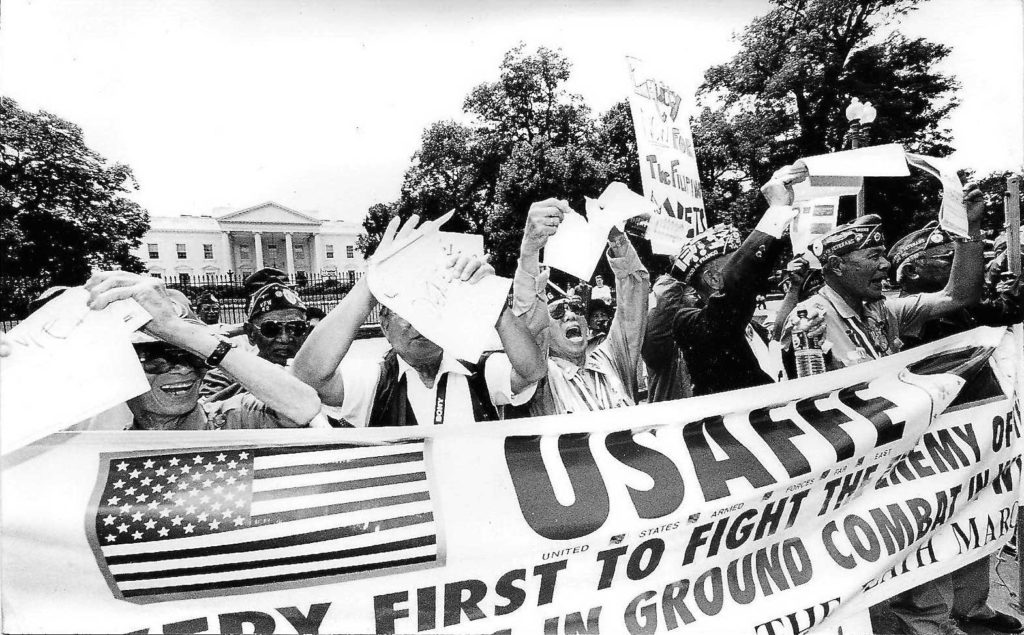
Filipino veterans of WWII and their supporters demonstrated for their war benefits.

By Filipino Veterans Recognition and Education Project (FilVetRep)

February 18, 1946 was an ugly stain on America’s history.

Seventy-five years ago this month, after America’s victory in World War II and two months after Filipino soldiers completed their wartime service to the United States, Congress passed the first of two Rescission Acts stripping Filipino soldiers of their status as U.S. veterans and effectively denying them their rightful benefits.

This unconscionable act of Congress, which has persisted for 75 years, amounted to discrimination and injustice against thousands of Filipinos who fought, died, and wounded for life under the American flag without compensation. It is time to repeal the Rescission Act.

Although they were ordered by President Franklin D. Roosevelt on July 25, 1941 as active members of the United States Army Forces of the Far East (USAFFE), the U.S. Congress rescinded the President’s Executive Order that promised them full U.S. veterans’ benefits. Titled “The Rescission Act of 1946,” the bill provided that “service in the Commonwealth Army of the Philippines should not be deemed to have been service in the military or naval forces of the United States.”

In the view of Congress, the Philippine Commonwealth Government was to be granted independence on July 4, 1946. Thus, Filipino soldiers and recognized Guerrillas in the U.S. Army were expendable and were no longer the problem of the U.S. government.

In signing the bill into law, however, President Harry Truman made it clear that the legislation “does not release the United States from its moral obligation to provide for the heroic Philippine veterans who sacrificed so much for the common cause during the war.

He stated further that “Philippine Army veterans are nationals of the United States and will continue in that status until July 4, 1946. They fought, as American nationals, under the American flag, and under the direction of our military leaders. Their official organization, the Army of the Philippine Commonwealth, was taken into the Armed forces of the United States by executive order of the President of the United States on July 26, 1941. That order has never been revoked or amended. I consider it a moral obligation of the United States to look after the welfare of Philippine Army veterans.”


But the Rescission Act of 1946 reduced the obligation of the U.S. government to take care of its Filipino war veterans. On May 22, 1946, Gen. Carlos P. Romulo, as Resident Commissioner of the Philippines, spoke on the floor of the US House of Representatives and denounced the US Congress for its “act of discrimination” against Filipinos.

Service and sacrifice

From July 26, 1941 to December 31, 1946, Filipino Army soldiers and guerrillas fought and defended a sovereign territory of the United States, as part of the U.S. Armed Forces in the Far East, commanded by General Douglas MacArthur. Their courage, selfless sacrifice, and fierce determination defeated the Japanese Imperial Forces in Oct 1944, and in the liberation of the Philippines in August 1945.

During the entire Philippine War campaign, over 260,000 Filipino and American soldiers and guerrillas served. They suffered heavy losses in casualties, estimated at 57,000, in the now famous battles of Bataan and Corregidor. During the infamous Bataan Death March, about seventy thousand prisoners of war – both American and Filipino – marched 65 miles to Japanese internment camps, where they were imprisoned under inhuman conditions.

Despite the essential role Filipino soldiers played in the United States victory in the Pacific during World War II, their contributions in defending democracy and liberty were totally ignored. Instead, the U.S. government denied them one important right given to everyone else who has served in the United States Military: the right to veterans’ benefits.

Of the 66 allied nations who fought with the U.S. in World War II, only the Philippines was singled out by the Rescission Act of 1946.


As American nationals, Fililpinos by the thousands answered President Franklin Roosevelt's call to arms to join U.S. Armed Forces during World War II.

Blatant Discrimination Against Veteran Minority Groups

Filipino soldiers are the last of veteran minority groups that suffered outright discrimination from the U.S.

African American soldiers were in segregated units led by white officers. On July 26, 1948, when President Truman signed Executive Order 9981, he directed the desegregation of the U.S. Armed Forces to repudiate 170 years of sanctioned discrimination against African American troops.

On February 19, 1942, President Franklin Roosevelt signed Executive Order 9066 and ordered the incarceration of over 120,000 Japanese Americans who were held in 10 internment camps across the U.S. This executive order was enforced on March 21, 1942 when Roosevelt signed Public Law 503. In 1943, some 16,000 Japanese Americans or Nisei soldiers enlisted in the U.S. Army to prove their loyalty to the United States.

In 1988, the Civil Liberties Act, Public Law 100-383, was passed by Congress that granted redress of $20,000 and a formal presidential apology to every Japanese American citizen who were incarcerated during World War II. The Nisei soldiers were awarded 21 Medals of Honor for their heroism and venerated for their African American soldiers were in segregated units led by white officers. On July 26, 1948, when President Truman signed Executive Order 9981, he directed the desegregation of the U.S. Armed Forces to repudiate 170 years of sanctioned discrimination against African American troops.

On February 19, 1942, President Franklin Roosevelt signed Executive Order 9066 and ordered the incarceration of over 120,000 Japanese Americans who were held in 10 internment camps across the U.S. This executive order was enforced on March 21, 1942 when Roosevelt signed Public Law 503. In 1943, some 16,000 Japanese Americans or Nisei soldiers enlisted in the U.S. Army to prove their loyalty to the United States.

In 1988, the Civil Liberties Act, Public Law 100-383, was passed by Congress that granted redress of $20,000 and a formal presidential apology to every Japanese American citizen who were incarcerated during World War II. The Nisei soldiers were awarded 21 Medals of Honor for their heroism and venerated for their uncommon courage and sacrifice in defense of their country.

Chinese Americans endured years of injustice under the Chinese Exclusion Act of 1882. In 1943, Congress repealed this statute, which allowed Chinese Americans to become U.S. citizens. Congress also allowed over 20,000 to enlist in the Army, Navy, Marines, Army Air Corps, Coast Guard, and Merchant Marines during WWII.

For the Filipinos, the Rescission Act of 1946 have taken a lasting toll of indignation and betrayal of promise made by a country they vowed to defend and were later victorious against a brutal enemy. It is beyond their time of having experienced a lifetime of racial discrimination and social injustice above their duty to serve the United States in war and not receive the same equal care and treatment granted by Congress to the African American soldiers, Japanese American soldiers, and Chinese American soldiers.

This is an insurmountable tragedy in American history. On July 22, 1998 at a Congressional Hearing, then Representative Nancy Pelosi (now Speaker of the House) stated:

“I consider the Rescission Act of 1946 to be a scar on the historical record of the United States. In a time of war, we asked for and received the commitment of these Filipino soldiers to serve under the U.S. authority. While they were fighting for their country, they were also fighting for the Unites States. Having U.S. and Filipino soldiers under one centralized command structure was vital to the expeditious liberation of the Philippines and saved the lives of American lives.”

'A moral obligation’

The late U.S. Senator Daniel K. Inouye (D-HI), who championed the Filipino veterans’ struggle for justice and equity, criticized the 1946 Rescission Acts for their “anti-Filipino discriminatory intent.” He said the United States “made a solemn promise, and with hardly a hearing, we revoked it. This episode is a blight upon the character of the United States, and it must be cleansed.” Throughout his long service in Congress, Sen. Inouye, along with other champions of Filipino World War II veterans, sought to repeal the Rescission Act “as a moral obligation.”

Numerous Filipino American veterans and community organization sought for years to correct this grievous injustice by seeking to win these benefits back, but with little success. In the 1990s, Congress allowed thousands to immigrate under a limited quota basis to become U.S. citizens. Funeral and burial rights came a decade later, prompting some of them to conclude that old Filipino soldiers must die first before the U.S. government can repay them for their military services. In 2009, almost 63 years later, Congress eventually granted them one-time lump sum payments as financial compensation: $15,000 each for those who are US citizens and $9,000 each for non-US citizens. Only some 18,000 were granted these payments from the 48,000 who applied for redress of their wartime service. Thousands of veterans who were denied of their compensation have died waiting for their appeals to be heard in court proceedings.

But official recognition for their service and sacrifice came more than 70 years later. On November 30, 2016, Congress passed the Filipino World War II Veterans Congressional Gold Medal Act of 2015. In remarks made during the awards ceremony on Oct. 25, 2017, Senate Democratic Leader Chuck Schumer said: “It is a mark of a confident and exceptional nation to look back on its history and say we made a grievous error, but we recognize it and pledge never to let it happen again.”

A matter of honor and dignity

But the untold story of Filipino World War II veterans remains a dark chapter in U.S. history for as long as the 1946 Rescission Act remains in the books.

“It not only deprived Filipino soldiers combat pay and their rightful benefits. It stripped them of their honor and dignity,” says Maj. Gen. Antonio Taguba (Ret), chairman of the Filipino Veterans Recognition and Education Project (FilVetREP). “They suffered severe humiliation and the shameful betrayal by a nation whom they served with loyalty and uncommon valor. For more than 70 years, our veterans endured these racially-motivated acts, which singled them out for discrimination and unfair treatment.”

In remarks made at a memorial the day before his inauguration, President Joe Biden reminded the American people that “to heal, we must remember. It’s hard sometimes to remember, but that’s how we heal. It’s important to do that as a nation.” At his inauguration on January 20, he invited the American people to reflect on the nation’s past, again reminding them that “there’s much to repair, and much to restore.”

In calling on Congress to repeal the Rescission Act, Taguba affirms President Biden’s words with this call to action: “Let us never forget that our veterans endured a lifetime of injustice and indignation inflicted by a shameful act of Congress. It’s time we remove this ugly stain and close this dark chapter in our nation’s history.”

On behalf of the Filipino veterans who fought with valor, loyalty and duty to serve the United States alongside Americans in the Philippines during World War II, we respectfully ask Congress to act and repeal the Rescission Act of 1946, repudiate the injustice these veterans have suffered for 75 years, and heal the indignation, pain, and sorrow they endured over a lifetime.

# # #

The Filipino Veterans Recognition and Education Project (FilVetREP), is a nonpartisan,501(c)(3) tax-exempt, community-based, all-volunteer national initiative whose mission is to obtain national recognition of Filipino and American WW11 soldiers across the United States and the Philippines for their wartime service to the U.S. and the Philippines from July 26, 1941 to December 31, 1946. For more information about Filipino WWII veterans and how to get involved, visit our website at www.filvetrep.org or find us on Facebook or Twitter.

Friday, January 22, 2021

Details of Biden's immigration reform bill includes reinstating the priority of family reunification for Filpino WWII vets


President Biden seeks to reinstate the Parole Program for WWII Filipino vets.

President Joe Biden's proposed immigration bill will restore the parole program that would reunite Filipino WW II veterans with their families who are waiting to become U.S. citizens, a program Trump heartlessly sought to end in in the waning days of his administration.

On the first day of his administration, one of the first acts of Biden, squeezed in between his inauguration, a parade and a celebrity-studded celebration of the new President and Vice President Kamala Harris, was to send a bill to Congress addressing immigration.

Unlike Donald Trump, who sought to limit immigration, and President Barack Obama, under whom Biden served as his Vice President, Biden's action has prioritized immigration reform through the U.S. Citizenship Act of 2021.

The U.S. Citizenship Act of 2021 also seeks to provide an 8-year path to citizenship for the 11 million undocumented Americans already in the U.S. 

It includes a provision that protects the participants in the Deferred Action on Childhood Arrivals (DACA) program, for those thousands of Americans who were brought to the U.S. with their parents, including thousands of potential DACA recipients who have not yet enrolled in the program.

"Today provides much-needed relief for our communities, which no longer have to live under the discriminatory Muslim Ban or the threat of DACA termination," said Asian Americans Advancing Justice in a statement. 

"President Biden’s bold immigration legislation aims to provide a path to citizenship for undocumented people, offering relief to our loved ones, neighbors, and allies, including the workers who have been in essential jobs long before the pandemic highlighted how essential they truly are to our communities and to our country."

The U.S. Immigration Act of 2021 will restore humanity and American values to our immigration system, says the Office of President Joe Biden in a statement. The bill provides hardworking people who enrich our communities every day and who have lived here for years, in some cases for decades, an opportunity to earn citizenship. 

The legislation modernizes our immigration system, and prioritizes keeping families together, growing our economy, responsibly managing the border with smart investments, addressing the root causes of migration from Central America, and ensuring that the United States remains a refuge for those fleeing persecution. 

The bill will stimulate our economy while ensuring that every worker is protected.

The Filipino World War II Veterans Parole, or FWVP, program, which was approved during the Obama years, The program allows family members with already approved visa applications to stay in the U.S. on parole while they continue to wait to receive their immigration visas.

"It would allow the veteran to spend his or her remaining years with the loved one. And it would allow the loved one to provide care and support for the aging veteran," said Daniel Cosgrove, a spokesman for U.S. Citizenship and Immigration Services

The Trump administration ended the program in 2019. 


According to the Office of President Joe Biden, the U.S. Citizenship Act will:

PROVIDE PATHWAYS TO CITIZENSHIP & STRENGTHEN LABOR PROTECTIONS

Create an earned roadmap to citizenship for undocumented individuals. The bill allows undocumented individuals to apply for temporary legal status, with the ability to apply for green cards after five years if they pass criminal and national security background checks and pay their taxes. Dreamers, TPS holders, and immigrant farmworkers who meet specific requirements are eligible for green cards immediately under the legislation. After three years, all green card holders who pass additional background checks and demonstrate knowledge of English and U.S. civics can apply to become citizens. Applicants must be physically present in the United States on or before January 1, 2021. The Secretary of the Department of Homeland Security (DHS) may waive the presence requirement for those deported on or after January 20, 2017 who were physically present for at least three years prior to removal for family unity and other humanitarian purposes. Lastly, the bill further recognizes America as a nation of immigrants by changing the word “alien” to “noncitizen” in our immigration laws.

Keep families together. ​The bill reforms the family-based immigration system by clearing backlogs, recapturing unused visas, eliminating lengthy wait times, and increasing per-country visa caps. It also eliminates the so-called “3 and 10-year bars,” and other provisions that keep families apart. The bill further supports familes by more explicitly including permanent partnerships and eliminating discrimination facing LGBTQ+ families. It also provides protections for orphans, widows, children, and Filipino veterans who fought alongside the United States in World War II. Lastly, the bill allows immigrants with approved family-sponsorship petitions to join family in the United States on a temporary basis while they wait for green cards to become available.

Embrace diversity. ​The bill includes the NO BAN Act that prohibits discrimination based on religion and limits presidential authority to issue future bans. The bill also increases Diversity Visas to 80,000 from 55,000.

Promote immigrant and refugee integration and citizenship. ​The bill provides new funding to state and local governments, private organizations, educational institutions, community-based organizations, and not-for-profit organizations to expand programs to promote integration and inclusion, increase English-language instruction, and provide assistance to individuals seeking to become citizens.

Grow our economy. ​This bill clears employment-based visa backlogs, recaptures unused visas, reduces lengthy wait times, and eliminates per-country visa caps. The bill makes it easier for graduates of U.S. universities with advanced STEM degrees to stay in the United States; improves access to green cards for workers in lower-wage sectors; and eliminates other unnecessary hurdles for employment-based green cards. The bill provides dependents of H-1B visa holders work authorization, and children are prevented from “aging out” of the system. The bill also creates a pilot program to stimulate regional economic development, gives DHS the authority to adjust green cards based on macroeconomic conditions, and incentivizes higher wages for non-immigrant, high-skilled visas to prevent unfair competition with American workers.

Protect workers from exploitation and improve the employment verification process. ​The bill requires that DHS and the Department of Labor establish a commission involving labor, employer, and civil rights organizations to make recommendations for improving the employment verification process. Workers who suffer serious labor violations and cooperate with worker protection agencies will be granted greater access to U visa relief. The bill protects workers who are victims of workplace retaliation from deportation in order to allow labor agencies to interview these workers. It also protects migrant and seasonal workers, and increases penalties for employers who violate labor laws.

PRIORITIZE SMART BORDER CONTROLS

Supplement existing border resources with technology and infrastructure. ​The legislation builds on record budget allocations for immigration enforcement by authorizing additional funding for the Secretary of DHS to develop and implement a plan to deploy technology to expedite screening and enhance the ability to identify narcotics and other contraband at every land, air, and sea port of entry. This includes high-throughput scanning technologies to ensure that all commercial and passenger vehicles and freight rail traffic entering the United States at land ports of entry and rail-border crossings along the border undergo pre-primary scanning. It also authorizes and provides funding for plans to improve infrastructure at ports of entry to enhance the ability to process asylum seekers and detect, interdict, disrupt and prevent narcotics from entering the United States. It authorizes the DHS Secretary to develop and implement a strategy to manage and secure the southern border between ports of entry that focuses on flexible solutions and technologies that expand the ability to detect illicit activity, evaluate the effectiveness of border security operations, and be easily relocated and broken out by Border Patrol Sector. To protect privacy, the DHS Inspector General is authorized to conduct oversight to ensure that employed technology effectively serves legitimate agency purposes.

Manage the border and protect border communities. ​The bill provides funding for training and continuing education to promote agent and officer safety and professionalism. It also creates a Border Community Stakeholder Advisory Committee, provides more special agents at the DHS Office of Professional Responsibility to investigate criminal and administrative misconduct, and requires the issuance of department-wide policies governing the use of force. The bill directs the Government Accountability Office (GAO) to study the impact of DHS’s authority to waive environmental and state and federal laws to expedite the construction of barriers and roads near U.S. borders and provides for additional rescue beacons to prevent needless deaths along the border. The bill authorizes and provides funding for DHS, in coordination with the Department of Health and Human Services (HHS) and nongovernmental experts, to develop guidelines and protocols for standards of care for individuals, families, and children in CBP custody.

Crack down on criminal organizations.​The bill enhances the ability to prosecute individuals involved in smuggling and trafficking networks who are responsible for the exploitation of migrants. It also expands investigations, intelligence collection and analysis pursuant to the Foreign Narcotics Kingpin Designation Act to increase sanctions against foreign narcotics traffickers, their organizations and networks. The bill also requires the Federal Bureau of Investigation (FBI), Drug Enforcement Agency (DEA) and DHS, in coordination with the Secretary of State, to improve and expand transnational anti-gang task forces in Central America.

ADDRESS ROOT CAUSES OF MIGRATION

Start from the source. ​The bill codifies and funds the President’s $4 billion four-year inter-agency plan to address the underlying causes of migration in the region, including by increasing assistance to El Salvador, Guatemala, and Honduras, conditioned on their ability to reduce the endemic corruption, violence, and poverty that causes people to flee their home countries. It also creates safe and legal channels for people to seek protection, including by establishing Designated Processing Centers throughout Central America to register and process displaced persons for refugee resettlement and other lawful migration avenues—either to the United States or other partner countries. The bill also re-institutes the Central American Minors program to reunite children with U.S. relatives and creates a Central American Family Reunification Parole Program to more quickly unite families with approved family sponsorship petitions.

Improve the immigration courts and protect vulnerable individuals. ​The bill expands family case management programs, reduces immigration court backlogs, expands training for immigration judges, and improves technology for immigration courts. The bill also restores fairness and balance to our immigration system by providing judges and adjudicators with discretion to review cases and grant relief to deserving individuals. Funding is authorized for legal orientation programs and counsel for children, vulnerable individuals, and others when necessary to ensure the fair and efficient resolution of their claims. The bill also provides funding for school districts educating unaccompanied children, while clarifying sponsor responsibilities for such children.

Support asylum seekers and other vulnerable populations.​The bill eliminates the one-year deadline for filing asylum claims and provides funding to reduce asylum application backlogs. It also increases protections for U visa, T visa, and VAWA applicants, including by raising the cap on U visas from 10,000 to 30,000. The bill also expands protections for foreign nationals assisting U.S. troops.

Source: Office of President Joe Biden

Thursday, December 24, 2020

Trump wants to end program reuniting Filipino WWII vets with their families

CNN
Filipino WWII vets celebrated when the Parole program passed during the Obama administration.

In the waning days of the Donald Trump administration, it is continuing to try and limit immigrants, the people he has attacked since the day he announced his intention to run for President. 

The U.S.  Citizenship and Immigration Services (USCIS) announced Wednesday (Dec. 23) its intent to terminate the Filipino WWII Veterans Parole program and the Haitian Family Reunification Parole Program by publishing a Federal Register notice on Dec. 28. There will be a 60-day comment period and the termination of these programs would not become final unless the termination is finalized by the Biden administration.

“To serve his pathological need to treat immigrants as cruelly as possible, and to undo any program ever created by Barack Obama, Donald Trump is dishonoring Filipino World War II veterans by ending the program that allows them to reunite their families in the United States," said Hawaii's Sen. Mazie Hirono when Trump first broached the idea last year. 

"The president’s decision means many of these veterans in their 90s will likely die without seeing their families again," she said.

Filipino veterans were granted citizenship in recognition of their service to the U.S. during World War II. Many of their children, however, were not. Due to the volume of immigrant visa applications from the Philippines, it can take more than 20 years for families to be reunited.

Under the FWVP program, the adult children of Filipino World War II veterans, along with their spouses and children

"This action is cruel and heartless and yet unsurprising from an administration that has gone to great lengths to separate Black, Latino, Asian American, Arab, and Muslim families," Marita Etcubañez, Director of Strategic Initiatives for Asian Americans Advancing Justice.


During World War II, approximately 250,000 Filipino soldiers fought alongside U.S. forces. Even though the Philippines was still occupied by the U.S. at the time we entered WWII, many of these soldiers were not able to become U.S. citizens following their military service.

It was not until 1990, 45 years after the end of the war, that the U.S. finally passed legislation allowing Filipino WWII veterans to apply for U.S. citizenship. By this time, since most of the veterans’ children were no longer minors, their children were not eligible for derivative citizenship. The veterans had to apply for visas for their children and these applications were subject to the growing backlogs in family preference categories. Since Filipino nationals already faced some of the longest visa backlogs, there are family members of Filipino veterans that are still awaiting approval of their green card applications, 75 years after the end of World War II.

The Filipino World War II Veterans Parole Program is a temporary administrative fix that allows these veterans to request parole for their children or siblings. Parole in this context means that the veterans’ family members are able to enter and live in the U.S. pending processing of their permanent resident applications. Many family members who received parole have not yet been able to obtain their green cards, and therefore, Wednesday’s announcement places them at risk of losing their status and being deported.

"Our veterans have endured so much. Those who are still with us are very elderly and should not have to face the upheaval of being separated from their family members once again. We need a permanent legislative solution for these families that would make green cards immediately available for their family members," said Etcubañez

"We call on President-elect Biden to continue the Filipino WWII Veterans Parole Program and the Haitian Family Reunification Parole Program and to support passage of Representative Judy Chu’s Reuniting Families Act, which includes the bipartisan Filipino Veterans Family Reunification Act."