Sunday, June 18, 2023

Where are the giving, caring, nurturing Filipino fathers?

Ivan Shaw plays the father Marco de la Rosa in the TV series "The Cleaning Lady."

OPINION

There are three Filipino American families depicted on US television and they all  have one thing in common. There's no Filipino father!

Usually, having Filipino characters, lead a television show would be a cause for celebration for an audience starving for representation. This season, there are three Filipino American families. Hooray! Even though that's not a whole lot, but it is better than zero, which was the case five years ago.

The shows where a FilAm family is a recurring part -- in varying degrees --  of the storyline are The Cleaning Lady, NCIS Hawaii and True Lies. Usually, we would be giddy with such an excess of representation (said with a hint of sarcasm).

RELATED Memories of my father, Major Melchor V. Diokno

The three fictional action-oriented shows share one missing element and that's what this rant is about: there is no Filipino father figure.

OK, True Lies, which stars Ginger Gonzaga as the Filipino American mother, Helen Tasker, is married to a white guy, Harry Tasker, played by Steve Howey, so essentially, the Filipino-father factor has never an issue because the character was never included in the script. (Nevertheless, I support the writers' strike.)

The Tasker's racially mixed marriage, is not uncommon for Filipino Americans. Along with Japanese Americans, Filipinos are the most likely AANHPI group to marry someone not of their race. 

Besides an occasional mention of Lolo and Lola, Gonzaga's Filipino heritage has not been a part of the storyline, at least, thus far and I'm more than half-way into the season.

In NCIS Hawaii, Vanessa Lachey plays Filipino American divorcee Jane Tennant, who is also head of Hawaii's NCIS unit. The separated father, Daniel Tennant, is played by Anthony Ruvivar, who in real life is a Filipino American. Although he plays a recurring role in which he shows concern for his kids, he is not part of the day-to-day life of the family.

NCIS: Hawaii's Anthony Ruvivar, right, with his TV son played by Filipino American Kian Talan.


The Filipino family in The Cleaning Lady is a complex unit. The lead character is  Thony de la Rosa, a Cambodian doctor played by Elodie Yung. Thony's Filipino husband, Marco de la Rosa, is played by Ivan Shaw, a Taiwanese American actor. (Apparently, The Cleaning Lady casting director couldn't find actors of Filipino descent to play these characters, but, I digress.)

The de la Rosas have a Filipino Cambodian son, who suffers from an autoimmune illness, the driving motivation for Thony to do whatever it takes (legal and illegal) to obtain his medication.

Unfortunately, for Marco, who was introduced and killed off in the second season. In his short-lived existence in the acclaimed series was a gambler and a bully. He was not a likeable man who probably deserved his fate.

The other family in the same series is that of Marcos' sister, Fiona played by Filipino Australian Martha Millan. The father of her two children is K.C. Collins, a non-Asian.

The two women, Fiona and Thony, plus their children form a complicated, mixed-race family, but, unfortunately, not a Filipino father among them. Maybe with a strong father-figure, they might not be the predicament they find themselves in week after week.

I realize that a Filipino American father without drama probably wouldn't make for an interesting enough character to sustain a television series. But, in the totality of American television, I long for some balance.

Oh, how I wish there was a Filipino American Everybody Loves Raymond-type character; an ordinary, Filipino American father on TV; someone who watches Sunday afternoon football, cheers for the Golden State Warriors, likes to cook adobo or sinigang, complains about not getting appreciated at his job, and shows up for his kids' soccer games and occasionally gives fatherly advice. You know, some guy I could be buds with. 

EDITOR'S NOTE: For additional commentary, news and views from an AANHPI perspective, follow @DioknoEd on Twitter or at his blog Views From the Edge.


Friday, June 16, 2023

Census releases new stats on the AA and NHPI communities


How does the Filipino American population differ from the total Asian population in the United States? Which Asian group is the oldest or the largest? Is the Native Hawaiian population larger than all other Pacific Islander groups?

The answers to these questions and a trove of other detailed data on hundreds of race, Hispanic origin, ancestry and tribal groups are in the New American Community Survey (ACS) population tables released Thursday.

The answer to the first question: The Filipino population and Japanese population had the largest percentage point difference (around 3%) between the alone and alone or in any combination groups; Filipinos have the second oldest median age (42.8) among other AANHPI groups; and the The Filipino population and Japanese population are more likely to be mixed race.

The US Census release ACS characteristics for race and ethnic groups every year but the new 2017-2021 ACS Selected Population Tables (SPT) and American Indian and Alaska Native Tables (AIANT) is an even broader release that covers a 5-year period and offers social, economic, housing and demographic characteristics of more population groups at numerous geographic levels.

There are 399 population groups in the 2017-2021 SPT that had a national population estimate of at least 7,000 and 1,059 population groups in the 2017-2021 AIANT that had a national population estimate of at least 100. This is the third time the Census Bureau has released these detailed 5-year ACS estimates.


The data includes two categories of race: race alone and mixed race. 

As a result, the race alone or in any combination population represents the maximum number of people who identified as that detailed Asian or NHPI group.

These concepts are important to frame the discussion of racial and ethnic composition and help us understand the changing demographics of our country as it becomes much more multiracial.

The Census release highlights 10 largest Asian and six largest NHPI population groups to illustrate the type of data available in these products. These groups were selected based on the race alone population size.


Some factoids from Thursday's release:

  • Among the Asian population, Asian Indian (22.8%) was the largest race alone group and Chinese, except Taiwanese the largest alone or in any combination group (23.0%).
  • Among the Asian population, Asian Indian (22.8%) was the largest race alone group and
  • Chinese, except Taiwanese, were the largest alone or in any combination group (23.0%).
  • The Hmong population had the youngest median age for both the alone (26.1) and alone or in any combination (25.2) populations.
  • Over three-quarters of the Asian Indian and over half of the Korean, Pakistani, Chinese except Taiwanese, and Japanese populations had a bachelor’s degree or higher.

EDITOR'S NOTE: For additional commentary, news and views from an AANHPI perspective, follow @DioknoEd on Twitter or at his blog Views From the Edge.

Thursday, June 15, 2023

Congress is getting more diverse, but AANHPI still uderrepresented

SCREEN CAPTURE / NBC


Even though the House and Senate have increased the diversity of their members after the 2022 midterm elections, Asian Americans are still underrepresented in Congress. 

A quarter of voting members of the US Congress identify their race or ethnicity as something other than non-Hispanic White, making the 118th Congress the most racially and ethnically diverse to date, according to an analysis by the Pew Research Center.

Although progress is slowly changing the racial makeup of Congress, the nation's lawmaking body is by no means as diverse as the nation. The good news is it is the seventh time in a row that Congressional diversity has increased.

After the 2022 midterm elections, there are 18 Asian American members of Congress: two in the Senate and 16 in the House. That's one more than the 117th Congressional term. Asian Americans make up around 6% of the US, they make up only 2% of the Senate and 4% of the House.

All but two AANHPI members of Congress are Democrats.

The Pew analysis includes ftwo multiracial representatives who have more than one race or ethnic identity: Rep. Bobby Scott, D-Va., is counted as Black and Filipino American. 
Rep. Marilyn Strickland, D-Wash., is both the first Black lawmaker to represent her state and one of the first Korean American women to be elected to Congress.


Overall, 133 senators and representatives today identify as Asian American, Black, Hispanic, American Indian or Alaska Native, according to the Pew Research Center analysis of data from the Congressional Research Service. This number has nearly doubled in the two decades since the 108th Congress of 2003-05, which had 67 minority members.

Black members of the House come close to their national population; 13% of House members are Black, about equal to the total share of Black Americans. That's better than the 100-member Senate which has only three Black members.

Hispanic and AANHPI members of Congress still have a ways to go to catch up with their White and Black peers. In both chambers, Whites account for 75% of voting members in the 118th Congress, considerably more than their 59% share of the U.S. population.

FYI: Read more about the 118th Congress’ demographics:
EDITOR'S NOTE: For additional commentary, news and views from an AANHPI perspective, follow @DioknoEd on Twitter or at his blog Views From the Edge.


Wednesday, June 14, 2023

Asian American chefs "represent" at James Beard awards

Benchawan Jabthong Painter was one of four Thai chefs to win a Best Chef award.


More and more, the cuisines of Asia are opening the eyes and doors of American fine dining. Asian American chefs captured eight of the 12 Best Chef regional awards handed out in ceremonies in Chicago last week.

It was a big night June 5 for Asian American chefs but it was an exceptional event for Thailand. Four of the regional chef winners serve up Thai cuisine meaning they won one-third of the regional Best Chef awards.

FYI: The complete list of James Beard winners.

“It means a lot for me,” said Houston's Benchawan Jabthong Painter on the night of her win for her work at Street to Kitchen. Adorned in a black gown with a colorful shawl made by Thai designer Nata Fashion, she said: “I’m just the girl who grow up with a family business.”

“I always make sure … I feel like I’m back home again. This is the food that you get when you go to a friend’s house, not like a restaurant or business,” she said. “I want to show you how good my grandma cooks and how happy I feel when I try her food.” Now, she’s expanding her repertoire, building upon her made-to-order cooking experience of Thai street and comfort foods, and into the world of luxe-tasting menus, a deliberate and timed experience that requires each guest to be served multiple dishes at various times.

Kasama owners Tim Flores and Genie Kwon celebrate their James Beard Award. 

Tim Flores, chef/owners of Kasama of Chicago followed up its first-ever Michelin star award last year with a James Beard award, sometimes referred to as the Oscar of US food scene.

Flores and his wife, Genie Kwon, pointed to the impact their James Beard award may have on broader perceptions of Filipino cuisine. “To be recognized for cooking my mom’s food is insane,” said Flores as he accepted the award. 

Kasama functions as a cafe during the day as a showcase for Kwon’s pastries and a few savory items from Flores, such as a Filipino American version of an Italian beef combo using longanisa sausage and shaved adobo pork. At night, it turns into a fine dining establishment with a tasting menu highlighting Flores' culinary roots.

ELLEN YIN
Ellen Yin, of High Street Hospitality Group (Fork, a.kitchen + bar, High Street, and others), Philadelphia, PA was named an Outstanding Chef, an award for the chef who sets high culinary standards and has served as a positive example for other food professionals, while contributing positively to their broader community.

Yin has been a force in the Philadelphia culinary scene, cofounding the Sisterly Love Coalition to champion women in hospitality and leading relief efforts during the pandemic, as well as raising money for anti-Asian discrimination through the Wonton Project, inspired by her mother.

With partners, including chef Eli Kulp, Yin went on to open a.kitchen where she  continues her farm-to-table philosophy.

Margarita Manzke a Filipino American and co-owner of République, Los Angeles, was presented the James Beard award for Outstanding Hospitality, which is awarded to a restaurant, bar, or other food and drinking establishment that fosters a sense of hospitality among its customers and staff and that serves as a beacon for the community, and demonstrates consistent excellence in food, atmosphere, hospitality, and operations, while contributing positively to its broader community.

Walter and Margarita Manzke, who also operate restaurants in the Philippines and Sari Sari Store in Los Angeles' Downtown’s Grand Central Market, know that their new namesake restaurant is too expensive for most diners. They’re hoping to bridge those two perspectives by offering both luxury and relative value, at least with respect to the service provided and the scope of the products being used."

The "best chefs" in the 12 regions in the US are:

California 

• Justin Pichetrungsi, Anajak Thai, Sherman Oaks, CA 

Best Chef: Great Lakes (IL, IN, MI, OH) 

• Tim Flores and Genie Kwon, Kasama, Chicago, IL 

Best Chef: Mid-Atlantic (DC, DE, MD, NJ, PA, VA) 

• Chutatip “Nok” Suntaranon, Kalaya, Philadelphia, PA 

Best Chef: Midwest (IA, KS, MN, MO, NE, ND, SD, WI) 

• Itaru Nagano and Andrew Kroeger, Fairchild, Madison, WI 

Best Chef: Mountain (CO, ID, MT, UT, WY) 

• Kris Komori, KIN, Boise, ID 

TWITTER
Kris Komori brought the entire staff of KIN in Boise, Idaho to the Chicago awards.

Best Chef: New York State 

• Junghyun Park, Atomix, New York, NY 

Best Chef: Northeast (CT, MA, ME, NH, RI, VT) 

• Sherry Pocknett, Sly Fox Den Too, Charlestown, RI 

Best Chef: Northwest & Pacific (AK, HI, OR, WA) 

• Vince Nguyen, Berlu, Portland, OR 

Best Chef: South (AL, AR, FL, LA, MS, PR) 

• Natalia Vallejo, Cocina al Fondo, San Juan, PR Best Chef: Southeast (GA, KY, NC, SC, TN, WV) 

• Terry Koval, The Deer and the Dove, Decatur, GA 

Best Chef: Southwest (AZ, NM, NV, OK) 

• Andrew Black, Grey Sweater, Oklahoma City, OK 

Best Chef: Texas 

• Benchawan Jabthong Painter, Street to Kitchen, Houston, TX 

EDITOR'S NOTE: For additional commentary, news and views from an AANHPI perspective, follow @DioknoEd on Twitter or at his blog Views From the Edge.

Monday, June 12, 2023

Loving Day 2023: Multiracial people the fastest growing population in the US

Richard and Mildred Loving defied the status quo.


Love conquers all! The movement towards a more multiracial population in the United States might scare the holy bejeebus out of white supremacists, but the good news is that the trend is unmistakable, according to data released by the US Census.


Count among the growing number of multiracial Asian American celebrities singer H.E.R, actor Darren Criss, US Senator Tammy Duckworth, tennis player Naomi Osaka and, of course, Vice President Kamala Harris.

Some have even coined the word "hapa" that originally meant a person of Hawaiian and White heritage but in recent usage, has grown to refer to those individuals who are Asian mixed with some other race. It is no wonder that Hawaii has the largest percentage of blended individuals -- 40% of the island state's population.

As we mark Loving Day, June 12, the day the US Supreme Court ruled that a white man and black woman, Richard and Mildred Loving, can legally marry, repealing the anti-miscegenation laws that dominated most of the nation for centuries. Since then, the mixing of the races has taken a natural path as people of different races, increase interaction with each other at work, play, school and in their communities.
RELATED: 

After getting arrested in Virginia in 1958 for having an interracial marriage, nine years later the Lovings won their case on June 12th, 1967. It was more than a victory for their family. It struck down all state laws against interracial marriage in the US. However, it wasn't until 2000 when Alabama complied.

For those Asian American immigrants who came to the US after that date, it might seem inconceivable that such laws existed as recent as 23 years ago. It goes to show how far the US has come as a country that today, interracial relationships are much more commonplace.

It is no coincidence that Loving Day takes place as we celebrate Multiracial Heritage Week, June 7-14.


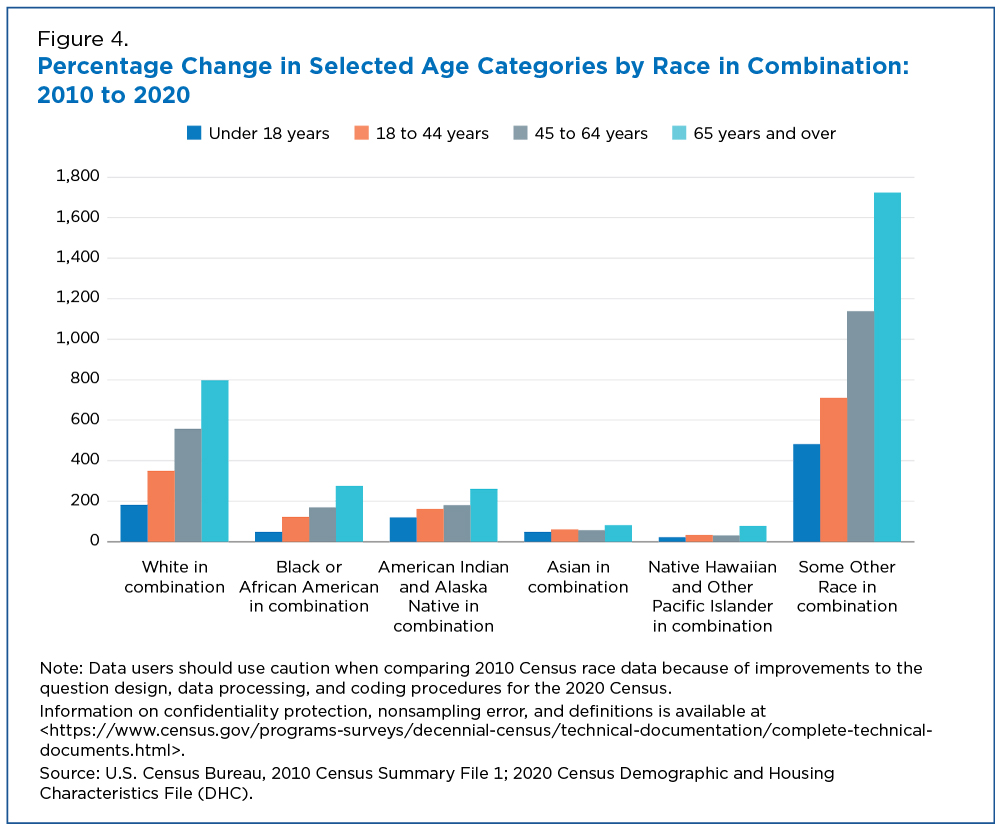
Census figures show that the population that reported multiple races grew faster than all race alone groups in 2020. Figure 4 shows age-specific changes for each race in combination population between the 2010 and 2020 censuses.

All race in combination groups saw growth across each age category over the decade. The Some Other Race in combination population grew the fastest – by over 482% for every age category.

Figure 4. Percentage Change in Selected Age Categories by Race in Combination: 2010 to 2020


Nearly all groups saw population gains this decade and the increase in the Two or More Races population (referred to throughout this story as the Multiracial population) was especially large (up 276%). The White alone population declined by 8.6% since 2010.

The 2020 Census shows:
  • The White population remained the largest race or ethnicity group in the United States, with 204.3 million people identifying as White alone. Overall, 235.4 million people reported White alone or in combination with another group. However, the White alone population decreased by 8.6% since 2010.
  • The Multiracial population has changed considerably since 2010. It was measured at 9 million people in 2010 and is now 33.8 million people in 2020, a 276% increase.
  • The “in combination” multiracial populations for all race groups accounted for most of the overall changes in each racial category.
  • All of the race alone or in combination groups experienced increases. The Some Other Race alone or in combination group (49.9 million) increased 129% surpassing the Black or African American population (46.9 million) as the second-largest race alone or in combination group.
  • The next largest racial populations were the Asian alone or in combination group (24 million), the American Indian and Alaska Native alone or in combination group (9.7 million), and the Native Hawaiian and Other Pacific Islander alone or in combination group (1.6 million).
  • The Hispanic or Latino population, which includes people of any race, was 62.1 million in 2020. The Hispanic or Latino population grew 23%, while the population that was not of Hispanic or Latino origin grew 4.3% since 2010.
Have a lovely Loving Day, folks!

EDITOR'S NOTE: For additional commentary, news and views from an AANHPI perspective, follow @DioknoEd on Twitter or at his blog Views From the Edge.

Friday, June 9, 2023

Asian Americans support for affirmative action wavers when it comes to college admissions


ANALYSIS 
UPDATED 1:30 a.m., June 11, 2023

A majority of Asian Americans approve affirmative action programs overall but when it comes to getting their own kids into college, that's another matter.

Although, in general, most Asian Americans like the idea and goals of affirmative action programs in employment and awarding of grants or contracts, a new survey by the Pew Research Center found that Asian Americans' view of affirmative action is more nuanced than a simple yea or nay across the board.

Based on a large multi-language survey of Asian American adults living in the US, the Pew analysis finds about half of those who have heard of affirmative action (53%) say it is a good thing, while 19% say it is a bad thing and 27% say they don’t know whether it is good or bad. 
However, when asked about affirmative action in college admissions, the survey reveals a reversal of opinion. The survey finds about three-quarters of Asian Americans (76%) say race or ethnicity should not factor into college admissions decisions. 


By the end of June, the right-wing dominated US Supreme Court is expected to issue their rulings in two affirmative action complaints brought forth by the anti-affirmative action group, Students for Fair Admissions headed by conservative activist Edward Blum.

In an attempt to appear less racist, Blum's complaint against the Harvard and University of North Carolina is alleging that the schools' admission programs are biased against Asian applicants.

Blum is using the high value Asian Americans place on a good education from prestigious schools as the door to economic security and opportunities to convince some Asian Americans that their children with high grades and test scores are being denied admission so that "less-qualified" applicants (code for Blacks and Latinos) can secure placement.

Both Harvard and UNC deny any racial bias towards Asians in their admission process, a claim supported by the rulings by lower courts.

Most Asian American civil rights organizations support affirmative action, including the Asian American Legal Defense and Education Fund and Asian Americans Advancing Justice (AAJC) both of which have filed briefs in support of race-conscious admissions.

However, when asked by Pew about a list of factors that colleges should consider, only 21% of Asian adults say colleges should consider race and ethnicity when deciding which students to accept. By contrast, Asian adults broadly say high school grades (87%), community service (71%) and standardized test scores (71%) should be factors considered in college admissions.

Lower shares say athletic ability (33%), family income (26%) and gender (17%) should be considered. Few Asian adults (10%) say schools should consider family connections or “legacies” in admissions.

Overall, majorities of Asian adults across gender, age, education and origin groups say race or ethnicity should not factor into college admissions. Similar shares of Indian (77%), Chinese (76%), Filipino (76%), Vietnamese (76%), Korean (72%) and Japanese (70%) American adults express this view.

This latest Pew survey is the latest in the nonpartisan Center’s series of in-depth analyses of public opinion among Asian Americans. It also features data from general population surveys of US adults and a qualitative study of Asian Americans. 

ABC
Asian Americans are at the center of the debate over affirmative action.

The Pew findings reinforce the complexity of the score of Asian communities that fall under the umbrella "Asian American" term. 

While, in general, Pew found that Asian Americans supported affirmative action as a policy to give equal opportunity for generations of intentional and unintentional, ingrained racist policies in institutions of government, education and finance.

However, when it came down to one's own family, Pew found that Asian American support seems to be less solid. Conservative media outlets jumped on that result  blaring out their own biased conclusions about a "divide" in the Asian American community giving the impression that affirmative action support is 50-50.

AAPI Data, which for years have reported through its own surveys that the support for  affirmative action was closer to 75% among Asian Americans, a finding that coincides with Pew's findings.

Janelle Wong, director of Asian American studies at the University of Maryland and senior researcher at AAPI Data, told NBC News that wording can significantly impact the way respondents perceive the role of race in admissions, particularly when the phrase “affirmative action” isn’t used.

“It’s not attached to a policy. It’s just saying, ‘Should race be considered?’ The way the law works, race can only be considered as one of many, many, many other factors and it can never be the primary factor, but the question wording makes it sound like it could be the primary factor,” Wong said. “There’s lots of different ways it could be interpreted and so that’s why we see that difference.”

Among the other key findings from this analysis:
  • Nearly three-in-four Asian adults in the US (74%) say they have heard the phrase “affirmative action” before, with awareness varying across Asian demographic subgroups. For example, 91% of US-born Asians say this compared with 67% of Asian immigrants.
  • Views of affirmative action among Asian Americans who have heard the term before diverge sharply by political party affiliation. Among Asian Americans, Democrats are more likely than Republicans to say affirmative action is a good thing (64% vs. 32%). Notably, views of affirmative action among Asian Republicans vary by education level.
  • When asked about a list of factors that colleges should consider in admissions decisions, only 21% of Asian adults say colleges should consider race and ethnicity when deciding which students to accept. By contrast, Asian adults broadly say high school grades (87%), standardized test scores (71%) and community service (71%) should be factors considered in college admissions. Lower shares say athletic ability (33%), family income (26%) and gender (17%) should be considered. Few Asian adults (10%) say schools should consider family connections or “legacies” in admissions
  • Majorities of Asian adults across gender, age, education and origin subgroups say race should not factor in college admissions. For example, seven-in-ten or more Indian (77%), Chinese (76%), Filipino (76%), Vietnamese (76%), Korean (72%) and Japanese (70%) adults express this view.
As the Supreme Court decision hangs over June, the Asian American community finds itself at the center of the contentious debate. One way or the other, it will be affected.

It should be noted that Harvard's incoming freshman class this fall is around 23% Asian. Those Asian applicants who were turned away will most likely get accepted in other schools so their pursuit of the American Dream will continue.

However, as Asian Americans await the Supreme Court's decision later this month, they must face larger questions. Are they willing to perhaps suffer individual disappointments for a more equitable society offered by affirmative action; or will they  enjoy the opportunities traditionally reserved for Whites by keeping the doors shut to those who have historically been stymied by racist traditions?

EDITOR'S NOTE: For additional commentary, news and views from an AANHPI perspective, follow @DioknoEd on Twitter or at his blog Views From the Edge.


Wednesday, June 7, 2023

Rose Zhang debut makes history by winning her first professional golf tournament

Rose Zhang just won her first pro tourney but she's worried about her exams at Stanford.

Rose Zhang just turned pro and on Sunday she became the first player to win an LPGA tournament in her professional debut in 72 years. 

No one was surprised to see the former Stanford star, Rose Zhang, holding the Mizuho Americas Open trophy on Sunday at Liberty National Golf Club. But few, even Zhang herself, expected success to come this early.

"Answer is no," Zhang said when asked if she expected to win in her pro debut. "I honestly didn't even expect to make the cut and the reason why I say this is because I don't think about my expectations a lot. I think about playing the golf course. I think about trying to shoot the best score that I can.

"Obviously, I have frustrations, disappointments with my game, but I never once think about where I finish, where I should finish, et cetera. The expectation for me winning did not even cross my mind. I was just playing my game. I was having a good time out there. This is the game that I love, and I'm so thankful to be a professional doing it now."

"I want to keep on doing better and better," said Zhang. "So we'll be seeing what I do in the future. As of now, I'm just soaking it all in."

At 20-years old, Zhang already has a pretty good resume: Twelve wins at Stanford University, two national championships, an Augusta National Women's Amateur title, a US Girls' Junior win, and a U.S. Women's Amateur victory are great forecasters for LPGA Tour success. 

As she drinks in the moment, the Stanford student will be celebrating this momentous occasion, but Zhang also has something else on her mind that might end up being a little more stressful than winning her first pro event…final exams.

"I have no idea what I'm going to do with that. I've got an essay due, pset due for CS," she said. "We'll figure that out. I'm also moving on the 13th, so I have a busy week ahead of me, and that's not golf related."


EDITOR'S NOTE: For additional commentary, news and views from an AANHPI perspective, follow @DioknoEd on Twitter or at his blog Views From the Edge.

FilAm Attorney General leads probe of "state-sanctioned kidnapping" of migrants.

California Attorney General Rob Bonta suspects Florida may have broken California law when
South American asylum seekers were transported to California from Texas.


Gloves are off in the brewing brouhaha between California and Florida. It is Blue state vs Red state. Conservative vs Progressive. Republican vs. Democrat. Gavin Newsom vs. Ron DeSantis.

California is investigating to see if Florida broke any laws by transporting migrants from Texas to California June 2, Friday.

When a chartered jetliner flew 16 legally documented migrants from Colombia and Venezuela and dropped them off in Sacramento, California's state capitol, someone was making a deliberate political statement. California Gov. Gavin Newsom and his Attorney General, Rob Bonta, aim to find out who was behind the act.

Since the initial batch of migrants were brought to Sacramento, another planeload of migrants were flown in yesterday (June 5).

“We are investigating the circumstances by which these individuals were brought to California," said the Filipino American AG. "We are also evaluating potential criminal or civil action against those who transported or arranged for the transport of these vulnerable immigrants. While this is still under investigation, we can confirm these individuals were in possession of documentation purporting to be from the government of the State of Florida."

"State-sanctioned kidnapping is not a public policy choice, it is immoral and disgusting," Bonta stated.

The migrants, who were legally processed in Texas and assigned court dates for their asylum hearings, had no idea what awaited them in California, according to the migrants.

A spokesperson for Florida's Division of Emergency Management, Alecia Collins, admitted that Florida helped arrange the flight from Texas. In a statement released Tuesday, he said, "Through verbal and written consent, these volunteers indicated they wanted to go to California." 

"Through verbal and written consent, these volunteers indicated they wanted to go to California. A contractor was present and ensured they made it safely to a 3rd-party NGO (non-governmental organization)," said Collins. "The specific NGO, Catholic Charities, is used and funded by the federal government."

A video provided by the Florida agency showed how the migrants were informed about California and them signing waivers, apparently without any coercion. 

After landing in Sacramento, the young men and women were dropped off Friday outside the office of the Roman Catholic Diocese of Sacramento with only a backpack’s worth of belongings each.

That's not what they told the California officials who interviewed them. “They were lied to and intentionally deceived,” said 
Eddie Carmona, campaign director at PICO California, a faith-based community group that has been assisting the migrants.

The diocese apparently was not informed ahead of time about the migrants' arrival. However, diocese staff acted quickly to feed them and find temporary housing. Miriam Sammartino, the diocese’s director of Catholic Charities and Social Concerns, told Crux that the agency was shocked and surprised at the arrival of the migrants. 

The act was heartbreaking, said Sammartino, especially considering it appears that Sacramento wasn’t the migrants’ final destination, nor was it on the way to where they intended to go after they were processed at the border. A few of them needed to get to San Diego and Chicago, she said.

“I don’t believe the migrants themselves even understood that they were being brought to Sacramento,” Sammartino told Crux.

There is no love lost between the progressive Newsom and DeSantis, who is a Presidential candidate for the GOP nomination.

Newsom has strongly criticized DeSantis' so-called anti-"woke" policies on reproductive rights, voting rights, LGBTQ rights and banning of books in schools that mention racism or gay lifestyles.

After meeting with the first planeload of migrants, an angry Newsom sent out a tweet saying, “This isn’t Martha’s Vineyard. Kidnapping charges?” wrote Newsom referring to the first instance when "someone" paid for migrants transported from Texas to the Massachusetts resort island.

In the same tween, Newsome called DeSantis a "small and pathetic man." and included a screenshot of a section of California penal code, stating that:

“Every person who, being out of this state, abducts or takes by force or fraud any person contrary to the law of the place where that act is committed, and brings, sends, or conveys that person within the limits of this state, and is afterwards found within the limits thereof, is guilty of kidnapping.”

"We are a nation built by immigrants and we must condemn the cruelty and hateful rhetoric of those, whether they are state leaders or private parties, who refuse to recognize humanity and who turn their backs on extending dignity and care to fellow human beings," said Bonta.

"California and the Sacramento community will welcome these individuals with open arms and provide them with the respect, compassion, and care they will need after such a harrowing experience.”

EDITOR'S NOTE: This is a developing story. Check back later for updates. For additional commentary, news and views from an AANHPI perspective, follow @DioknoEd on Twitter or at his blog Views From the Edge.


Tuesday, June 6, 2023

12-year old wins Doodle for Google contest


A sixth-grade student from Washington state won the 15th annual Doodle for Google contest.

Rebecca Wu's Doodle, “My Sweetest Memories,” — which is on the Google homepage today — reflects her gratitude for her sisters and the memories they’ve created together.

For the 15th annual Doodle for Google contest, Google invited K-12 students to create artwork that answers the prompt “I am grateful for….” Google received  submissions from all over the US, including our 55 state and territory winners and five national finalists.

Rebecca’s Doodle, “My Sweetest Memories,” — which is on the Google homepage today — reflects her gratitude for her sisters and the memories they’ve created together.

When Rebecca was thinking about how to answer this year’s Doodle for Google contest prompt, “I am grateful for…”, her mind instantly went to her sisters. She decided to highlight the ways in which they support each other using the metaphor of a garden growing. She thinks gratitude is important because it allows us to look beyond the negative to focus on the positive.

Rebecca Wu (center) and her sisters.

Rebecca explains her Doodle inspiration:
“Sometimes I love them, and sometimes I dislike them very much, but I can't imagine my life without my sisters. I have learned to be a little bit more patient with them, and they have had an enormous impact on me. We help to inspire each other and to help each other grow like the vines and flowers in my picture. I am never lonely with them, and they can cheer me up. I am grateful for them and all that they have done for me. In this drawing, we are having a fun time drinking hot chocolate, which is one of my fondest memories. The rainbow in the background symbolizes one of the first things I helped one of my sisters draw. In one of my family pictures, my sisters (sitting next to me) and I (the one in the middle) are sitting in flowers with a background that I drew, so I thought it would be fun to reference that by drawing us sitting flowers here. The word "Google" is related with the stems of flowers and vines, also following the flower/garden theme. My drawing is composed of all our happiest memories to show just how grateful I am for them.”
This was not the first time Rebecca entered the Doodle contest. "I entered the Doodle for Google contest for the first time when I was eight or nine after my art teacher introduced it to me," said the budding artist. "It was fun for me to interpret the prompt and put 'Google' in my drawing. I’ve entered it almost every year since, so it’s sort of a yearly thing for me to do now.

As the U.S. 2023 Doodle for Google contest national winner, Rebecca wins a $30,000 college scholarship and a $50,000 technology package for her school.

EDITOR'S NOTE: For additional commentary, news and views from an AANHPI perspective, follow @DioknoEd on Twitter or at his blog Views From the Edge.