Showing posts with label U.S. Census. Show all posts

Friday, August 13, 2021

2020 CENSUS: Asian American population explodes to 24 million

Asian American population numbers translates into growing political influence.

It's time to throw out the old 2010 stat used for the past decade that counted 18 million Asian Americans in the U.S. The 2020 Census counts 24 million Asian Americans, 7.2% of the U.S. population, up from 2010's 6%.

Combined with the Native Hawaiian and Pacific Islander population of 1.6 million, the umbrella designation of Asian American, Native Hawaiian and Pacific Islander, the AANHPI  population numbers 25.6 million, or 7.7% of the U.S. population. 

RELATED: The U.S. is diversifying faster than expected

As impressive as these numbers are, they are likely an undercount because of Trump administration efforts to not count people of color and immigrants by asking a question about citizenship status and moving up deadlines despite natural disasters such as the pandemic, wildfires and floods. Those attempts to undermine the Census were thrown out by the Supreme Court.

Assuming an undercount occurred, the AANHPI population could be closer to 8% of the U.S. population, which makes us harder to ignore by pollsters, marketers, political parties and pop culture.

Reasons for the increase is due to several factors. The AANHPI population is generally younger than the American average. In other words, a larger portion of the AANHPI community is of child-bearing age; and legal immigration from Asia is greater than from any other region.

California, trendsetter

If you want to know what the U.S. will look like in the future, one needs to look at California, where national trends often start. California’s White population plummeted by 24% in the last decade, confirming California is one of three states — along with New Mexico and Hawaii — where Whites are not the largest ethnic group.

In 2014, Hispanics surpassed Whites as California’s largest ethnic group. The state's Hispanic population grew by 11% to 15.5 million people, making up almost 40% of California's nearly 40 million residents.

But it was the Asian population that had the biggest percentage gain, 25%, over the past decade, making up 15.1% of the population. California now has more than 6 million people of Asian descent — more than the total population of most other states. 

“I think the story nationwide focuses primarily on the Hispanic population, but in California ... I think the Asian population, in particular related to the growth in the younger age groups, is sort of a major driver of factors as to why we see this large increase over the past 10 years,” said Noli Brazil, a demographer at the University of California-Davis, told the Associated Press.

Other highlights about the AANHPI community from the data released Thursday:

Asian Population

Approximately 19.9 million people (6% of all respondents) identified as Asian alone in 2020, up from 14.7 million people (4.8%) in 2010.
  • Coupled with the 4.1 million respondents who identified as Asian in combination with another race group, such as White or Native Hawaiian and Other Pacific Islander, the Asian alone or in combination population comprised 24 million people (7.2% of the total population).
  • The Asian alone population grew by 35.5% between 2010 and 2020. In comparison, the Asian in combination population grew by 55.5%.
  • Hawaii is the only state where Asians make up the largest ethnic group coming in at 36.5% of it's  total population of 1,455,271; followed by White at 21.6%, Native Hawaiian and other Pacific at 10.2% and Hispanic or Latino at 9.5%. Just over 20% of Hawaii's population were of two or more races.

Native Hawaiian and other Pacific Islander population

Over half of Native Hawaiians and Other Pacific Islanders identified with more than one race.

  • In the 2020 Census, 689,966 people (0.2%) identified as Native Hawaiian and Other Pacific Islander alone, up from 540,013 people (0.2%) in 2010.
  • Coupled with the 896,497 people who identified as Native Hawaiian and Other Pacific Islander in combination with another race group (such as Asian or White), the Native Hawaiian and Other Pacific Islander alone or in combination population totaled about 1.6 million people and 0.5% of the total population.
  • The Native Hawaiian and Other Pacific Islander alone population grew by 27.8% between 2010 and 2020. In comparison, the Native Hawaiian and Other Pacific Islander in combination population grew faster — 30.8% since 2010.

Multiracial Americans is the fastest growing ethnic and racial group in the U.S.

Multiracial Population

In 2020, the percentage of people who reported multiple races changed more than all of the race alone groups, increasing from 2.9% of the population (9 million people) in 2010 to 10.2% of the population (33.8 million people) in 2020.

  • The largest Multiracial combinations in 2020 were White and Some Other Race (19.3 million), White and American Indian and Alaska Native (4 million), White and Black or African American (3.1 million), White and Asian (2.7 million), and Black or African American and Some Other Race (1 million).
  • Between 2010 and 2020, the White and Some Other Race population added 17.6 million people to the Multiracial population, a change of over 1,000%.
  • The White and American Indian and Alaska Native population also increased, growing by about 2.5 million people or 177%.
  • The White and Black or African American population increased by 1.2 million people, a 67.4% change.
  • The White and Asian population increased by 1.1 million people, a 65.8% change in size.
  • The Black or African American and Some Other Race population increased by 722,383 people, a 230% change.

The observed changes in the Multiracial population could be attributed to a number of factors, including demographic change since 2010. But we expect they were largely due to the improvements to the design of the two separate questions for race and ethnicity, data processing, and coding, which enabled a more thorough and accurate depiction of how people prefer to self-identify.


EDITOR'S NOTE: For additional commentary, news and views from an AAPI perspsective, follow @DioknoEd on Twitter.


Thursday, August 12, 2021

CENSUS: U.S. is getting more diverse faster than expected; white population declines for first time


Aided by immigration, the Asian American population grew at the fastest rate.


UPDATED: 1:00 p.m. PDT to include info from Census press releases.

The Republican Party and white supremacists are not going to like the findings released today (Aug. 12) by the U.S. Census: For the first time since the Census has been taken, the white population in the U.S. is showing a decline.

The data confirms what has long been predicted by demographers about the unprecedented and potentially tumultuous racial shift  that people of color will become the majority in this country by 2040, is occurring faster than expected.

The Census Bureau findings, released Thursday shows the first decline in history for the nation's non-Hispanic white population, according to an analysis of U.S. Census Bureau data by the Brookings Institution's William Frey.


The U.S. is rapidly moving toward a majority-minority population — a trend likely to continue for generations. "This really is moving in a direction that’s going to favor the issues and the political agendas of these younger people," Frey told Axios.

Despite the usual undercount of people of color, experts predict that the 2020 census will show a decline in the white population for the first time in U.S. history. For the first time, the portion of white people could dip below 60% and the under-18 population is likely to be majority non-white, reported The Washington Post, a decade earlier than expected.

“Twenty years ago if you told people this was going to be the case, they wouldn’t have believed you,” said Frey. “The country is changing dramatically.” 

“The U.S. population is much more multiracial and much more racially and ethnically diverse than what we have measured in the past,” said Census Bureau official Nicholas Jones to the Associated Press.

Despite the historic decline in the white population -- partially due to Whites of the Boomer generation tend to be older and the low birth rate among younger Whites -- the U.S. population is still growing, albeit slowly. 

Making up for the decline of Whites, the source of that growth is coming mainly from Asian, Black and Hispanic communities.

When translated into population totals, Latinos or Hispanics contributed 10 million people—over half of the nation’s 2010 to 2019 growth. Asian Americans, Black residents, and persons of two or more races contributed 4.5 million, 3.2 million, and 1.7 million people, respectively.

Other highlights of today's release of the Census' race and ethnicity data:

  • Despite the decline in the White population, it remained the largest race or ethnicity group in the United States, with 204.3 million people identifying as White alone. Overall, 235.4 million people reported White alone or in combination with another group. However, the White alone population decreased by 8.6% since 2010.
  • The Two or More Races population (also referred to as the Multiracial population) has changed considerably since 2010. The Multiracial population was measured at 9 million people in 2010 and is now 33.8 million people in 2020, a 276% increase.
  • The “in combination” multiracial populations for all race groups accounted for most of the overall changes in each racial category.
  • All of the race alone or in combination groups experienced increases. The Some Other Race alone or in combination group (49.9 million) increased 129%, surpassing the Black or African American population (46.9 million) as the second-largest race alone or in combination group.
  • The next largest racial populations were the Asian alone or in combination group (24 million), the American Indian and Alaska Native alone or in combination group (9.7 million), and the Native Hawaiian and Other Pacific Islander alone or in combination group (1.6 million).
  • The Hispanic or Latino population, which includes people of any race, was 62.1 million in 2020. The Hispanic or Latino population grew 23%, while the population that was not of Hispanic or Latino origin grew 4.3% since 2010.

The news from the Census  while welcomed by some, can be a two-edged sword for minorities, especially for Asian Americans and Pacific Islanders. While they might gain in political and economic clout,  AAPI can expect a likely increase in hate incidents continuing the alarming surge the AAPI community has been experiencing for the last 18 months.

"Republicans are going to have to awaken to this," said Frey of the data.

The GOP is already trying to hold onto their grip on power by riling up anti-immigrant sentiment and passing laws that would make it harder to vote for POC.

The nation can expect the White extremists to not take the Census news lightly. White supremacists, already nervous about the demographic shift taking place, will likely  find more reasons to express their frustration and outrage. White supremacist-driven protests such as Charlottesville and the Jan. 6 coup attempt could grow in number and level of violence. AAPI can also expect an increase in attacks as whites grow more resentful of their perceived decline in status and power.

Domestic extremism “poses the most lethal and persistent terrorism-related threat to the homeland today,” Alejandro N. Mayorkas, the homeland security secretary, told a House committee in an assessment delivered to the Biden White House earlier this year.

“The Jan. 6 attack on the U.S. Capitol and on American democracy is a searing example of this threat,” Mayorkas said.

Results of the U.S. Census that confirms the White population decline only adds fuel to their insecurities and fears.

“You’ve got an aging white electorate that does not seem to be willing to make the investments in a young population that propels people to success — schools, infrastructure,” Manuel Pastor, a sociology professor at the University of Southern California told The Associated Press

“There’s a portion of the population — myself included — who’s delighted by Korean taco trucks popping up …But, on the other hand, there are people who feel a great dislocation and loss of personal identity.”

WORD OF CAUTION: This post is news with a smattering of opinion. Readers are urged to seek multiple news sources to form their own opinion.

Friday, October 2, 2020

Court orders Census count continue until October 31


The U.S. Census will continue it's field operations until Oct. 31 after the 9th U.S. Circuit Court of Appeals rejected the Trump administration sought an early end to the decennial head count of U.S. residents.

U.S. District Judge Lucy Koh issued her new order late Thursday in San Jose, Calif and described the Census Bureau one-sentence announcement stating an Oct. 5 deadline as "the most egregious violation," of her preliminary injunction that she ordered last week.

In her latest ruling Koh that the Census Bureau and Commerce Department, which oversees the agency, had violated the injunction she ordered last week "in several ways." She threatened them with sanctions or contempt proceedings if they violated the injunction again.

"Defendants' dissemination of erroneous information; lurching from one hasty, unexplained plan to the next; and unlawful sacrifices of completeness and accuracy of the 2020 Census are upending the status quo, violating the Injunction Order, and undermining the credibility of the Census Bureau and the 2020 Census," Koh wrote. "This must stop."
“The court’s decision affirms our contention that changes to the census schedule will irreparably harm the integrity of the 2020 Census and result in a devastating undercount of vulnerable communities," said Marc H. Morial, President and CEO, National Urban League. "Career officials at the Census Bureau opposed the shortened schedule precisely for these reasons, and to avoid the perception of political manipulation, and we are confident that integrity and equity will win out over the partisan vandalism that threatens our democracy."

The judge ordered the Census Bureau, which employs hundreds of thousands of temporary workers for the national tally and had reportedly begun ending their employment, to send a text message to all of its employees on Friday (Oct. 2) stating that the Oct. 5 date is "not operative" and that the agency will continue its data collection operations through the end of the month, according to National Public Radio (NPR).

RESPOND to the Census online here. Additionally,  the Census Bureau will offer live, non-English help by phone between 7 a.m. – 2 a.m. ET.
Later Friday, the Census Bureau began complying with Koh's order. It updated its website to include the extension to the end of October.

The Census Bureau also said it sent out the mandated message Friday afternoon. "As a result of court orders, the October 5, 2020 target date is not operative, and data collection operations will continue through October 31, 2020," the message read. "Employees should continue to work diligently and enumerate as many people as possible. Contact your supervisor with any questions."

In response to Koh's order,  Julie Menin, Director of NYC Census 2020, and Executive Assistant Corporation Counsel, NYC Law Department issued a statement:

"The Trump Administration picked a fight with democracy and democracy won. We now expect the Census Bureau to fully comply with Judge Koh's order and not only inform every census employee that the census will continue until October 31, as it should have all along, but also ensure that this is the end to all legal shenanigans and the count actually continues until the end of the month. This is a victory for all of us and for the rule of law to ensure that everyone is counted. In NYC, we will continue our fight to ensure New Yorkers get every ounce of the money, power, and respect to which we are entitled."

The suit in National Urban League et al. v. Wilbur L. Ross Jr. et asks the court to keep the 2020 Census on the schedule proposed by census officials in April in response to Covid-19. Under that plan, the bureau would complete the census, including door-knocking, by October 31, 2020, and deliver apportionment numbers to the president by April 30, 2021. Redistricting data would be reported to the states by July 31, 2021.

Koh’s decision to extend the Census deadline means that the bureau will have more time to go to approach historically hard-to-count demographics -- such as predominantly immigrant or minority communities -- won’t be overlooked and produce an incomplete count, said attorneys for the plaintiffs after the ruling.

After field operations ends, the Bureau will begin crunching numbers to determine the number of congressional representatives will be needed per state and how many electoral votes each state will have.

Those opposed to the early deadline believed that immigrant-heavy states such as California and New York, would lose Congressional seats if those groups were undercounted. Instead of turning the numbers over to Trump on Dec. 31 for apportionment, the Bureau will not have to deliver the information until next Spring to whoever is President.

“Today’s decision is a victory for democracy. Census officials outlined an extended counting period in order to achieve the full enumeration of all people living in the United States," said plaintiff Virginia Kase, CEO, League of Women Voters of the United States. "The effort to rush the timeline set by our trusted census experts was a blatant attempt to force an undercount, deprive American communities of critical funding, and undermine the accuracy of our representative districts. The League now urges the American public to fill out the census and ask their friends and family to do the same. Our democracy depends on it.”

EDITOR'S NOTE: A word of caution, this article is news laced with opinion. Readers are encouraged to seek multiple news sources to formulate their own positions. 

Tuesday, September 29, 2020

Census wrestles with shifting deadlines - now Oct. 5 - and natural disasters

Census takers will have a hard time finding the residents of this household.

Ignoring a federal judge’s ruling last week allowing the decennial head count of every U.S. resident to continue through Oct. 31, U.S. Secretary of Commerce Wilbur Ross says the 2020 census will end Oct. 5 according to a one-sentence press release issued by the Census Bureau late Monday.

"The Secretary of Commerce has announced a target date of October 5, 2020 to conclude 2020 Census self-response and field data collection operations," said the press release.

U.S. District Judge Lucy Koh issued a preliminary injunction last Thursday suspending the Sept. 30 deadline and continuing the Census until at least through the end of October.

The press release came as a virtual hearing was being held in San Jose, California, as a follow-up to Koh’s ruling. The injunction issued last week suspended the Census Bureau’s deadline for ending the head count on Sept. 30, which automatically reverted back to an earlier Census Bureau plan ending field operations on Oct. 31.

The Oct. 31 deadline was agreed to by the Bureau because the coronavirus pandemic had derailed to Census timetable and field operations that required enumerators to go the households who had not yet self-reported.

But last August, the Bureau announced a return to the Sept. 31 deadline without explanation.


A lawsuit of civil rights organizations and local governments led by the National Urban League sought the Census to return to the October 31 deadline. Koh sought and explanation from the Census why the decision was made to revert to the September deadline.

Koh asked federal attorneys during Monday’s hearing to provide documents on how the Oct. 5 date was decided upon. When a federal government lawyer suggested that the decision-making was a moving target without any records, the judge asked, “A one sentence tweet? Are you saying that is enough reason to establish decision-making? A one sentence tweet?”

In her preliminary injunction issued Thursday, Koh said the Sept. 30 deadline would not provide enough time for an accurate count.

As Census takers continue to scramble to complete their task as best as possible while assuming the Oct. 5 deadline would go into effect. Koh had received messages from Census field offices that they were ordered to assume the Sept. 30 deadline was the effective end of their field operations.


Besides determining the political representation for communities, the data from the Census helps allocate about $1.5 trillion for government assistance.

"In 2010, in just watching what happened the census bureau, we know that there were a lot of gaps, maybe a lot of resources that didn’t land in our communities," said Victoria Huynh, Vice President of the Center for Pan Asian Community Services, to  11Alive in Georgia where the AAP community has grown by 83% in the past decade. 


"2020 is a really important time to capture that information, especially as those cities continue to grow and plan for that growth," said Karuna Ramachandran, the Deputy Director of "Asian Americans Advancing Justice Atlanta."

Additionally, the Constitutionally mandated head count is having difficulty in those areas where wildfires and flooding has forced thousands of residents from their homes.

In Northern California, a Census manager told the staff working underneath her Monday that they needed to complete 99% of households in the the Santa Rosa region where new evacuation orders had been sent out because of threatening wildfires by Sept. 30, including 12,000 households yet to be counted in Mendocino County, reported the Associated Press.

Meanwhile, a measure passed by the U.S. House of the Representatives officially extending the deadline to Oct. 31 never went into effect because the Republican-controlled Senate has not voted on it.

The Trump administration is pushing for the early end to the Census because an inaccurate count -- especially of those areas with historically hard-to-count immigrants -- would likely lose representation if they are undercounted. 

The administration's earlier attempts to dissuade immigrants from participating in the Census -- by adding a question about citizenship status to the Census form and to not include undocumented immigrants when drawing boundaries for Congressional districts -- have been ruled illegal by the courts. 

EDITOR'S NOTE: A word of caution, this article is news laced with opinion. Readers are encouraged to seek multiple news sources to formulate their own positions. 

Friday, September 25, 2020

Court: Census deadline extended to Oct. 31, but government appeal expected

CENSUS BUREAU
Census workers will continue to count people until the deadline, whenever that is.Add caption

A federal court has ordered the U.S. Census to extend by an extra month its self-imposed deadline that was supposed to be Sept. 30. However, the ruling by U.S. District Judge Lucy Koh in the Northern District of California, will most likely be appealed, leaving the final outcome up in the air for at least another few days.

The Census is being asked to extend its Sept. 30 deadline because the coronavirus and natural disasters such as the California wildfires and tropical storms hitting the Gulf states have thrown off the Census' timetable. Last Spring, the Census Bureau, the Trump administration and their community partners had agreed to extend the deadline to Oct. 31. 

With days to go, the U.S. Census and Asian American community groups are scrambling to make sure as many people as possible are included in the tally mandated by the Constitution.

The Census is being asked to extend its Sept. 30 deadline because the coronavirus and natural disasters such as the California wildfires and tropical storms hitting the Gulf states have thrown off the timetable. Last Spring, the Census Bureau, the Trump administration and their community partners had agreed to extend the deadline to Oct. 31. However, last month, the Census reverted to Sept. 30 as the end of the count.

"It is ludicrous to think we can complete 100% of the nation's data collection earlier than 10/31 and any thinking person who would believe we can deliver apportionment by 12/31 has either a mental deficiency or a political motivation," wrote Tim Olson, who oversees the enumerators who are going door-to-door to the households who have not self-reported online, phone or by mail.

The hearing Tuesday (Sept. 22) sometimes became testy as the government lawyers wanted to the judge to issue a ruling quickly so that they could file an appeal. However, Koh fired back that the government attorneys were the ones causing delays. She pointed out that the government's legal team violated two of her orders to produce documents, and even denied the existence of documents that it later turned over to the court.

Attorneys representing the National Urban League and other groups suing the government are asking for a preliminary injunction blocking the government from concluding the nationwide count on Sept. 30.

Koh signaled concern with sudden decision by Commerce Secretary Wilbur Ross to move up the agreed-to deadline from October 31. She pointed out that it is unlikely the Census Bureau will  reach its goal of 99% response rate for completion by next week.

"Four out of 50 states reached the threshold for closing," she said, referencing the Census Bureau's latest data. "Why is the bureau insisting on ending data collection in seven days? ... That means 46 states have not met the requirements yet," according to CNN.

One of the government's arguments contended that the Constitution's requirement to conduct a count of the U.S. population every 10 years does not specify whether or how it should be accurate.

Census officials said that over 60% of the households have self-responded and that door-to-door Census workers pushed the rate to over 90% therefore, a deadline extension is not needed

However, those claims seem dubious with data provided by the Census. Minnesota is leading the country in self-response rates to the 2020 census while Puerto Rico, a U.S. territory, is dead last, according to Census Bureau data.

Nearly 75% of Minnesota residents responded to the census by phone or mail or online, while just 34% of Puerto Rico residents self-responded.

The states or territories with the highest self-response percentage rates (as of Saturday) are:
Minnesota, 74.6 
Washington, 71.8 
Wisconsin 71.8 
Nebraska, 71.4 
Iowa, 70.8 
Michigan 70.8 
Illinois, 70.5 
Virginia, 70.5 
Utah, 70.4 
Maryland, 70.3 

The states or territories with the lowest self-response rates (as of Saturday) are:
Puerto Rico, 34.2
Alaska, 53.8
West Virginia, 55.9 
New Mexico, 57.3
Maine, 57.8 
Louisiana, 59.3 
Montana, 59.5 
Mississippi, 59.6 
Vermont 60.
South Carolina, 60.1
Arkansas, 60.1

The Census is not going well for New York City and Los Angeles, home to the country's largest immigrant communities. The count effort for NYC is at 60% and even worse for L.A. at 57.2%, far below the national average.

Census data is used to determine the number of members of Congress and who they would represent. The data is also used by government agencies to determine the allocation trillions of dollars of social service funds and infrastructure funds.

At the end of the hearing when she rendered her ruling, apparently exasperated at the the government attorneys' behavior, Koh said, "Go ahead and appeal me."

EDITOR'S NOTE: A word of caution, this article is news laced with opinion. Readers are encouraged to seek multiple news sources to formulate their own positions. 


Wednesday, September 23, 2020

Report: Identity unknown who ordered to change its Census deadline to Sept. 30


No one seems to know who ordered the Census Bureau to end its once-in-a-decade tally on Sept. 30.

With just a week to go, Census staff and community groups are scrambling to count as many people as possible.

Due to the coronavirus and natural disasters that threw off the Census timetable, the Census Bureau, the Trump administration and community partners agreed to extend the original Sept. 30 deadline a month to Oct. 31.

The Commerce Department's inspector general has concluded that the order to revert to the Sept. 30 deadline did not come from the Census Bureau. according to ABC News. Even the bureau's director doesn't know who ultimately made the call, says the department's watchdog.

"The schedule change was not the Bureau’s decision, nor was it the first time the 2020 Census schedule had been changed. Senior officials at the Bureau, including the Director, did not know who ultimately made the decision to accelerate the Census schedule," the inspector general report states.

Returning to the Sept. 30 will not provide an accurate count, say community agencies partnering with the Census Bureau.

So far, the Census Bureau claims that 95.4% of households in the U.S. either from self-submitted responses or field data collection, have been counted.

However, in some states, including Alabama, Mississippi, Louisiana, and Montana, that percentage is under 90%.

The Census is not going well for New York City and Los Angeles, home to the country's largest immigrant communities. The count effort for NYC is at 60%, and even worse for L.A. at 57.2%, far below the national average.

The low counts mean those cities and states could lose representation in Congress and get short-changed for federal funds for social services and infrastructure.

"Clearly, there are political motivations to change the timeline and particularly to close off the census and the count early, because what that's going to do is bias the final count," said Paul Ong, director of UCLA's Center for Neighborhood Knowledge and a former Census Bureau adviser.

"It's going to lead to a substantial undercounting of low income people, and people of color, and the political implication to that is very clear: by excluding them from the count you also bias the reapportionment process and the redistricting process," Ong told ABC News.

"There are real political motivations to essentially bias the final count because certain parties will gain from it at the expense of people they consider not worthy of being included," Ong told ABC News. "And so, again, I'm not surprised if this is true, because politicians play politics, and certainly one could play politics with the census to skew and bias the outcomes in their favor."

EDITOR'S NOTE: This is a developing story. Check back later for updates.


Friday, September 11, 2020

Court rules against Trump's attempt to not include undocumented immigrants in the U.S. Census


To the consternation of Donald Trump, a panel of judges ruled that the government must count unauthorized immigrants for the Census.

A special three-judge court in New York Thursday blocked the Trump administration's efforts to leave out unauthorized immigrants from the census numbers that determine each state's share of seats in Congress.

“This is a huge victory for voting rights and for immigrants‘ rights,” Dale Ho, director of the ACLU’s Voting Rights Project, said in a statement. “President Trump has tried and failed yet again to weaponize the census against immigrant communities. The law is clear — every person counts in the census.”

The judicial panel's decision comes after the release of a Trump memo in July  that directs Commerce Secretary Wilbur Ross, who oversees the Census Bureau, to stop including  undocumented immigrants from the apportionment count.

Excluding undocumented immigrants from the census could benefit Republicans electorally. One study found that California, which is solidly Democratic, could lose two House seats if undocumented immigrants did not get counted. The state’s attorney general, Xavier Becerra, sued to stop the move in July.

The lawsuit challenged “President Trump’s lawless attempt to exclude undocumented immigrants from the ‘persons’ who must be counted in the census for purposes of apportioning congressional seats to states.”

Plaintiffs are the New York Immigration Coalition, Make the Road New York, CASA, American-Arab Anti-Discrimination Committee, ADC Research Institute, FIEL Houston, and AHRI for Justice.

The U.S. Constitution mandates that the Census count every person living in the U.S. regardless of status. The Census, currently underway, is scheduled to end it's effort on Sept. 30. That deadline is also being challenged because the government and the Census Bureau had previously agreed to extend the Census count to the end of October because the pandemic had interfered the Census' timetable.

Besides the New York case, there are eight other lawsuits in courts in other parts of the country filed against Trump's attempt to affect representation in Congress.

The New York ruling is likely to be appealed directly to the U.S. Supreme Court. Federal law allows decisions by a three-judge court — which are convened for lawsuits challenging the constitutionality of how congressional seats are reapportioned — to skip having to go in front of an appeals court.

“We will not be moved by the President’s attempts to silence people in our country," said the Asian Americans Advancing Justice coalition of five legal advocacy agencies. 

"This is the latest in a series of attempts to politicize the census and use it as a weapon in his anti-immigrant agenda," continued the AAAJ statement. "It is a move straight out of the white supremacists’ playbook that has every discriminatory practice to restrict the rights of Black, Brown, Indigenous, and Asian American people.”

EDITOR'S NOTE: A word of caution, this is news sprinkled with opinion. Readers are encouraged to seek multiple news sources to formulate their own positions. 


Friday, June 26, 2020

Young Americans more diverse than older generations


White supremacists, already spooked by a demographic future where they are not in the majority, probably won't like this bit of news from the Census.

For the first time, people of color were a majority of people under age 16 in 2019, a sign that for this generation, the future is already here. The demographic shift is expected to grow over the coming decades, according to figures released by the U.S. Census Bureau on Thursday.

“We are browning from bottom up in our age structure,” William Frey, a senior fellow at The Brookings Institution, told the Associated Press. “This is going to be a diversified century for the United States, and it’s beginning with this youngest generation.”

It's not a new trend but the numbers mark a turning point that demographers have been predicting for decades. In 25 years, when today's young people, Gen Z and Gen Z+, will be 26 to 51 years old, the white population in the U.S. will no longer be in the majority but will still be the largest ethnic group in the nation. 
As the white population has gotten smaller, the ranks of people of color, swollen by immigrants from Asia and Latin America, is getting larger.
Of the racial groups, Asians had the biggest growth since the last Census in 2010. The Asian population has grown almost 30%, spurred by migration from Asia. India and China are the biggest contributors to the immigration rate.

Hopefully, younger generations having grown up in a  society in which diversity is a common thing in everyday life, will have a better handle on how to treat race than the generations that preceded them.

Sunday, April 26, 2020

Sunday Read: Covid-19 takes the spotlight away from the US Census


If not for the coronavirus pandemic and the anti-Asian hate spawned by it, the US Census currently underway would be the big story in the Asian American and Pacific Islander community.

When Census Day arrived, the official launch of the Constitutionally mandated tally, it was buried under the daily news about the rapid spread of the virus, number of cases and how many have died.

Because of the social and economic impact of the virus changing the way we go about our lives, the Census count has taken a back seat in the efforts by community groups to spread the word about how important the count is.

No one planned on a once-in-lifetime global pandemic. Years of planning of going out door-to-door went, well, out the door. Instead the community groups the Census was depending on for that personal touch have moved to other strategies to reach out. 

Telephone banking and text-a-thons have replaced door knocking. The cities hard-hit by the coronavirus like New York City have moved their advertising campaign for the subways to TV and online ads.

The Congressional Asian Pacific American Caucus sent a letter Tuesday to the Census Bureau, urging it to pump up paid outreach advertising and address long wait times at census call centers, among other things


Typically, the door-to-door efforts have played a key role in remnding much of the public to fill out the questionnaire. But without extensive physical outreach, Democrats and voting rights advocates warn the result could be an undercount of populations that can’t be easily reached online — including low-income households, immigrant and minority communities and homeless individuals.

The AAPI communities made up largely of first-generation immigrants, have historically been difficult to count due an inherent distrust in government.


In Queens, NYC, which has a large AAPI population, just 1 in 4 people have so far completed the Census survey, so far, according to Chuck Park of the MinKwon Center for Community Action

“We are concerned the count will remain low due to illness in the family, loss of life, loss of income, loss of a job, and fear of losing one's home, which all make over-the-horizon thinking and civic participation ever the more daunting," said Annetta Seecharran, executive director of Chhaya Community Development Corporation,one of the community nonprofits reaching out to the New York City AAPI.


A study done by AAPI Data found that only 55 percent of Asian American said they were extremely, or very likely, to fill out the census form, compared to 69 percent of white respondents, 65 percent of Latino respondents and 64 percent of black respondents, respectively. 

That same study found that 41 percent of Asian Americans said they were concerned that the census would be used against them, compared to just 16 percent of white respondents.

Because the coronavirus has affected outreach, the Census Bureau has extended the response deadline from August 15 to Oct. 31. The Census plans to reactivate field offices June 1. 

Census Bureau Director Steven Dillingham and Secretary of Commerce Wilbur Ross, whose department oversees the Census Bureau, said they are seeking approval from Congress to delay the deadline for delivering state population counts used for apportionment — the process of carving up congressional districts — from the end of this year to the end of April 2021.

The Census results will affect our political representation, the disbursement of $1.5 trillion of federal funds for our physical infrastructure, education, social services and health. The collected data will have impacts on our job opportunities, career advancement, housing and how we are valued and seen in the marketplace.


As of Saturday (April 25), slightly less than 53% of the households have answered the 12-question Census form online or by phone. A paper questionnaire will be mailed to those who haven't answered.

AAPIVote, which produced the accompanying videos, is also providing language assistance is available for some languages. The online questionnaire and telephone assistance are available in Spanish, Vietnamese, Korean, Russian, Arabic, Tagalog, Polish, French, Haitian Creole, Portuguese, and Japanese.

In addition, the nonprofit, one of several contracted with the Census to conduct outreach within the AAPI communities specifically, will launch a media advertising campaign working with over 175 local AAPI ethnic press across the country to promote census participation. This is to fill a gap that is left by the U.S. Census who is only advertising in certain markets in Chinese, Korean, Vietnamese, Japanese and Filipino ethnic press.

Saturday, March 2, 2019

U.S. Census: Higher percentage of Asian Americans hold college degrees


At the risk of reinforcing the Model Minority Myth, Asian Americans outpace other groups in holding college diplomas with bachelors' degrees and higher.

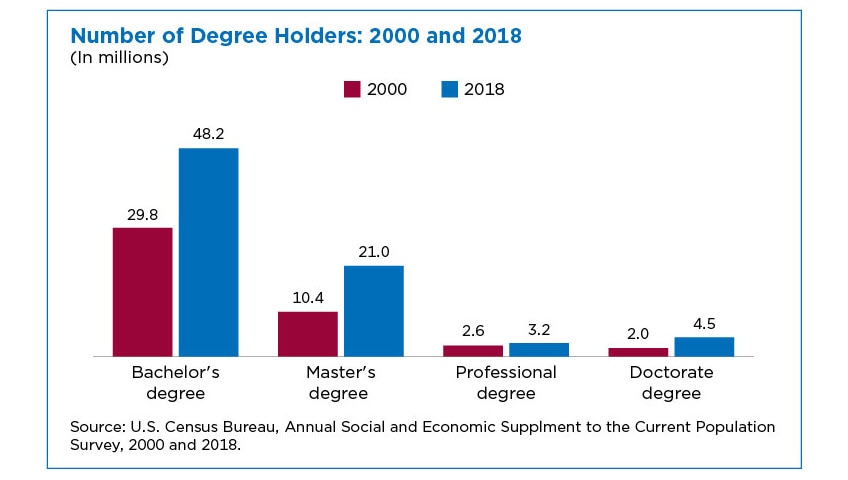
The educational level of American adults overall is on the rise as more college graduates go on to earn master’s, professional and doctoral degrees.

Leading the way are Asian Americans as a combined group although wide disparities exist between subgroups.


Among Asians ages 25 to 29 in 2018, almost 7 in 10 (69%) had a bachelor’s or higher degree. Five years earlier (in 2013), the bachelor’s degree attainment rate for this group was 59%.

Recent immigrants -- the majority of which come from Asia -- to the United States were more likely to have a college education than earlier immigrants or the native born.

Since 2000, the number of people age 25 and over whose highest degree was a master’s has doubled to 21 million. The number of doctoral degree holders has more than doubled to 4.5 million.

Now, about 13.1% of U.S. adults have an advanced degree, up from 8.6% in 2000.


About 21.2% of Asians, age 25 and older, have an advanced degree (e.g., Master's, Ph.D., M.D. or J.D.). This compares with 13.1% for all Americans 25 and older. However, different Asian ethnic groups have different educational attainment levels -- 68% of Asian Indians, age 25 and older, had a bachelor's degree or more education and 37% had a graduate or professional degree; the corresponding numbers for Vietnamese Americans were 24% and 7%, respectively.
number-of-people-with-masters-and-phd-degrees-double-since-2000-figure-1

These findings come from the U.S. Census Bureau’s Educational Attainment in the United States: 2018 table package that uses data from the Current Population Survey Annual Social and Economic Supplement.

It examines the educational attainment of adults age 25 and older by demographic and social characteristics, such as age, sex, race and Hispanic origin, nativity and disability status.


The tables show, among other things, that women make up a smaller share of high school dropouts than men.

They also clearly show a rise in the number of college graduates who have advanced degrees. In 2000, one-third of people with at least a bachelor’s degree had completed an advanced degree. By 2018, 37 percent had done so.

In 2017, on average a person with an advanced degree earned 3.7 times as much as a high school dropout.


The Census findings correspond with research by PEW Research Center.

Education levels have generally risen since 1980 among the largest U.S. immigrant-origin populations. More than three-in-four immigrants ages 25 and older from India (77.5%) had a bachelor’s degree or higher in 2016 – the highest share of any top origin country – up from 66.1% in 1980.

Meanwhile, immigrants from Korea, which is second to India, have had the biggest increase in educational attainment among those ages 25 and older. The share of Korean immigrants with a bachelor’s degree jumped from 34.4% in 1980 to 53.6% in 2016, a 19-percentage-point increase.

By contrast, the share of Mexican immigrants with a bachelor’s degree or higher has increased by only a few percentage points since 1980, reaching 6.2% in 2016. However, the share of Mexican immigrants ages 25 and older with a high school degree has more than doubled, from 11.4% in 1980 to 25.2% in 2016.

Other highlights from the Census report:
  • The percentage of people age 25 and over who had completed less than a high school diploma or equivalent was higher for men (10.6%) than for women (9.8%).
  • Between 2000 and 2018, the percentage of people 25 years and older who had completed a bachelor's degree or higher increased by 9 percentage points, from 25.6% to 35.0%.
  • Among immigrants who have arrived since 2000, 38.8 percent have a bachelor’s degree or higher, compared with 35.2% of the native-born. Among earlier immigrants, the rate of college education was lower — for those who arrived in the 1990s, it was 31.3%.
  • Naturalized citizens were among the groups with high levels of college attainment — 38.4 percent had a bachelor’s degree or higher.
  • The children of immigrants were also likely to have a bachelor’s degree (39.6 percent).
Today, the U.S. has more immigrants than any other nation in the world. About 13.5% of the U.S. population was foreign born in 2016. This share has been on the rise since 1970, when it was at a historic low of 4.8%, but it remains below the record of 14.8%, reached more than a century ago in 1890.


_____________________________________________________________________