Showing posts with label Model Minority Myth. Show all posts

Monday, November 2, 2020

Biden Campaign: Candidate vows to break down the model minority myth


Joe Biden issued a statement this summer that distinguishes him from any previous candidate running for President of the United States.

I believe this is the first time that a nonAsan Presidential candidate has even acknowledged that the model minority myth that is a problem that weighs down the AAPI community designed to separate us from other people of color.

He stressed the need for disaggregating data collected by government agencies regarding AAPIs. The model minority stereotype gives the false impression that all is well with all Asian Americans and Pacific Islanders and they don't need any assistance. 

If you ask any health professional, educator or job recruiter, you know this is not true. It may be true for a certain sector of the diverse AAPI community, but other parts are haunted by ailments, mired in poverty and continually perform poorly in school  limiting job opportunities.

Biden tells NBC that this can only be solved by disaggregating data collected by the federal governement agencies such as the Labor, Education, Health and Housing departments.

His comment an example of how his advisors for the AAPI community have Biden's ear. Of course, it helps that your running mate is an Indian American.

It appears that this item went unnoticed by mainstream media because ... well, they're mainstream media. (I'd be happy to print a retraction if anyone can show me evidence of coverage of this item.)

EDITOR'S NOTE: A word of caution, this is news sprinkled with opinion. Readers are encouraged to seek multiple news sources to formulate their own positions.


Sunday, May 31, 2020

Blacks and AAPIs forming new alliances in the struggle for equality


FACEBOOK
AAPI protestors in Seattle Saturday night before violence broke out.

The incremental changes in race relations that have occurred since Rodney King was beaten in Los Angeles are barely noticeable. 

Not much has changed since Eric Garner gasped, "I can't breathe!" the same words uttered six years later in Minnesota when George Floyd was pinned to the ground with a knee to his neck.

If we had smart phones around during the Jim Crow era when lynchings of black men were commonplace, cities would have been burnt to the ground.

Black and AAPI groups are quietly forging an alliance even though the convergence is barely reported in mainstream media that prefers to focus on the more sensational differences between the communities. 

When video of Floyd's last breath was splattered all over social media, AAPI organizations were quick to condemn the police tactics that resulted in the black Minnesotan's death.

Filipino American author Carlos Bulosan recognized the link between the black Americans' struggle for equality and the unbreachable wall of discrimination Asian Americans encounter while seeking economic and social opportunities, when he wrote in his classic novel "America Is In the Heart:"


Marchers wear Hawaiian leis crossing the Edmund Pettis Bridge in Selma.

"America is ... the nameless foreigner, the homeless refugee, the hungry boy begging for a job and the black body dangling from a tree. America is the illiterate immigrant who is ashamed that the world of books and intellectual opportunities is closed to him. We are that nameless foreigner, that homeless refugee, that hungry boy, that illiterate immigrant and that lynched black body. All of us, from the first Adams to the last Filipino, native born or alien, educated or illiterate — We are America!"

Since Floyd's death, the wheels of justice moved too slowly before Eric Chauvin, the officer who put the full weight of his body with a knee to Floyd's neck, was arrested. Even after his arrest, he was only charged with 3rd degree murder, or manslaughter.

In a YouGov poll of 5,600 Americans taken before Eric Chauvin's arrest found 60% of Asian Americans used excessive force resulting in Floyd's death. In the same survey, 80% of black Americans say too much force was used; Latino Americans (58%), mixed-race Americans (57% and 54% of Native Americans agreed.

In contrast, only 46% of white Americans say that police officers tend to use too much force. 

The fact that almost two-thirds of AAPI agreed with black respondents is noteworthy. The historically socially conservative Asian Americans have been used as a wedge to shame other minorities. The stereotype of the "model minority" myth which characterizes Asian Americans as a polite, law-abiding group who have achieved a higher level of economic success than the general population through some combination of innate talent and pull-yourselves-up-by-your-bootstraps immigrant initiative.


CAPAC
Congressional caucuses support each other in Washington, DC.

Asian Americans have been held up by the dominant culture as an example what a racial minority can accomplish inspite of the racism that is deeply embedded in US institutions. In other words, to other people of color, the model minority myth is used to minimize the reality of racism in American culture.

The Minnesota flashpoint was quickly condemned by Asian Americans as AAPI organizations began issuing statements placing their sympathies with the Floyd family and the black community. The Minneapolis-based Coalition of Asian American Leaders said, "Today and every day we support #BlackLivesMatter and stand with George Floyd's family and community to demand justice."

Other AAPI groups across the nation joined in support of those demanding justice in the Floyd homicide.

The unequivocal reaction supporting justice for Floyd from AAPI advocacy organizations and politicians is in contrast to perceived reluctance to whole-heartedly join the #BlackLivesMatter movement as painted by mainstream media.

In reality, away from the parachuting journalists making quick analyses, bridges were being built by activists who knew that they could be more effective if they were joined in a common cause.

As far back as Bloody Sunday, as black civil rights activists were marching across the Edmund Pettis Bridge In Selma, Ala., some of them in the front line were wore Hawaiian leis sent to them by the Rev. Abraham Akaka, the brother of future U.S. Sen. Daniel Akaka. For the reverend, it was a symbolic gesture that affirmed Asian American support for the civil rights movement.

Even before Selma, Detroit's Grace Lee Boggs and Los Angeles' Yuri Kochciyama were working with black activists for social justice and for human rights.

Asian American student organizations were in the middle of the organizing of the Third World Liberation Front in  the late 1960s and 1970s at San Francisco State University uniting with black and Latino organizations for an unprecedented student strike that ultimately leading to the creation of ethnic studies departments across the nation.

Asians4BlackLives began in Oakland, CA in late 2014 after the non-indictment of the police officer who killed Eric Garner. The advocacy group recognizes that AAPI activism was greatly influenced by Black struggles for liberation, A4BL returns to the roots of the Asian American social formation and its debt to Black liberation movements. 

In 2016, over 100 AAPI civil rights advocates made it clear to #BlackLivesMatter where they stood in a joint statement: "While words cannot bring back Alton Sterling, Philando Castile, Sandra Bland, Freddie Gray, Rekia Boyd, Eric Garner, Michael Brown, Renisha McBride, Akai Gurley and many more whose stories go unrecognized, we join together with Black organizers in a movement ignited to fight for Black liberation, human dignity and transformative justice. We, as Asian Americans and Pacific Islanders, stand firmly with #BlackLivesMatter and the movement for Black lives."


This past year, the joining of the Congressional Black Caucus, the Congressional Asian Pacific American Caucus and Congressional Hispanic Caucus in issuing joint statements in support of anti-Asian hate resolutions and the treatment of immigrants.

Part of the problem is that in this Twitterverse and Tic Toc-crazy world, no leader of the stature of Martin Luther King has emerged in either community. With almost everybody having a smart phone and easy access to Youtube and tanyone has the ability create an online persona it is difficult for a voice to rise above the social media din. 

TWITTER
Filipino Americans in Las Vegas express their sentiments Saturday night.
The quick response of AAPI organizations to the death of George Floyd could be a sign that Asian Americans and Pacific Islanders are rejecting the mainstream media belief that AAPI don't sympathize with Black issues and see the common struggles of the two groups.

"As refugees and descendants of refugees, as survivors of war and genocide, our communities also know the devastating impacts of police force.," said a statement from South East Asian Resource Action Center. 

"It is incumbent on us as Southeast Asian Americans to show up for the Black community. We must acknowledge that our own paths to equity are a direct product of their historic civil rights wins and struggles, that they continue to build, as well as to endure, to this day. We must name the systems that have benefitted from having communities of color pitted against one another, and we must boldly resist them."

EDITOR'S NOTE: For additional commentary, news and views from an AANHPI perspective, follow @DioknoEd on Twitter.


Tuesday, May 5, 2020

New California Common Cause director to fight model minority myth and “false sense of security” in Asian American community

Common Cause director Jonathan Mehta Stein


By Akemi Tamanaha
ASAM NEWS

On Friday morning, armed with a cup of homemade lemongrass chai, Jonathan Mehta Stein began his first day as executive director of California Common Cause.
The non-partisan political advocacy group announced Stein as their new executive director on Thursday, April 30. The announcement was followed by a conversation between Stein and outgoing executive director Kathay Feng on Facebook live. AsAmNews spoke with Stein about his work as an advocate and his plans for California Common Cause.

Stein, who currently lives in Oakland, considers himself a “California kid through and through.” He grew up in Cupertino, California from the late 80s through the 90s when much of the area was still filled with orchards.

Stein’s father was White and his mother was an Indian American immigrant. She came to the US without money and access to networks. Her experience, according to Stein, was what “one might expect for an immigrant woman with an accent in the Midwest in the 1970s.”

“In many ways I do what I do because of my mom and her experience as an immigrant,” Stein said.

His mother taught Stein and his brother from a very young age that every voice matters. She also made sure that he and his brother understood that as two American White men they would have opportunities she never had.

“I took from that a sense of service that I had a responsibility to use the relative privilege that I have,” Stein said.

Stein attended Lynbrook High School, a school in Cupertino near San Jose, whose student body is majority Asian American. After high school, he spent eight years on the East Coast after graduating high school. He attended Harvard University and earned his BA in English literature. He said that transitioning from a diverse place like Cupertino to the Northeast was a big adjustment. He knew that he would eventually return to California.

After graduating from Harvard in 2005, Stein spent four years working as a journalist before he decided to pursue a career in political advocacy.

“Over time I grew tired of writing about people who were making social and political change and wanted to be someone who made social and political change,” Stein said.

The best way to pursue a career in political advocacy was to be as prepared as possible. For Stein, that meant going to graduate school and law school to acquire the “credentials needed to take on the world.”

Stein enrolled in a public policy program at University of California, Berkeley. The program allowed him to concurrently earn his Masters in Public Policy and his JD. After graduating from law school in 2013, Stein was hired as a staff attorney for the ACLU where he worked as a voting rights attorney. In 2016, he continued his work in voting rights at the Asian Law Caucus. When Stein arrived, the Asian Law Caucus’ voting rights program had been dormant for several years. By the time he left in 2020 to work with California Common Cause, the program had grown into a state-wide leader in ensuring language access for limited English or non-English speaking voters.

Sunday, April 5, 2020

Sunday Read: Andrew Yang is asking us to be the 'model minority' to prove we are 'good Americans'

SCREEN CAPTURE / CNN
Andrew Yang's oped drew flak from Asian Americans.

Et tu, Brute? Now I know how Caesar felt when his good buddy, Brute, stabbed him in the Senate chambers of ancient Rome.

Former presidential candidate Andrew Yang's oped is the proverbial knife. And the fact the stabber is prominent in the eyes of mainstream media and general populace, makes the wound even more hurtful.

Yang's Washington Post oped entitled, “We Asian Americans are not the virus, but we can be part of the cure” published Wednesday got a response he probably wasn't expecting.
Yang wrote the piece to address the rise in hate acts against Asians and Asian Americans by racists who blame them for the coronavirus. 
The key lines that drew the wrath of AAPI activists, celebrities and and former supporters, apparently, follows:
"We Asian Americans need to embrace and show our American-ness in ways we never have before. We need to step up, help our neighbors, donate geaer, vote, wear red white and blue, volunteer, fund aid organizations and do everything in our power to accelerate the end of this crisis. We should now without a shadow of a doubt that we are Americans wh will do our part for our country in this time of need.
"Demonstrate that we are part of the solution. We are not the virus, but we can be part of the cure."
With this oped, Yang has undone all the hard work he did during his campaign to win the support of Asian Americans and at the same time, drew the approving nods of whites from the white supremacists to those who still harbor the image of an American as a white male backed up by history textbooks largely written by ... white males.

His oped takes the onus off of whites, who created the artificial notion of race in the first place just so they can put themselves on top, and puts it on AAPIs' shoulders to once again, prove that we deserve to be called American. My father, who was in the US Army during WWII, survived the Bataan Death March, fought in Korea then served as a public servant for his home city in California, must be turning over in his grave; along with the thousands of his Filipino American compatriots who paid the ultimate price for their patriotism.

So not only did Yang stab Asian Americans and Pacific Islanders betraying the AAPI support he gained, but for good measure, he had to twist the blade, too. Ouch!

Japanese Americans were particularly critical of Yang's myopic views culled by growing up in upstate New York.

Being American, didn't erase the racism against Japanese Americans even though thousands of their brothers and sons and fathers died during WWII as members of the famous 442nd Regiment.


“During World War II, Japanese Americans volunteered for military duty at the highest possible levels to demonstrate that they were Americans,” Yang wrote in the Washington Post.  “Now many in the Asian American community are stepping up, trying to demonstrate that we can be part of the solution.”

Filmmaker and UCLA Asian American studies professor Renee Tajima-Peña  took umbrage at Yang's inference by using the 442nd as an example. She tweeted a photo of her uncle in military uniform, flanked by her grandparents. The photo was taken behind the barbed wire of Gila River, where her family was imprisoned. “My family served in US Army & wore red/white/blue. Didn't work out well for them.” the caption reads.


And doesn't Donald Trump's racist dog whistles of the "Chinese virus" have anything to pumping up his white surpemacists have any responsibility in this current wave of race blaming.
Other's took to social media to express their reaction to Yang's opinion piece. Jeff Yang of the Wall Street Journal disagreed, as did others.


Yang did not comment on the backlash while his name was trending. However, the next day, the current CNN commentator responded to a tweet from actor Simu Liu.

Liu had initially weighed in by stating that the Asian community unequivocally rejected the op-ed.


“I know he can and will do better,” Liu added in a second tweet, clarifying that he supports everyone doing their part, but found Yang’s take to be “horribly misguided and tone-deaf.”

Replying to Liu on Friday, Yang tweeted that he’s “just saying we need to do all we can to ease this crisis” and step up in a time of national and global need.

“Lead and serve,” Yang said. “(I’m) very proud of my heritage and know that different people will have different takes.”


“Reading (Yang's oped) gave me a sense of deja vu,” Bruce Embrey, the co-chair of Manzanar Committee, a nonprofit organization dedicated to educating the public on Japanese American incarceration, told NBC Asian America,

“Andrew Yang may think the solution to racism is to be compliant, but fighting for one’s rights against the dominant narrative has been an integral part of our nation’s development,” Embrey said. “Fighting back is as American as you can get.”


Andrew, you're still missing the point. Those bigots who choose to target Asian Americans are the ones who need to be "more American." Asian Americans have nothing to prove.

ASAM NEWS contributed to this article.

Tuesday, March 31, 2020

Coronavirus is making Equal Pay Day for women of color even worse

NAPAWF

Today (March 31) is Equal Pay Day for American women. The day symbolizes how long it would take American women to “catch up” to the average earnings of white men working in the same positions — and when broken out into specific ethnicities, AAPI women fare far worse than the model minority stereotype would suggest.

The good news is that before February and March, the pay gap was getting smaller. But the bad news: The Coronavirus happened.

“On Equal Pay Day 2020, we face yet another threat to economic justice—this time in the form of a pandemic, said Ms. Foundation for Women President and CEO Teresa C. Younger in a statement.

“There is a certain irony in celebrating Equal Pay Day during this historic time in the United States,” said Younger. “Today, as women around the country are suffering from lost wages, cut hours, and facing extreme economic hardships due to the spread of COVID-19, the pre-existing gaps in pay inequality are even more reprehensible."

Compared to other women of color, Asian American and Pacific Islander women are on the higher end of the wage gap earning on average 92 cents for every dollar earned by men. The Equaly Pay Day for AAPI women was observed Feb. 11.

RELATED: AAPI Equal Pay Day highlights disparities between AAPI communities.
The model minority myth is used to cover up reality for most Asian American and Pacific Islanders. The success of a few doesn't make up for the vast majority of AAPI workers.


“Race and ethnicity, age, whether you’re a mother -- all these things affect how a woman experiences the wage gap. Because Asian American and Pacific Islander people are often lumped together and considered a monolith that is the ‘model minority,’ the reality of our struggles is made intentionally invisible," said National Asian Pacific American Women’s Forum Executive Director Sung Yeon Choimorrow.

If you break it down into specific Asian American and Pacific Islander communities, the wage gap grows.


For certain communities, the wage gap is far greater. Vietnamese women earn $0.64, Hmong women earn $0.57, and Burmese women earn only $0.50, making them some of the lowest paid people in the nation. Even within high earning fields, Asian women are paid less than their male counterparts. "Model-minority" rhetoric is racist, classist, divisive, and just plain wrong. 

Here a list of what women by other racial groups make compared to white men, and their Equal Pay Day for 2020. 

  • Asian American and Pacific Islander women: February 11, $0.92
  • Black women: August 13, $0.62
  • Native American women: October 1, $0.57
  • Latina women: November 2, $0.54

Those professions heavily populated by women are suffering under the policies in place to combat the coronavirus.

Today (March 31), because sales have dramatically dropped because of the stay-at-home policies mandated by local jurisdictions, Macy's announced it will begin furloughing most of its 130,000 employees across the nation. Most of those will be women working as retail clerks in their stores.

Thousands of restaurants employing waitresses have been forced to shut down, day care providers have been laid off as the children have stopped coming because their mothers are at working at home or have lost their jobs, the hotel industry is laying off workers, because the hotels are empty.

Amid the pandemic, "Many hourly wage, gig and contract workers lack paid sick leave, family leave, and medical leave at a time when our national health and economy are under threat," said Younger. "Women comprise two-thirds of this workforce, and a disproportionate amount of these women are women of color, who now may face reduced hours, alongside the challenges of homeschooling children and tending to family members across generations.”


Sunday, September 22, 2019

Job offers pour in to woman who received "Me love you long time" racist email

CONNIE CHEUNG

ASAM NEWS

Connie Cheung dared to speak out and now she’s the better for it.
Cheung is the young job applicant who went public with a potential employer’s “me love you long time” email. In the two months that followed, she’s received nearly a dozen job interviews and has since started a new job.

Cheung received the email from James McMahon of the Chicago Search Group where she applied. McMahon had meant his message to go to his boss because they had seen the movie Full Metal Jacket together. The movie features a scene in which an Asian prostitute utters the now infamous phrase.

After numerous media outlets covered Cheung’s story, she received immediate offers for interviews.

“I was so mind-blown,” Cheung said to Block Club Chicago.

“Hopefully for these two gentleman in the email thread, they will wake up and realize not to diminish any applicant based on the person’s gender or background,” said Cheung’s new boss, Dennis Mondero, the director of the Chinese Mutual Aid Association.

Mondero, an immigrant from the Philippines, says his group is the beneficiary of Cheung’s unfortunate experience.

Cheung said she went public with her story against the advice of her mother who feared it could ruin her career.

“I’m happy I had the courage to say something,” she said. “It is OK to speak out. It is OK to speak truths, to say this type of behavior is not OK.”
__________________________________________________________________

Thursday, August 29, 2019

Eddie Huang will direct coming-of-age film

SCREEN CAPTURE / CBS
Restaurateur and author Eddie Huang will add 'movie director' to his resume.

ASAM NEWS


Author and chef Eddie Huang will enter the world of directing for the first time with a coming-of-age film set in contemporary New York City, Deadline reports.

The movie, Boogie, which is also written by Huang, tells the story of a young Chinese American basketball phenom who struggles to balance the expectations of his immigrant family and his own dreams to play in the NBA. 

Newcomer Taylor Takahashi will play Boogie, while Pamelyn Chee (Prescient, Beyond Skyline) and Jorge Lendeburg Jr. (Spiderman: Far From Home, Love, Simon) are set to co-star.

Huang, the son of Taiwanese immigrants and chef and owner of the acclaimed restaurant  Baohouse, said a lot of his existing work has presented the Asian American experience “like a triumphal arch.”

“Planet Asia needed me to stand out here with my two arms up, but I’m in my Purple Phase now,” Huang said in a statement Monday. “Boogie is the reflection of my ancestor’s spirit and values as I’ve always felt them navigating me through this American life.”

Huang’s debut screen project will be produced and domestically distributed by Focus Features.

“[Huang] lays waste to expectations and shapes the ground of our culture with every new endeavor he embarks upon, and we couldn’t be any more proud or excited to a part of bringing his voice to the world,” Focus chairman Peter Kujawski said. “Hold on tight and watch what he does here.”


Huang's 2013 memoir, "Fresh Off the Boat," of growing up as part of an immigrant family was translated into the TV series with the same name.

Despite the groundbreaking nature of the show featuring an Asian American family, he was dissatisfied with the sanitized version of what he felt was "his" story. Huang left the series after the first series over creative differences. 

He subsequently hosted a series of travel/food shows, Huang's World, on the Vice network, and Cheap Bites on the Cooking Channel.

In an interview on CBS' Sunday Morning, he explained that in almost everything he does, he tries to smash the model minority myth imposed on Asian Americans. 

Having an Asian American with dreams of becoming a pro-basketball player is a continuation of that goal. 
RELATED: Baller Jeremy Lin encounters on-court bias in the NBA
Views From the Edge contributed to this report.
___________________________________________________________________________________


Saturday, March 2, 2019

U.S. Census: Higher percentage of Asian Americans hold college degrees


At the risk of reinforcing the Model Minority Myth, Asian Americans outpace other groups in holding college diplomas with bachelors' degrees and higher.

The educational level of American adults overall is on the rise as more college graduates go on to earn master’s, professional and doctoral degrees.

Leading the way are Asian Americans as a combined group although wide disparities exist between subgroups.


Among Asians ages 25 to 29 in 2018, almost 7 in 10 (69%) had a bachelor’s or higher degree. Five years earlier (in 2013), the bachelor’s degree attainment rate for this group was 59%.

Recent immigrants -- the majority of which come from Asia -- to the United States were more likely to have a college education than earlier immigrants or the native born.

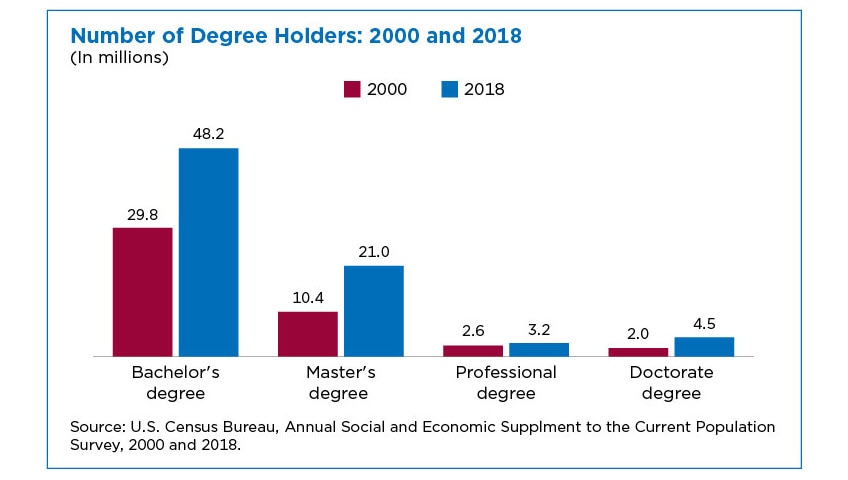
Since 2000, the number of people age 25 and over whose highest degree was a master’s has doubled to 21 million. The number of doctoral degree holders has more than doubled to 4.5 million.

Now, about 13.1% of U.S. adults have an advanced degree, up from 8.6% in 2000.


About 21.2% of Asians, age 25 and older, have an advanced degree (e.g., Master's, Ph.D., M.D. or J.D.). This compares with 13.1% for all Americans 25 and older. However, different Asian ethnic groups have different educational attainment levels -- 68% of Asian Indians, age 25 and older, had a bachelor's degree or more education and 37% had a graduate or professional degree; the corresponding numbers for Vietnamese Americans were 24% and 7%, respectively.
number-of-people-with-masters-and-phd-degrees-double-since-2000-figure-1

These findings come from the U.S. Census Bureau’s Educational Attainment in the United States: 2018 table package that uses data from the Current Population Survey Annual Social and Economic Supplement.

It examines the educational attainment of adults age 25 and older by demographic and social characteristics, such as age, sex, race and Hispanic origin, nativity and disability status.


The tables show, among other things, that women make up a smaller share of high school dropouts than men.

They also clearly show a rise in the number of college graduates who have advanced degrees. In 2000, one-third of people with at least a bachelor’s degree had completed an advanced degree. By 2018, 37 percent had done so.

In 2017, on average a person with an advanced degree earned 3.7 times as much as a high school dropout.


The Census findings correspond with research by PEW Research Center.

Education levels have generally risen since 1980 among the largest U.S. immigrant-origin populations. More than three-in-four immigrants ages 25 and older from India (77.5%) had a bachelor’s degree or higher in 2016 – the highest share of any top origin country – up from 66.1% in 1980.

Meanwhile, immigrants from Korea, which is second to India, have had the biggest increase in educational attainment among those ages 25 and older. The share of Korean immigrants with a bachelor’s degree jumped from 34.4% in 1980 to 53.6% in 2016, a 19-percentage-point increase.

By contrast, the share of Mexican immigrants with a bachelor’s degree or higher has increased by only a few percentage points since 1980, reaching 6.2% in 2016. However, the share of Mexican immigrants ages 25 and older with a high school degree has more than doubled, from 11.4% in 1980 to 25.2% in 2016.

Other highlights from the Census report:
  • The percentage of people age 25 and over who had completed less than a high school diploma or equivalent was higher for men (10.6%) than for women (9.8%).
  • Between 2000 and 2018, the percentage of people 25 years and older who had completed a bachelor's degree or higher increased by 9 percentage points, from 25.6% to 35.0%.
  • Among immigrants who have arrived since 2000, 38.8 percent have a bachelor’s degree or higher, compared with 35.2% of the native-born. Among earlier immigrants, the rate of college education was lower — for those who arrived in the 1990s, it was 31.3%.
  • Naturalized citizens were among the groups with high levels of college attainment — 38.4 percent had a bachelor’s degree or higher.
  • The children of immigrants were also likely to have a bachelor’s degree (39.6 percent).
Today, the U.S. has more immigrants than any other nation in the world. About 13.5% of the U.S. population was foreign born in 2016. This share has been on the rise since 1970, when it was at a historic low of 4.8%, but it remains below the record of 14.8%, reached more than a century ago in 1890.


_____________________________________________________________________


Friday, July 13, 2018

Report: Income inequalitiy greatest among Asian Americans


The model minority myth overlooks lower income Asian Americans.


INCOME INEQUALITY -- the gap in incomes between the rich and poor --in the U.S. is now greatest among Asians, according to a new report from the Pew Research Center that was released Thursday (July 12).

In the simplest terms, among Asian Americans, the rich got richer and the poor - not so much. 

In 2016, the latest year for which data are available, Asians near the top 10%  had incomes 10.7 times greater than the incomes of Asians in the bottom 10%. Asians at the 90th percentile had an income of $133,529 in 2016, compared with $12,478 for those at the 10th percentile. Thus, in 2016, the ratio of these two incomes – the 90/10 ratio – stood at 10.7 for Asians.

The income inequality among Asians was greater than any other racial and ethnic groups. The distribution of income among Asians transformed from being one of the most equal to being the most unequal.

The report should provide more ammunition against the model minority stereotype that haunts Asian Americans. Yes, the report confirms that Asian Americans fared better than other demographic groups in earnings, but that is not a characteristic that can't be applied to the community as a whole. Asian Americans at the bottom of the economic ladder, often overlooked by the myth, did worse than their counterparts in other groups.

In 2016, the median annual income for Asian adults was $51,288, compared with $47,958 for whites, $31,082 for blacks and $30,400 for Hispanics. 

However, lower-income Asians did not keep pace. Asians at the 10th percentile earned 8% more than whites in 1970, but in 2016 they earned 17% less.

To view the complete report, click here.
_________________________________________________________________________________


Saturday, January 13, 2018

Stereotypes about Asians just won't die


TWO ASIAN STEREOTYPES are alive and still in the minds of many non-Asians. They popped up again this week in the hubbub surrounding Donald Trump's racist remarks when referring to immigrants from Haiti, El Salvador and Africa.
In defense of Trump, a conservative commentator on CNN referred to the model minority trope when she said Trump “would welcome immigrants from Asia so he is open to accepting people from other countries.” said Carrie heffield said, referencing information from a White House official.

Liberal commentator Keith Boykin, who was on the same panel, called her on her use of the model minority image, “This is not good because it’s playing into the stereotype of the model minority,”

The comparisons of recent immigrants from South Asia, China and Korea working in tech and as engineers is not a fair comparison to immigrants who came as refugees or working in lower-paying jobs.

The model minority stereotype also hurts Asian/Americans because it ignores the wide diversity within that community, some who sruggle academically or live in extreme poverty.

The other instance of the Asian woman came about when NbC began researching other instances of racism in the White House. NBC investigators found out that when Trump was being briefed by a former senior analyst, who is Korean/American, about the situation on Pakistan, he interrupted the intelligence briefing by asking where she was from.

That's right that stupid question Asians and Asian/Americans have heard in our lives. This is how NBC reported the incident:
A career intelligence analyst who is an expert in hostage policy stood before President Donald Trump in the Oval Office last fall to brief him on the impending release of a family long held in Pakistan under uncertain circumstances.

It was her first time meeting the president, and when she was done briefing, he had a question for her.

”Where are you from?” the president asked, according to two officials with direct knowledge of the exchange.

New York, she replied.

Trump was unsatisfied and asked again, the officials said. Referring to the president’s hometown, she offered that she, too, was from Manhattan. But that’s not what the president was after.

He wanted to know where “your people” are from, according to the officials, who spoke off the record due to the nature of the internal discussions.

After the analyst revealed that her parents are Korean, Trump turned to an adviser in the room and seemed to suggest her ethnicity should determine her career path, asking why the “pretty Korean lady” isn’t negotiating with North Korea on his administration’s behalf, the officials said.

Was he even listening to the critical information in the briefing? Trump apparently had fallen under the spell of "yellow fever," a fetish for Asian women, something that is shared by alt-right men, according to a New York Times article.

"As a commenter wrote on an alt-right forum, 'exclusively' dating Asian women is practically a 'white-nationalist rite of passage,' reads the article.

Damn those stereotypes! They refuse to die!

(CORRECTED on Jan. 13, 8:30 a.m. PST, to correct subject of intelligence briefing.)
_______________________________________________________________________________