Showing posts with label Democrats. Show all posts

Monday, June 1, 2026

FilAm strikes a nerve with Trump strategist Stephen Miller


SCREEN CAPTURE
The Democrats' social media rapid response team led by Filipino American Paulina  Mangubat
was interviewed by the Meidastouch Network.

Republicans completely miscalculated. By trying to rely on old-school bullying tactics and outdated stereotypes of Asian American women, they ran straight into a digital buzzsaw.
A Filipino American political strategist is shattering stereotypes and giving a masterclass in clapping back after a high-stakes Twitter war erupted into personal, racist-adjacent attacks from the far-right.

Paulina Mangubat, the Deputy Chief Mobilization Officer at the Democratic National Committee, found herself in the crosshairs of Katie Miller—wife of Trump adviser Stephen Miller—proving once again that Asian American leaders are no longer letting the "quiet and subservient" myth stand.

Katie Miller may have bitten off more than
she can handle.
Mangubat is a 2017 Barnard College graduate and the daughter of Filipino immigrants. Before executing her high-profile role at the DNC, she honed her skills as the digital mastermind for Boston Mayor Michelle Wu and Sen. Raphael Warnock. In today's hyper-fast internet age, she leads the digital armor for the Democratic party, showing that representation in the political decision-making room matters.

The drama kicked off when Stephen Miller lobbed an unprovoked, transphobic insult on X (formerly Twitter) targeting Texas Democratic Senate candidate James Talarico. The official Democrats account — overseen by Mangubat’s rapid-response team —fired back with a blunt, profane tweet: "shut up you ugly f---."

Mangubat backed it up on her personal account, throwing her own shade at Miller’s notorious track record.

The far-right's anti-Asian dog whistle?

That is when Katie Miller stepped in, using classic right-wing identity politics to single out the Asian American staffer. Miller posted Mangubat's picture online.

FACEBOOK
On behalf of her husband, Katie Miller responded to the Democrats.

But Mangubat wasn't having it. She quickly shut down the "unmarried" insults by posting news of her trying on wedding gowns and revealing that she is in the middle of planning for her upcoming wedding.

To top it off, she shared a photo of a celebratory cake gifted by her DNC colleagues. The icing on the cake? "You ratioed Temu Hitler and also are hot."

Mangubat flipped the script on Miller, quoting Katie Miller post and writing “Well, now seems like a good time to share that I’m getting married! We just put down the deposit on the venue and bought my dress lol!”

Later, in an interview with the eidasTouch network, Mangubat would further double down on her comments about the Millers:

“I want Katie Miller to know that her husband is an ugly fuck. um Stephen Miller is one of the most powerful men in the country right now. He is a White House official who is taking to Twitter to make these absolutely false and transphobic attacks against an amazing candidate in Texas, James Talarico.”

“We simply called him ugly, and I think that what he has been doing is ugly. He is celebrating when ICE shoots down Americans in the street. He thinks that it's cool when families are separated and it's just absolutely disgusting. And so, yeah, I stand by calling him an ugly f*ck.”

FACEBOOK
Paula Mangubat, left, and her response to Katie Miller.

For many in the AANHPI community, the public targeting of a young woman of color felt all too familiar — an attempt to bully an Asian American professional back into a corner.

New era, new strategy

The digital feud between  Mangubat and the Millers serves as a case study in modern political communication. It highlights a massive shift from traditional, polished press releases to aggressive, internet-native tactics.

Here is the breakdown of the contemporary digital strategy tactics used in this clash:

The key is "unhinged" branding that moves away from corporate terile political rhetoric toward raw, authentic and somtimes profane text.

The DNC’s blunt reply mimics the natural behavior of everyday internet users. It cuts through social media algorithms by favoring high-emotion engagement over standard policy talking points.


Utilizing internet-native terms like "ratioed" and sharing tangible, real-world visual artifacts (the cake), Mangubat reminded the audience of her modernity and humanity.

She neutralized the "sad, single liberal" narrative not with a statement, but with undeniable visual proof — an engagement announcement and a celebratory cake from her team. By labeling Stephen Miller "Temu Hitler," the team packaged a complex political critique into a highly shareable, humorous pop-culture meme.

By forcefully responding directly beneath Stephen Miller's initial post, the DNC guaranteed that their rebuttal would capture the attention of everyone following the original controversy, successfully hijacking the narrative.

Democrats' dilemma

Based on the social media reaction, this type of communicating is a hit with the younger demographic but the older establishment has doubts. The DNC's new approach has effectively shattered the "when they go low, we go high" philosophy in favor of decentralized, punchy digital combat.

For decades, the right-wing has held a virtual monopoly on aggressive, highly emotional digital media layout and have been successful in stirring up their base to amplify their messaging. The DNC's willingness to fight fire with fire has successfully hijacked the media narrative, pulling eyes away from conservative talking points and forcing Republicans onto the defensive.

Democrats like California Gov. Gavin Newsom and Rep. Jasmine Crockett argue that aggressive, unfiltered clapbacks are highly effective at shattering voter perceptions that Democrats are out-of-touch, elitist, "robotic" or —worst of all —unresponsive.

Early indicators prove the approach is a metrics goldmine, with Democratic lawmakers racking up over 87 million views on response content by ditching legacy press releases for direct-to-camera, influencer-style videos.


Opponents of the "unhinged" brand argue that inside-baseball internet slang (like "ratioing" or sheet-cake memes) only appeals to hyper-online, progressive partisans and doesn't connect with ordinary folks. The true test is if the new tactic will turn into votes from younger voters, the demographic least likely to cast their ballots.

View from the edge

Mainstream media still isn’t looking, but Asian Americans are dominating the digital space, carving out their own narratives at a staggering 12-plus hours a week, according to the Pew Research Center. Instead of waiting for a seat at Eurocentric tables, Asian Americans use platforms like Instagram, YouTube, and TikTok to define their own identities and for news sources.


It’s a clear sign of the times. A new generation of AANHPI political workers are stepping up, building power, and refusing to stay silent when the old guard tries to tear them down.

For a generation of younger Asian Americans and progressives weary of traditional politicos offering polite, watered-down rhetoric, Mangubat’s raw style feels undeniably authentic. It breaks the "model minority" archetype of staying quiet, showing that a young Asian American woman can fiercely hold her ground in the face of MAGA culture-war trolling.

While the internet-style feud generated massive engagement and high-flying view counts, social media points do not automatically equal ballots in the box. Young voters are disproportionately impacted by economic anxieties, high housing costs, and targeted anti-immigrant rhetoric. They are also least likely to vote.

The feud generated tens of millions of views, bringing significant attention to Democratic criticisms of prominent MAGA figures like Stephen Miller.

Mangubat is being praised online for standing her ground. Many have commended her resilience in the face of intense cyberbullying from MAGA supporters

Mangubat’s viral moment shows a formidable willingness to punch back, but the real test for Democrats won't be won through viral tweets. It will depend on whether the party can pivot from Twitter theater to real-world community organizing that addresses the substantive needs of a diverse new generation of voters.
But you can't argue that many young, progressive voters are exhausted by polite, diplomatic political rhetoric. Playing by the rules of the past doesn't work against the rule-breaking Republicans. Mangubat's unfiltered approach aligns with a desire for candidates and operatives to punch back against right-wing culture wars and "troll" tactics. 
In the fight for swing states and moderate voters, highly personal internet brawls can muddy the water, say critics. Instead of keeping the focus on critical policy matters or systemic inequities, the mudslinging risks turning off independent or apathetic youth who are already cynical about the juvenile state of American politics.

The rightwing megaphone, aided and amplified by state-sponsored actors, have had the upper edge in the social media frontlines, and responding with righteous indignation, press releases and carefully thought out policies has not been enough to counter the misinformation campaigns of the reight.

 Internal party research showed that audiences prefer fast, direct, and emotionally resonant language over conventional talking points. Many young, progressive voters are exhausted by polite, diplomatic political rhetoric. Mangubat's unfiltered approach aligns with a desire for candidates and operatives to punch back against right-wing culture wars and "troll" tactics. 

EDITOR'S NOTE: For additional commentary, news, views and chismis from an AANHPI perspective, follow me on Threads, on X, BlueSky or at the blog Views From the Edge. If you find this perspective interesting, please repost.

Thursday, June 1, 2023

Asian American voters still mostly in the Democrats' corner


ANALYSIS

Asian American voters remain solidly with the Democratic Party despite recent stories making it appear that Asian American voters are moving to the right.

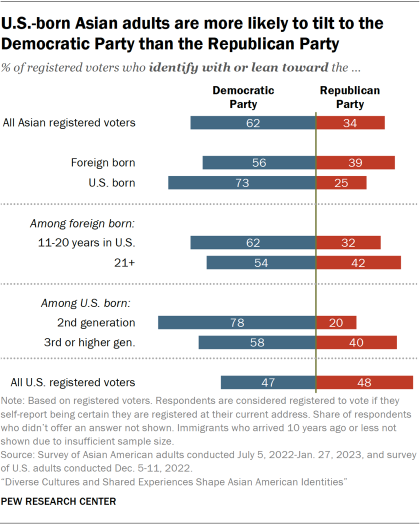
About six-in-ten Asian American registered voters (62%) identify as Democrats or lean to the Democratic Party, and 34% are Republicans or GOP leaners, according to a Pew Research Center survey of Asian adults conducted from July 2022 to January 2023.

Admittedly, the Pew survey found that Vietnamese Americans broke from the left-leaning trend. It found that about half of Vietnamese American registered voters are Republicans or lean to the GOP – the highest share across the five largest Asian origin groups in the United States.  

But recent stories from the mainstream media have made it appear that this rightward trend -- a preference for more policing and a loud but small group against affirmative action -- is a sign of of a conservative movement within the diverse Asian American community made up of a score of ethnicities, nationalities and languages.

However, Democrats should guard against taking the AANHPI vote for granted. The Democrats should be concerned that Republicans have been able to take advantage of some dissatisfaction among Asian American voters at the local level where the electorate felt they were being ignored resulting in progressives were ousted in San Francisco and New York.  

There also has been a noticeable movement towards supporting a  stronger police presence and a questioning of educational equity at the local level that gives the appearance of a move towards conservative values. 

Races in which Asian American voters voted for Republicans are still the exceptions and doesn't indicate a trend. That was the case in California's Orange County  where Vietnamese voters, the most conservative of Asian Americans, were apparently swayed by the anti-communist rhetoric of Rep. Michelle Steel, a Korean American, in the 2022 midterms.

However, that doesn't necessarily mean a rightward shift on local concerns translates to the national level where the majority of AANHPI voters, especially Indian Americans and FIlipino Americans, align with Democrats on issues such as affirmative action, healthcare, the economy, reproductive rights, immigration, voting rights, gun control and civil rights. 

A bar chart showing that U.S.-born Asian adults are more likely to tilt to the Democratic Party than the Republican Party

The diversity under the Asian American umbrella shows a wide spectrum of political views but there is still a strong lean towards the Democrats.

Around two-thirds of US registered voters who are Filipino (68%), Indian (68%) or Korean (67%) identify as Democrats or lean Democratic. Chinese American voters are also majority Democratic (56%), while Vietnamese American voters tilt to the GOP (51% Republican, 42% Democratic), reports the Pew study.

Asian voters are more likely than voters overall to affiliate with the Democratic Party: US registered voters are about evenly split between the Democratic Party (47%) and the Republican Party (48%).

Overall, 80% of Asian Americans who are US citizens ages 18 and older (and therefore eligible to vote) report being “absolutely certain” that they are registered to vote at their current address. This includes about three-quarters or more in each of the five origin groups in the Pew analysis.

Differences in Asian voter identification by age, gender, education and immigrant status


Among Asian registered voters, majorities across most demographic groups favor the Democratic Party, but there are some differences by age, gender and other factors:

  • Younger Asian registered voters are far more likely than older ones to tilt Democratic. Among all Asian Americans who are registered to vote, 88% of those under 30 identify with or lean to the Democratic Party, compared with 67% of those ages 30 to 49, 51% of those 50 to 64 and 48% of those 65 and older. 
  • Just 11% of Asian registered voters under 30 are Republicans or lean to the GOP, compared with larger shares in older age groups. Among Asians 65 and older, for instance, 43% are Republicans or Republican leaning.
  • Among Asian registered voters, women are more Democratic than men. About two-thirds of Asian women who are registered voters are Democrats or lean to the Democratic Party (67%), compared with 56% of Asian men.
  • Asian registered voters with a lower level of education are somewhat more likely to support the GOP. For instance, 45% of those with a high school diploma or less education are Republicans or lean Republican, compared with 30% of Asian voters with a bachelor’s degree and 27% of those with a postgraduate degree.
  • Asian registered voters born in the U.S. are more likely than those who immigrated to the country to affiliate with the Democratic Party. About three-quarters of those born in the U.S. are Democrats or lean Democratic (73%), compared with 56% of foreign-born Asian registered voters. 
  • A quarter of US-born Asians are Republicans or lean to the GOP, as are 39% of those who are foreign born.
  • About four-in-ten foreign-born Asian registered voters who have lived in the country for more than 20 years identify as Republican or lean to the GOP (42%). This compares with about a third (32%) of those who have spent 11 to 20 years in the US.

Asian Americans represent a relatively small but fast-growing segment of the US electorate. In 2021, 13.4 million Asian Americans were eligible to vote, making up 5.6% of all eligible voters, according to a Pew Research Center analysis of the 2021 American Community Survey. 

Eligible voters in this analysis are defined as US citizens ages 18 and older who live in the 50 states and the District of Columbia. Not all eligible voters are registered to vote.

In 2021, the 2.8 million Chinese American eligible voters in the U.S. accounted for the largest population of any Asian origin group, followed by Filipino (2.6 million), Indian (2.1 million), Vietnamese (1.3 million) and Korean American (1.1 million) eligible voters.

Where the voters live

As of 2021, the majority of Asian American eligible voters (56%) live in just five states. 

The state with the highest share is California, which is home to 4.3 million Asian eligible voters – accounting for about a third (32%) of the total Asian eligible voter population. 

The state with the second-largest share of Asian American eligible voters is New York (1.1 million), followed by Texas (960,000), Hawaii (575,000) and New Jersey (545,000).

Among each of the country’s five most populous Asian origin groups, California also has the highest share of eligible voters of each group. 

This includes about four-in-ten eligible voters who are Filipino (41%), Chinese (38%) or Vietnamese (37%). Three-in-ten Korean eligible voters (29%) and one-fifth of Indian eligible voters (20%) live in California as well. 

The second-largest share of eligible voters among each origin group varies among the ethnic subgroups from state to state. 

Some 14% of Vietnamese eligible voters live in Texas, and 7% of Filipino eligible voters live in Hawaii. New York is home to 15% of Chinese, 11% of Indian and 7% of Korean eligible voters.

EDITOR'S NOTE: For additional commentary, news and views from an AANHPI perspective, follow @DioknoEd on Twitter or at his blog Views From the Edge.


    Wednesday, October 12, 2022

    Ex-Hawaii Congress Representative Tulsi Gabbard leaves the Democrats

    Former Congressmember Tulsi Gabbard launches a new podcast.

    To no one's surprise, Tulsi Gabbard made it official Tuesday when she announced that she is leaving the Democratic Party.

    The former Congressional Representative from Hawaii has announced that she is leaving the Democrats, calling it an “elitist cabal of warmongers”, and inviting her “common sense independent minded” Democrats to join her. Despite leaving the party, she left her future political affiliation up in the air.

    Gabbard, who ran for United States President in 2019, said in a video published on Twitter on Tuesday said that the Democratic Party is driven by “cowardly wokeness.”

    A frequent critic of the Biden administration, Gabbard's announcement was not a complete surprise. Since Biden took office, the Samoan American's criticism more and more began to echo the rhetoric coming from the conservative extremists who have taken over the GOP.

    Gabbard's tweet said: "I can no longer remain in today’s Democratic Party that is now under the complete control of an elitist cabal of warmongers driven by cowardly wokeness, who divide us by racializing every issue & stoke anti-white racism, actively work to undermine our God-given freedoms, are hostile to people of faith & spirituality, demonize the police & protect criminals at the expense of law-abiding Americans, believe in open borders, weaponize the national security state to go after political opponents, and above all, dragging us ever closer to nuclear war."

    Gabbard’s announcement comes as she also kicks off a new podcast this week, “The Tulsi Gabbard Show.”

    Once seen as a rising political star, Gabbard has gained a reputation as a wild card within Democratic circles, often questioning Democratic positions. She also faced criticisms earlier this year from local Democrats who voted to condemn her “for participating in an event that raised funds that will harm Democrats across the country” after she spoke at the Conservative Political Action Conference.

    EDITOR'S NOTE: For additional commentary, news and views from an AANHPI perspective, follow @DioknoEd on Twitter.


    Tuesday, October 27, 2020

    AAPI voters could play a critical role in Presidential election


    UPDATED Oct. 29, 1:45 p.m. to include Georgia developments.

    It is a given that Asian American voters will have an impact in states like Hawaii, California, Nevada and New York where their numbers are large enough to determine election outcomes. 

    But Asian Americans could also play pivotal roles in next week's elections in states outside of those population hubs. The Asian American populations in Pennsylvania, North Carolina, Texas, Florida, Michigan, Georgia and Arizona have sprouted significantly since the 2010 Census.

    "If you take a look at the numbers of all the eligible AAPI voters in almost all of our battleground states, (they) outnumber the number of votes that we lost by (four years ago), so our community should feel proud and empowered," said Congresswoman Grace Meng, D-NY, in a virtual town hall meeting organized by a coalition of affinity groups supporting Biden, AAPIs for Biden.

    Asian Americans, while not a large share of the electorate nationally, could swing the outcome of many individual congressional races. AAPI make up more than 10% of the voting-age population in 45 House districts, according to Census estimates compiled by AAPI Data.

    While Congressional districts with the highest tally of Asian-American voters are mostly found in California, increasingly, the impact of AAPI votes are being felt in districts and states not usually linked to AAPI centers.

    AAPI are moving away from the urban centers in California, New York City and Chicago, said Natalie Masuoka, a political scientist at UCLA. “The growth of Asian America really is in the suburbs.”

    Asian Americans are dispersing across the entire country away from Hawaii and California and moving to Arizona, Nevada, and North Carolina—the states with the fastest-growing populations. The number of Asian American residents in Florida and Pennsylvania has grown by more than 80% since 2010. South Asians are flocking to  Texas, where estimates show that the number of eligible Asian American voters rose by at least 40% between 2012 and 2018.

    PENNSYLVANIA

    Both parties see Pennsylvania as a key state and have been spending time and resources there. 

    Pennsylvania's Asian American population has exploded by 99 percent since 2000, according to data compiled by APIAVote, a nonpartisan group. About 251,000 AAPI voters are spread across that state and they are getting noticed. Indian and Chinese Americans are the largest ethnic groups.

    "When we first started, very few Asian organizations wanted to even do this work or even understood that they were allowed to do nonpartisan voter registration, voter education, get-out-the-vote activities," APIA Vote's Christine Chen told NBC News. "It's so exciting to see in 2020 not only do we have more organizations, but they're also organizing themselves as a coalition and working together."

    In 2016, "Donald Trump [won] by 44,000 votes in the state of Pennsylvania," says Helen Gym, the first Asian American woman to serve on the Philadelphia City Council. Four years later, Gym, a Biden supporter, now says, "AAPIs are the margin of victory in Pennsylvania."

    The presence of U.S. Sen. Kamala Harris, an Indian American, as Biden's running mate, could boost turnout among AAPI voters. Also on the ballot is Nina Ahmad, who was born in Bangladesh, who is running for state auditor general.

    Increasing AAPI voter turnout can help the largely immigrant community play a bigger role in their communities beyond politics. "I believe Asian Americans can play a bigger role if we can break down the language barrier for some of our older residents or recent immigrants," said state Rep. Patty Kim, the first Asian American to serve in the Pennsylvania House.

    GEORGIA

    Joe Biden spent most of Tuesday in Georgia, trying to swing the state from Trump to the Democrats.. 

    Asian Americans “literally will make up the margins of victory in key races across our battlefield,” said U.S. Rep. Cheri Bustos, chairwoman of the DCCC, in a press conference. Georgia's Republicans and Democrats have realized that, and major efforts are underway to reach the once-ignored demographic group.

    “There’s a real misconception that Asian Americans don’t vote, and that’s becoming increasingly not true, especially as you have new voters coming on,” said Stephanie Cho, executive director of Asian Americans Advancing Justice Atlanta, a nonpartisan nonprofi. 

    "It’s critical for candidates, critical for parties, critical for anyone who does nonpartisan work to pay attention,” she told the Atlanta Journal-Constitution.

    Today (Oct. 29) the #DearGeorgia, It’s Time campaign led by Asian Americans Advancing Justice-Atlanta (Advancing Justice-Atlanta) and supported by more than 30 voting rights organizations announced new in-language voting resources including officially translated ballots in Korean and Spanish that are available immediately. DeKalb County becomes the first county in Georgia to offer an officially translated ballot in an Asian language, and in doing so, also becomes the first county to voluntarily take steps beyond those required by the federal Voting Rights Act to expand meaningful language access.

    Stephanie Cho, Executive Director of Advancing Justice-Atlanta, shared, “Today’s announcement marks a turning point for our fight to strengthen voting rights, ensuring that more Georgians will be welcomed and included in our democracy. We are moving from defense to offense. As we continue to protect voting rights, we will also focus our efforts to increase language access for Georgia’s more than 165,000 Limited English Proficient (LEP) voters.

    Asian American voters make up only 2.5% of Georgia’s active registered voters, or about 193,000, so their votes will be key in races like the 7th Congressional District. In Gwinnett, where a quarter of the state’s Asian American population lives and where they make up 9.5% of registered voters.

    “A lot of people in the state were not being talked to because we were not in a swing state,” said Aisha Yaqoob Mahmood, director of the Asian American Advocacy Fund told the AJC. “Asian American communities and immigrant communities were not considered a powerful voting bloc in 2016... But we have a massive voter population in key areas.”

    “Before the vice presidential nomination, I didn’t feel as much excitement about the race as I did after the nomination of Kamala Harris,” said Mahmood. “I am thoroughly surprised to see how many Indian Americans are getting involved, volunteering with us or with campaigns. It’s a level of excitement in that particular community I haven’t seen before.”

    “Representation matters, and especially for immigrant communities,” said state Rep. Sam Park, a second generation Korean American Democrat who represents parts of Lawrenceville and Suwanee. He told the AJC, “When they see themselves reflected in leadership, it’s a reminder that the American dream is alive and well, and if I can do it, so can they. It also sends a message that our government is inclusive, and our leadership is inclusive, and gives them incentive to participate in our democracy.”

    From left: Kamala Harris, Joe Biden, Michigan Gov. Whitmer and Sen. Cory Booker.

    MICHIGAN

    Biden will be joined with President Barack Obama on Saturday when they will campaig in Michigan, traditionally a Democratic stronghold. In 2016, the state went to Trump. 

    "What Democrats are trying to do and need to do if they're trying to be successful in the mid-terms and in the future is reach voters who don't look necessarily like a traditionally Democratic voter," said Adam Joseph, who canvassed with SAMOSA a group formed after 2016 to increase voting by Indian Americans.

    Joseph was also the communications director for Dr. Abdul El-Sayed's gubernatorial campaign. El-Sayed came in second to Gretchen Whitmer in the primaries.

    "What I think is amazing about what's happening here is that these are Indian Americans knocking Indian doors," he.told. "This is the community ... engaging with itself."


    The largest AAPI ethnic groups in Michigan include: Indian (112,368), Chinese (67,602), Filipino (40,847), Korean (32,893), and Japanese (20,883). From 2010 to 2016, the number of eligible AAPI voters in Michigan grew 31%. This compares to a 3% growth rate for the statewide eligible voting population between 2010 to 2016, according to AAPI Data.

    The largest concentration of Asian Americans, about 44%, are in Detroit and it's suburbs, says AAPI Data.

    In 2016, Truimp beat Hillary Clinton by only 10,704 votes, In that election, Asian American turnout was abysmal. AAPI activists believe that if AAPI voters had turned out in numbers comparable to the state average, Clinton could have won the state, and possibly the election.

    "Our goal is to get people from our community out to vote. ...We felt that we are best equipped to do that because we are from the same community." says Shuvra Das, co-founder of SAMOSA. Indian Americans lean heavily towards the Democrats.

    Harris has the Indian American community excited and hope to take part in a history-making vote. Trump's immigration policies which generally limited change of visas for workers and students has become a major issue for the largely immigrant community.

    NORTH CAROLINA

    Since 2012 the number of Asian Americans eligible to vote in North Carolina grew 55 percent, more than six times the statewide growth rate, according to the nonprofit Asian and Pacific Islander American vote.

    In 2016, only about 57% of Asian American voted compared to the overall turnout of 69%.

    “I think sometimes when people talk about Asian Americans as not as engaged, they don’t care about these things, I think that’s not necessarily true," says Phian Tran, the voting engagement director for North Carolina Asian Americans Together (NCAAT). "Thinking about the context of Asian American folks coming over and immigrating here, there are so many things to worry about.”

    NCAAT recently released it's first poll of voter attitudes among North Carolina’s Asian American population.

    “In the polling that we conducted we found that 59% of respondents to our polls say that health access including Medicare for all is among one of their most important public health priorities,” explains Ricky Leung, Senior Director of Programs.

    The group says there are about 209,000 Asian American voters in the state, enough to influence the results of this year’s election.

    For a democracy to function best, Tran says your civic duty can’t stop at the ballot box. “We cant just vote and say 'my job is done, I've fixed the world.' I don’t believe voting is the thing that’ll change and fix everything, but it’s a great step," he says.

    Though Asian Americans make up just 3.5% of the state’s electorate, NCAAT says greater participation could’ve swayed some congressional races in 2016.

    TEXAS

    Until recently, Texas was not considered a battleground state. This Friday, the last day for early voting in Texas, Kamala Harris will be campaigning in the Lone Star state where she given a wildly enthusiastic welcome when she visited during her Primary campaign. 

    Harris' visit is historic as it marks the first time a Democratic vice presidential candidate has campaigned in Texas since 1988 when Lloyd Bentsen, a native Texan was the ticket with Michael Dukakis.

    Harris' multi-city visit is a sign that the Democrats think that their ticket could pull an upset in Texas, which has been in the GOP's hip pocket for several presidential cycles. If Biden-Harris could capture the state's 38 electoral votes, it would be a fatal blow to the Trump campaign.


    In the run-up to Nov. 3, Texas Democratic Party’s AAPI Caucus, AAPIs for Biden and the Asian American Democrats of Texas have been conducting a campaign to celebrate and mobilize AAPI voters, running bilingual ads on radio, TV and ethnic media.

    Biden is not the only Democrat that would benefit if Texas was to turn blue. There are sizable Asian American communities in Texas districts that hold an outsized importance this year. Democrats are hopeful that they can flip nine seats in the state House to gain a majority in the lower chamber ahead of next year’s legislative session. Key among those efforts are nine seats held by Republicans in which former U.S. Rep. Beto O’Rourke, a Democrat, received more votes than U.S. Sen. Ted Cruz, R-Texas, in 2018. In two-thirds of those districts, the Asian share of the population is more than double the statewide share, according to the Texas Tribune. 

    “There are some districts where there’s a significant enough level of organization and voters that can make a difference if it’s a matter of turnout and the races are close enough,” said Madeline Hsu, a history professor at the University of Texas at Austin.

    Multiple U.S. House seats targeted by Democrats have large Asian American populations, too.

    Perhaps the district where the impact of the targeted political campaigning is most clear is the 22nd Congressional District, where Indian AmericanSri Preston Kulkarni is running against Republican Troy Nehls for the seat being vacated by Republican Congressmember Pete Olson.

    Kulkarni says his campaign is engaging with voters in 27 different languages in the diverse Fort Bend County district, once a conservative stronghold. The incumbent squeaked a win in 2018 against Kulkarni by only 5 percentage points. After Olson announced he wouldn’t seek reelection in 2020, Democrats identified the seat as one of their top targets.

    “The Asian American voters my campaign is talking to every day are ready and enthusiastic for more representation in this country’s halls of power,” Kulkarni told the Texas Tribune. “I think the rise in Asian American turnout is a great sign for our race. These are voters who aren’t overly partisan, they just want reasonable leadership who will fight for them in Congress, rather than an ideology or a political party.”

    Also benefitting by the Harris visit and the Democrats' push in Texas is Filipino American candidate Gina Ortiz Jones, running to fill the seat in Congressional District 23, one of the biggest districts in the nation, running along the Texas-Mexico border. Ortiz Jones received an early endorsement from Kamala Harris.

    She has a 74% chance of winning the seat, according to Five Thirty-eight, the nonpartisan poll aggregation site. If she were to win, Ortize Jones would be the first openly Lesbian AAPI member of Congress.

    EDITOR'S NOTE: A word of caution, this is news sprinkled with opinion. Readers are encouraged to seek multiple news sources to formulate their own positions. 

    Tuesday, December 10, 2019

    Tulsi Gabbard will skip the next Democratic debate even if she qualifies

    SCREEN CAPTURE / ABC
    Tulsi Gabbard criticizes the Democratic Party's criteria for the debates.

    Even if Rep. Tulsi Gabbard, D-HI, gets the one more poll she needs to qualify for the December Democratic debate, she says she won't take part.

    "For a number of reasons, I have decided not to attend the December 19th "debate" — regardless of whether or not there are qualifying polls," Gabbard tweeted. "I instead choose to spend that precious time directly meeting with and hearing from the people of New Hampshire and South Carolina."

    She has been critical of the criteria put up by the Democratic National Committee that the candidates have to meet in order to participate in the series of debates. The debate on Dec. 19 will be the sixth time the qualifiers meet on stage.


    So far, former Vice President Joe Biden, Sen. Elizabeth Warren, D-Mass.; Sen. Bernie Sanders, I-Vt.; South Bend, Ind. Mayor Pete Buttigieg, Sen. Amy Klobuchar, D-Minn.; and tech billionaire Tom Steyer have qualified for the next debate. The rest of the large field is left out in the cold.

    “There’s been a lack of transparency in that whole process about which polls are selected, which aren’t, which they’re seeing as qualifying, which ones are actually polling,” Gabbard told Hill.TV as she struggled to meet the criteria in an earlier debate.


    “Spending time with voters in Iowa and New Hampshire, they don’t take kindly to seeing how a few people in Washington, D.C. at the DNC are trying to be the gatekeepers,” she said.

    She wasn't the only candidate questioning the hurdles set by the Democrats.

    Sen. Cory Booker rebuked the DNC for letting “elites” and “money” decide which candidates gain the opportunity to occupy the debate stage. 

    "I'm a little upset with the (Democratic National Committee) right now because they seem to be trying to make the decisions for you," Booker told a Sunday crowd gathered in a Dubuque bar.

    Booker also made note that the New Hampshire Democratic Party voted last weekend to send the DNC a letter urging the party to reconsider the qualifying criteria for the debate to ensure greater diversity and give voters "the greatest opportunity" to hear from the candidates.

    The fact that the candidates who have qualified for the December debate are all white sharpened the flaws of the DNC's attempt to winnow down the crowd of candidates that at one point numbered 24.

    Booker, who is one of two African Americans running for president, pointed out that there are now more billionaires among the candidates than there are African Americans, after Sen. Kamala Harris, D-CA, dropped out of the race.

    Booker and Gabbard, who is Samoan American, and the other candidates of color, Julian Castro and Andrew Yang have also not met the DNC criteria. Yang needs one more poll where he has garners 4% to qualify.

    DNC spokesperson Xochitl Hinojosa told the Washington Times that the party’s debate requirements were “inclusive." 

    She asserted that historically, candidates who have polled lower than 4% in the primary season have never been selected as the Democratic presidential nominee. “While we are legally required to have objective criteria for each debate, our qualifying criteria has stayed extremely low throughout this entire process,” she said in an emailed statement. “We’ve never seen a political party take this many steps to be inclusive.”

    However, "historically," there have never been this many candidates running for president, which greatly dissipates potential supporters and donors among the diverse presidential hopefuls representing a wide political spectrum.
    ___________________________________________________________________

    Monday, July 30, 2018

    Sen. Kamala Harris' book deal prompts talk about 2020

    Sen. Kamala Harris got national attention with her aggressive questioning of AG Jeff Sessions.

    ANALYSIS


    CALIFORNIA Sen. Kamala Harris is set to release a new book about her life and her solutions for the country.

    The California Democrat's book, titled "The Truths We Hold: An American Journey," is scheduled to be published by Penguin Press on January 9, 2019,

    If you will recall, Presidents Bill Clinton and Barack Obama and Presidential hopefuls Hillary Clinton and Mitt Romney released books about the same time before they launched their runs at the U.S. Presidency.


    The Indian American senator has moved from two years ago when she denied any presidential aspirations, to jiu-jitsu-like deflections a year ago in saying she was too busy learning the ropes in the Senate, to two months ago when she said that the possibility of presidential run hasn't been ruled out.

    There are better known Democrats that might run for president in 2020: Senators Bernie Sanders, Elizabeth Warren and former Vice President Joe Biden for starters. Harris, formerly California's Attorney General, is not as well known outside of her home state, but she has an appeal that may be broader than the others. 

    The first-term senator from California has surged into a tie with Sen. Bernie Sanders(I-Vt.) as the betting favorite among potential Democratic candidates to win the 2020 presidential election.

    Betting site Oddshark lists Donald Trump as the runaway favorite to win in 2020, with betting odds of +140. However, Harris and Sanders each hold the second-best odds at +1,200, as of Aug. 7.

    Oddschecker, a site that averages odds across different betting platforms, gives Harris the best odds to win the Democratic nomination, followed by Biden, who has emerged as the favored candidate among Democrats in a number of recent polls.

    Another key sign that she might be a serious contender for the presidency is that her candor and her obvious contempt for Donald Trump has drawn the attention of the White House tweeters, conservative media outlets like the Fox News network, Brietbart News and the Washington Times are featuring more articles critical of Harris, and GOP-funded conservative researchers and think-tanks are beginning their search for dirt.

    “America Rising PAC, which at the time of its founding five years ago focused exclusively on researching, tracking and deploying rapid-response against Hillary Clinton, is well into a beneath-the-radar effort to define — and ultimately derail — the Democrats preparing to take on President Donald Trump in 2020. The oppo-research carpet-bombing has commenced against Sens. Kamala Harris and Elizabeth Warren, among others. ... " wrote Politico's Christopher Cadelago in his article titled "Inside the mission to blow up the 2020 Democratic field."

    As a cautionary warning to Democrats, Cadelago says the groups are also pursuing a strategy intended to pit Democrats against each other. The rise of so-called Democratic Socialists within the Democratic party probably has the GOP rubbing their hands in glee. They have already branding the Democratic ideological split as the  “#RaceToTheLeft.”

    “They are sitting back and building up their ammunition stockpile,” said Ryan Williams, a Republican strategist who is not involved in this current effort to dig up dirt against Harris. He adds that Rising has proven to be among the best at “exploiting a candidate’s weaknesses.”

    In listing her presidential attributes in mainstream media, they usually start out something like, "she's young, female and black." even though his father is from Jamaica. For some reason MSM always forget that she's half-Asian American (Her mother was an immigrant from India.) or that her mother brought her and her sister to India frequently.

    Her atypical upbringing hasn't turned off any of her black supporters in the way Barack  Obama's Hawaii and Indonesian upbringing created an initial suspicion among African Americans as he set the foundation for his eventual presidential campaign.

    Harris wouldn't even be the first Asian American to declare a run for the presidency. That honor goes to entrepreneur Andrew Yang, a long shot for sure, but he has some interesting ideas that might garner wide appeal.

    Her rousing performance at the Netroots Nation gathering in New Orleans earlier this month had the progressive wing of the Democrats buzzing despite the presence of other presidential hopefuls Senators Bernie Sanders, Elizabeth Warren and Cory Booker.

    If she chooses to be a candidate, Harris could be a formidable opponent. In the two years since she's been a senator, some observers say she has taken the strategic steps to raise her profile nationally:
    • She has adopted Bernie Sanders' healthcare plank, "medicare for all," pleasing the legions of devout Bernie supporters; 
    • raised tons of money for other lesser known Democratic candidates across the country, building up a wad of political IOUs which she can call upon; 
    • during this primary season, her endorsement has been sought across the nation; 
    • as the daughter of immigrants, she has taken head-on Trump's immigration policies from the Muslim ban to family reunification and she's not afraid to call the policies for what they are -- racist; 
    • her background as a prosecutor makes her almost immune from the law-&-order types who attack candidates with lesser credentials as soft on crime; and 
    • she comes from a deep-blue state that has the most electoral votes (55) and has battled Washington on a host of fronts, including the environment, immigration, and healthcare.
    Sen. Kamala Harris often gets the rock-star reception among voters.

    In addition, since the day after Trump won, she has been relentless in developing an online presence and following.
    Harris has insisted she is focused on the 2018 midterm elections, raising $3 million for Democratic senators up for reelection this year.

    But that same digital infrastructure can be used for fundraising which allows her to forgo  contributions from corporations and special interests, the traditional source of campaign financing. She has built up a small-donor base

    Perhaps, Harris' most attractive attribute might be her ability to talk like a moderate on issues popular with traditional politicians such as law-and-order, foreign policy and the economy, but also she has the ability to inspire like an idealistic socialist when she talks about civil rights, equality and justice. 

    She might be able to bridge the ideological divide raging within the Democratic Party between those moderates who want to win back the white voters who defected to Trump to voters of color and #MeToo voters who abhor the Republican agenda on right to choose, race relations, immigration and trickle-down tax plan and the far left margin, tired of the same ol', same ol', which includes the rabid Bernie supporters who still feel they were cheated out of the 2016 Democratic nomination.

    Harris might not be a official presidential candidate yet, but everything she's doing sure makes her look like one, act like one and talk like one.

    UPDATED: May 9 to include oddsmaker results.
    ______________________________________________________________________________

    Thursday, January 25, 2018

    Hey Democrats! Here is Trump's bargaining strategy for DACA


    AS SEN. CHUCK SCHUMER begins to renegotiate with Donald Trump the budget by  using the Deferred Action for Childhood Arrivals (DACA) as a bargaining chip, it might be helpful for him and the other Democrats to read parts of "Art of the Deal," the book Trump had ghost-written for him.

    The "Art of the Deal" became a No. 1 Best Seller back in 1987. It is part autobiography and part describing how to bargain for anything - whether it be a raise, a job or business proposition ... or, negotiating with Democrats about DACA.

    He fancies himself unsurpassed as a wheeler-dealer as he outlines his strategy for negotiating a deal, which Shumer and the Democrats find themselves doing with the White House.

    Inc, outlined Trump's strategy with quotes from the book. I've added the references to the U.S. policies that his administration has proposed or implemented:

    Think big

    "I like thinking big. I always have. To me it's very simple: if you're going to be thinking anyway, you might as well think big."

    Trump: Build the Damned Wall on the border between Mexico and the U.S.

    Protect the downside and the upside will take care of itself


    "I always go into the deal anticipating the worst. If you plan for the worst--if you can live with the worst--the good will always take care of itself."

    Trump: Characterize all immigrants as criminals.

    Maximize the options


    "I never get too attached to one deal or one approach...I keep a lot of balls in the air, because most deals fall out, no matter how promising they seem at first."

    Trump: Mexico will pay for the wall. If that doesn't work, get Congress to include $25 million for the wall. Meanwhile, throw in a Muslim ban and push an anti-family immigration plan.

    Know your market


    "I like to think that I have that instinct. That's why I don't hire a lot of number-crunchers, and I don't trust fancy marketing surveys. I do my own surveys and draw my own conclusions."

    Trump: Don't alienate the white, xenophobic Republican base of support. Play to their fears of "others."

    Use your leverage

    "The worst thing you can possibly do in a deal is seem desperate to make it. That makes the other guy smell blood, and then you're dead."


    Get the word out

    "One thing I've learned about the press is that they're always hungry for a good story, and the more sensational the better...The point is that if you are a little different, a little outrageous, or if you do things that are bold or controversial, the press is going to write about you."

    Trump: Not much to add to this one. Pick any number of tweets postet by @realdonaldtrump.

    Fight back

    "In most cases I'm very easy to get along with. I'm very good to people who are good to me. But when people treat me badly or unfairly or try to take advantage of me, my general attitude, all my life, has been to fight back very hard."

    Trump: If Democrats want something for DACA participants, demand funding for the Wall, threaten to end family reunification priorities, propose to halve the total of legal immigrants - all of which in Trump's proposed "reform" of immigration rules.


    Deliver the goods

    "You can't con people, at least not for long. You can create excitement, you can do wonderful promotion and get all kinds of press, and you can throw in a little hyperbole. But if you don't deliver the goods, people will eventually catch on."

    Trump: People are catching on that there's no substance to Trump, just a lot of hot air. Witness the millions of people who joined the marches against the Trump administration policies in Trump's first year of office.

    Democrats have to be careful not to give in too easily when bargaining with Trump. It may take walking away from the table, or ... shutting down the government.
    _________________________________________________________________________________