Views From The Edge

Raves, Rants, Reviews & Ramblings from an Asian American, Native Hawaiian & Pacific Islander Perspective

Showing posts with label Asian American Voters. Show all posts

Thursday, June 1, 2023

Asian American voters still mostly in the Democrats' corner


ANALYSIS

Asian American voters remain solidly with the Democratic Party despite recent stories making it appear that Asian American voters are moving to the right.

About six-in-ten Asian American registered voters (62%) identify as Democrats or lean to the Democratic Party, and 34% are Republicans or GOP leaners, according to a Pew Research Center survey of Asian adults conducted from July 2022 to January 2023.

Admittedly, the Pew survey found that Vietnamese Americans broke from the left-leaning trend. It found that about half of Vietnamese American registered voters are Republicans or lean to the GOP – the highest share across the five largest Asian origin groups in the United States.  

But recent stories from the mainstream media have made it appear that this rightward trend -- a preference for more policing and a loud but small group against affirmative action -- is a sign of of a conservative movement within the diverse Asian American community made up of a score of ethnicities, nationalities and languages.

However, Democrats should guard against taking the AANHPI vote for granted. The Democrats should be concerned that Republicans have been able to take advantage of some dissatisfaction among Asian American voters at the local level where the electorate felt they were being ignored resulting in progressives were ousted in San Francisco and New York.  

There also has been a noticeable movement towards supporting a  stronger police presence and a questioning of educational equity at the local level that gives the appearance of a move towards conservative values. 

Races in which Asian American voters voted for Republicans are still the exceptions and doesn't indicate a trend. That was the case in California's Orange County  where Vietnamese voters, the most conservative of Asian Americans, were apparently swayed by the anti-communist rhetoric of Rep. Michelle Steel, a Korean American, in the 2022 midterms.

However, that doesn't necessarily mean a rightward shift on local concerns translates to the national level where the majority of AANHPI voters, especially Indian Americans and FIlipino Americans, align with Democrats on issues such as affirmative action, healthcare, the economy, reproductive rights, immigration, voting rights, gun control and civil rights. 
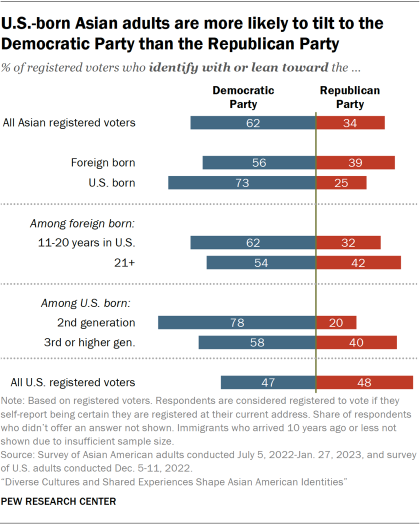
A bar chart showing that U.S.-born Asian adults are more likely to tilt to the Democratic Party than the Republican Party

The diversity under the Asian American umbrella shows a wide spectrum of political views but there is still a strong lean towards the Democrats.

Around two-thirds of US registered voters who are Filipino (68%), Indian (68%) or Korean (67%) identify as Democrats or lean Democratic. Chinese American voters are also majority Democratic (56%), while Vietnamese American voters tilt to the GOP (51% Republican, 42% Democratic), reports the Pew study.

Asian voters are more likely than voters overall to affiliate with the Democratic Party: US registered voters are about evenly split between the Democratic Party (47%) and the Republican Party (48%).

Overall, 80% of Asian Americans who are US citizens ages 18 and older (and therefore eligible to vote) report being “absolutely certain” that they are registered to vote at their current address. This includes about three-quarters or more in each of the five origin groups in the Pew analysis.

Differences in Asian voter identification by age, gender, education and immigrant status


Among Asian registered voters, majorities across most demographic groups favor the Democratic Party, but there are some differences by age, gender and other factors:

  • Younger Asian registered voters are far more likely than older ones to tilt Democratic. Among all Asian Americans who are registered to vote, 88% of those under 30 identify with or lean to the Democratic Party, compared with 67% of those ages 30 to 49, 51% of those 50 to 64 and 48% of those 65 and older. 
  • Just 11% of Asian registered voters under 30 are Republicans or lean to the GOP, compared with larger shares in older age groups. Among Asians 65 and older, for instance, 43% are Republicans or Republican leaning.
  • Among Asian registered voters, women are more Democratic than men. About two-thirds of Asian women who are registered voters are Democrats or lean to the Democratic Party (67%), compared with 56% of Asian men.
  • Asian registered voters with a lower level of education are somewhat more likely to support the GOP. For instance, 45% of those with a high school diploma or less education are Republicans or lean Republican, compared with 30% of Asian voters with a bachelor’s degree and 27% of those with a postgraduate degree.
  • Asian registered voters born in the U.S. are more likely than those who immigrated to the country to affiliate with the Democratic Party. About three-quarters of those born in the U.S. are Democrats or lean Democratic (73%), compared with 56% of foreign-born Asian registered voters. 
  • A quarter of US-born Asians are Republicans or lean to the GOP, as are 39% of those who are foreign born.
  • About four-in-ten foreign-born Asian registered voters who have lived in the country for more than 20 years identify as Republican or lean to the GOP (42%). This compares with about a third (32%) of those who have spent 11 to 20 years in the US.

Asian Americans represent a relatively small but fast-growing segment of the US electorate. In 2021, 13.4 million Asian Americans were eligible to vote, making up 5.6% of all eligible voters, according to a Pew Research Center analysis of the 2021 American Community Survey. 

Eligible voters in this analysis are defined as US citizens ages 18 and older who live in the 50 states and the District of Columbia. Not all eligible voters are registered to vote.

In 2021, the 2.8 million Chinese American eligible voters in the U.S. accounted for the largest population of any Asian origin group, followed by Filipino (2.6 million), Indian (2.1 million), Vietnamese (1.3 million) and Korean American (1.1 million) eligible voters.

Where the voters live

As of 2021, the majority of Asian American eligible voters (56%) live in just five states. 

The state with the highest share is California, which is home to 4.3 million Asian eligible voters – accounting for about a third (32%) of the total Asian eligible voter population. 

The state with the second-largest share of Asian American eligible voters is New York (1.1 million), followed by Texas (960,000), Hawaii (575,000) and New Jersey (545,000).

Among each of the country’s five most populous Asian origin groups, California also has the highest share of eligible voters of each group. 

This includes about four-in-ten eligible voters who are Filipino (41%), Chinese (38%) or Vietnamese (37%). Three-in-ten Korean eligible voters (29%) and one-fifth of Indian eligible voters (20%) live in California as well. 

The second-largest share of eligible voters among each origin group varies among the ethnic subgroups from state to state. 

Some 14% of Vietnamese eligible voters live in Texas, and 7% of Filipino eligible voters live in Hawaii. New York is home to 15% of Chinese, 11% of Indian and 7% of Korean eligible voters.

EDITOR'S NOTE: For additional commentary, news and views from an AANHPI perspective, follow @DioknoEd on Twitter or at his blog Views From the Edge.


    Posted by Edward Diokno at 2:41 AM No comments:
    Email ThisBlogThis!Share to XShare to FacebookShare to Pinterest
    Labels: Asian American Voters, Democrats, Pew Research Center

    Sunday, November 27, 2022

    Democrats, Republicans focus in on Georgia's AAPI voters for key Senate contest

    Georgia's AAPI voters will choose between Sen. Raphael Warnock, left, and Herschel Walker.


    Early voting has already begun in some Georgia counties to determine who Georgians will send to the US Senate in a runoff election between Senator Raphael Warnock and Republican foe and former football player Herschel Walker.

    Asian American voters could be the difference-makers in the runoff election after neither candidate was able to win the majority needed to declare victory last Nov. 8.

    Asian American voters overwhelmingly voted Democrat in the 2020 Presidential election and is largely credited for providing the margin of victory and the state's electoral votes to Democrat President Biden. 

    In the 2020 US Senate races, Asian Americans voted for the Democratic candidates over the Republicans by a margin of 61% to 34%, according to exit polls conducted by the Asian American Legal Education Fund.

    In the 2022 campaign, Warnock garnered 49.44% of the vote to Walker's 48.49%, or difference of about 38,000votes. runoff contest, both Democrats and Republicans have focused more of their campaigns to woo this crucial demographic. The seat will determine whether the Democrats expands its thin 50-49 majority in the chamber after flipping a GOP seat in the Midterm Elections. If Warnock wins, the Democrats won't have to do the stiff negotiations with Republicans to pass Democratic policies.

    Democrat State Representative Marvin Lim, the only Filipino American in elected office in Georgia, is hoping the Democratic party will do better in the days leading up to Dec. 6.

    "I think for Democrats, it really hammers home the importance of meeting voters on the ground consistently, not just a month or week before an election," Lim told the Filipino American network ABS-CBN News, "and meeting on issues that they care about rather than the issues we think they should care about. I don’t think Democrats necessarily did that here."

    "Senator Warnock has really been effective in actually getting things done on the issues people care about and showing that he has done that in a year and in a state where everything is swinging Republican, it’s going to be important to keep doing that leading up to the runoffs a month from now," he said.


    “Our community needs to hear directly from leaders and from the candidate saying, ‘We have a real message of change that’s positive,’” Shekar Narasimhan, the founder of AAPI Victory Fund, told Politico. “And we think by doing what we’re doing and continuously doing it, we’re giving that message to them.”

    Largest Asian American ethnic groups in Georgia include: Asian Indian (165,545), Korean (71,877), Chinese, except Taiwanese (71,388), Vietnamese (66,834), Filipino (46,601) and Japanese (21,078), according to APIAVote, a nonpartisan advocacy agency. All the communities, except for the Vietnamese, leaned heavily towards the Democrats.

    Voting turnout among Asian Americans almost doubled in the state of Georgia from 2016 to 2020, and the number of ballots cast by Asian Americans in Georgia went up by 60,000 votes in 2020, according to the Democratic firm TargetSmart.

    The deep political engagement of the AANHPI community in the political affairs of their state showed up in the Nov. 8 elections when six AANHPI first-time candidates won seats to the state's Senate and House of Representatives bringing the highest number of  AANHPI lawmakers in the state capitol, eight Democrats and two Republicans.

    Republicans have learned from the 2020 election results that also gave the state two Democratic Senators, Warnock and Sen. Jon Ossoff.  Prior to the Nov. 8 election, Walker held a rally with the Indian American community in September ahead of Election Day.

    “Republicans have been on the ground investing in Georgia’s Asian American community and earning votes all cycle,” said Nainoa Johsens, the RNC’s director of Asian Pacific American media.


    Raymond Partolan, National Field Director of the Asian Pacific Islander American Vote, stressed to ABS-CBN News the important role Asian American voters might play in the the Senate race.

    "In the runoff election which occurred in 2021, Raphael Warnock, who is now Senator Warnock, won the Georgia runoff by just 93,550 votes. And based on our counts, there are over 270,000 Asian American voters within the state of Georgia. So you can see Asian American voters can indeed be the margin of victory," Partolan told the Filipino American news outlet.


    Both parties are bringing in money and people from around the nation to rally the Asian American electorate. Maryland Lt. Gov.-elect Aruna Miller, the first South Asian woman elected to the post, said she is planning to make calls to get Asian American voters to the polls for Warnock.

    She told Politico: “Look, many South Asians left their country of origin to come to the United States to seek opportunities. But those opportunities come with being engaged civically, with coming out and voting. It doesn’t just happen overnight.”

    Former President Obama is scheduled to campaign for Warnock this coming week, just before the Dec. 6 deadline.

    The former US ambassador to the United Nations and South Carolina governor Nikki Haley told Republicans at a rally for Walker that Warnock, should be “deported.” a message that the GOP thinks rings with the majority immigrant communities of Asian Americans.

    “I am the daughter of Indian immigrants,” Haley said. “They came here legally, they put in the time, they put in the price, they are offended by what’s happening on [the southern US] border.

    “Legal immigrants are more patriotic than the leftists these days. They knew they worked to come into America, and they love America. They want the laws followed in America, so the only person we need to make sure we deport is Warnock.”

    Her statements drew a sharp reaction from Black leaders.

    Cornell William Brooks, a Harvard professor and pastor, tweeted: “Were it not for civil rights laws Black folks died for, Nikki Haley’s family might not be in America.

    “Were it not for a HBCU [historically Black college and university] giving her father his first job in the US, Haley wouldn’t be in a position to insult Georgia’s first Black senator. Warnock’s history makes her story possible.”

    Working against the Democrats this time around are the voting restrictions the GOP-led legislature passed in SB 202, such as the reduction of drop-off boxes, and a shorter time limit for mail-in ballots. Also, instead of the nine-weeks that was in effect in 2020 election runoff, the time between the election and runoff has been reduced to four weeks giving organizers a shorter time to organize, outreach and rally its voters.

    Partolan expects money and volunteers to come pouring into Georgia right up until the Dec. 6 election day. Then, it will come down to which party has better ground game in getting their voters to the polls and withstand the long lines made longer by the reduction in places to vote, another result of SB 202.

    "It’s going to be a mad scramble to get as many Asian American and Filipino American voters to go to the polling place to cast their ballots again on December 6th."

    EDITOR'S NOTE: For additional commentary, news and views from an AANHPI perspective, follow @DioknoEd on Twitter.


    Posted by Edward Diokno at 11:50 AM No comments:
    Email ThisBlogThis!Share to XShare to FacebookShare to Pinterest
    Labels: Asian American Voters, Georgia Senate, Herschel Walker, Raphael Warnock

    Saturday, October 22, 2022

    Support for Kamala Harris among California's Asian Americans not as solid as it should be

    TWITTER / ROB BONTA
    Vice President Kamala Harris endorses Rob Bonta for California's Attorney General.


    If Vice President Kamala Harris intends to run for President, she has some work to do.  Surprisingly, a new survey suggests that California's Asian Americans are lukewarm in their support for Harris' potential candidacy for leader of the free world.

    In fact, California-born Harris ranked sixth among Democrats who might be in possible candidates for President if President Biden does not run in 2024 or 2028. Being of Indian heritage does not seem to give her an advantage among Asian American voters finishing behind Sen. Bernie Sanders, Sen. Elizabeth Warren, California Gov. Gavin Newsom, Transportation Secretary Pete Buttigeig and progressive Rep. Alexandra Ocasio Cortez.

    A new Carnegie-YouGov poll reveals the political views of Asian American voters in California—one of the fastest-growing groups of voters in the nation’s largest state. Asian Americans make up 16% of the state's total population and about the same, 15.3%, of California's voters.
    FYI View the entire Carenegie-YouGov poll

    Given Harris’s deep California roots nurtured in her campaigns for San Francisco's District Attorney, the state's Attorney General and as a US Senator, the findings should serve as an indication of her support from a community that should be supporting a fellow Asian American more strongly and a community that is starting to flex its political muscle. 

    When the survey asks whether respondents would support her as the Democratic presidential nominee in the 2024 general election. Of the total citizen sample, 42% indicate they would support her, while 37% say they would not.

    A sizable share, 21% of all respondents, are unsure how they would vote if Harris were the nominee. These numbers suggest that Harris is badly underperforming the generic ballot considering Democrats hold a 51–17% advantage over the Republicans.


    On the question of Harris’s possible nomination by the Democratic Party, there is interesting variation among ethnic subgroups. Indian-origin (52%) and Japanese-origin (51%) respondents express the greatest degree of support for Harris if she were the 2024 Democratic nominee. 

    A plurality of Chinese (42%) and Filipinos (45%), the two largest Asian American subgroups in the state, the respondents see her a generally  favorable light. However, there is less support from Koreans, Vietnamese, and respondents from smaller ethnic groups, with only 33% to 35% of respondents from these groups inclined to support a Harris nomination.


    Among respondents willing to support Harris as the nominee in 2024, it is not Harris herself, but rather her status as the Democratic nominee that most attracts supporters: 
    • 32% of respondents to this question say they would support whoever the Democratic nominee is, whether that be Harris or someone else.
    • 20% indicate they would support her because they would like to see a president with Harris’s personal background (as someone who is African American, Asian American, Indian American, and a woman). 
    • 15% report they would support Harris due to her experience, 
    • 13% value her leadership and personality, and 
    • 12% agree with where Harris stands on the issues.
    • 6% responded that Harris represents Asian American interests,
    • 2% specify another reason. 
    Among those who would not support Harris in 2024, the most popular response for their reasoning—selected by 30% of respondents—is that “Harris does not have the leadership or personality needed to serve as president,” as the survey item put it\.

    Another 20% report that they disagree with where Harris stands on the issues, and 18% do not think she has the requisite experience to serve as president.

    In addition, 11% would not support any Democratic nominee, 9% believe she does not represent Asian American interests, and 7% report she places too much emphasis on her personal identity. A total of 5% provide another reason for not supporting her.


    POLITICAL LEANINGS

    The good news for the Democrats according to the Carnegie survey is that the Asian American electorate reflects earlier polls that show the Asian American community, 48%, leaning heavily towards the Democratic Party despite recent GOP efforts to sway the same community to their radical right views.

    Only 17% of respondents identify with the Republican Party, while more than one quarter (27%) identify as independents. A total of 7% of the sample are not sure about their partisan affiliation, while 1% identify with another, smaller political party.

    Finally, there is a discernible gender skew in the data: 53% of female respondents report identifying as Democrats compared to 44% of males.

    In line with their partisan identification and ideological self-placement, Asian Americans in California overwhelmingly intend to vote for Democrats this November favoring incumbent Gavin Newsom for Governor, Padilla for US Senate and most the House Representatives. 

    A 54% share of respondents plan to vote fo Newsom. Brian Dahle, the Republican challenger, lags far behind with 16% of the vote. Meanwhile, 12% of respondents do not intend to vote, despite being eligible to do so, while 17% are still undecided.

    Researchers caution that the results of their study shouldn't be extrapolated to represent the broad and diverse Asian American community. Because it drew its respondents from YouGov sources, it surveyed mostly US citizens and only English-speakers.

    However, the Carnegie-YouGov survey responses of California's Asian Americans roughly reflect similar findings of earlier polls and presents a good picture of the political preferences of Asian Americans prior to the Nov. 8 election day.

    The survey is the first in a series of articles that will explore the political and social preferences of Asian Americans in the Golden State.

    Future pieces in the series will explore other topics of relevance to the Asian American community in California, such as policy priorities, identity and discrimination, foreign policy, and civic and political engagement.


    EDITOR'S NOTE: For additional commentary, news and views from an AANHPI perspective, follow @DioknoEd on Twitter.


    Posted by Edward Diokno at 1:26 AM No comments:
    Email ThisBlogThis!Share to XShare to FacebookShare to Pinterest
    Labels: Asian American Voters, Carnegie, Kamala Harris, Representation Matters, YouGov

    Wednesday, October 27, 2021

    It's happening now, AAPI voting power being diluted as voting rights bills stalled in Congress

    Asian American voters were influential in a number of races in the 2020 elections.

    Just as AAPI voters begin to flex their political muscles, Republicans are trying their best to diminish the influence the Asian Americans and Pacific Islander electorate exercised in recent elections.

    Asian and Pacific Islander American Vote (APIAVote( is disappointed that debate on the Freedom to Vote Act has been blocked again in the Senate. A majority of Americans support the provisions in this bill, but a minority of Senators continue to block it.

    “When Asian Americans and Pacific Islanders came out in historic numbers in 2020, we were able to do so because of options such as voting-by-mail and early voting," said Asian and Pacific Islander American Vote (APIAVote) in a statement. 

    "Now, however, 19 states have passed 33 laws this year alone that will make it harder for Americans to vote – many of which make a point to limit the voting options that allowed our communities to make a decisive impact last year in the first place. This is no coincidence. This is a direct attack on Asian and Pacific Islanders and other marginalized communities in an attempt to silence us.”

    The 2020 federal election drew the United States’ highest voter turnout in more than a century, breaking records despite the Covid-19 pandemic and efforts to undermine the election process with the Big Lie of a stolen election," said a report from the Brennan Center for Justice, a nonpartisan think tank.

    In a backlash to this historic voter participation, many state lawmakers have proposed and enacted legislation to make it harder for Americans to vote, justifying these measures with falsehoods steeped in racism about election irregularities and breaches of election security.


    “For democracy to work for all of us, it must include us all – and this bill does that. It protects our freedom to vote, ensures fair representation, and limits the influence of big money in our politics; this bill will make our government accountable to the people,” continued APIAVote.


    The Freedom to Vote Act, which is currently before the Senate, is a comprehensive package of voting, redistricting, and campaign finance reforms. It includes national standards for voting that would ensure access to the ballot across state lines. The John Lewis Voting Rights Advancement Act, which has passed in the House, would complement the Freedom to Vote Act.

    The Brennan Center report goes on to point out that restrictive laws in four states — Georgia, Iowa, Kansas, and Texas — impose new or more stringent criminal penalties on election officials or other individuals. These new criminal laws will deter election officials and other people who assist voters from engaging in ordinary, lawful, and often essential tasks.

    People in Georgia, where the registration of new AAPI voters helped give the GOP-controlled state to Biden and elect two Democratic Senators, can now be charged with a crime for handing out water or snacks to voters waiting in line at the polls.


    In Iowa and Kansas, people could face criminal charges for returning ballots on behalf of voters who may need assistance, such as voters with disabilities. And in Texas, election officials could face criminal prosecution if they encourage voters to request mail ballots or attempt to prevent poll watchers’ intimidating behavior on voters or election department workers.

    For example, Texas enacted S.B. 1, omnibus legislation that disproportionately burdens Latino, Black, and Asian voters and makes it harder for those who face language access barriers or who have disabilities to get help casting their ballots, reports the Brennan Center. The law also constrains election workers’ ability to stop harassment by poll watchers and bans 24-hour and drive-thru voting, among other measures. In a state where it was already hard to vote, S.B. 1 compounds the barriers faced by Texas voters. 

    REDISTRICTING

    Let's not mince words. It is the Trump-led Republicans who are providing the resistance to voting rights under the guise of the baseless allegation that they are protecting the election process from voter fraud.

    And if they have their way, through the process of gerrymandering Congressional districts, they're hopeful that they can cheat their way to gaining the majority in the House and Senate in the 2022 mid-terms, thus assuring that the anti-voting laws stay in place.

    Although the 2020 Census that Texas has grown more diverse over the last decade -- 95% of the state's population growth were people of color -- thus awarding the state two new Congressional districts, through newly drawn districts, Republicans have effectively turned back time by ensuring White majority rule that has controlled Texas since the Reconstruction. Thus, there are more majority-white districts and fewer Hispanic majority districts at the expense of the growing political power of Latino, Black and Asian voters in the cities and suburbs.

    Districts like the 22nd in Fort Bend County and the 24th in the Dallas-Fort Worth suburbs had finally become competitive political battlegrounds in the last election cycle as multi-racial coalitions banded together almost electing Filipino American Gina Ortiz in the 22nd and Indian American Sri Preson Kulkarni in the 24th.

     “That was like a glimpse of the future of American politics. Very coalitional, very multi-racial,” says Michael Li, a redistricting lawyer with the Brennan Center for Justice. But Republicans chose to dismantle those seats, packing diversifying areas into new deep-blue Democratic districts or adding them to GOP-held seats made whiter and redder by extending out into far-flung rural counties.

    “Republicans are really scared of the suburbs because they’re becoming more diverse and because White voters in the suburbs aren’t as reliable for Republicans anymore and they’re not sure they’re getting it back anytime soon,” Li says.


    This tactic of dividing Democratic districts, many of which have large numbers of constituencies of color is going on in other states: Georgia, Arizona, Michigan among others.

    “We now urge the Senate to do whatever it takes to pass the Freedom to Vote Act and send it to President Biden’s desk," says APIAVote. "Time is running out, and passing vote rights legislation now is imperative.”

    EDITOR'S NOTE: For additional commentary, rips, raves and references from an AAPI perspective, follow me on Twitter @DioknoEd.
    Posted by Edward Diokno at 1:53 AM No comments:
    Email ThisBlogThis!Share to XShare to FacebookShare to Pinterest
    Labels: APIVote, Asian American Voters, Voting Rights

    Thursday, April 8, 2021

    Asian American legal advocates file suit vs. Georgia's voting law

    Asian Americans were made their votes count in the 2020 and 2021 elections in Georgia.

    It is fairly obvious that Georgia Republicans are afraid of losing it's dominance and influence in the Peach state. Hence, the new voting law passed which critics say makes it harder to vote.

    Asian Americans Advancing Justice - Atlanta, Advancing Justice -AAJC and Advancing Justice -Asian Law Caucus, along with pro bono counsel, Keker, Van Nest, & Peters, filed a lawsuit to ensure that Asian American voters in Georgia will have the freedom to vote equally in elections.

    “Asian Americans turned out in record numbers, alongside other communities of color, in a safe and fair election in both the 2020 presidential election and the 2021 runoff elections in Georgia,” said Phi Nguyen, Asian Americans Advancing Justice-Atlanta’s Litigation Director. “We won’t let them shut the door on us after all our efforts to enliven our democracy."

    The civil rights groups charge that SB 202, Georgia’s sweeping anti-voting bill, erects unconstitutional barriers intended to silence Asian American voters. SB 202 shortens the window to apply for mail-in ballots; restricts access to secure drop boxes; forces voters to satisfy onerous, unnecessary ID requirements before voting by mail; and prohibits elections officials from proactively mailing ballot applications to registered voters.

    The lawsuit, filed by AAAJ-Atlanta, is the fourth court challenge to the voting law since Gov. Brian Kemp signed it on March 24.

    The three other pending lawsuits contesting Georgia’s voting law were filed by the NAACP, the African Methodist Episcopal Church, the New Georgia Project and several other organizations.


    Georgia's new voting law is part of a national strategy of the GOP to make voting more difficult, primarily because Republicans believe they have a better chance at winning  when voting turnout is low.

    Republicans, masters of wordsmithing, describe their efforts as ensuring the security of the vote against voter fraud, something that is almost nonexistent in the U.S.; or at the very most, barely negligible. There is no other way to describe this effort other than anti-democratic, at best; or at worst, voter suppression. Critics have called it Jim Crow reborn, referring to that period in the U.S. history in the 1950s-1960s prior to the 1965  Voting Rights Act, when southern lawmakers put in place laws that prevented Black voters from casting their ballots.

    "The majority of Asian Americans in Georgia voted by mail during the 2020 general elections, and the politicians who drafted this bill intentionally targeted our community’s preferred voting method," said Nguyen. "These deliberate barriers will disproportionately harm Asian American voters, many of whom already face barriers due to limited English proficiency and dearth of translated voting materials. We should be making it easier, not harder, to vote.”

    Asian American voters came voted in record numbers in 2020 and 2021 and helped turn the traditional Republican stronghold into a purple state, giving the state's electoral votes to Democrat Joe Biden and voting in two Democratic U.S. Senators.

    “This bill is not only an attack on Asian Americans,” said Stephanie Cho, Asian Americans Advancing Justice-Atlanta’s Executive Director, “it’s an attack on all Americans who cherish democracy and freedom. 

    Republican lawmakers changed voting rules after Democrats won 2020 and 2021 statewide races thanks to strong turnout among Black voters.

    "The bill drafters aimed for communities of color, but every community will have restricted access to voting and democratic participation will be diminished across all of Georgia. This bill attempts to undo the work of grassroots organizers, advocates, and voters who turned out in record numbers to make their voices heard. 

    "This reactionary, racist, and backwards bill is a stain on Georgia, the beating heart of the Civil Rights movement. We won’t go back - we will fight them in the courts to make sure all voices are heard,” Cho added.

    “The Asian American community will not be silenced. Not by the wave of anti-Asian violence that threatens the safety and security of our friends and family; and not by SB 202, which seeks to restrict our constitutional right to vote,” said Candice Mai Khanh Nguyen of Keker, Van Nest, & Peters.

    EDITOR'S NOTE: A word of caution. Views From the Edge presents news articles  laced with opinion. Readers are encouraged to read other news outlets to form their own opinion.


    Posted by Edward Diokno at 1:53 AM No comments:
    Email ThisBlogThis!Share to XShare to FacebookShare to Pinterest
    Labels: AAAJ-Atlanta, Asian American Voters, Georgia

    Wednesday, November 4, 2020

    AALDEF exit poll: Asian Americans vote 2-to-1 for Biden


    Correction: Nov. 5, 10:30 a.m. for headline fix

    Two-thirds of Asian American voters cast their ballots for Democratic presidential nominee Joe Biden. Donald Trump received only 30% of the Asian American vote according to an exit poll by the Asian American Legal Defense and Education Fund.

    The AALDEF reelased preliminary results of its nonpartisan multilingual exit poll found that Asian Americans favored Biden over Donald Trum by a margin of 67% to 30%. They also favored Democratic candidates in close races in Georgia and supported Democratic candidates in Senate races in Maie, Michigan, New Jersey and Virginia

    “With record voter turnout in the midst of a pandemic, the Asian American Exit Poll provides an important snapshot of the growing Asian American electorate, including their party affiliations and issues influencing their votes,” said AALDEF executive director Margaret Fung.

    The exit poll also learned that 30% of the Asian American voters were first-time voters, the result of massive voter registration drives by a host of AAPI communityi agencies and the two major parties.

    AALDEF volunteers, including attorneys, law students, community-based organizations, bar associations, student organizations, and community advocates, surveyed Asian American voters at 91 poll sites in 13 states and Washington, DC.

    AALDEF also dispatched teams of attorneys and law students to monitor poll sites in California (San Jose), Massachusetts (Boston, Dorchester, Lowell, Malden, and Quincy), New Jersey (Bergen and Middlesex Counties), New Mexico (Albuquerque), New York City (Bronx, Brooklyn, Manhattan, and Queens) and Pennsylvania (Bucks County, Delaware County and Philadelphia) for compliance with the language assistance provisions of the Voting Rights Act and to guard against anti-Asian discrimination and intimidation.

    More details of the exit poll will be released soon after all the ballots are tabulated. However, other initial highlights of the survey included:

    • Party Affiliation: 56% Democrat, 16% Republican, 25% Not Enrolled, 4% Other
    • Vote for U.S. Senate: 65% Democrat, 30% Republican, 2% Other, 4% Did not vote
    • Gender: 53% Female, 47% Male, 1% Non-Binary
    AALDEF Democracy Program Director Jerry Vattamala said: “In all states, a large percentage of the Asian American voters were not enrolled in a political party. Asian Americans, now the nation’s fastest growing racial minority group, could play a critical role in determining electoral outcomes in 2020 – particularly in Nevada, Michigan and Pennsylvania.”

    AALDEF
    Volunteers conducted the exit poll in several Asian languages.

    AALDEF attorneys and volunteers also observed a number of voter problems:

    Georgia
    A computer glitch appeared to show that several Asian American voters had voted during early voting, when they had not, preventing the voters from voting by regular ballot at the Oakcliff Elementary School poll site in DeKalb County, GA.

    Another apparent computer glitch resulted in several voters, after waiting in line, learning that the polling place to which they were designated the night before (where they had voted in prior elections) had been changed to a different polling place and were turned away.

    Pennsylvania
    Voters overheard a poll worker make an Anti-Asian comment about an Asian American voter at the Reed Street Presbyterian Apartments poll site in Philadelphia.

    After waiting in line at Mastery Thomas Charter School in Philadlephia, a Middle Eastern couple seeking to vote in person was told to go back home, return to the polling place and surrender their envelope and mail-in ballot. The couple complied and sought to vote by regular ballot after their mail-in ballot was spoiled by the poll workers. However, they were turned away without being allowed to vote, and told to “come back in four years.”

    New York
    An Asian American voter was directed by poll workers to another site, only to be told at the second site that she was not registered and was not allowed to vote at JHS 189 In Flushing, Queens.

    In Brooklyn, Queens, and Manhattan, poll monitors observed missing Asian-language signage and interpreters that are required under the federal Voting Rights Act for the following languages: Chinese, Korean, Bengali, and Hindi. Poll sites in Sunset Park, Brooklyn, and multiple poll sites in Queens opened late, and some poll sites were missing poll site supervisors.

    New Jersey
    In Middlesex County and Bergen County, Gujarati and Korean bilingual poll workers and translated signage were missing at multiple poll sites.


    Posted by Edward Diokno at 10:28 PM No comments:
    Email ThisBlogThis!Share to XShare to FacebookShare to Pinterest
    Labels: AALDEF, Asian American Voters, Exit Poll, Jerry Vattamala, Margaret Fung

    Friday, October 9, 2020

    Pew poll: Asian Americans, Blacks and Hispanics show strong preference for Biden


    With less than a month to go before the Nov. 5 Presidential election day, Asian Americans and other communities of color are showing a strong preference for Joe Biden over Donald Trump. 

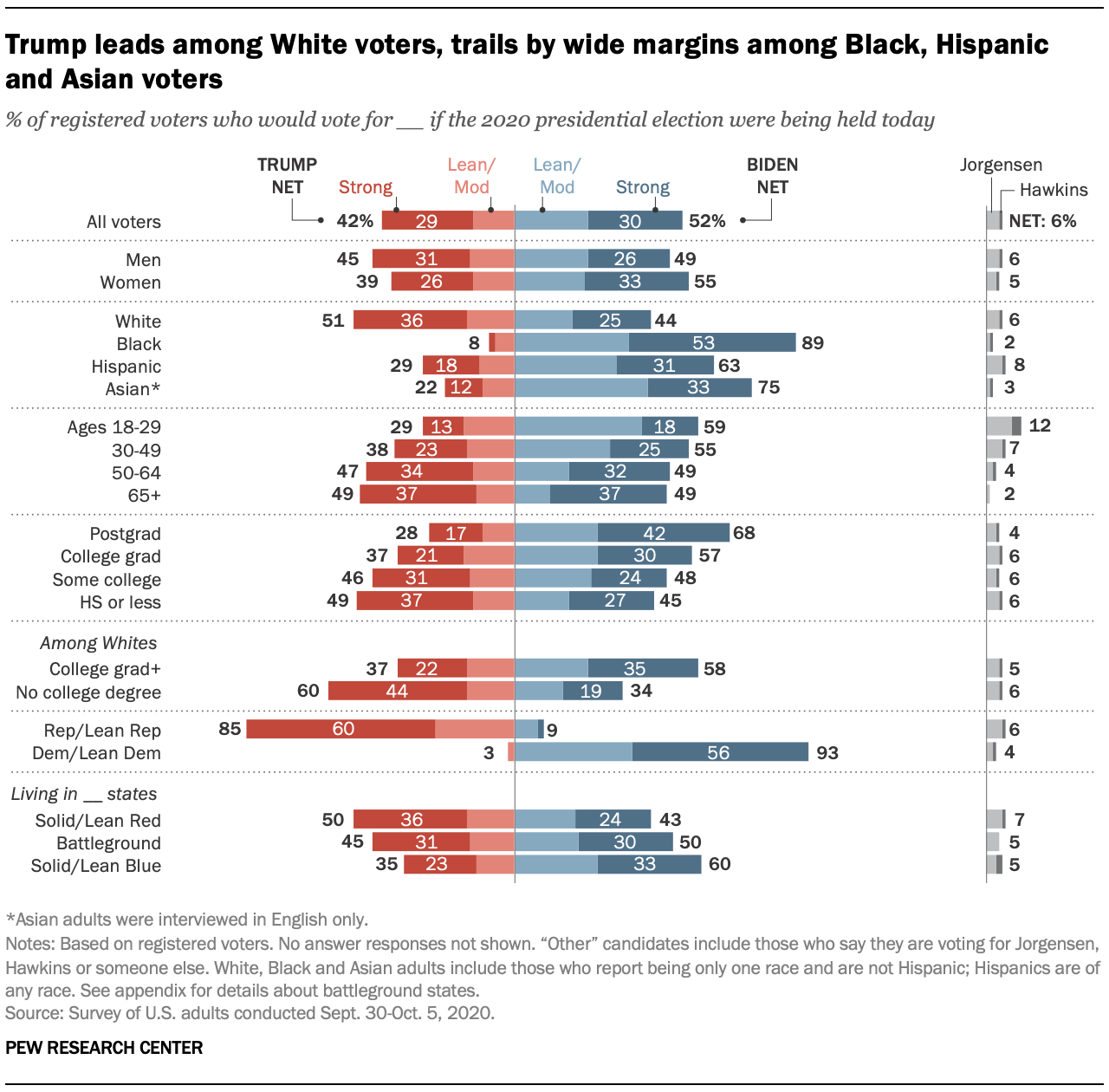
    According to a poll by the Pew Research Center, Biden holds a 10 percentage point lead over Trump among registered voters in the presidential race (52% Biden, 42% Trump). 

    Many of the demographic patterns of support for both candidates are similar to those in the 2016 presidential contest

    There are sizable gaps by race and ethnicity. White voters appear to be split, preferring Trump to Biden (51% vs. 44%, respectively), though Biden is faring slightly better among White voters in the current race compared  to Hillary Clinton in 2016.

    In contrast, there is no hemming and hawing among communities of color -- Asian American, Black and Hispanic -- showing a preference for Biden by wide margins. The sizable Democratic advantages among Black, Hispanic and Asian American voters are just as large for Biden as they were in 2016. Biden currently leads Black voters by 81 percentage points, Hispanic voters by 34 points and Asian voters by 53 points. (Note: Surveys are conducted in English and Spanish.)

    Early on in the Democratic primary campaign, Biden was endorsed by the AAPI Victory Fund. Shekar Narasimhan, the founder and chairman of the PAC, said, “Out of all the presidential candidates, he has the most experience and cares deeply about AAPI issues. In our view, Joe can lead us to a safer, more stable world, with less inequality and more justice."

    READ the full report.
    Biden is also showing a greater appeal among younger voters by far: Voters under 30 support Biden over Trump by 30 percentage points (59% vs. 29%, respectively). Voters ages 30 to 49 also prefer Biden to Trump by a 17-point margin. 

    But voters 50 and older are far more divided: 48% say they currently support or lean toward Trump, while a nearly identical share say they support or lean toward Biden (49%). This marks a shift from 2016 – when Trump held a modest lead over Clinton among voters in these age groups.

    Trump leads among White voters, trails by wide margins among Black, Hispanic and Asian voters

    Just as was the case in 2016, there is a sizable gender gap in candidate preference: Women voters continue to favor the Democratic candidate for president by 17 percentage points (55% to 39%).

    However men are almost evenly split. Today, 49% favor Biden while 45% favor Trump. In 2016, men favored Trump by modest margins in preelection polls, as well as among validated 2016 voters.

    There continue to be large gaps in candidate preference by education. As in 2016, those with a college degree or more are more likely to support Biden over Trump. Today, those with no college degree are slightly more divided: 47% say they would vote for Trump if the election were held today, while 46% say they would vote for Biden.

    Education is also a dividing line among White voters: College-educated White voters favor Biden by 21 percentage points, while those without a college degree favor Trump by a similar margin.

    Among other key findings from the report:


    • A majority of voters (57%) say they are very or somewhat confident in Biden to handle the public health impact of the coronavirus, while 40% express a similar level of confidence in Trump. In June, Biden held a narrower, 11-percentage-point lead on handling the coronavirus outbreak (52% Biden, 41% Trump).

    • At a time of deep political divisions and partisan antipathy, voters are far more likely to express confidence in Biden than Trump to unify the country. Half of voters (50%) say they are confident in Biden to “bring the country closer together,” compared with just 30% who express confidence in Trump.

    • Voters have similar levels of confidence in Trump and Biden on the economy. About half of voters (52%) express confidence in Trump to make good decisions about economic policy, one of the highest shares expressing confidence in the president on any of the six issues on the survey. However, about as many voters (51%) have confidence in Biden on the economy. Confidence in Biden to make good decisions about economic policy has risen modestly since June (48% then vs. 51% today).

    • Since summer, there has been some improvement in views of the nation’s economy. Among all voters, 35% say economic conditions are excellent or good, up from 28% in June. However, this change has come almost entirely among Trump supporters and the gap in economic perceptions has grown much wider: Two-thirds (67%) of Trump supporters now say that economic conditions are excellent or good, compared with 51% who said this in June. Just 11% of Biden supporters view economic conditions positively, which is little changed from four months ago (9%).

    • Voters view Biden much more positively than Trump for compassion, honesty and being a good role model. Nearly twice as many voters say “compassionate” describes Biden very or fairly well than say it applies to Trump (67% vs. 34%). More than half of voters (53%) say Biden is honest, compared with 35% who describe Trump as honest. And far more voters say Biden is a good role model (54% vs. 28%). Among six personal traits included in the survey, Trump holds his widest edge in standing up for his beliefs: 69% say this describes Trump very or fairly well, compared with 61% who say it describes Biden well.

    • While voters on both sides share a sense of the importance of the election, they also share concern about the country’s future if the opposing candidate wins. Fully 89% of Trump supporters say that if Biden wins, they not only would be very concerned over the country’s direction, they believe it would lead to “lasting harm” for the country. A nearly identical majority of Biden supporters (90%) say Trump’s election would result in lasting harm to the United States.

    • There is a widespread sense among voters that if their candidate wins the election, the next president should primarily focus on the concerns of all Americans, not just those who voted for him. This view – like the belief that the country may face lasting harm if the opposing candidate wins – is shared widely among the supporters of both candidates. Fully 89% of Biden supporters and 86% of Trump supporters say that if their candidate is victorious, he should focus primarily on the concerns of all Americans, even if it means disappointing some of his supporters.

    • A large majority of all registered voters (69%) say they are extremely motivated to vote in the presidential election; another 18% say they are very motivated to vote while 8% say they are somewhat motivated. Just 5% of registered voters say they are not too motivated or not at all motivated to vote in the presidential election. The shares of Trump and Biden supporters who say they are extremely motivated to vote also are strikingly similar: 71% of Trump supporters and 72% of Biden supporters say they are extremely motivated to cast ballots.

    EDITOR'S NOTE: The margin of sampling error for the survey conducted Sept. 30-Oct. 5 on the Center’s American Trends Panel is plus or minus 1.5 percentage points for results based on the full sample of 11,929 respondents. (This survey was in the field when Trump announced on Twitter, early on the morning of Oct. 2, that he and First Lady Melania Trump had contracted COVID-19. There are no significant differences in voter preferences, or in confidence in the two candidates to handle the impact of the coronavirus, before and after his announcement.)


    Posted by Edward Diokno at 1:32 AM No comments:
    Email ThisBlogThis!Share to XShare to FacebookShare to Pinterest
    Labels: 2020 Presidential Elections, Asian American Voters, Joe Biden, Pew Research Center

    Friday, February 14, 2020

    Warren issues her 'working agenda' for AAPI and Native Hawaiians

    Roger Lau, left, is Elizabeth Warren's campaign manager.

    With the voting done in two of the whitest states in the US, presidential candidates turn to more diverse states like Nevada and California where the AAPI vote is significant. On Thursday (Feb. 13,) Elizabeth Warren released a document entitled, “Working Agenda for Asian Americans, Native Hawaiians, and Pacific Islanders,” outlining what her administration would do that would benefit this group of ethnic communities.
    It is a comprehensive document covering a wide range of issues from immigration and climate change to college debt and small business assistance, LGBTQ rights to housing.

    First off, from the document, is clear that the Massachusetts senator recognizes the economic and cultural complexity of the diverse communities that fall under the all-encompassing banner of Asian Americans and Pacific Islanders.

    She calls for disaggregated data collection.

    "The AAPI community includes nearly 50 diverse racial and ethnic groups, but the data we gather today doesn’t capture the richness of the communities—or significant differences on key economic and social outcomes," reads the document.

    "Everywhere you look, aggregated data hides Asian American families that are hanging on by their fingernails. Income inequality in Asian American communities nearly doubled from 1970 to 2016—Burmese, Nepalese, Hmong, and Bangladeshi Americans make, on average, less than half what people in some other AAPI groups make."

    Then she pays homage to some AAPI historical figures and current day heroes, demonstrating that she has done her homework. Warren writes:
    ’ll listen to and learn from the AAPI leaders who have been at the forefront of the fight for data equity, language access, and racial and economic justice. From civil rights leader Fred Korematsu and labor leaders Larry Itliong and Phillip Vera Cruz to anti-racist organizers like Grace Lee Boggs, Asian Americans and Pacific Islanders have helped lead the fight for justice. And today, AAPI organizers are continuing that fight, as survivors of the Japanese internment camps oppose Donald Trump’s racist immigration policies, Native Hawaiians protect sacred land on Mauna Kea, and AAPI women like Saru Jayaraman and Ai-Jen Poo led the fight for fair wages and safer working conditions." 
    Under immigration, one of the key concerns of the AAPI communities, a Warren administration will:

    • Increase legal immmigration and recognize immigrants’ important contributions in creating jobs and business

    • Make it easier for eligible green card holders to naturalize,

    • Expand family reunification by reducing the backlog of visa applications,

    • Reverse the Muslim Ban on day one of Elizabeth Warren’s presidency,

    • Decriminalize migration and create accountability for the abuses perpetrated during the Trump era, and

    • Immediately reinstate DACA protections for our Dreamers and shield their families from deportation.

    • Create a fair and achievable pathway to citizenship for the estimated 1.45 million Asian Americans who are undocumented.

    Even though she didn't "win" in Iowa or New Hampshire, Warren is undeterred. Nationally, she polls third behind Bernie Sanders and Joe Biden. The next few states, Nevada and South Carolina are much more diverse that the first two states. Then on March 3, will be Super Tuesday when giant delegate-rich states like Texas and California will hold their primaries.

    In conclusion, she writes:

    "If we’re going to reshape our countr"y and our economy, restore our government, and save our democracy, we need to be willing to fight for bold, structural solutions to the problems we face as a nation. That means tackling generations of racial injustice and systemic discrimination head on and building a government that works for everyone.

    "In our country, you ought to be able to take care of yourself and the people you love and build a better future for your children. That should be the fundamental promise of America.

    "This is my commitment to AAPI communities. When I’m President, I will continue to fight and work with the communities to put real economic and political power in the hands of working people."

    Posted by Edward Diokno at 1:24 AM No comments:
    Email ThisBlogThis!Share to XShare to FacebookShare to Pinterest
    Labels: 2020 Presidential candidates, Asian American Voters, Elizabeth Warren, Roger Lau

    Wednesday, December 11, 2019

    Seriously though, don't ignore the Asian American vote In 2020, says Hasan Minhaj

    NETFLIX
    Hasan Minhaj and Andrew Yang interview an Asian American voter.

    Making someone laugh gets them to lower their walls and sometimes, insight breaks through. 
    Hasan Minhaj's Patriot Act on Netflix does that in his latest episode released Dec. 1, "Don't Ignore The Asian Vote in 2020."


    Using disarming humor, the Sacramento-born Indian American, jabs elbows in the ribs of Asian American voters and the major political parties of the US.

    "It's pander season, baby," Minhaj opens.

    “Despite our growing numbers, politicians and the media ignore us,” Minhaj says.

    What a dilemma: Asian American voters have voter turnout because they are mostly ignored by the Democrats and Republicans. On the other hand, the Dems and GOP don't bother with Asian American voters because they don't vote.

    Using statistics from AAPI Data, Minhaj points out how Asian American communities have turned elections in Virginia and Orange County, CA.

    He interviews Andrew Yang's about his beef with MSNBC and Cory Booker about reaching out to his Asian American electorate in New Jersey. 

    Minhaj points out the importance of immigration policy to the diverse Asian American communities and suggests that a good slogan for a candidates is "I'll let your cousing in."

    With less than a year left before Americans pick their President, it behooves Asian American voters to pay attention to the primaries and the candiadtes. For Democrats and Republicans, they ignore Asian Americans at their own peril. That's no joke.

    Patriot Act is available for streaming on Netflix.
    _________________________________________________________________

    Posted by Edward Diokno at 1:13 AM No comments:
    Email ThisBlogThis!Share to XShare to FacebookShare to Pinterest
    Labels: Andrew Yang, Asian American Voters, Cory Booker, Hasan Minhaj, Netflix, Patriot Act
    Older Posts Home
    View mobile version
    Subscribe to: Posts (Atom)

    FILIPINO AMERICAN HISTORY MONTH

    UPDATED: This blog compiles scores of posts about Filipino American history, accomplishments and individuals

    EDITOR'S NOTE : THIS POST IS CONSTANTLY BEING UPDATED TO THE PRESENT "POSITIVELY NO FILIPINOS ALLOWED" said the sign in a Stoc...

    Dedicated to the next generation.

    My photo
    Edward Diokno
    News & Analysis and random commentary from an Asian American Perspective
    View my complete profile

    Search This Blog

    Blog Archive

    • ▼  2026 (198)
      • ▼  September (15)
        • Asian Americans side with the Supreme Court's deci...
        • Olivia Rodrigo’s Vogue Philippines cover shows she...
        • Emmys 2026: Hiro Murai makes history with his Emmy...
        • Trump's video games are no laughing matter
        • 9/11 anniversary: The towers came down and hate sp...
        • US Open: Jessica Pegula falls to the No. 1 seed bu...
        • US Open: Lone Asian American Jessica Pegula fights...
        • A FilAm journalist brings down the NBA elite and w...
        • US Open: Eala ousted, Pegula, Osaka, Zheng, Tien m...
        • Lea Salonga receives dual honors: Her own Walk of ...
        • US Open: Asian players advance as matches grow har...
        • Eala Mania graces NYT front page—And It’s the Asia...
        • First Afghan American sworn-in to the US Congress
        • Wave of Asian players and fans wash over the US Op...
        • Olivia Rodrigo's music festival raises $20M for no...
      • ►  August (24)
      • ►  July (21)
      • ►  June (19)
      • ►  May (23)
      • ►  April (26)
      • ►  March (33)
      • ►  February (22)
      • ►  January (15)
    • ►  2025 (170)
      • ►  December (16)
      • ►  November (17)
      • ►  October (17)
      • ►  September (17)
      • ►  August (13)
      • ►  July (17)
      • ►  June (13)
      • ►  May (13)
      • ►  April (11)
      • ►  March (13)
      • ►  February (9)
      • ►  January (14)
    • ►  2024 (179)
      • ►  December (16)
      • ►  November (17)
      • ►  October (21)
      • ►  September (15)
      • ►  August (16)
      • ►  July (21)
      • ►  June (12)
      • ►  May (14)
      • ►  April (10)
      • ►  March (11)
      • ►  February (11)
      • ►  January (15)
    • ►  2023 (241)
      • ►  December (17)
      • ►  November (9)
      • ►  October (16)
      • ►  September (13)
      • ►  August (20)
      • ►  July (20)
      • ►  June (23)
      • ►  May (28)
      • ►  April (22)
      • ►  March (24)
      • ►  February (25)
      • ►  January (24)
    • ►  2022 (361)
      • ►  December (22)
      • ►  November (23)
      • ►  October (26)
      • ►  September (29)
      • ►  August (31)
      • ►  July (29)
      • ►  June (37)
      • ►  May (38)
      • ►  April (27)
      • ►  March (31)
      • ►  February (34)
      • ►  January (34)
    • ►  2021 (491)
      • ►  December (33)
      • ►  November (28)
      • ►  October (27)
      • ►  September (36)
      • ►  August (40)
      • ►  July (49)
      • ►  June (39)
      • ►  May (48)
      • ►  April (43)
      • ►  March (56)
      • ►  February (47)
      • ►  January (45)
    • ►  2020 (735)
      • ►  December (38)
      • ►  November (40)
      • ►  October (50)
      • ►  September (56)
      • ►  August (63)
      • ►  July (72)
      • ►  June (65)
      • ►  May (69)
      • ►  April (67)
      • ►  March (76)
      • ►  February (69)
      • ►  January (70)
    • ►  2019 (900)
      • ►  December (67)
      • ►  November (66)
      • ►  October (67)
      • ►  September (74)
      • ►  August (78)
      • ►  July (73)
      • ►  June (78)
      • ►  May (77)
      • ►  April (82)
      • ►  March (90)
      • ►  February (68)
      • ►  January (80)
    • ►  2018 (852)
      • ►  December (74)
      • ►  November (73)
      • ►  October (87)
      • ►  September (67)
      • ►  August (65)
      • ►  July (63)
      • ►  June (71)
      • ►  May (73)
      • ►  April (71)
      • ►  March (66)
      • ►  February (68)
      • ►  January (74)
    • ►  2017 (692)
      • ►  December (60)
      • ►  November (62)
      • ►  October (66)
      • ►  September (58)
      • ►  August (51)
      • ►  July (59)
      • ►  June (51)
      • ►  May (49)
      • ►  April (58)
      • ►  March (69)
      • ►  February (49)
      • ►  January (60)
    • ►  2016 (623)
      • ►  December (58)
      • ►  November (61)
      • ►  October (51)
      • ►  September (50)
      • ►  August (51)
      • ►  July (65)
      • ►  June (46)
      • ►  May (61)
      • ►  April (54)
      • ►  March (48)
      • ►  February (38)
      • ►  January (40)
    • ►  2015 (335)
      • ►  December (35)
      • ►  November (40)
      • ►  October (36)
      • ►  September (34)
      • ►  August (29)
      • ►  July (30)
      • ►  June (29)
      • ►  May (27)
      • ►  April (22)
      • ►  March (24)
      • ►  February (14)
      • ►  January (15)
    • ►  2014 (87)
      • ►  December (12)
      • ►  November (12)
      • ►  October (20)
      • ►  September (15)
      • ►  August (10)
      • ►  July (10)
      • ►  June (3)
      • ►  May (2)
      • ►  April (3)

    Translate

    The opinions expressed here are my own.. Simple theme. Theme images by compassandcamera. Powered by Blogger.