Showing posts with label Tani Cantil-Sakauye. Show all posts

Sunday, July 31, 2022

California's Filipino American Chief Justice will be leaving the state's Supreme Court

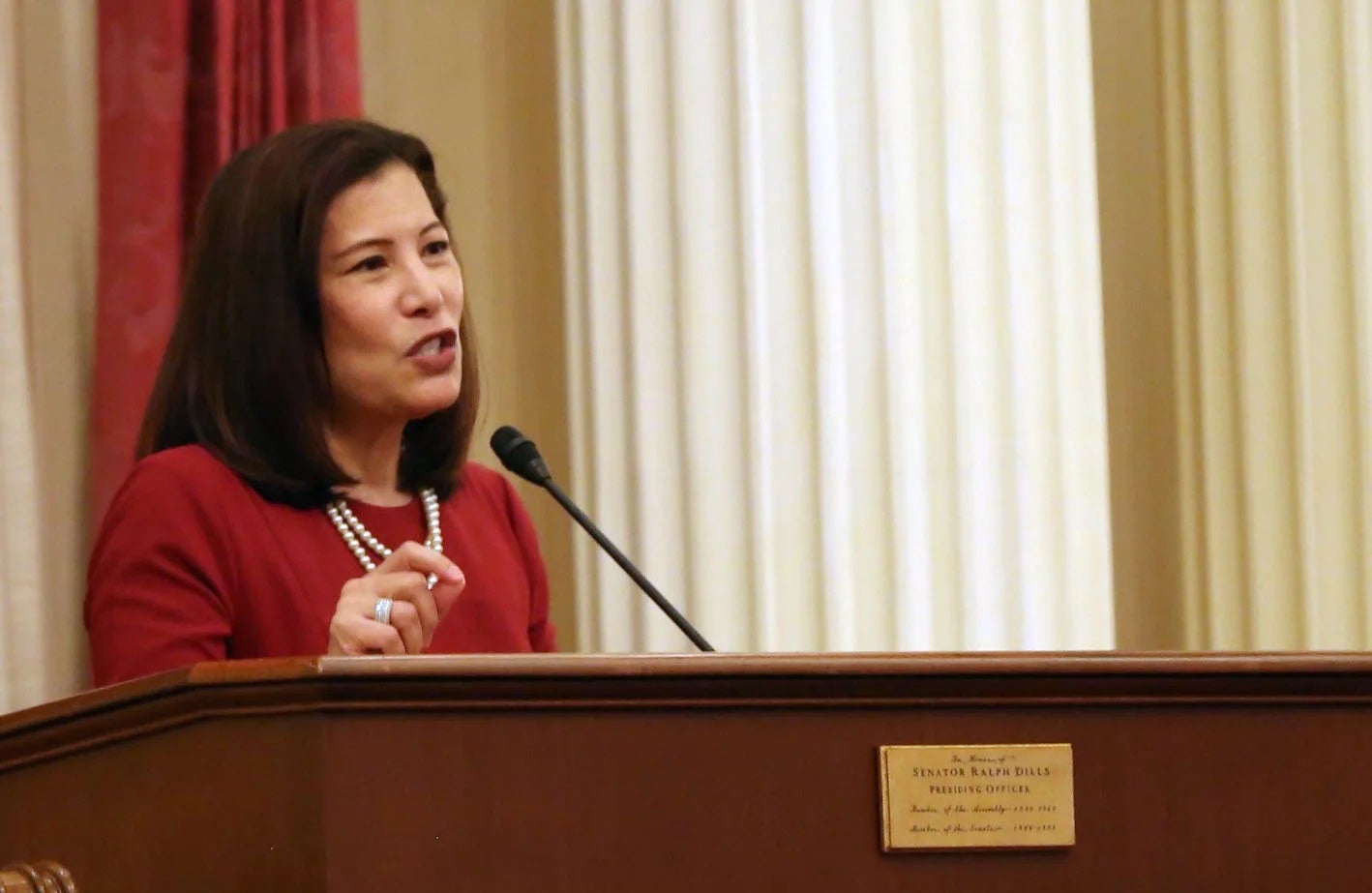
Chief Justice Cantil-Sakauye
California Chief Justice Tani G. Cantil-Sakauye will not seek re-election.


Chief Justice Tani G. Cantil-Sakauye will not seek re-election as Chief Justice of California in the November 2022 general election. 

“I have informed Governor Gavin Newsom that I will not seek re-election as Chief Justice of California and will conclude my judicial service when my current term of office ends," Cantil-Sakauye said in a statement. She will conclude her current term of office on January 1, 2023, after 32 years of service at every level of the state courts.

As the 28th Chief Justice of California, she is the first Asian American and the second woman to serve as the state’s chief justice. During her 12-year term, 

The Filipino American Chief Justice envisioned an accessible court system on every level for all Californians that reflects the people and communities that courts serve. She has successfully advocated for reforms of court funding models, fees, and procedures that unfairly impact the poor; adequate, sustainable funding for court operations; diversity and inclusion in the legal profession; and the role of civic education and engagement in sustaining public trust and confidence in the judicial system.

“Born and raised in Sacramento by farmworker parents, Chief Justice Cantil-Sakauye learned early on the importance of knowing your rights and pushing back against injustice," said Gov. Gavin Newsom. "She served with distinction at every level of the state courts before breaking barriers as the first person of color and the second woman to serve as the state’s chief justice."

Cantil-Sakauye's July 27 statement continues:

"Of course, I will support the smooth transition of Judicial Branch leadership. Through his efforts, and those of recent governors, he will have a diverse pool of exceptionally well qualified jurists and legal professionals to choose from, and I believe the judiciary, the courts, and access to justice in California will be in good hands.

"My first interaction with our justice system was when my family faced eviction from our home and my mother felt helpless. As the daughter of farmworkers, I experienced in my community what it was like to stand up for your rights and demand protections. As a wife I felt the impact of unjust Japanese Internment on my in-laws. As a judge I saw the devastating effects of family violence and established the first court in Sacramento dedicated solely to domestic violence issues. As Chief Justice I continue to keep in mind the faces behind the cases and remain focused on the goal of providing all Californians with equal, fair, and accessible justice.

"A graduate of a public school, community college, and public university, I am proud to have served the people of California to the best of my ability at every level of our state court system.

"The support and encouragement of my family, my extended Filipino family, minority bar associations, and numerous role models and mentors throughout my public service career have enabled me to achieve and succeed even under sometimes difficult circumstances. I am grateful to them all.

"My career as chief justice is bookended by the Great Recession and administrative challenges at the beginning and now an historic judicial branch budget and the persisting difficulties of a Global Pandemic. Throughout my tenure, I have been privileged to serve in government with so many dedicated public servants and advocates: three governors; successive Senate Pro Tems, Assembly Speakers, and legislative members; justice partners and stakeholders involved with every part of our court system; as well as the judicial officers, court professionals, and the staff who serve on the Judicial Council of California and its advisory bodies. Their collegiality and professionalism have enabled us to move mountains—making sound statewide policy decisions and implementing an array of court programs and initiatives to benefit the public.

"For me, collegiality with my bench colleagues was also critical to my service as a justice on the court of appeal and as Chief Justice on the Supreme Court of California, along once again with a wonderful and brilliant professional staff. We discussed, debated, and sometimes disagreed, but we were always focused on the rule of law and what was right and just.

"I have taken, and administered, many oaths during my public service career, but no matter how many times I hear an oath “…that I will support and defend the Constitution of the United States and the Constitution of the State of California against all enemies, foreign and domestic,” it always resonates. Each generation must renew and refresh our constitutional democracy. I truly appreciate the opportunities previous governors, judicial branch leadership, and the People of California have given me to support, defend, and enhance the rule of law.

"I have said before that I hold my office in trust until it is time for the next leaders to protect and expand access to justice—that time is now.”

"As the 28th Chief Justice of California, she is the first Asian American and the second woman to serve as the state’s chief justice. 

"During her 12-year term, Chief Justice Cantil-Sakauye envisioned an accessible court system on every level for all Californians that reflects the people and communities that courts serve. She has successfully advocated for reforms of court funding models, fees, and procedures that unfairly impact the poor; adequate, sustainable funding for court operations; diversity and inclusion in the legal profession; and the role of civic education and engagement in sustaining public trust and confidence in the judicial system.

"For me, collegiality with my bench colleagues was also critical to my service as a justice on the court of appeal and as Chief Justice on the Supreme Court of California, along once again with a wonderful and brilliant professional staff. We discussed, debated, and sometimes disagreed, but we were always focused on the rule of law and what was right and just.

"I have taken, and administered, many oaths during my public service career, but no matter how many times I hear an oath “…that I will support and defend the Constitution of the United States and the Constitution of the State of California against all enemies, foreign and domestic,” it always resonates. Each generation must renew and refresh our constitutional democracy. I truly appreciate the opportunities previous governors, judicial branch leadership, and the People of California have given me to support, defend, and enhance the rule of law.

"I have said before that I hold my office in trust until it is time for the next leaders to protect and expand access to justice—that time is now.”

Since her historic appointment in 2011, Cantil-Sakauye has been recognized for her early work on domestic violence issues, support for minority bar associations, and for advancing the role of women and minorities in the legal profession. The Chief Justice is a leader in revitalizing civic learning through her Power of Democracy initiative. She, along with other state leaders, fulfilled one of the initiative’s goals in July 2016 when the state Board of Education unanimously approved an instructional framework that encourages civic learning. 

In 2019, she was honored with the Sandra Day O’Connor Award by the National Center for State Courts for her work inspiring, promoting, and improving civics education.

She left the Republican Party when Brett Kavanaugh was appointed to the US Supreme Court. At the time, she said, "I've been thinking about it for some time," Cantil-Sakauye said, adding that she talked it over with her husband and friends. Their consensus, she said, was that "you didn't leave the party. The party left you."

“A fierce defender of access to the courts, she fought against immigrant enforcement raids at courthouses targeting vulnerable victims and witnesses of crime," said Newsom.

"During the pandemic, her tireless efforts modernized operations and expanded access to services at California’s courts, while retaining jobs and safe in-person access for those who need it," said Newsom. "Chief Justice Cantil-Sakauye has been a leading voice for bail reform, calling out its disproportionate impacts on low-income people, and has raised awareness about the unfair financial hardships caused by fines and fees on those unable to afford them.

“From the wake of the Great Recession to a global pandemic, Chief Justice Cantil-Sakauye has led with a deep dedication to the rule of law, California values and the highest ideals of public service," continued the governor. "On behalf of a grateful state, I thank Chief Justice Tani Cantil-Sakauye for her nearly four decades of service to the people of California and wish her well in her next chapter.”

EDITOR'S NOTE: For additional commentary, news and views from an AANHPI perspective, follow @DioknoEd on Twitter.

Friday, December 14, 2018

California's Chief Justice leaves the Republican Party

CALIFORNIA'S CHIEF JUSTICE TANI CANTIL-SAKAUYE

THE U.S. SENATE confirmation hearings for U.S. Supreme Court Justice Brett Kavanaugh was the last straw for California Chief Justice Tani Cantil-Sakauye. She
 is no longer a Republican.

“I’ve been thinking about it for some time,” Cantil-Sakauye  told CALmatters, The  consensus of her husband and frieds she said, was that “you didn’t leave the party. The party left you.”

The 59-year-old Filipina American is a rarity in California -- a moderate Republican of color. She was appointed to court's top post in 2011 by Gov. Arnold Schwarzenegger, 

The news has not been good for the state's GOP, which lost seven Congressional seats in the midterms, including four in conservative Orange County. Republicans hold only seven House seats out of 53. Republicans is the third largest political entity in California, after the Demorats and non-affiliated. Cantil-Sakauye will join the latter.

During the Kavanaugh hearings, the nominee denied allegations by Christine Blasey Ford, a Palo Alto professor, that he assaulted her when they were high school students in Maryland. The Republicans approved his nomination despite Blasey Ford's convincing testimony.

Prior to the hearings, she wrote a letter to Attorney General Jeff Sessions criticizing ICE agents arresting undocumented immigrants at courthouses.

“Enforcement policies that include stalking courthouses and arresting undocumented immigrants, the vast majority of whom pose no risk to public safety, are neither safe nor fair,” she wrote.

Sessions blew her off. Instead, he told her to talk to California's Gov. Jerry Brown and his support for sanctuary cities and opposed Donald Trump's attacks against immigrant communities.

 At an event at the National Press Club for judges and justices who discussed attacks on the judiciary by Donald Trump, she said, “I don’t believe the attacks are going to stop. I do not believe the undermining and marginalizing of the branch will ever stop. And it is people’s right to speak up,” according to CALmatters.

Cantil-Sakauye, who was appointed in 2011 by Gov. Arnold Schwarzenegger, 

“I felt compelled to make a choice now,” said Cantil-Sakauye, the second woman to serve as California’s chief justice. “It better suits what I do and how I approach issues.”
_______________________________________________________________________________

Sunday, April 9, 2017

Bill introduced to stop ICE arrests at courthouses

Asian/American Senators Kamala Harris and Mazie Hirono

A BILL was introduced in the U.S. Senate that would make courthouses safe zones from ICE agents.


U.S. Senator Kamala D. Harris, a member of the Homeland Security and Governmental Affairs Committee, joined Sen. Mazie Hirono, D-Hawaii and ten other Senators to introduce legislation to prevent immigration enforcement officers from taking enforcement actions at sensitive locations like schools, hospitals, and religious institutions without prior approval and exigent circumstances.

The Protecting Sensitive Locations Act codifies the Department of Homeland Security’s existing policies and expands on those policies to ensure that immigrants are able to access education, criminal justice, and social services without fear of deportation.

The April 5 legislation was introduced after California Chief Justice Tani Cantil-Sakauye wrote to Homeland Security chief John Kelly and Attorney General Jeff Sessions complaining about arrests made in California courthouses by ICE agents. The Filipina/American justice  said those actions undermine the safety of the community by scaring away the cooperation of law-abiding witnesses, plaintiffs or victims of crimes.

Kamala's legislation follows her questioning Department of .Kelly at a committee hearing this morning on exempting witnesses and victims of crimes from being arrested by ICE agents outside of courthouses.

“We are a nation founded by immigrants, and this Administration’s targeting of facilities that provide public health, public safety and public education runs contrary to our values,” said Senator Harris. “In California and throughout this country, immigrants and their families live in fear. Children don’t want to go the school because they are afraid their father or their mother will be detained while they’re gone. Children are missing doctors’ appointments out of fear they or their parents will be exposed and reported to ICE. We also know that immigrants have become less likely to report crimes for fear of deportation. We must act to ensure that the schools, hospitals, courthouses, and churches in our communities are safe areas – not places of fear.”

The Asian/American senators' legislation is co-sponsored by Richard Blumentahal (D-Conn), Al Franken (D-MN), Tim Kaine (D-VA), Jeff Merkley (D-OR), Kirsten Gillibrand (D-NY), Edward J. Markey (D-MA), Cory Booker (D-NJ), Elizabeth Warren (D-MA), and Ron Wyden (D-OR).

According to recent reports, immigration enforcement agencies have increased their presence at schools, courthouses, homeless shelters, and hospitals. A few of the reported cases include:

  • In March, a father in Highland Park, Los Angeles was apprehended by Immigration and Customs Enforcement (ICE) agents while dropping his children off at school.
  • In March, NPR reported that domestic violence cases were being dropped due to a fear of encountering ICE agents at the courthouse. In February, a woman was apprehended by ICE after being awarded a protective order for domestic abuse. In response to these and other incidents, judges in Washington and California wrote ICE asking the agency to stop “stalking undocumented immigrants” in the states’ courthouses.
  • In February, ICE agents staked out a church’s homeless shelter in Alexandria, Virginia.
  • In February, ICE agents in Fort Worth, Texas apprehended a mother with a brain tumor at a hospital.
The Protecting Sensitive Locations Act requires that, except in special circumstances, ICE agents receive prior approval from a supervisor when there are exigent circumstances before engaging in enforcement actions at sensitive locations, such as: schools, hospitals and health clinics, places of worship, organizations assisting crime victims, and organizations that provide services to children, pregnant women, victims of crime or abuse, or individuals with mental or physical disabilities.

This bill codifies and expands upon rules already in place at ICE, which would provide policy consistency across enforcement agencies and administrations over time, giving immigrant communities greater certainty that their rights will be respected.

###

Tuesday, April 4, 2017

California justice doubles down after rebuke from Trump officials

California Chief Justice Tani Cantil-Sakauye

ATTY. GEN. JEFF SESSIONS and Homeland Security chief John Kelly issued a strong response to California's Chief Justice in a letter made public Friday. 

The two Trump appointees mansplained the meaning of "stalking" to Chief Justice Tani Cantil-Sakauye, who used the term describing ICE agents who are making arrests at the state's courthouses.

"As the chief judicial officer of the State of California, your characterization of federal law enforcement officers is particularly troubling. As you are aware, stalking has a specific legal meaning in American law, which describes criminal activity involving repetitive following or harassment of the victim with the intent to produce fear of harm."

Cantil-Sakauye, a Republican, wrote a letter to the Attorney General and Homeland Security on March 16 because of instances where ICE agents made arrests at courthouses.

Instead of backing off, the Chief Justice doubled down on her original criticism. “Making arrests at courthouses, in my view, undermines public safety because victims and witnesses will fear coming to courthouses to help enforce the law,” said the Filipina/American justice. “I am disappointed that despite local and state public safety issues at stake, courthouses are not on ICE’s ‘sensitive areas’ list that includes schools, churches, and hospitals.”

“When others see that happening and even for that person themselves, it can absolutely feel like what we all would commonly call stalking,” said Stanford Professor Jayashri Srikantiah. “If you’re undocumented and you’re the victim of domestic violence, it may make you very reluctant to go to the courthouse at all, even if you have a very valid need for the legal system.”

Kelly and Sessions also made an obvious slap at California's top elected officials who have been opposed to many of Donald Trumps policies, especially in reference to immigration.

"We would encourage you to express your concerns to the Governor of California and local officials who have enacted policies that occasionally necessitate ICE officers and agents to make arrests at courthouses and other public places," concluded the letter from Sessions and Kelly.

Yesterday, April 3, the California Senate voted to make the state a sanctuary state. The bill goes to the state Assembly before going to Gov. Jerry Brown.


Thursday, March 30, 2017

Chief Justice: 'We are living in a time of ... unprecdented polarization'

SCREEN CAPTURE
Chief Justice Tani Cantil-Sskauve being interviewed by KQED-TV.

SHE'S A REPUBLICAN, but California's Chief Justice Tani Cantil-Sakauye, is not hesitating to strongly criticize Donald Trump's immigration policies. 

In her State of the Judiciary address Monday (March 24), the Filipina/American justice said that the rule of law was being "challenged" amid the administration's immigration crackdown.

The address followed a letter that she sent earlier this month criticizing federal immigraiton authories for using courthouses as "bait" to arrest undcocumented  immigrants. A few days later, she criticized Trump's comments about federal judges who ruled against his poorly written executive orders on travel restrictions from six predominantly Muslim countries.

In a departure from her usual State of the Judiciary addresses that she usually uses to outline the budget needs of the state's judicial system, Justice Cantil-Sakauye  told the state’s lawmakers that “the rule of law means that we as a people are governed by laws and rules, and not by a monarch.”
RELATED:


“We are living in a time of civil rights unrest, eroding public trust in our institutions, economic anxiety, and unprecedented polarization,” she said. “Our values, our rules and our laws are being called into question, and all three branches of government and the free press are in the crosshairs.”

In an interview for KQED, she recalls the tipping point for her was an incident in Pasadena, CA. where ICE agents arrested an attorney's clients on the steps of the courthouse. "Courthouses are where we encourage to come for due process as witnesses, as victims, and that would have a chilling effect." People will no longer report, crime will go unreported in the community and they won't come to the court as bad guys, she said.

During her address to a joint session of the California Legislature, the chief justice, whose parents worked as agricultural workers in Hawaii, recalled her husband’s parents who were held at U.S. internment camps for Japanese/Americans for four years during World War II.


###

Friday, March 17, 2017

Undocumented being arrested in the courts, says California chief justice


IN A LETTER, California Supreme Court Chief Justice Tani Cantil-Sakauye expressed her deep concern "about reports from some of our trial courts that immigration agents appear to be stalking undocumented immigrants in our courthouses to make arrests.

The letter asked Homeland Security and the Attorney General to cease the practice.

“Courthouses should not be used as bait in the necessary enforcement of our country’s immigration laws,” Cantil-Sakauye wrote Thursday to Attorney General Jeff Sessions and Homeland Security Secretary John Kelly. “[E]nforcement policies that include stalking courthouses and arresting undocumented immigrants, the vast majority of whom pose no risk to public safety, are neither safe nor fair.” 

Reports from attorneys up and down the state, from the urban centers to the Central Valley, are telling the Chief Justice that since January, ICE agents are arresting immigrants when they show up at courthouses, according to the Huffington Post. 
RELATED: Looking for an Asian/American in the U.S. Supreme Court
Cantil-Sakauye's Filipina mother was a farmworker, and her Hawaiian-born Filipino/Portuguese father, worked in sugar cane and pineapple plantations before moving to Sacramento. 

She is the 28th Chief Justice of the State of California. She was sworn into office on January 3, 2011 by then Gov. Arnold Swarzenegger. She is the first Asian/Filipina/American and the second woman to serve as the state’s chief justice.

Since Trump has taken office, border control officers and ICE agents have been more aggressive in going after people who have no documentation. In some instances, the agents have arrested people inside the courtroom.

"Enforcement policies that include stalking courthouses and arresting undocumented immigrants, the vast majority of whom pose no risk to public safety, are neither safe nor fair," reads the letter. "They not only compromise our core value of fairness but they undermine the judiciary’s ability to provide equal access to justice."

###