Showing posts with label Asian American Studies. Show all posts

Tuesday, March 29, 2022

San Diego State University will establish Asian American Studies Department

SDSU
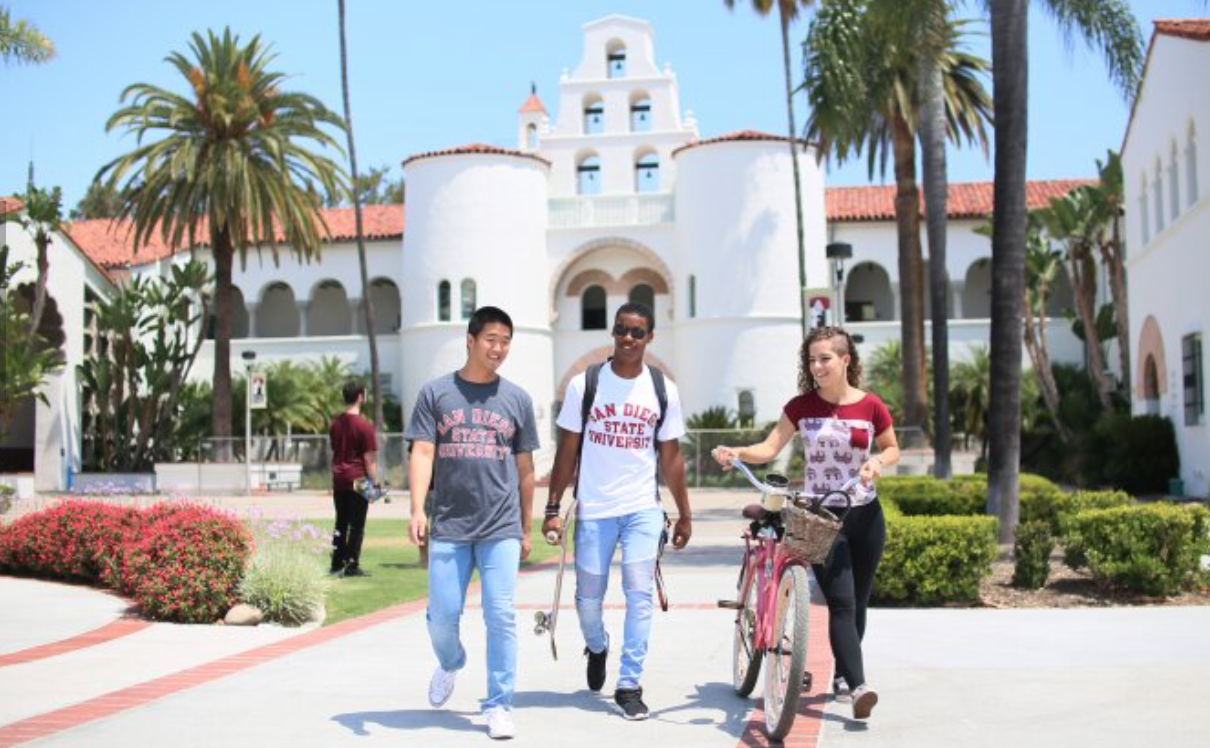
SDSU students on campus.


With AAPI students making up 13% of the 31,000 students at San Diego State University, the school is playing catchup in creating an Asian American Studies Department.

The California state university (CSU) is committed to filling what has been a "glaring gap in the inclusiveness of ethnic studies," according to Associate Professor and Deaprtment Chair of Sociology, Minjeong Kim.

Currently, CSUSD has only three Asian American courses, says Kim.

The Asian American Studies department would offer majors and new curricula covering more than an intro to Asian American history.

Proposing new courses will be crucial to building the department. A search for faculty has already been launched and is in its final selection stage.

The two newly hired professors will be responsible for building the Asian American Studies department, reported The Daily Aztec.

“I’m hoping that all our students will have the opportunity to really dig deep into knowing APIDA history,” said Dr. Virginia Loh-Hagan, member of the faculty search committee. “I think that’s important because I think that ignorance is one of the root causes of anti-Asian hate. The more visibility and more understanding we have of people, the less likely we are going to suffer from discrimination and hate.”

EDITOR'S NOTE: Don't miss additional commentary, news, views and tips from an AAPI perspective, follow @DioknoEd on Twitter.


Sunday, February 3, 2019

California students petition for Asian American Studies course


Asian American high school students in Irvine, Calif. can't wait until college to learn how Asian Americans helped build this country.

Over 700 signatures have been collected for a petition to have the Irvine Unified School District offer an Asian American Studies course for high school students, which make up about 60% of the student body.

The online petition was created by and led by the Korean American Young Leaders, a youth empowerment program run by the Southern California city's Korean American Center.

"All our social studies, literary and history courses are taught from a Euro-American perspective," reads the petition. "There are no schools within IUSD that offer an Asian American Studies or Ethnic Studies class. Most students are not aware of contributions that were made by Asian Americans to the fabric of this country. This lack of awareness among Asian Americans and the general population has resulted in Asian Americans often being disenfranchised."

"As students, we believe this is important in promoting diversity and intercultural understanding. This class will provide all students with an opportunity to learn and understand Asian American history and our contributions to the United States while allowing students to take pride in their dual cultural heritage," continues the petition.

The students might have some legislative help in their endeavor. 

Last week, Assemblymember Jose Medina, D-Riverside, introduced Assembly Bill (AB) 331 to mandate Ethnic Studies as a graduation requirement in all California high schools. This follows Governor Brown’s veto of AB 2772 last year, which would have created a pilot program for select school districts to require Ethnic Studies.

“Knowledge of our history plays a critical role in shaping who we become," said Medina, a former teacher. "When I was growing up, the history of those who look like me was not represented in the classroom. As a former Ethnic Studies teacher, I saw firsthand how much more engaged my students were when they saw themselves reflected in the coursework."

Assembly Bill 331, introduced Jan 31, would require the students in grades 9-12 to take an ethnic studies course in either social studies or English starting in the 2023-24 school year. The Instructional Quality Commission would develop the course curriculum with input from ethnic studies professors at universities and colleges, along with representatives from local education agencies and teachers with experience or educational backgrounds in studying and teaching ethnic studies. The class could run either one semester or a full school year, depending on what the individual school district decides.
According to a 2016 study from Stanford’s Graduate School of Education, students who took part in a pilot ethnic studies program at San Francisco high schools had higher GPAs and better attendance rates and more credits earned than those who didn’t.
“Taken at face value, these findings provide a compelling confirmation of an extensive literature that has emphasized the capacity of [culturally relevant pedagogy] to unlock the educational potential of historically marginalized students,” the report said.
School district officials said they are open to hearing the students' concerns.
"California is one of the most diverse states in the country and we should celebrate that diversity by teaching a curriculum that is inclusive of all of our cultures and backgrounds," Medina said. "Ethnic Studies provide students an opportunity to learn about histories outside of the Euro-centric teachings most prominent in our schools. At a time when the national climate drives divisiveness and fear of otherness, Ethnic Studies can play a critical role in increasing awareness and understanding."
_________________________________________________________________________________

Thursday, November 29, 2018

50th anniversary: Founding of Asian American Political Alliance

Some of the original members of Asian American Political Association and friends recently celebrated the 50th anniversary of the Asian American Political Alliance in Berkeley, Calif.

By Sara Hossaini
Reprinted by Permission of KQED

IN 1968, six young Americans of Asian heritage gathered at a house on Berkeley's Hearst Avenue to discuss how to create a place for themselves in the activism of the day.
It was one of the most politically tumultuous years the United States had seen. The Tet Offensive by the North Vietnamese was eroding public support for the Vietnam War; Martin Luther King, Jr. and Robert Kennedy had been assassinated; and San Jose athletes Tommie Smith and John Carlos raised their fists in protest on an Olympic podium.

Vicci Wong of Salinas was a 17-year-old first-year student at UC Berkeley in 1968, and she was searching for a place to contribute to what she saw as "the struggle."

"The peace movement was led by whites," Wong said, "and then I tried to join the Black Panther Party in Oakland, and they told me you can't because you're not black. So they said you should form your own group, and I thought, 'Well, what is my group?' "

Wong found the answer at the meeting held at the home of two PhD students, Emma Gee and Japanese internment survivor, Yuji Ichioka. They'd found her and the others by searching for Asian last names in the rosters of other political groups.

"When I came to the steps here and knocked on that door, my life, and like everyone here else said, their lives all changed," said Wong on Saturday at 2005 Hearst Avenue, celebrating the 50th anniversary of that momentous meeting.

RELATED: 1968 - The Year of Asian America
During that first session, the group coined the concept and the term, Asian-American, and officially founded the Asian American Political Alliance. Wong says they immediately looked around at each other and knew they had created something special and that they were representing more than just themselves.

"I went in Oriental and left Asian-American," Wong said.

AAPA established main chapters at UC Berkeley and San Francisco State, and the group helped lead unprecedented long student strikes at both schools, which resulted in the first Ethnic Studies departments in history.

"We wanted to save not only our communities, but establish control over our communities," Wong said.

That meant pushing back against the notion that they were perpetual foreigners and fighting things like the gentrification of San Francisco's Manilatown.


The plaque marking the birthplace of the Asian American Political Association.

AAPA co-founders in attendance said that their successors in AAPA and the people influenced by its activism have continued to fight for justice for their communities and others.

"We're seeing it circle back against Muslims now," said former Oakland Mayor Jean Quan, who helped found the Asian American studies program at UC Berkeley along with her husband and AAPA co-founder Floyd Huen. "(Asian-Americans) are still not seen as full Americans."

For all of its influence, AAPA has ebbed and flowed at Berkeley, going inactive twice, including up until this year. But a new group of Berkeley students is coordinating the third incarnation of AAPA at Berkeley, calling it "AAPA 3.0."

"I think what AAPA means to me is learning from leaders who were really persistent and courageous to fight against injustice and to establish our roles as Asians in American history," said Johnny Nguyen, a first-year UC Berkeley student who's helping lead the current effort. "Having taken my first ever Asian-American studies class this semester, it's surreal to hear about my place in history in the textbooks. I'd like to see Asian-American studies expanded and enhance it. That's exactly what we want to do with AAPA 3.0."

Photos by Sara Hossaini/KQED
______________________________________________________________________________