 |
| NBC
I don't know where this graduation took place or how much larger the class was, but it was used to illustrate an NVC editorial.
|
I ENCOUNTER this question a lot from non-Asian friends, "What's so wrong about being the model minority? Sigh!
I remember a time in my second-grade class, the teacher was asking a series of questions and I raised my hand to answer every one of them. I don't know how I knew the answers. I read a lot. I hung out at the library reading all the sci-fi and the Bobbsey Twins series I could get my hands on.
I was also curious.
But by the time I had reached 5th grade, I had learned to hold back to let other classmates have an opportunity to answer the questions. The need to "fit-in" clashed with the need to meet with my parents' and teachers' expectations.
The most recent discussion about the "model-minority myth" started with an Oct. 10 article by New York Times oped columnist Nicholas Kristoff titled "The Asian Advantage." He sums up the model-minority stereotype pretty well.
"It's no secret that Asian-Americans are disproportionately stars in American schools, and even in American society as a whole. Census data show that Americans of Asian heritage earn more than other groups, including whites," Kristoff wrote. "Asian-Americans also have higher educational attainment than any other group."
"Mr. Kristof heaps praise and wonder on Asian American achievement with little awareness of the damage he does to the community," wrote Khin Mai Aung and Russell Chun in Salon. "While he thinks he cleverly argues against critics who claim that racism is no longer an issue, Mr. Kristof naively reinforces the tired and long debunked noxious notion of the model minority."
I remember a time in my second-grade class, the teacher was asking a series of questions and I raised my hand to answer every one of them. I don't know how I knew the answers. I read a lot. I hung out at the library reading all the sci-fi and the Bobbsey Twins series I could get my hands on.
I was also curious.
But by the time I had reached 5th grade, I had learned to hold back to let other classmates have an opportunity to answer the questions. The need to "fit-in" clashed with the need to meet with my parents' and teachers' expectations.
The most recent discussion about the "model-minority myth" started with an Oct. 10 article by New York Times oped columnist Nicholas Kristoff titled "The Asian Advantage." He sums up the model-minority stereotype pretty well.
"It's no secret that Asian-Americans are disproportionately stars in American schools, and even in American society as a whole. Census data show that Americans of Asian heritage earn more than other groups, including whites," Kristoff wrote. "Asian-Americans also have higher educational attainment than any other group."
He cites Confucianism and its emphasis on education that created a culture in which parents are willing to make extraordinary sacrifices to ensure the success of their children in schools.
Not surprisingly, his column got some strong reactions.
"Mr. Kristof heaps praise and wonder on Asian American achievement with little awareness of the damage he does to the community," wrote Khin Mai Aung and Russell Chun in Salon. "While he thinks he cleverly argues against critics who claim that racism is no longer an issue, Mr. Kristof naively reinforces the tired and long debunked noxious notion of the model minority."
It's always dangerous to make sweeping generalizations about a large segment of the human race, when you consider what we describe as "Asian/American" in the United States is actually a lumping together of scores of countries and as many different cultures and dozens of languages.
First off, "Asian American" is more of a political construct to help us navigate through this American social, economic and political environment. It is not a race. A Montagnard from the mountains of Vietnam has little in common with a resident of Bombay, and a Malay fisherman has no connection at all with a Tokyo businessman or a university student from Beijing. A report entitled, "A Community of Contrasts" issued last week by the Asian Americans Advancing Justice Coalition describes how disparate we are.
First off, "Asian American" is more of a political construct to help us navigate through this American social, economic and political environment. It is not a race. A Montagnard from the mountains of Vietnam has little in common with a resident of Bombay, and a Malay fisherman has no connection at all with a Tokyo businessman or a university student from Beijing. A report entitled, "A Community of Contrasts" issued last week by the Asian Americans Advancing Justice Coalition describes how disparate we are.
Another explanation for the apparent success of Asian Americans was made for NBC by Janelle S. Wong is Director of the Asian American Studies Program and Professor of American Studies at the University of Maryland, College Park":
"Too many people assume the community's educational and economic success is due to the cultural traits of Asian Americans," wrote Wong. "Like Kristof, they believe Asian Americans care more about education than the average American."
She points out that prior to 1965, from the early 1900s to mid-century, the stereotype of Asians in America were of stooped labor and as domestic servants. What happened to change that perception? Wong argues that the 1965 Immigration reform act is perhaps a better explanation why Asians stand out academically.
"After 1965, the U.S. started to recruit high-skilled immigrants from Asia. More than half of the Asian-American population immigrated after 1990, when these efforts were ramped up even further. Today, fully 72 percent of all high-skilled visas are allocated to immigrants from Asia. And the majority of international student visas go to Asian immigrants." she writes.
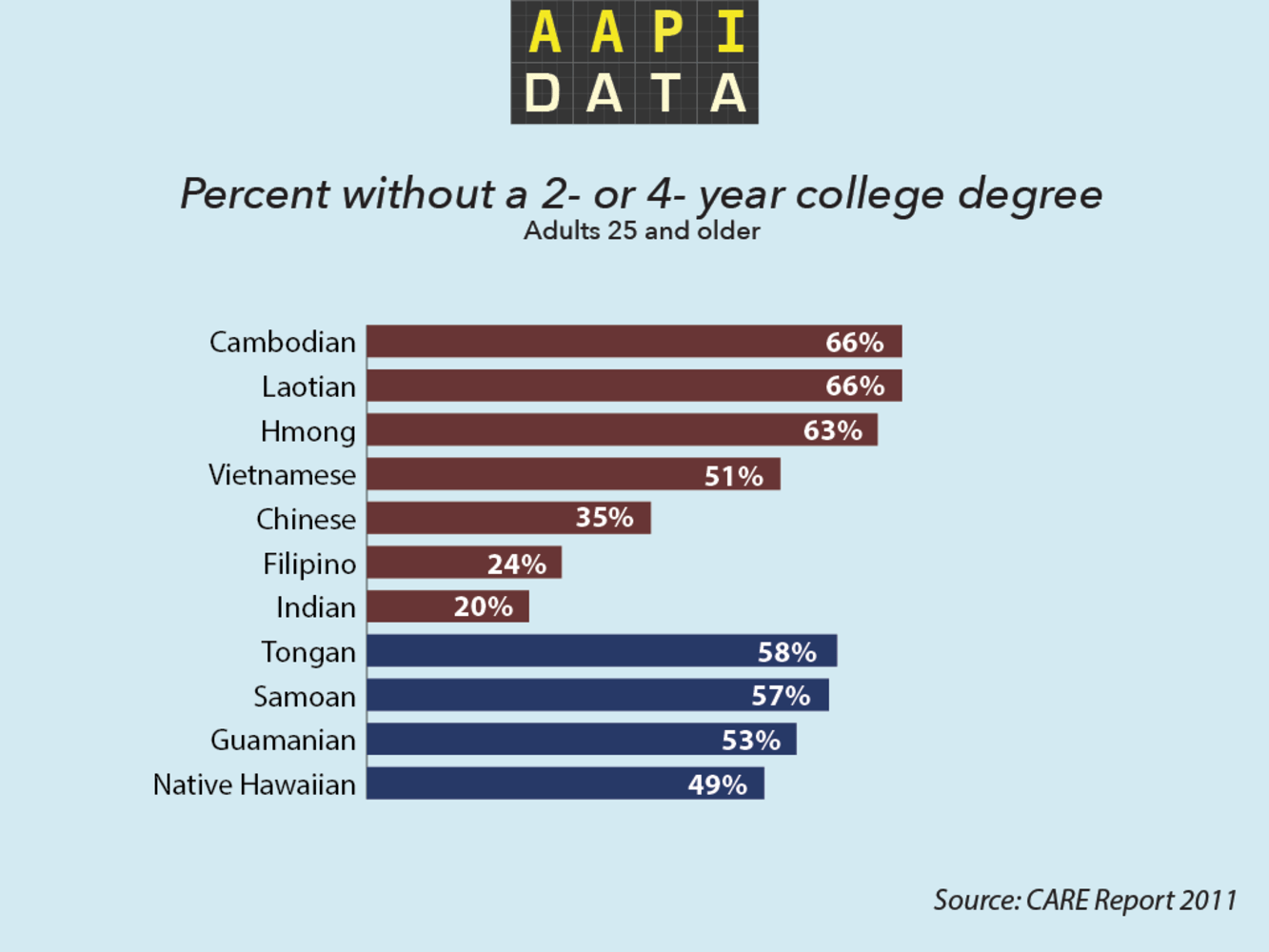 |
| As this graph indicates, the majority of Asian/Pacific Islanders do not have higher education. |
"This mode of selective recruitment challenges the idea that Asian success in the U.S. is due to Asian values. That is too simple. If Asian cultural values were the explanation, why don't we see the same kind of educational achievement in Asia as in the U.S.? We don't. As Jennifer Lee points out, more than 50% of Chinese immigrants in the U.S. have a bachelor's degree. In China, the rate is about 5%. About 70% of Indian immigrants have a bachelor's degree, while in India, less than 15% of Indians of college-age enroll in college. (India, by the way, has never been a stronghold of Confucian values.)"
This selective recruitment of the "best and brightest" from Asia has may be a strong argument for immigration but like Kristoff, Wong's explanation also reinforces the myth of the model minority.
"U.S. immigration policy creates a highly educated Asian-American class and this group sponsors highly educated family members. And the model minority stereotype is given life. As Kristof states so compellingly, this stereotype takes on a remarkable life of its own," concludes Wong.
"If Asian cultural values were the explanation, why don't we see the same kind of educational achievement in Asia as in the U.S.? We don't. As Jennifer Lee points out, more than 50% of Chinese immigrants in the U.S. have a bachelor's degree. In China, the rate is about 5%. About 70% of Indian immigrants have a bachelor's degree, while in India, less than 15% of Indians of college-age enroll in college. (India, by the way, has never been a stronghold of Confucian values.)"
(I might throw in Filipino-Americans - the vast majority of whom are Roman Catholic - don't fall into this paradigm, either.)

Studies by other academics show that Latinos and African/Americans value education as a route to success just as much - if not more - than Asian/Americans.
And -- if you accept the mantle of the "model-minority stereotype," and that Asian/Americans have overcome racism, that raises another interesting discussion why this pool of talent is not more represented in leadership roles.
Data gathered by the Leadership Education of Asian Pacifics seems to indicate that the "bamboo ceiling" is real. It seems to indicate any "advantage" we have seems to disappear the higher we go in the leadership structure.
Yes, it can be argued that hard work is part of the reason for what some perceive as success, but to conclude that Asian/Americans and Pacific Islanders have overcome the racism embedded in our American culture is a far reach.
By perpetuating the model minority myth by singling out Asian/American successes, we get separatee from other people of color, as if the discrimination they face is something that we don't face - as if BlackLivesMatter doesn't affect the Asian/American Pacific Islander communities.
Kristoff may have written his oped with the best of intentions - to show that despite our academic and economic success, we Asian/Americans still face prejudice and bigotry - but he simply reopened the debate a debate that Asian/Americans and Pacific Islanders may be tired of hearing. Nevertheless, it's an interesting topic that needs further examination. Join in if you want.


